
Nylon Injection Molding
Injection molding technology processes a range of high-performance polymers to produce desired parts, and Nylon is not an exception. In many applications, it is considered a lightweight alternative to metal and alloys.
This polyamide material provides balanced physical, mechanical, and chemical properties. It is strong, with high structural, tensile, and toughness strengths, as well as chemical resistance. Additionally, Nylon has a low coefficient of friction and good thermal stability.
Although having many advantages, Nylon injection molding requires strict control of the process to tackle its high melting temperature, moisture absorption, shrinkage of Nylon, and flow variability. Nylon injection molding is used across industries for high-performance, low-friction, corrosion-resistant, and durable parts. For instance, car engine manifolds, electrical housing, gears, fasteners, and sporting goods.
In this article, we will discuss Nylon material (Nylon 6, 66, PA 12, etc.), advantages, disadvantages, the injection molding process, mold & part design tips, and critical factors to consider during Nylon plastic injection molding.
What is Nylon?
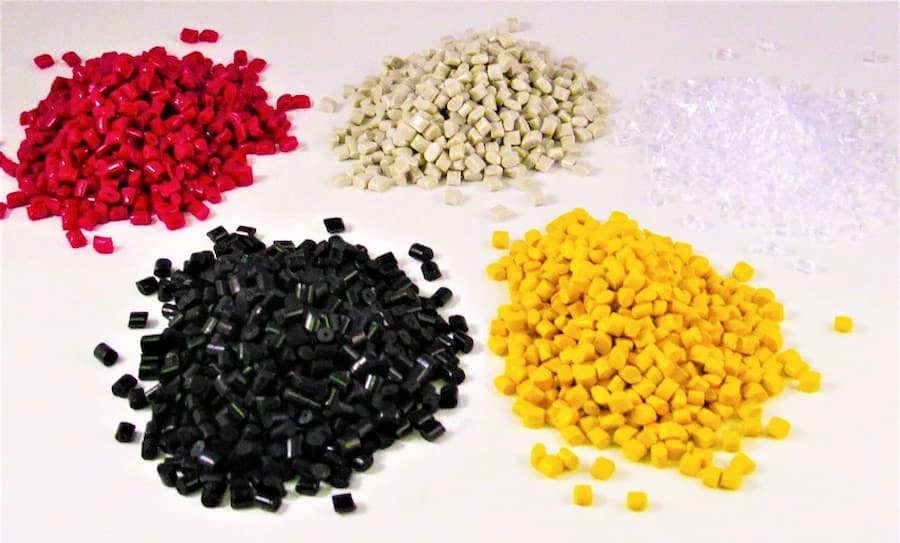
Nylon Injection molding pellets
Nylon is a synthetic Polyamide (PA) thermoplastic polymer that was first introduced by DuPont in the 1930s. Over the years, it has become more advanced and popular. Many industries prefer this injection molding material for its strong, wear-resistant, durable, and low-friction components. Subsequently, it is also a good choice for thermal- and chemical-resistant parts.
The composition of Nylon includes continuous –CONH– linkages, featuring aliphatic C-chains. This structure provides rigidity, stiffness, thermal tolerance, and other useful properties.
Nylon Material Properties
Nylon is a versatile and high-performance material, offering excellent tensile, bending, and flexural strength, along with good resistance to acids, alkalies, fuel, lubricants, and other chemicals.
Next, let’s break down the key Nylon Material Properties.
Elasticity
Nylon is elastic in nature, so the parts can withstand high stress and return to their original shape after removing the load. It is also beneficial for products requiring stretchability.
Strong and Tensile Strength
Nylon is a strong polymer that can withstand high loads. Especially, composites like 40% glass-filled Nylon provide high tensile strength.
Corrosion Resistance
Nylon is a corrosion-resistant material. Although having a high moisture absorption rate, it can survive humid and other harsh environments without losing its properties.
Water Absorption
Nylon is a hygroscopic material, and the water absorption rate ranges from 0.25 to 10 %, depending on grade. However, Nylons can be dried quickly.
Chemical Resistance
Nylon is resistant to many acids, alkalies, oils, fuels, and solvents.
Nylon Properties Overview
The table below illustrates various nylon properties with corresponding values:
|
Property |
Nylon 11 |
Nylon 12 |
Nylon 46 |
Nylon 66 |
Glass-filled 66 |
|
Density (g/cm³) |
1.04 |
1.31 |
1.2 |
1.17 |
1.38 |
|
Mold Shrinkage (cm/cm) |
0.0083 |
0.00694 |
0.019 |
0.0139 |
0.0044 |
|
Tensile Strength (MPa) |
37.1 |
46.1 |
73.9 |
72.5 |
155 |
|
Elongation (%) |
119 |
67.4 |
43.4 |
47.1 |
4.03 |
|
Flexural Modulus(GPa) |
0.948 |
5.66 |
2.64 |
3.09 |
7.96 |
|
Mold Temperature(°C) |
48.9 |
70.7 |
103 |
74.9 |
86.1 |
The values are approximate and might differ slightly based on the supplier
The Process of Nylon Injection Molding
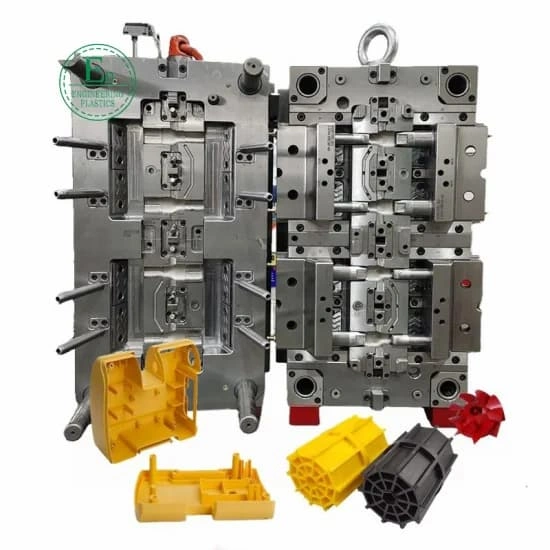
Nylon injection mold
Injection molding is one of the nylon fabrication methods that involves multiple steps, including design, material selection, tool setup, injection, mold cooling, and part ejection.
Let’s shortly elaborate on each step.
Step 1: Part and Mold Design
First, design the part in software such as AutoCAD by defining its shape, geometry, orientation, features, and other characteristics. Then, make an injection mold for that part, using Machining, EDM, or other suitable methods.
Step 2: Material Selection
As there are several grades of Nylons available, choose the one that meets the functionality and performance you require. Nylon 66, Nylon 12, Nylon 46, and glass-filled Nylon are the common grades used in injection molding.
|
Nylon Grade |
When to Use |
Examples |
|
Nylon 66 |
General-use Nylon, strength & wear resistance |
Gears, connectors, housings |
|
Nylon 12 |
As an impact resistance plastic, and for flexibility |
Tubing, hoses, cable jackets |
|
Nylon 46 |
When heat-resistance matters |
Under-hood parts, clips, sensors |
|
Glass-filled 66 |
Glass filled nylon injection molding offers stiffness/strength and low shrinkage. |
Brackets, covers, frames |
Step 3: Tooling & Machine Setup
Install the mold on the injection molding machine by clamping the two halves and securing them tightly. Additionally, set the melting temperature, injecting pressure, cycle time, etc.
Step 4: Drying Nylon Pellets
Since Nylon is hygroscopic in nature (absorbs and releases moisture), dry the pellet to remove moisture content. Often, vacuum drying gives the best results.
Step 5: Injection Process
During the injection of Nylon, or polyamide molding, the screw pushes dried pellets to the nozzle and ultimately into the mold cavity. Then, apply pressure to ensure complete filling.
Step 6: Mold Cooling
Let the mold cool for a specific time, based on the size & complexity of the mold and the Nylon grade.
Step 7: Part Ejection and Post-Processing
Once the mold is cooled, open it with ejector pins or other mechanisms the mold has, and eject it carefully. Then, process them with secondary operations and surface finishing, if required.
Try Prolean Now!
What are the Advantages of Nylon Plastic Injection Molding?
Thermal resistance, chemical resistance, wear resistance, low-friction, and low melt viscosity are some of the key Nylon injection molding advantages.
Let’s further break down the key Nylon material Properties:
- Tensile & Flexural Strength: Glass filled Nylon injection molding parts, Nylon 66 parts, and other Nylons offer high tensile and flexural strength.
- Thermal Stability: Nylon retains its properties at elevated temperatures, up to 120°C. It also has a high melting point, 180°C +, based on the type of Nylon.
- Chemical Resistance: Nylon is resistant to many acids, alkalies, oils, and solvents.
- Low-friction: The Nylon surface has low friction, making it suitable for moving or rotating components.
- Wear Resistance: Nylon fabrication parts provide abrasion resistance and a low-friction surface, which opposes any kind of wear, making them durable & reliable.
- Low Melt Viscosity: It means the molten Nylon flows easily inside the mold, which favours the molding of thin walls and complex features.
Best Practices for Nylon Injection Molding Design
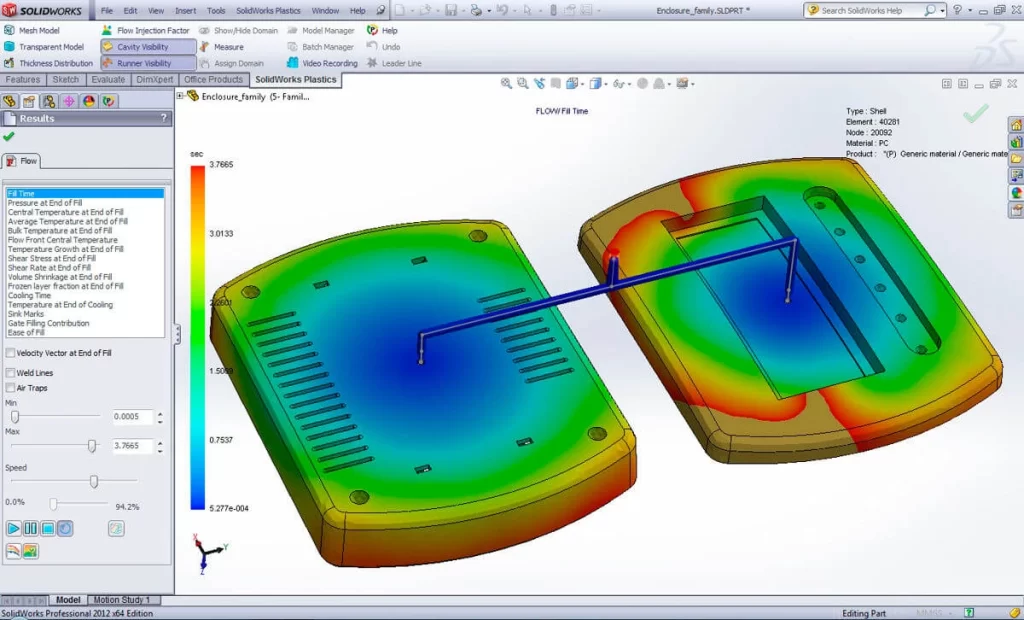
Nylon molding part design
There are some specific standard practices in the manufacturing industry while designing Nylon injection molding parts, such as wall thickness, wall uniformity, corner radii, draft angle, shrinkage, ribs, and gate location.
- Minimum Wall Thickness
The wall thickness of the Nylon part must be a minimum of 0.76–2.92 mm, based on grade, and a maximum of 6mm. It is for better flowability and to avoid shrinkage.
- Uniform walls and Transitions
Uniform wall thickness is important for mold filling and the part’s strength. If parts need varied thickness sections, there should be an additional 10-15% of thickness at the transitional sections.
- Add Corner Radii
Add corner radii at a minimum of 0.5 mm or 0.6–0.75 times the wall thickness. It helps to avoid stress concentrations at sharp corners.
- Draft Angle
0.5–1° per side for dimensional accuracy and to avoid defects.
- Ribs
40–60% of nominal wall thickness, as it improves the stiffness of the Nylon injection molding part.
- Shrinkage of Nylon
Compared to other thermoplastics, the shrinkage of Nylon is higher, ~ 0.7–2.0%. So, consider this for dimensional accuracy and to avoid the risk of molding defects.
Factors to Consider for the Nylon Injection Molding Process
For a successful Nylon plastic injection molding, consider factors like Nylon viscosity, moisture content, melting temperature, mold temperature, injection speed & pressure, and risk of entrapment.
Let’s further elaborate on these.
Viscosity of Molten Nylon
The low viscosity of liquid Nylon can be a limitation if the flow is not controlled. So, ensure a correct cycle time based on the depth and complexity of mold cavities.
Moisture Content In Pellets
The ideal target in drying nylon pellets should be between 0.10 to 0.15% moisture content. Otherwise, it compromises the strength and dimensional stability.
Melting & Mold Temperature
The melting (or injection barrel) temperature must be between 250 and 280°C. It can not exceed 300°C; otherwise, Nylon will lose its strength and stiffness. Consequently, the recommended mold temperature is 60 to 80 °C.
Injection Speed and Pressure
The high flowability of Nylon allows for faster injection speed. Subsequently, the injection pressure typically lies between 7-140 MPa, and the back pressure of 3-10 MPa.
Gas Entrapment
To avoid surface imperfections and voids, ensure proper venting for the generated and entrapped gas inside the mold.
Try Prolean Now!
What are the Additives used for Nylon Injection Molding?
Additives and reinforcement agents are used in injection molding to enhance properties such as strength, flowability, thermal resistance, plasticizing quality, UV resistance, and aesthetic appeal. The list below explains common additives for nylon plastic injection molding & when to use them.
- Glass fiber (GF) reinforcement: To increase the strength and stiffness.
- Carbon fiber fillers: They are used when a better strength-to-weight ratio is needed.
- Flame Retardants: Aluminum diethyl phosphinate, melamine polyphosphate, and other flame retardants complied with UL94 V-0, and other standards.
- Thermal Stabilizers: Phenolic, copper salts, and other additives to increase the thermal resistance of Nylon parts.
- Process Additives: To reduce friction and increase the flowability of molten Nylon.
Types of Injection Molded Nylon Parts
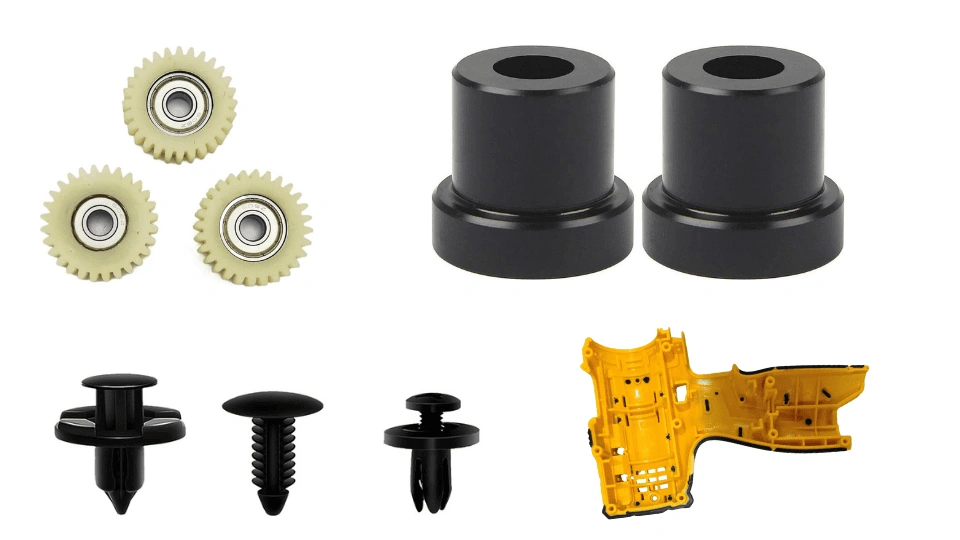
Types of Nylon parts
Based on end uses and application industries, injection-molded Nylon parts can be classified into several types, including gear & bushings, electrical components, fasteners, tool housing, medical components, and auto parts.
Let’s further explain them.
Gears & Bushings
Low-friction, wear-resistant, and high-fatigue gears. E.g., ear & bushings for power tools, printers, cars, conveyor, etc.
Automotive Parts
Heat, chemical, and oil-resistant parts that withstand high stress. E.g., Engine covers, intake manifolds, radiator tanks.
Electrical Components
Flame-retardant and electrically insulated parts, such as terminal blocks, circuit housings, and connectors
Fasteners and Clips
Lightweight fasteners & Clips, such as snap-fits, cable ties, and plastic rivets.
Industrial Parts
High-strength machinery parts, such as valve bodies, pumps, and conveyor systems.
Tool Housings
Consumer equipment and power tool housing with high impact strength and custom finishes
Medical Components
Nylon parts are easy to sterilize, hygienic, and easy to clean. Some applications in the medical industry include surgical instruments, tubing connectors, and diagnostic device parts.
Nylon Vs Rubber Injection Molding
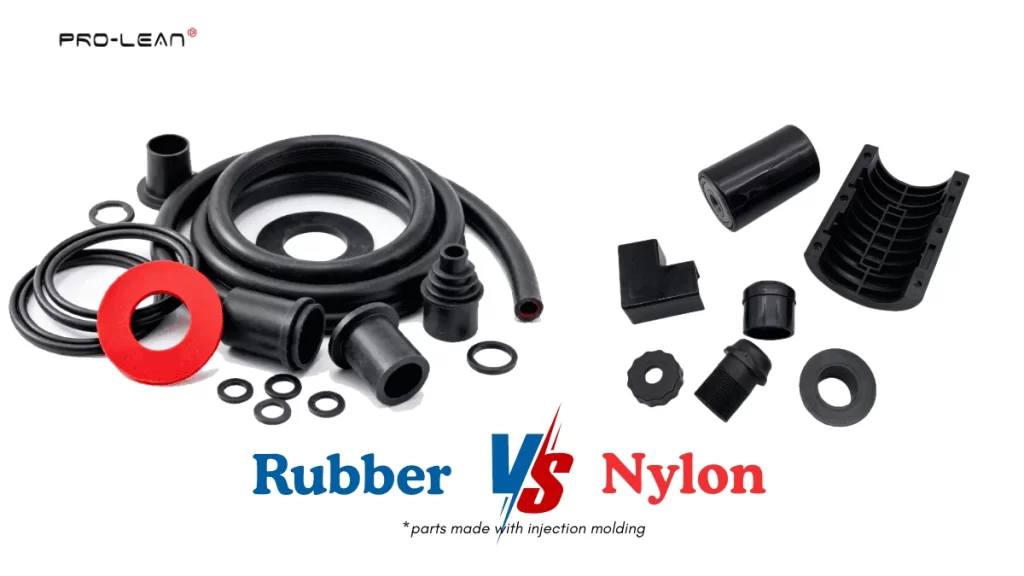
Rubber vs nylon parts
Rubber injection molding is used for flexible parts, metal overmolding, and sealing components. You can use elastomers, silicone rubber, nitrile, liquid silicone rubber, and other materials.
Furthermore, the table below compares Nylon vs Rubber injection molding.
|
Feature |
Nylon Injection Molding |
Rubber Injection Molding |
|
Material Type |
Thermoplastic polymer |
Natural and synthetic rubbers |
|
Processing |
Melting and cooling |
Chemical curing, vulcanization |
|
Mold Temperature |
Typically 60–120 °C |
Typically 160–200 °C |
|
Recyclability |
Re-meltable and recyclable |
Typically, not recyclable after curing |
|
Properties |
Rigid and strong engineering plastic |
Flexible, elastic material |
|
Examples |
Gears, bearings, and electrical connectors |
Seals, gaskets, O-rings |
Summing Up
Nylon can be the best choice for the injection molding of strong, wear-resistant, durable, and low-friction parts for diverse applications, such as appliance gears, conveyor bearings, clips, snap-fits, and pump parts.
However, you must consider part design, mold tooling, moisture in the feed, Nylon’s viscosity, injection speed & pressure, and other factors to ensure precise, defect-free parts.
If you are looking for custom Nylon parts & products, our injection molding service can be the one-stop solution for you. At ProleanTech, experienced engineers handle the project to deliver quality and cost-competitiveness.
Referances
https://www.acs.org/education/whatischemistry/landmarks/carotherspolymers.html


0 Comments