
Engineering plastic material guide
PEEK CNC
Machining
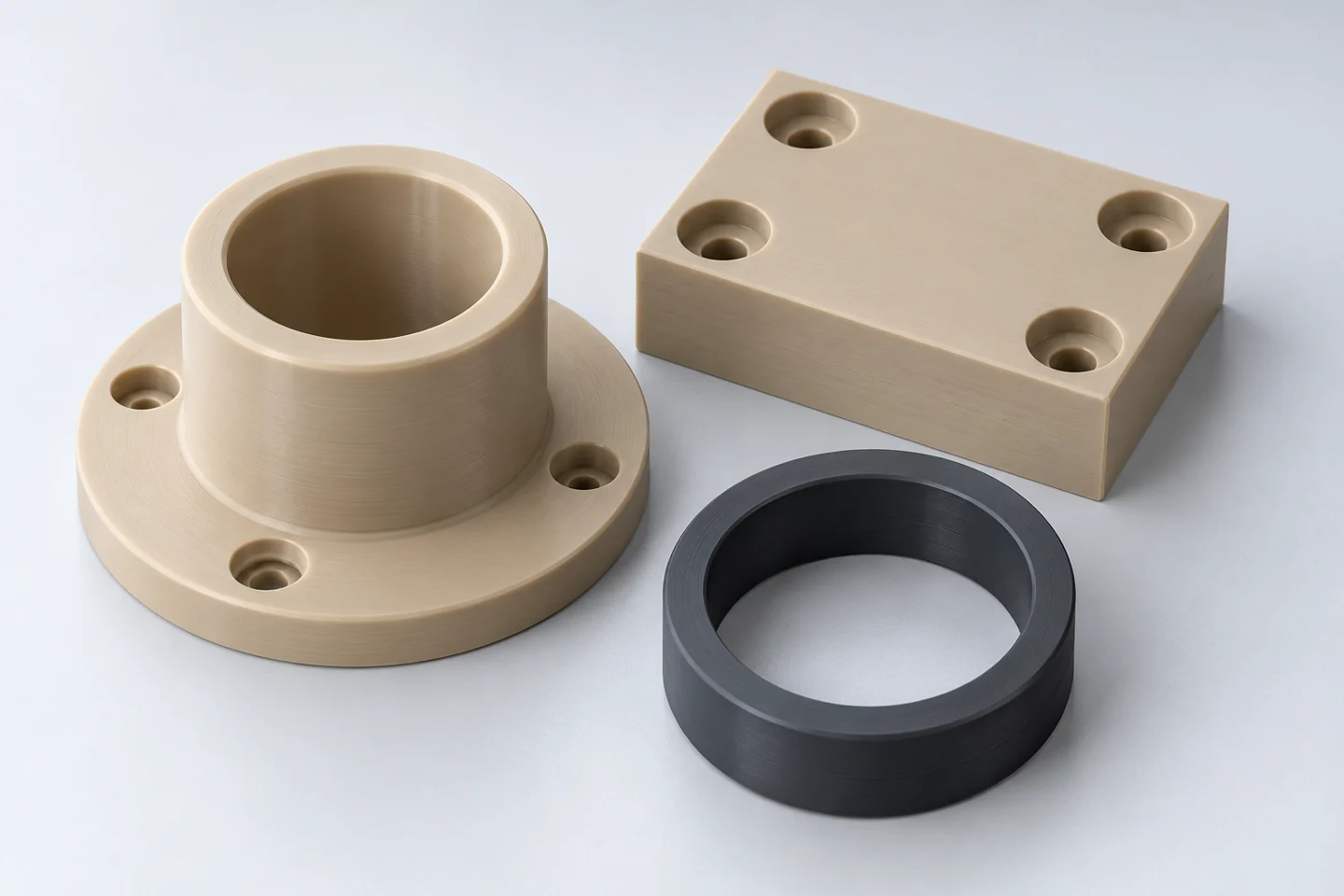
Machined bushings, insulators and precision components, with the PEEK grade and working conditions defined before cutting.
Confidential enquiries. NDA available.
- Specify
- Stock grade and filler system
- Review
- Load, heat and chemical exposure
- Confirm
- Critical fits and material records
Match PEEK to a demanding operating condition.
PEEK belongs on the shortlist when a part faces a combination of temperature, chemicals, wear or electrical requirements. Define that combination before accepting the cost of a high-performance polymer.
Bushings & wear components
Describe the load, motion, speed, mating surface and lubrication. The filler package needs to suit the complete contact pair.
Insulators & equipment parts
State the electrical requirement alongside temperature and mechanical loading. A reinforced grade must be checked against the required insulation performance.
Process-contact components
Identify the chemicals, concentrations, cleaning cycles and contact duration. Any regulated application needs the exact grade and supporting records.
Choose the grade and stock together.
A PEEK family name is not a complete material specification. Specify the machinable stock supplier and product grade as well as the resin and filler where required. A resin datasheet alone does not confirm the properties of every stock shape.
| Formulation family | Why compare it | What to resolve |
|---|---|---|
| Unfilled PEEK | Start here when an unreinforced formulation can meet the mechanical and electrical requirements. | Name the stock grade, colour if required, service conditions and critical dimensions. |
| Glass-fibre-reinforced PEEK | Compare grade-specific improvements in stiffness, creep resistance and dimensional stability. | Specify fibre content and supplier grade. Exposed glass fibres can be abrasive to a mating surface, so review sliding applications carefully. |
| Carbon-fibre-reinforced PEEK | Compare a reinforced stock grade when rigidity, thermal expansion and load capability drive the design. | Check electrical behaviour, direction-dependent properties, surface requirements and tooling implications. |
| Bearing or wear-modified PEEK | Compare for sliding or rotary contact with a defined duty cycle. | Name the complete compound, contact material, load, speed and lubrication. A generic filler label is insufficient. |
Selection examples are subject to material and drawing review. They are not an inventory list.
Already have a grade on the drawing?
Add it to your quotation checklist ↓Protect the dimensions that matter in service.
For a close-fit PEEK component, the important question is how the geometry will be produced and measured in the specified state. Explain the assembly and operating conditions with the drawing.
Thin rings and clamping
Show the free-state geometry and fitted condition. A thin sleeve or ring can be distorted by clamping, so the inspection method must describe the state in which size is accepted.
Heat and residual stress
Review heat control and whether the stock or part needs an agreed stress-relief route. For heavy material removal, discuss roughing, any intermediate treatment and final sizing.
Filled grades and surface details
Fibres can affect tool wear and the exposed surface. Identify sealing faces, sliding contacts and features where loose fibres, burrs or roughness would be unacceptable.
Mark critical dimensions on the drawing. Achievable tolerances, wall thickness, part size and delivery are confirmed for the geometry, material, finish and quantity in the quotation.
Define a functional surface before adding a finish.
As-machined surfaces
State roughness on the faces that seal, slide or locate. Apply appearance requirements only where they are needed.
Edges and cleanliness
Identify burr-sensitive grooves, small holes and contact surfaces. Define cleanliness, cleaning compatibility and packaging for the application.
Marking or surface treatment
Specify the marking method and location. Any coating, bonding or additional treatment needs grade-specific compatibility and acceptance criteria.
Verify the grade, then agree the inspection state.
Material documentation
List the stock grade, supplier documents and traceability needed. Add application-specific compliance evidence only where the project requires it.
Dimensions and conditioning
Define datums, fitted diameters and measurement conditions. Agree when the part is measured after machining or any treatment.
Application validation
Temperature, chemicals, wear and cleaning performance need to be assessed for the specified grade and service cycle. Part inspection alone does not establish application approval.
Three different checks.
The material record identifies the purchased stock. The inspection report checks the drawing. Application validation checks the part in service.
Review inspection requirements ↗PEEK machining questions.
Answers to the decisions that affect the material, drawing and finished part.
Is glass-filled PEEK interchangeable with unfilled PEEK?
No. Filler changes the formulation and can change stiffness, machining response, surface condition and other properties. The design should name the required stock grade; substitutions need approval.
Can the colour identify the PEEK grade?
No. Beige or black appearance does not establish the resin, filler or approval status. Specify the supplier product and use the required material documents.
Does every machined PEEK part need annealing?
The route depends on the supplied stock, geometry, amount of material removed and dimensional requirements. Review the stock supplier guidance and agree any stress-relief steps rather than applying one cycle to every part.
How should a close-fit PEEK bushing be specified?
Provide the shaft and housing interfaces, fit limits, service temperature, loading and free or assembled inspection state. Add the grade, surface requirement and any conditioning instructions.
Can I request a medical or food-contact PEEK component?
Name the application and the exact required material and compliance documents. A PEEK family designation does not establish medical, implant or food-contact suitability. The available grade and manufacturing scope must be reviewed.
What makes a PEEK RFQ more useful?
Include the stock grade and filler, quantity, drawing, load, temperature and chemical exposure. Mark critical fits, wear or seal faces, required records and cleaning requirements. This allows the quote to address material and machining together.
Prepare your enquiry
Review the PEEK grade against the working part.
Send the CAD model and dimensioned drawing with quantities, service conditions and the requirements below. If the grade is undecided, describe the function and the constraints.
Your files stay confidential. NDA available.
PEEK RFQ checklist
Material: PEEK, [stock supplier + product grade], [filler + content]
Quantity: [prototype quantity / production quantity]
Service: [temperature, load, chemicals, motion and lubrication]
Critical features: [fit diameters, seal faces, inspection state]
Surface and cleaning: [roughness, deburring, cleanliness]
Documents: [material records, traceability, application requirements]
Material references & specification notes
Manufacturer information supports material selection. Use the datasheet for the exact grade, stock form and test conditions. It does not establish Prolean inventory, application approval or a guaranteed machining result.
- Victrex: grade-specific PEEK technical datasheets ↗
- Ensinger: machining and annealing guidance ↗
- Ensinger: glass-filled stock grade example ↗
- Ensinger: engineering stock-shape comparisons ↗
Prepared October 2026. Final material and manufacturing requirements are agreed in the quotation.