
Electroless Nickel Plating
Autocatalytic nickel-phosphorus coating for parts where geometry, substrate preparation, service condition and the drawing call for controlled coverage.
Electroless nickel is a coverage and specification decision.
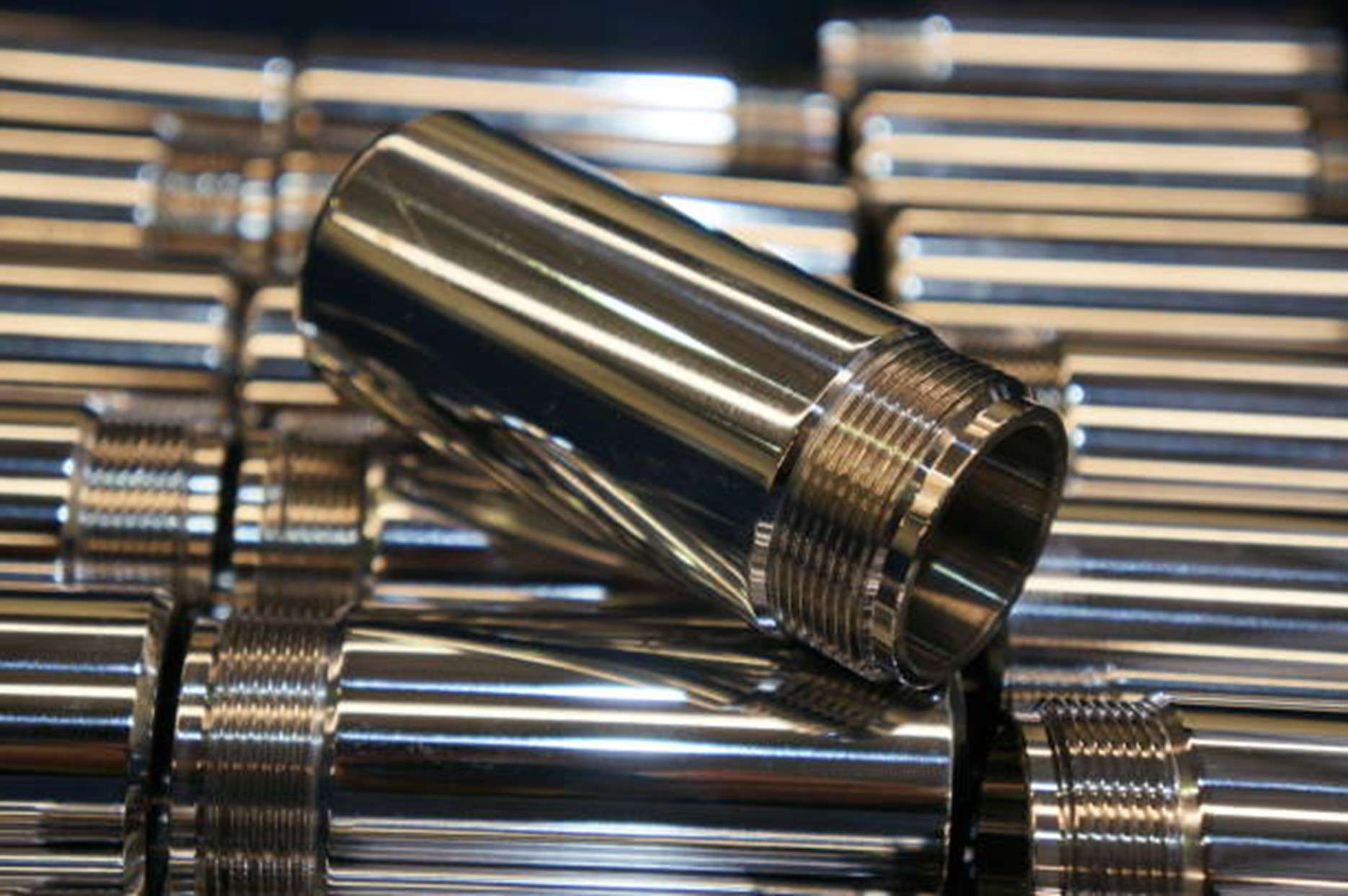
Electroless nickel is a coverage and specification decision.
Published information, order decisions and items requiring confirmation are kept separate. No universal capability is implied by a single number.
| Governing standard | ASTM B733-22(2026); confirm revision and purchase-order applicability. |
|---|---|
| Materials | Aluminium, steel and stainless steel are listed in the published table. Copper, tungsten and polymer remain to confirm. |
| Phosphorus class | Low / medium / high class is selected from service and property requirements; do not assume a shop-wide class. |
| Thickness | Published table: 5–8 μm. Published text: up to 5 μm. Both are retained until the order requirement is reconciled. |
| Heat treatment | Class, temperature, time and substrate limitations are confirmed per order. |
| Pre-plating roughness | Published value: not more than Ra 1.6 μm; confirm route and measurement method. |
| Appearance | Smooth, glossy silver-grey is published; appearance class and sample remain order-specific. |
Geometry, dimensions and sequence decide the result.
Treat fits, holes, contact areas and post-treatment operations as explicit requirements.
The bath reaches faces the solution wets; deep blind holes and very tight gaps require review.
The coating adds a layer on coated faces. Mark dimensions as before or after plating and identify fits that must stay as machined.
Name threads, bores, sealing faces, rack/contact areas and any faces that must remain uncoated.
Confirm substrate condition, cleaning, activation/strike and any stress-relief or hydrogen-embrittlement controls.
State whether parts in a load must match; loading and bath control affect uniformity.
Agree any machining, deburring, inspection or packaging after plating.
Reference standard, test method and order acceptance separately.
Agree sampling, acceptance criteria and report format before production.
Choose the applicable method and sampling plan; the two published figures cannot be treated as one universal range.
Agree the ASTM method, substrate limits and acceptance criterion before quoting.
Specify whether porosity, phosphorus content, microhardness or corrosion evidence is required.
Agree lot identification, report format, appearance reference and documentation.
Copy the requirement into the drawing, then replace every bracket.
Use the note as a starting point. Replace each bracket with the material, service, thickness, faces and acceptance method agreed for the order.
ELECTROLESS NICKEL: ASTM B733-22(2026), TYPE / PHOSPHORUS CLASS [ ], SERVICE CONDITION [ ], MIN. THICKNESS [ ] μm, HEAT-TREATMENT CLASS [ ].nCOAT FACES [ ]; MASK [ ]; THREAD / BORE ALLOWANCE [ ].nACCEPTANCE METHOD, SAMPLING AND RECORDS [ ]. CONFIRM SUBSTRATE PRETREATMENT AND POST-PLATING MACHINING.
Questions engineers and buyers ask before ordering.
Use these answers to prepare a drawing review and decide what the quote must confirm.
Does electroless nickel cover internal faces?
It coats faces the solution reaches, but circulation and geometry still control coverage. Identify blind holes, gaps and masked faces on the drawing.
Is 5–8 μm always the required thickness?
It is the published table range. The page text also says up to 5 μm, so the drawing and order requirement control until the figure is reconciled.
Which phosphorus class should be selected?
Select the class from service, wear, corrosion, magnetic and heat-treatment requirements. Do not assume a universal shop composition.
What should be inspected?
Agree appearance, thickness, adhesion, porosity and any composition, microhardness or hydrogen-embrittlement testing before production.
Send the drawing with the finish decision points marked.
Send the drawing, substrate, coated faces, roughness, thickness requirement and acceptance method. An NDA can be arranged when required.