
Engineering plastic material guide
Polypropylene
CNC Machining
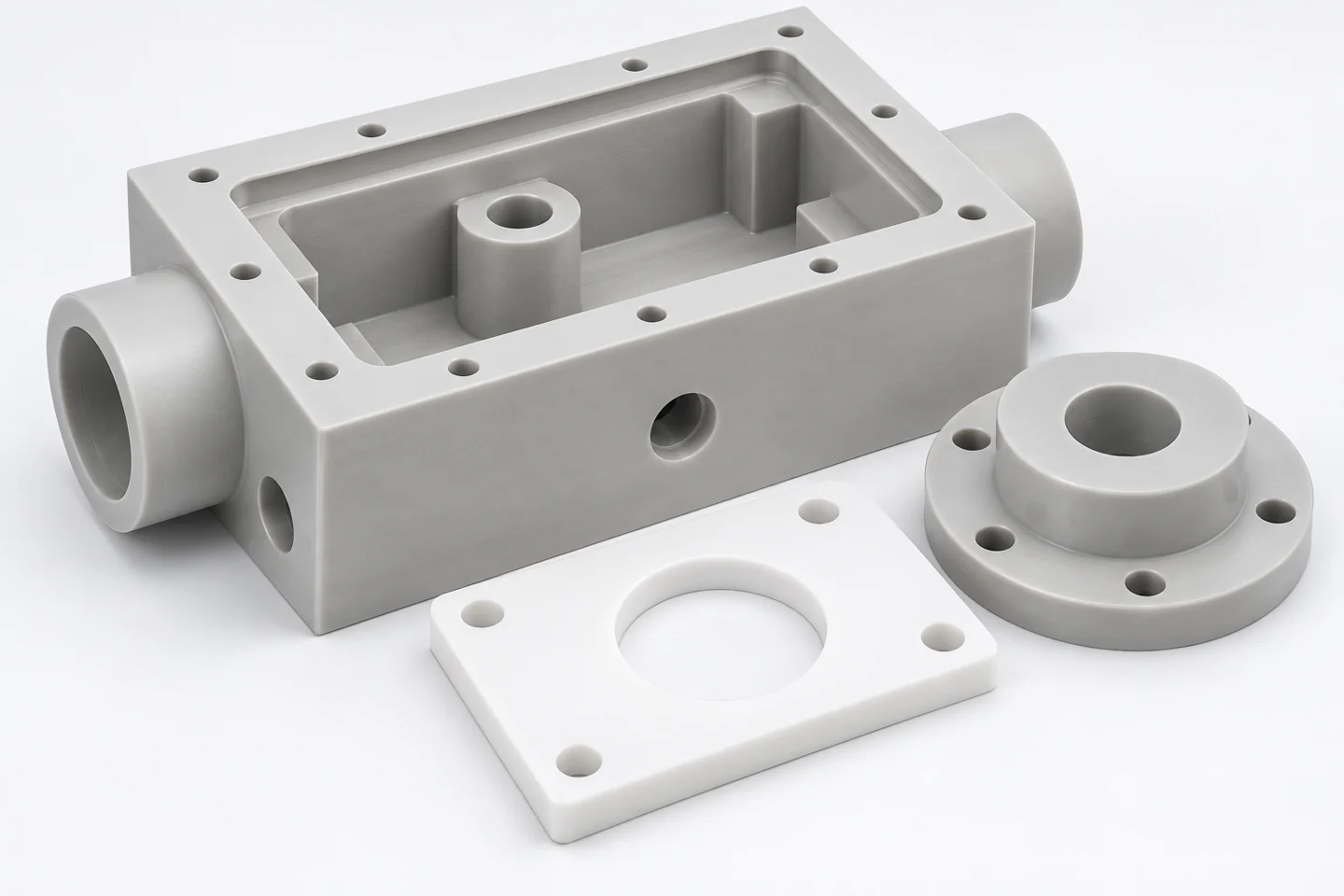
CNC-machined PP blocks, flanges and equipment details, with resin type, chemical service and assembly stiffness reviewed together.
Confidential enquiries. NDA available.
- Specify
- PP-H homopolymer or named alternative
- Review
- Wetted face and Bolt interface
- Confirm
- Final condition and acceptance records
Choose PP around the fluid and the loaded geometry.
Polypropylene is often considered for chemical equipment and lightweight components. The exact grade, service temperature, stiffness and later joining route should guide the stock selection.
Chemical-equipment details
Identify the fluid, concentration, temperature and exposure. Show the wetted surfaces, ports and any joining interfaces.
Flanges and mounting blocks
Define bolt loads, support and allowed deflection. A flexible polymer interface needs an assembly requirement, not only a nominal thickness.
Washdown and process fixtures
State cleaners and contact requirements. Use the actual product evidence for food contact, detection or special electrical properties.
Choose the grade and stock together.
Compare the Polypropylene PP options below against the drawing and service conditions. Specify the complete supplier grade, condition and stock form; material examples do not establish current inventory or permit substitutions.
| Grade or stock | Why consider it | What to resolve |
|---|---|---|
| PP-H homopolymer | A specified homopolymer stock for chemical equipment or rigid details. | Define the stock product, service chemistry and temperature. |
| PP copolymer | A grade chosen for a different stiffness and impact balance. | State the exact supplier product and operating environment. |
| Filled or electrically modified PP | A design requiring a particular reinforcement or electrical property. | Specify filler or additive package and the test requirement. |
| Approved contact-grade PP | An application needing documented contact suitability. | Name the product and intended conditions of use; a family name is not approval. |
Selection examples are subject to material and drawing review. They are not an inventory list.
Already have a grade on the drawing?
Add it to your quotation checklist ↓Review the shape with its assembly loads.
For a machined PP component, holding a nominal size is only one part of the problem. Define what the part must do under clamping, temperature and sustained load.
Wall stiffness and clamping
Show thin sections, broad panels and deep pockets. Review how the free part is supported and which dimensions matter in assembly.
Machining heat and residual stress
Identify heavy or uneven material removal. Discuss the stock condition and route needed to preserve functional geometry.
Joining and fastener load
Provide the weld, adhesive or mechanical joint requirement. Show gaskets, bolt patterns and any limits on compression or movement.
Mark critical dimensions on the drawing. Achievable tolerances, wall thickness, part size and delivery are confirmed for the geometry, material, finish and quantity in the quotation.
Specify the PP surface and the joint separately.
As-machined
Identify wetted and mating faces, allowed marks and edge condition. Avoid unnecessary polishing of a functional dimension.
Deburred internal features
Mark ports and intersections where loose material is unacceptable. Define the allowed edge break.
Weld preparation, bonding or marking
Confirm the method against the exact stock and service. Include preparation and acceptance for the completed joint.
Check the stock, free geometry and assembled function.
Grade identity
Request PP type, supplier product and any additive or application records.
Final dimensions
Define support, datum faces, measurement conditions and final state after any joining or treatment.
Functional acceptance
Where needed, define joint, leak, deflection or contact tests separately from dimensional inspection.
Three different checks.
The material record identifies the purchased stock. The inspection report checks the drawing. Application validation checks the part in service.
Review inspection requirements ↗Polypropylene machining questions.
Answers to the decisions that affect the material, drawing and finished part.
Is every PP product interchangeable?
No. Homopolymers, copolymers and modified compounds can have different property balances. Specify the exact stock grade and substitution rules.
Can PP be selected on chemical name alone?
No. Concentration, temperature, duration and stress must be reviewed for the product. Include the cleaning cycle and any mixed exposure.
Why review bolt loading on a PP flange?
The polymer and joint can deform under assembly and sustained load. Define gasket, support, fasteners and the required functional acceptance.
Does a weldable grade guarantee a qualified joint?
No. Joint geometry, preparation, procedure and acceptance still need to be defined for the assembly.
Should a machined PP part be polished?
Only where the function and acceptance call for it. Prioritise the surfaces that locate, seal or contact the process.
What information supports a PP machining quote?
Send the stock grade, fluid and temperature, drawing, mating assembly, quantity, joining method and any functional or documentation requirements.
Prepare your enquiry
Review the PP stock with the chemical service and assembly.
Send the CAD model and dimensioned drawing with quantities, service conditions and the requirements below. If the grade is undecided, describe the function and the constraints.
Your files stay confidential. NDA available.
Polypropylene RFQ checklist
Material: [PP-H / PP copolymer / named compound + stock grade]
Service: [fluid, concentration, temperature, cleaning]
Assembly: [gaskets, bolts, support, joining method]
Features: [ports, pockets, mating faces, wall sections]
Acceptance: [dimensions, joint or leak test if required]
Quantity and records: [lot size, product and contact documents]
Material references & specification notes
Manufacturer information supports material selection. Use the datasheet for the exact grade, stock form and test conditions. It does not establish Prolean inventory, application approval or a guaranteed machining result.
Prepared October 2026. Final material and manufacturing requirements are agreed in the quotation.