
PRECISION CNC MACHINING
Swiss Turning
Services
Custom Swiss machining for small, complex turned parts. Bring your drawing for material, tolerance and production review.
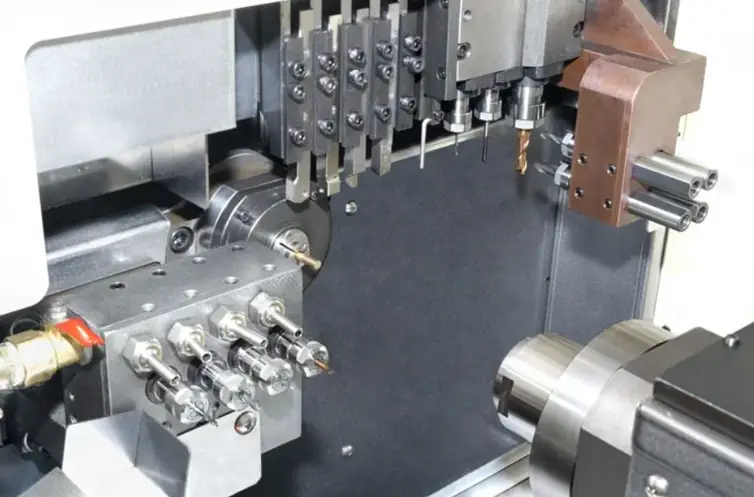
Swiss machining capabilities
A practical starting point for sourcing custom Swiss turned parts, with project-specific engineering review before manufacture.
Small features.
One considered machining route.
Swiss turning is a CNC process suited to bar-fed components with slender sections, close-fitting diameters and multiple features. Turning, drilling and compatible live-tool operations can reduce transfers between machines.
Also called Swiss screw machining, the process produces much more than screws. Geometry, bar stock and batch requirements determine whether it is the right route.
- Bar diameter
- Published service reference: up to Ø32 mm (1.25 in). Confirm the required stock diameter and machine route during drawing review.
- Tolerance reference
- The existing service lists ±0.0102 mm general and ±0.0025 mm for critical features. These are review references, not a blanket acceptance standard. State feature-specific requirements.
- Length & slender sections
- Overall length, unsupported features, stock condition and tooling determine feasibility. Send the complete drawing rather than relying on one length-to-diameter ratio.
- Feature scope
- Turned steps, grooves, threads and axial holes; cross-holes, flats and back-working are assessed against tooling, access and setup.
- Surface & final condition
- Specify roughness on functional surfaces, edge breaks and dimensions after treatment. Finish and tolerance are agreed together.
- Order quantities
- Prototype and production enquiries welcome. Setup, bar utilisation, inspection and forecast volume affect the proposed route and price.
Identify fits, runout, concentric relationships, sealing faces and small-hole requirements. The quotation confirms achievable features, exceptions and the inspection scope.
Parts that benefit from support close to the cut
Use part function to guide the process. These examples describe suitable geometries, without implying approval for a regulated end use.
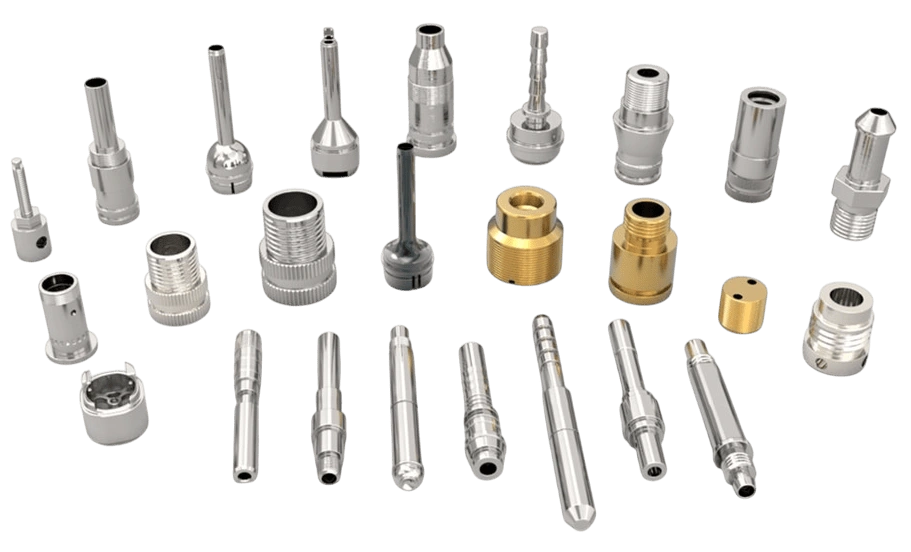
Stepped shafts & precision pins
Bearing seats, locating features and slender sections. Identify datum relationships, straightness and runout where they control assembly.
Threaded fittings & connectors
External and internal interfaces with bores, hex features or grooves. Define the thread standard, class and any sealing requirement.
Sleeves, spacers & small housings
Thin walls and coaxial diameters require attention to distortion, burrs and measurement access.
Instrument & equipment components
Small features used in automation, instrumentation and medical or aerospace assemblies. Sector-specific documentation and qualification must be agreed for the project.
Choose the process around the part
Support, tool access and the number of setups matter more than a process name alone.
How Swiss turning works
In a guide-bushing setup, a sliding headstock feeds rotating bar stock axially through a bushing. Support close to the cutting zone helps limit deflection of slender features.
Turning tools cut the rotating workpiece; driven tools can add suitable milling or drilling operations. Tool access and the machine configuration determine which features can be combined.
Some Swiss-type machines also operate without a guide bushing. The setup is selected for the part, rather than treating every component the same way.
Swiss turning vs conventional CNC turning
| Decision | Swiss-type route | Conventional turning / turn-mill |
|---|---|---|
| Part geometry | Often useful for small bar-fed parts with slender or closely spaced features. | Often practical for larger diameters, short rigid parts and chuck-held blanks. |
| Work support | A guide bushing can support stock near the cut. | Chuck, collet, tailstock or other support chosen for the operation. |
| Multiple features | Compatible tools can consolidate turning and secondary work. | Live tooling and multi-axis setups can also consolidate features. |
| Economics | Setup and stock preparation can be offset by repeat cycles and fewer transfers. | May offer a simpler route for a short, uncomplicated part or a different blank. |
The most economical process depends on the drawing and volume. Swiss machining is not automatically more expensive or more accurate for every part.
Material grade and condition come first
Material options are subject to stock and process review. A family name alone is not a complete manufacturing specification.
Stainless steel
303, 304 and 316L are listed on the existing service. Specify the exact grade and condition; machinability, burr control and passivation needs differ.
Aluminum
6061 and 7075 are among the listed alloys. Include temper, surface requirements and any dimensions required after anodizing.
Brass & carbon / alloy steel
Specify alloy designation and stock or heat-treatment condition. Lead restrictions, hardness and subsequent treatment belong in the RFQ.
Titanium
Grade 2 and Grade 5 are listed material options. Confirm stock, small-feature feasibility and documentation for the intended application.
Engineering plastics
PEEK and other requested polymers require grade-specific review. Bar straightness, thermal expansion, thin walls and burrs affect the route.
Plan the finished part
Define functional roughness, edge condition and any treatment before machining.
Finishing options ↗Review anodizing, passivation, plating or polishing by substrate.Protect critical fits ↗Identify masking, coating allowance and post-treatment inspection.
Make acceptance clear before production
Turn engineering intent into dimensions, surfaces and documents that both teams can verify.
Dimensions that control assembly
Dimension shoulders from functional datums. Call out thread class, bore fits, runout and geometric tolerances where needed; avoid tightening every feature by default.
Slender sections & small holes
Provide overall length, minimum diameter, wall thickness, hole depth and entry geometry. Deep holes and fine internal features require a specific tooling and chip-removal review.
Burrs, edges & cleanliness
Identify cross-hole intersections, sealing edges and acceptable edge breaks. Specify cleaning, particle or cosmetic requirements explicitly when they affect function.
Inspection & traceability
Agree critical characteristics, sampling and reporting before ordering. Request material certificates, first-article or dimensional documentation in the RFQ; availability and scope are confirmed in the quote.
Review the drawing revision, agreed deviations and final-condition acceptance criteria before production. A quality-system certificate does not replace part-specific verification.
From drawing review to repeat orders
A clear RFQ reduces assumptions and makes supplier comparisons more useful.
Send the complete RFQ
Share the 3D model, dimensioned drawing, revision, grade and condition, order quantity, forecast demand and requested delivery date.
Review the proposed route
Confirm critical features, stock, finishing, inspection and any exceptions. Compare quotes using the same scope and accepted drawing.
Approve and manufacture
Approve the quotation and technical requirements. Confirm any sample approval or first-article hold point needed before the production batch.
Inspect and deliver
Parts are checked against the agreed requirements, then packed for shipment. Confirm reports, identification and protective packaging in the order.
Pricing and timing reflect setup, material utilisation, cycle time, secondary work, inspection and quantity. Delivery is confirmed with the quotation.
Swiss turning FAQs
Answers for engineering review and procurement planning.
What is Swiss turning used for?
Swiss turning is used for small bar-fed components such as pins, stepped shafts, sleeves and threaded fittings. Support close to the cutting zone can make it useful for slender features and multiple closely spaced operations.
Are Swiss machining and Swiss screw machining the same service?
The terms often refer to the same Swiss-type machining process. Swiss screw machining is a traditional name and does not limit the output to screws or threaded fasteners.
What size and tolerance can ProleanTech review?
The existing service lists up to 32 mm outer diameter, with ±0.0102 mm general and ±0.0025 mm critical tolerance references. Actual acceptance limits depend on the feature, material, length, finish and measurement plan and must be confirmed against the drawing.
Can Swiss turning include milling and cross-drilling?
Compatible live tooling can add features such as flats and cross-holes. Whether they can be completed in one setup depends on tool access, geometry and machine configuration, so include all features in the RFQ.
Can I order prototypes or small batches?
Prototype and production enquiries are welcome. For a small batch, setup cost can outweigh cycle-time savings; the engineering review can compare Swiss turning with other machining routes.
Is Swiss machining always more expensive than CNC turning?
No. Compare the total manufacturing route, including setup, material, secondary operations, handling and inspection. A Swiss route may reduce repeat cycle time or transfers, while conventional turning can be simpler for other parts.
What files and quality documents should I request?
Send a 3D model and dimensioned drawing with material, revision, quantity, critical dimensions and final finish. State any material certificate, first-article, dimensional-report or traceability requirement so its scope can be included in the quote.
Does a Swiss-machined part meet medical or aerospace requirements automatically?
No. Process suitability does not establish regulatory compliance or application approval. Specify the applicable material, documentation, process controls and qualification requirements for project review.
START WITH YOUR DRAWING
Source your next
Swiss turned part.
Share the complete geometry and the requirements that matter. We’ll review the machining route and prepare a project-specific quote.
Your files are confidential. Optional NDA available ↗