Injection molding tooling
Injection molding tooling is a set of specialized parts that combine to form the cavity that molds molten plastic. While the most prominent component of the system is the mold, the others are the delivery system, the ejection system, and the auxiliary system.
This definition and breakdown may seem fundamental, yet many buyers overlook tooling decisions. The mold type, material used, and design can affect the molded part’s quality, the total manufacturing cost, and the lead time.
Plastic injection mold tooling is the precision-manufactured equipment that facilitates plastic injection molding. It facilitates the shaping and cooling of molten plastic into the final part, so it is an important business consideration. Mold units are available as single-cavity molds, family molds, multi-cavity molds, and insert molds. The Injection Molding service provider recommends any of these designs based on the production strategy.
Tool steel is a standard material for molds because of its hardness, wear resistance, and dimensional stability. However, stainless steel, aluminum, and copper alloys also offer distinct advantages, which are also utilized. More about molding tooling, including production process, design considerations, and injection mold tooling cost concerns, has been addressed in this article. Keep reading for more insights.
What is Injection Molding Tooling?
Injection molding tooling can take two broad meanings: A set of tools used to shape materials or the engineering process of designing and manufacturing the tools used in injection molding. Focusing on the first meaning, injection molding tooling, often simply called tooling, is the machinery, primarily the mold, that manufacturers use to shape molten material into finished parts.
Injection molding is a manufacturing process that forces molten material into a mold. The material is allowed to cool and solidify in the mold, and then the part is ejected as a solid. A standard injection molding machine comprises an injection unit, a clamping unit, and a mold. The mold, which is the subject of discussion in this article, gives the plastic material being injected the final shape.
Tooling Components of the Injection Mold
The mold consists of various components, including the base plate, movable plate, runner plate, ejector pins, core, and cavity. These and other details are shown in the diagram below.
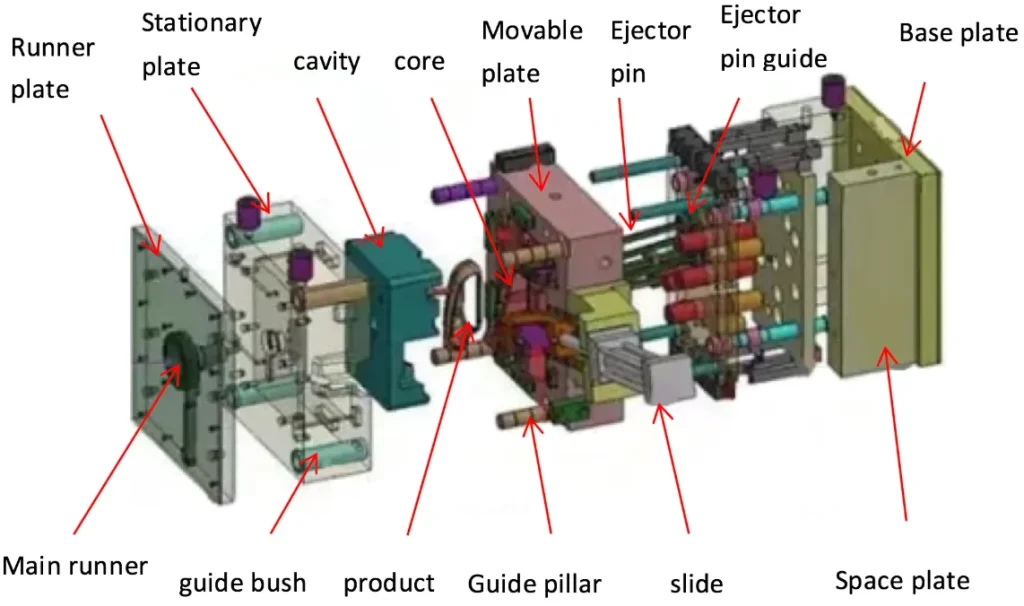
Parts of the injection mold
Types of Injection Molding Tools
Focusing on the mold unit, the main types of injection molding tools are single-cavity molds, family molds, multi-cavity molds, and insert molds.
Single-Cavity Molds – These are the simplest types of injection molding tooling with the lowest initial investment. However, their cost per part at scale is the highest.
Single-cavity molds are best suited for large, complex parts. They are also used for prototype runs. So, if you are still validating your design, single-cavity molds are your best choice.
Family Molds – A family mold is built as an assembly set, with the capability to produce different parts in a cycle. This brings incredible efficiency gains in the production process.
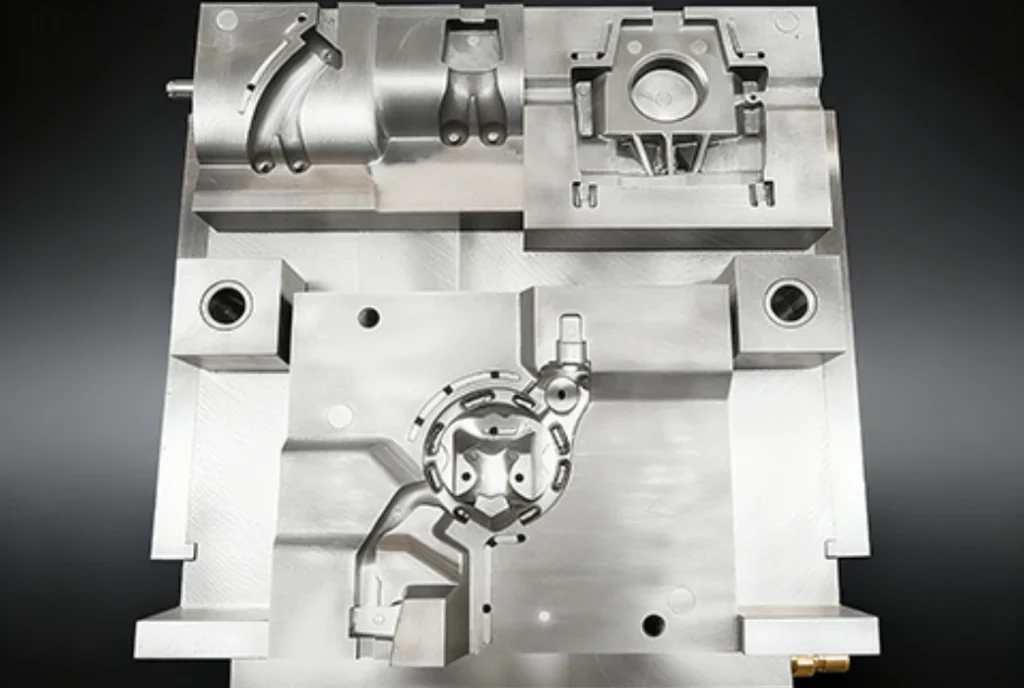
Family mold
Alt text: Multi-cavity family injection mold with three distinct part geometries including a curved component, a circular housing, and a complex lower cavity with integrated runner channels. The concerns or risks of family molds include short shots in parts with varying thicknesses, the requirement that parts use the same resin, and the requirement that all cavities fill uniformly. The bottom line is that tight process control is required for family molds.
Multi-Cavity Molds – The types of molds are a perfect demonstration of high-volume production. The same part is produced in multiple cavities. A 16-cavity mold tool can significantly reduce the lead time and manufacturing cost.
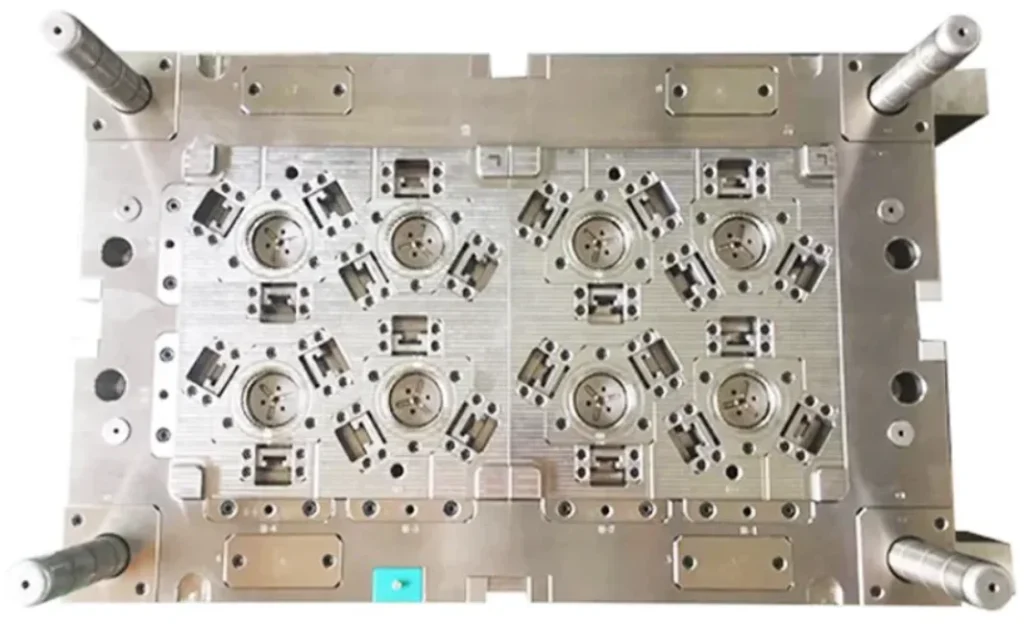
Multi-cavity mold
Consider the following points for multi-cavity molds:
- Volume economies can offset the high initial investment
- Cooling must be uniform
- The runner system must be balanced
Insert Molds – Insert molds involve preplacement of a component within the molded part. The tooling is commonly used to manufacture structural reinforcements and electrical contacts. The tool is complex, but it minimizes assembly costs.
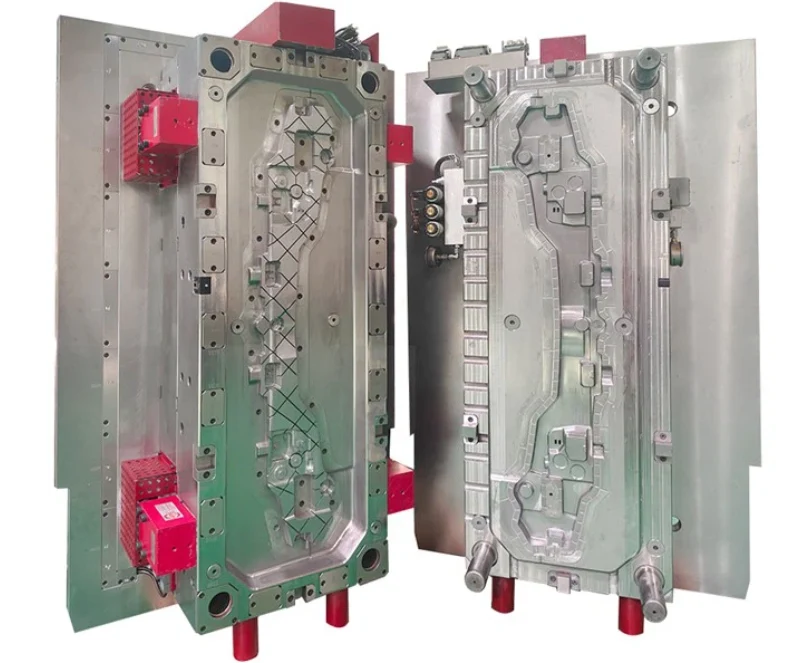
Insert mold
Common Materials for Injection Molding Tooling
The preferred injection mold tooling materials are aluminum, brass, tool steel, stainless steel, and copper alloy.
Aluminum Injection Molding Tooling
Aluminum makes excellent injection molding tooling for low-to-medium volume production. 7075 aluminum is widely used for this purpose.
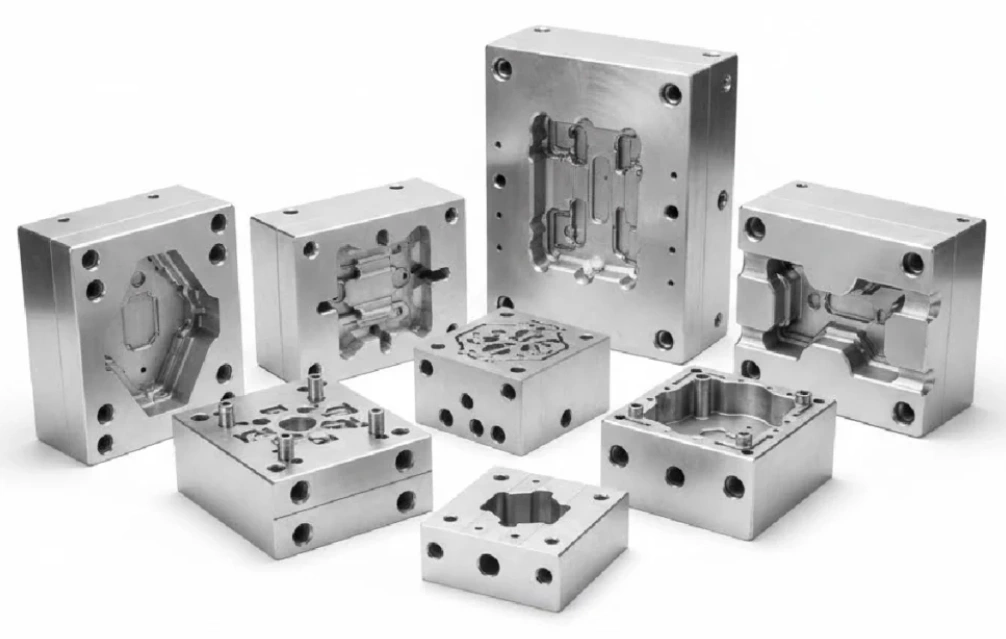
Aluminum injection molding tooling
What to expect from aluminum injection mold tooling materials:
- Shorter cycle time due to higher thermal conductivity
- Faster wear if abrasive materials are used – e.g., glass fiber
- Faster lead time due to easier machining, for instance, compared to steel
Brass Injection Molding Tooling
Like aluminum, brass has a high thermal conductivity – 109 to 130 W/m·K. The material is sometimes used for specialized injection molding tooling. However, it is typically used for mold inserts, not the main mold body.
What Steel is Used for Injection Molding Tooling? – Tool Steel and Stainless Steel
The main types of steel in injection molding tooling are tool steel and stainless steel.
Tool Steel Injection Molding Tooling
Tool steel options, such as P20 and H13, are popular in production tooling. These are designated under ASTM A681, the standard specification for tool steels. The material is widely accepted for its wear resistance, dimensional stability, and hardness (supports higher cycle tool life). P20 is primarily specified for standard molds, while H13 is recommended for high-temperature applications. 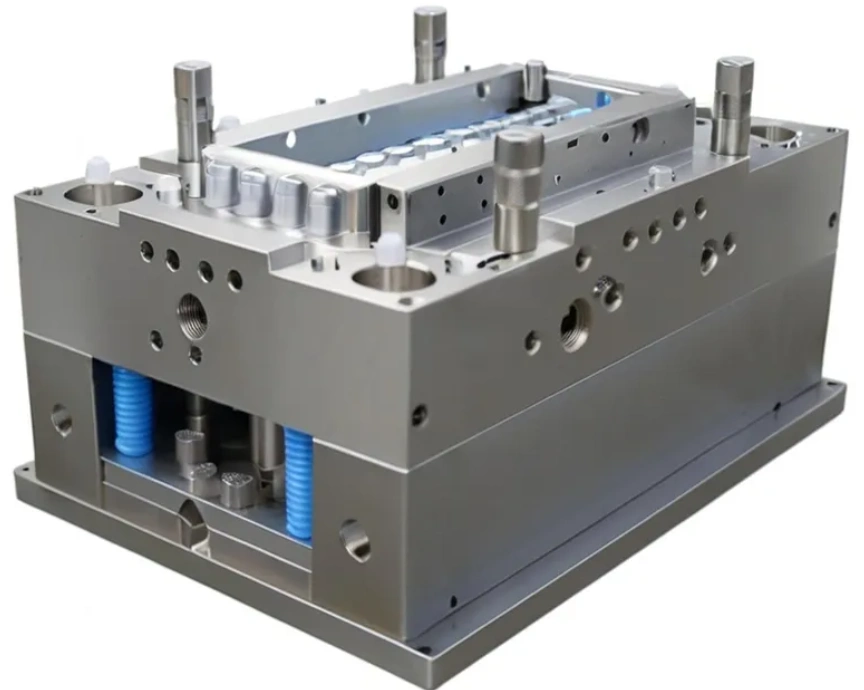
Steel injection molding tool
Stainless Steel Injection Molding Tooling
Stainless steel for plastic injection molding is usually recommended where corrosion resistance is critical. It applies to medical and chemical-ridden environments. Due to its unmatched surface finish, stainless steel tooling is also common in the manufacture of cosmetic parts. If you are in a highly regulated industry such as food processing, you can expect us to use this type of plastic injection mold tooling.
Copper Alloy Injection Molding Tooling
Beryllium copper and other copper alloys function as highly dependable inserts in critical parts of the injection molding tools. High thermal conductivity helps in faster cooling of thick sections. The material can also be used in slides and core pins. Due to the high cost, copper alloys are used selectively. Usually, for enhanced thermal management.
The Main Factors in Injection Molding Tooling Design
Various factors drive the injection molding tool design decision. The main ones are part complexity, material compatibility, surface finish requirements, dimensional accuracy, and production volume.
It is essential to address these factors because the design affects the efficiency and success of the manufacturing process.
Part Complexity – Lead time and cost are directly related to thin walls, undercuts, and other geometry aspects. Uniform walls and draft angles of 1–2° are standard requirements in injection molding tooling.
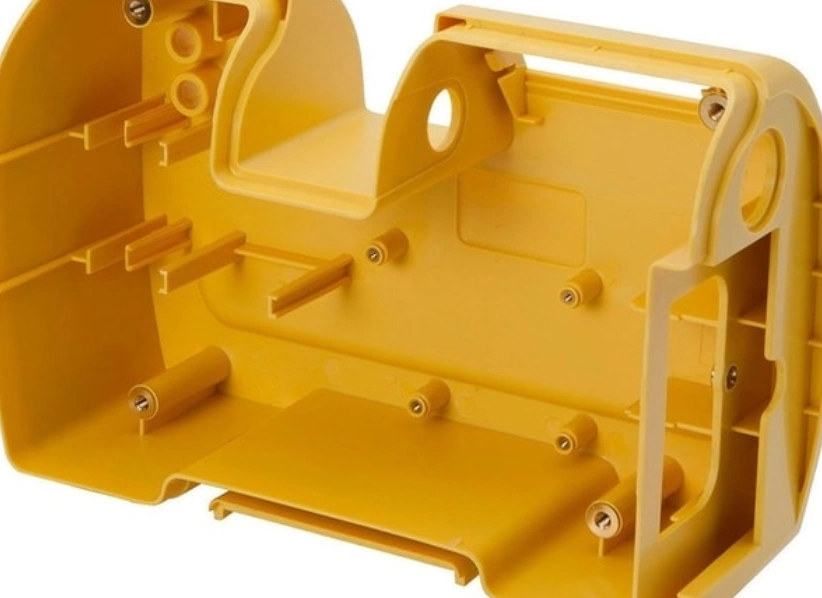
Complex injection molded part
Material Compatibility – The surface treatment and tooling material influence the applicable resin. These are the recommended pairings:
| Resin | Recommended Tool material |
| Carbon fiber, glass fiber | CrN or TiN-coated hardened steel |
| PPS, PEEK | H13 |
| FR, PVC | Stainless steel |
Surface Finish Requirements – The SPI (Society of the Plastics Industry) provides the classifications for surface finishes for injection molded parts. Always make sure your RFQ indicates the desired SPI grade.
Dimensional Accuracy – The typical tolerance for injection molding tooling on production parts is approximately ±0.05mm. An accuracy of ±0.01mm is achievable with precision tooling, the primary drivers being;
- Compensation for shrinkage
- Uniformity of thermal cooling and expansion
- CNC machining accuracy
Production Volume – Production tooling designers also consider the injection molding production volume, as this factor can determine the number of cavities and the type of tool material.
Here is a table highlighting how these factors relate.
| Production volume | Ideal tool type | Common tool material |
| Below 10,000 | Single cavity | Aluminum |
| 10,000 to 100,000 | Single cavity/multi-cavity | Tool steel |
| 100,000 to 500,000 | Multi-cavity | P20 / H13 |
| Above 500,000 | Hardened multi-cavity | Hardened steel |
*Data derived from multiple renowned industry sources and supplier information
Try Prolean Now!
Injection Molding Tooling Costs and Quality
Injection molding tooling cost depends on factors such as the production volume, material type, and design complexity. However, you don’t have to compromise these factors to save costs. Our two main strategies for cost-effectiveness revolve around the mold design and the mold material.
Mold Design – We optimize the production cost by simplifying the mold design as much as possible.
Injection Mold Tooling Materials – It is equally important to evaluate the injection mold tooling materials. For instance, using aluminum instead of steel can significantly reduce injection mold tooling costs in low-volume production runs.
What is the Process of Injection Molding Tooling?
The injection molding tooling process comprises injection mold tool design, prototyping & testing, plastic injection mold tooling fabrication, and tooling assembly & inspection.
Step 1: Injection Molding Tool Design
This entails producing detailed mold designs. These designs are derived from part requirements and specifications. Computer-aided manufacturing (CAM) and Computer-Aided Design (CAD) software are commonly used in this step.
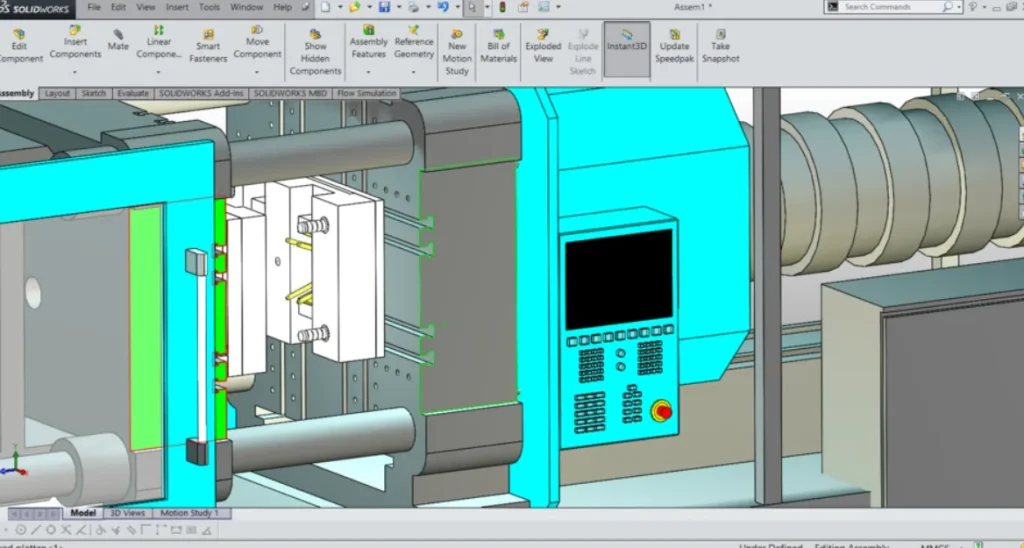
Injection molding tool design
Step 2: Prototyping & Testing
The engineers then proceed to produce prototypes using CNC machining or 3D printing. These prototype molding tooling solutions are used to test the equipment early in the design process. That way, the tooling is fabricated with significantly reduced risk of rework.
Step 3: Plastic Injection Mold Tooling Fabrication
The tool design step paves the way for fabrication. CNC machining is a common fabrication method. It allows for the production of different tooling sizes and shapes from diverse materials, including aluminum and steel.
Step 4: Tooling Assembly & Inspection
Since the molding tooling comprises various components, these parts must be assembled and inspected. In this final step, precision tooling assembly strategies are used for fit and alignment. The mold tooling process is incomplete until the unit has passed the requisite inspections for injection mold tooling standards and specifications.
What is the Difference Between Tooling and Molding?
Molding is the process, while tooling is the equipment used to perform the molding process. These terms are constantly used interchangeably in procurement, which should not be the case.
- Molding – The process of putting molten material into a mold, leaving it to cool, and removing the finished part. It is a recurring cost that involves the use of the tool/tooling.
- Tooling – This is the physical mold or tool used in the molding process. It could also mean the process of designing and fabricating the mold. It is a capital cost.
Soft Tooling vs Hard Tooling
Soft tooling is a temporary solution built to prove a design, while hard tooling is more permanent, as it is designed to run production. Differences between soft tooling and hard tooling are in lead time, tool life, material used, and upfront cost.
|
Comparison Element |
Soft Tooling |
Hard Tooling |
|
Used for |
Design validation, Rapid Injection Molding |
Full-scale production |
|
Upfront cost |
Lower |
Higher |
|
Lead time |
Up to 4 weeks |
Up to 14 weeks |
|
Tool life |
Up to 50,000 shots |
1,000,000 plus shots |
|
Material used |
Aluminum, soft steel |
Hardened steel |
Pro tip: Use hard tooling only after the design has been validated using soft tooling.
Try Prolean Now!
How Much Does an Injection Mold Tool Cost? Why It Is Often Expensive
Injection mold tooling can be expensive due to factors such as precision engineering, raw material cost, design complexity, customization, and maintenance. As supplier data shows, a 3D-printed low-volume mold can cost as little as $100. There are also complex steel molds that cost $100,000 and more.
Precision Engineering – Achieving ±0.01mm tolerance requires skilled personnel, multi-axis CNC machining, EDM machining for complex geometries, and inspection, all of which are expensive.
Raw Material Cost – Production-grade molds are built from relatively costly materials such as 420 stainless steel, P20 pre-hardened steel, and H13 hot-work tool steel.
Design Complexity – Every additional feature to the mold adds to the initial cost. Features that can significantly increase the cost of injection molding tooling include intricate cooling circuits, undercut slides, and hot runner systems. For instance, adding a slide for an external undercut can inflate cost.
Customization – Every injection mold is built with consideration for production volume, type of resin, and part geometry. Customizing a steel tool after the component has already been machined can cost a significant portion of the initial cost.
Maintenance – Like any other production equipment, the mold demands maintenance.
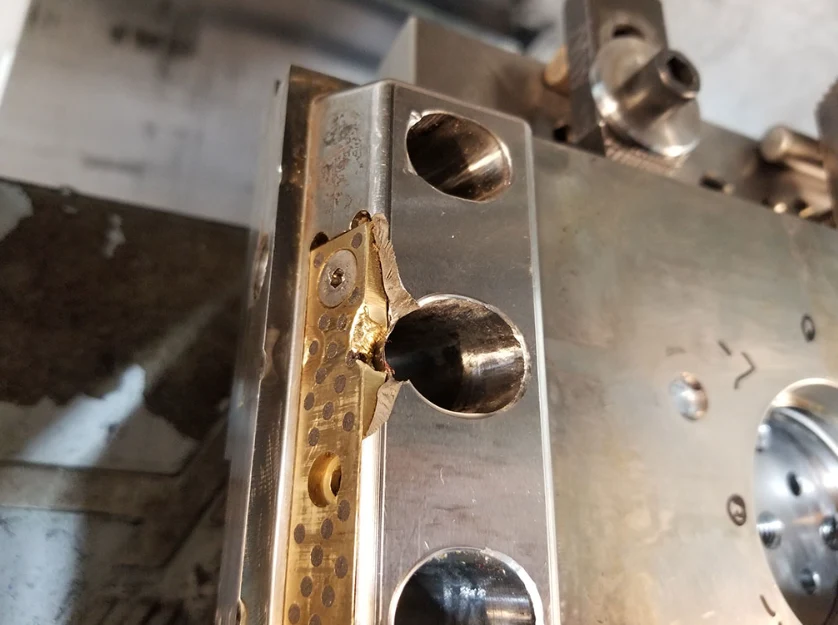
Damaged injection mold
Typically, a production mold requires regular preventive maintenance. The exact maintenance frequency is based on factors such as tooling material, molding category, and resin abrasiveness. Critical parts that require keen maintenance are gate inserts, cooling circuits, ejector pins, and slides.
Best Practices in Injection Molding Tooling Design
Experienced injection molding tooling engineers follow five main design best practices: Uniform wall thickness, 1°–2° draft angles, avoidance of undercuts, well-designed cooling circuits, and conservative design around critical dimensions.
Uniform Wall Thickness
Inconsistent wall thickness can cause uneven cooling. The resulting warpage and sink marks can trigger product rejections. If a thick section must be used, the coring method is recommended.
1°–2° Draft Angles
Draft angles of at least 2° per side are recommended to prevent surface damage and drag marks during part ejection. [1] Engineers should use steeper angles if the surface is textured.
Avoidance of Undercuts
Undercuts add tooling cost and increase part complexity. All issues related to undercuts should be addressed at the design stage, if that is possible.
Well-Designed Cooling Circuits
Cooling accounts for a significant amount of cycle time. Conformal cooling channels prevent hot spots and optimize cycle time.
Critical Dimensions
Some extra material/allowance should be left when designing tight-tolerance parts. The material should then be removed in bits to the recommended dimensions. It is difficult to add material after it has been removed.
Conclusion
The injection molding tooling in plastic manufacturing is critical. The process influences the cost-effectiveness, speed, and quality of plastic parts. Selecting the material, complexity, surface finish, and dimensional accuracy of the part is central to the design process for molding tooling.
ProleanTech integrates engineering experience with custom injection molding tooling and a comprehensive rapid tooling service. This approach produces molds with tolerances as good as ±0.01mm and a lifespan of up to 1 million strokes. Are you ready to get the right injection molding tooling results? Contact our engineering team with the part requirements and ask for a custom quote.
Sources
[1]https://www.making.unsw.edu.au/learn/injection-moulding-basics/