When it comes to choosing the right material grade for stainless steel machining projects, you must consider several factors. The right grade not only impacts machinability and pricing, but also determines the desired properties for end-use applications. Among many stainless grades, 904L vs 316L stainless steel is a popular debate in manufacturing for engineers, machinists, and product developers.
904L is highly resistant to chemicals and pitting, while 316L is more machinable, less expensive, and suitable for various marine applications. This article will break down the key differences between 316L and 904L steel and when to choose them.
Let’s get started!
What is 316L Stainless Steel?
316L stainless steel is a low-carbon variation of alloy grade 316, limiting carbon content at 0.03%. The main difference between 316 vs 316L is that 316L offers better weldability by slightly compromising strength. However, it maintains the same level of corrosion resistance and slightly improves the machinability.
When excellent corrosion resistance, good chemical resistance, pitting resistance, and weldability are required, 316L is a better option than 316. Subsequently, 316 stainless steel machining is slightly easier than its low-carbon variation.
The chemical composition of 316 L stainless steel is given below (% by weight) [1]
|
Carbon (C) |
Silicon (Si) |
Manganese (Mn) |
Phosphorus (P) |
Sulfur (S) |
Chromium (Cr) |
Molybdenum(Mo) |
Nickel (Ni) |
|
0.030 |
0.75 |
2.0 |
0.045 |
0.030 |
16.0 – 18.0 |
2.0 – 3.0 |
10.0 – 14.0 |
What is 904L Stainless Steel?
904L is a distinct high-alloy austenitic stainless steel. The L designation indicates a low-carbon composition, with a maximum carbon content of 0.02%, which helps reduce carbide precipitation and the risk of intergranular corrosion during welding.
Unlike 316L, 904L contains higher Nickel, molybdenum, and copper, along with approximately 19–23% chromium. This alloy composition provides enhanced resistance to pitting, crevice corrosion, and reducing acids, particularly sulfuric acid.
The low carbon content in 904L slightly reduces mechanical strength but improves cold-working and post-weld annealing properties. It is a good choice for chemical processing, food processing, marine, and heavy-gauge welding applications.
The chemical composition of 904 L stainless steel is given below (% by weight) [1]
|
Carbon (C) |
Silicon (Si) |
Manganese (Mn) |
Phosphorus (P) |
Sulfur (S) |
Chromium (Cr) |
Molybdenum(Mo) |
Nickel (Ni) |
Copper(Cu) |
|
0.020 |
1.0 |
2.00 |
0.045 |
0.035 |
19.0 – 23.0 |
4.0 – 5.0 |
23.0 – 28.0 |
Cu 1.0-2.0 |
904L vs 316L Stainless Steel: Alloying Composition and Structure
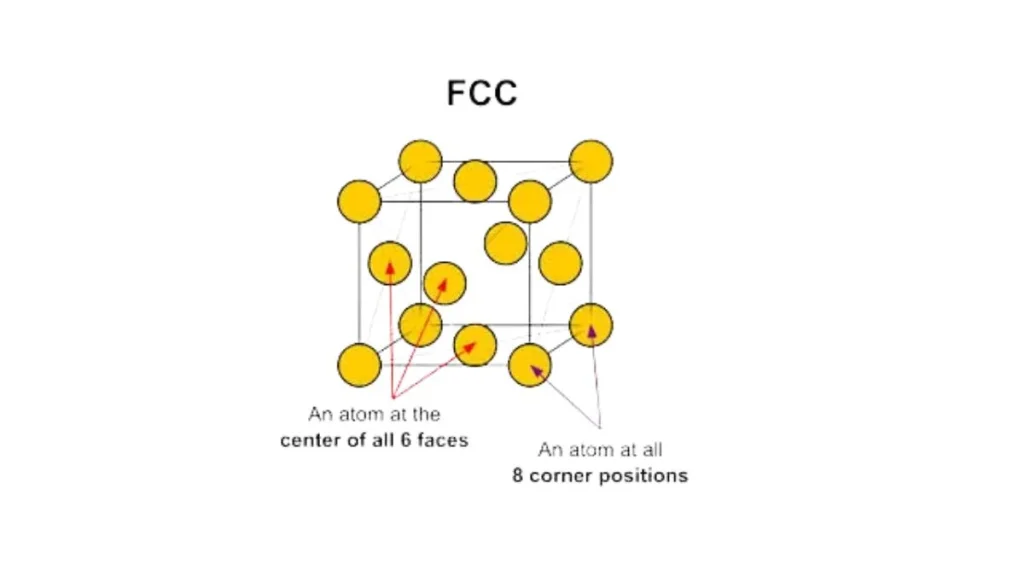
Austenite FCC structure
First, let’s address the letter “L” designated after the grade code; it denotes the lower carbon content in the composition, compared to the respective standard compositions.
904 L contains more nickel than 316 L and an addition of 2% molybdenum. The higher Mo content in 904L enhances the resistance to saltwater, chlorides, and pitting.
In terms of internal structure, both 904L and 316L are austenitic stainless steels with a face-centered cubic(FCC) structure. The FCC structure provides ductility and maintains toughness at elevated temperatures.
904L vs 316L Stainless Steel: Physical Properties
904L alloy is brighter than 316L because of higher nickel % and the addition of copper. The polished 904L parts give a white, deep, mirror finish, whereas 316 L is relatively warmer and gives a smokier finish.
- Density: Both 904L (7.95–8.00 g/cm³) and 316L (7.95 g/cm³) have nearly similar density.
- Melting Point: The melting points of both alloy grades are close to each other (1350 to 1400°C).
- Corrosion Resistance: Both of the alloys have excellent general corrosion resistance. In chloride and acidic exposure, 904L provides better resistance to corrosion and pitting, with PREN ~ 35.
904L vs 316L Stainless Steel: Mechanical Properties
904L and 316L provide nearly similar tensile strength and hardness, but the yield strength of 904L is modestly higher. The higher content of alloying elements(especially Ni and Mo) in 904L makes it more stable in extreme conditions. Subsequently, the elongation at break of 316L is slightly higher for standard bars and sheets.
|
Property |
904L |
316L |
|
0.2% yield strength (MPa) |
220 |
170 |
|
Tensile strength (MPa) |
490 |
485 |
|
Elongation (%) |
35% |
40% |
|
Hardness (Rockwell B) |
90 |
95 |
|
Elastic modulus (GPa) |
200 |
195 |
|
Modulus of Rigidity (GPa) |
78 |
77 |
*These are approximate values at annealed, room-temperature conditions; actual values may differ by specific material standard and supplier.
If you want to read more about other high-performance materials, click nickel alloys here.
904L vs 316L Stainless Steel: Chemical & Thermal Properties
The higher content of Cr, Ni, and Mo, along with additional copper, makes 904L more resistant to chemical attack, as the composition provides a more stable internal structure compared to 316L. The ~2% Cu adds resistance to reducing acids like HCl. Subsequently, Molybdenum is 4% in 904L, and it increases the localized pitting resistance against chloride exposure.
904L offers better performance in acidic exposures (sulfuric, hydrochloric, phosphoric, nitric, formic, acetic, etc.), alkaline exposure, and seawater exposure. However, the exact performance depends on acid concentration, temperature, impurities, and operating conditions.
Let’s compare the corrosion rate of 904L and 316L under different acidic exposure conditions.
|
Acid type/environment |
Concentration/composition |
Thermal Condition |
316L (mm/year) |
904L (mm/year) |
|
Sulfuric acid |
10% H₂SO₄ |
Boiling |
16.137 |
2.57 |
|
Hydrochloric acid |
1% HCl |
Boiling |
5.74 |
0.55 |
|
Phosphoric acid |
20% H₃PO₄ |
Boiling |
0.015 |
0.01 |
|
Formic acid |
45% HCOOH |
Boiling |
0.594 |
0.2 |
|
Acetic acid |
20% CH₃COOH |
Boiling |
0.003 |
0.02 |
|
Oxalic acid |
10% H₂C₂O₄ |
Boiling |
1.224 |
0.69 |
|
Wet-process phosphoric acid |
54% P₂O₅, 0.06% HCl, 1.1% HF, 4% H₂SO₄ and other impurities |
60°C |
>5 |
1.2 |
|
Nitric–hydrofluoric pickling acid |
20% HNO₃ + 4% HF |
25°C |
>6 |
0.47 |
Next, let’s compare the thermal characteristics [7];
- Thermal Conductivity: 316L (~16 W/m·K) provides slightly higher thermal conductivity than 904L (~11.5 to 13.0 W/m·K )
- Expansion: Both of the alloys expand quickly with an approximate rate of 15.0 µm/m·°C.
- Oxidation Resistance: 316L has good oxidation resistance, ~ 870°C for intermittent service and 925°C for continuous service [8].
904L vs 316L Stainless Steel: Machinability and Cold-Working
316L vs 904L machining
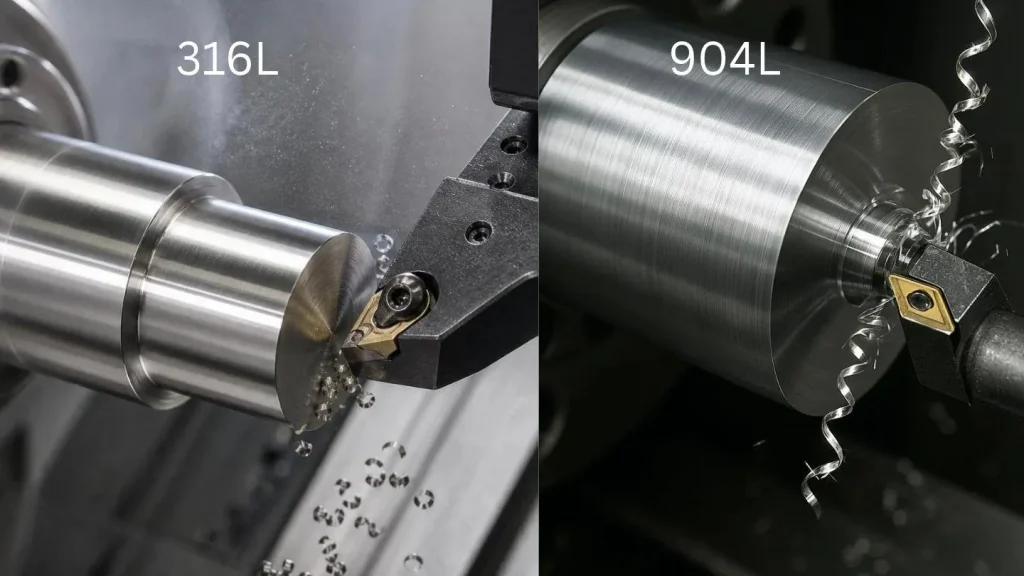
Both 904L and 316L are compatible with machining and cold-working, but 316L is generally easier to machine and cold-work because it has lower alloying content. However, the gap is small. They need carbide-coated tooling and lower feeds. You must consider the risk of work hardening while machining them.
Comparing the standard stainless steel machinability of these two alloy grades with AISI1212, 316L is generally easier to machine than 904L.
904L contains higher levels of nickel, molybdenum, and copper, making it relatively more difficult to machine than conventional 316L. However, exact machinability varies with the reference material, cutting tool, and machining conditions.
316 also has a benefit for cold-working; its formability is higher than 904L steel. You must consider tonnage capacity and tooling based on the thickness and other characteristics of each worksheet.
904L vs 316L Stainless Steel: Material Costs
Comparing the 316L vs 904L stainless steel cost, 316L is more cost-effective because of the lower content of Nickel, chromium, and molybdenum. These alloying materials are costlier, and their % in the composition directly impacts the cost.
904L stainless steel raw bars, rods, or sheets typically cost 1.5 to 2.25 times more than 316L. However, the exact cost of raw material is not solely decided by the % of alloying elements; it varies by processing method, order quantity, raw material form, supplier location, and other factors.
Although the initial material cost is expensive for 904L, the prices are justifiable in environments prone to frequent corrosion, chemical exposure, and maintenance.
904L vs 316L Stainless Steel: Common Applications
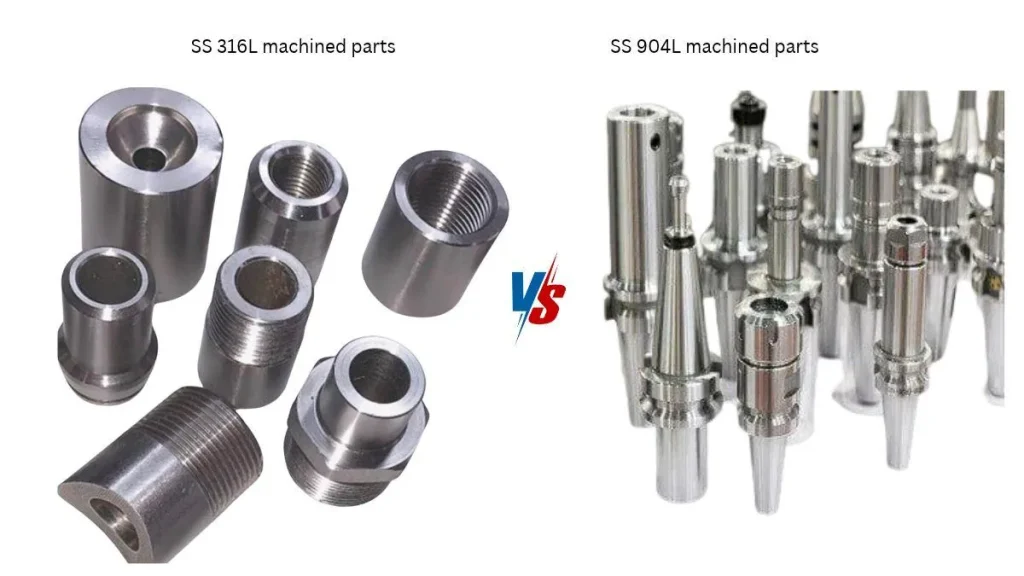
SS 316L and 904L machined parts
Baseline strength, general corrosion resistance, and elongation are similar for both alloy grades. The choice of applications between 316L vs 904L stainless steel mainly depends on how aggressive the environment is. 904L is suitable for harsh corrosion duty in chemical, chloride, and other aggressive conditions.
Applications of 904L Stainless Steel
|
Industry |
Application Examples |
|
Chemical Processing Plants |
Acid tanks, chemical transfer piping, reactors, evaporators, and heat exchangers. |
|
Oil & Gas Refining |
Processing equipment, piping, pump components, piping for contaminated streams. |
|
Pharmaceutical |
Medicine production equipment, processing vessels, and piping. |
|
Paper Industry |
Components for bleaching equipment, chemical recovery tanks, pulp storage tanks. |
|
Power Plants |
Flue gas desulphurization (FGD) scrubber systems, high-temperature fans, and absorber components. |
|
Watch Industry |
High-end watch cases, bracelets, bezels, and lugs. |
Applications of 316L Stainless Steel
|
Industry |
Application Examples |
|
Food Processing |
Storage and mixing tanks, dairy processing equipment, brewery tanks, and pumps. |
|
Marine |
Boat fittings, deck hardware, marine fasteners, piping, and pumps. |
|
Medical |
Medical trays, surgical instruments, and diagnostic equipment parts. |
|
Chemical Processing |
Processing tanks, piping, and custom vessels for mild acids, alkalies, and other chemicals. |
316L vs 904L Stainless Steel: Factors to Consider
While choosing between 316L and 904L stainless steel, consider the operating environment, corrosion mechanism, welding needs, project budget, material availability, and specified standards.
- Operating Environment: Does the application environment include chloride, boric acid, sulfuric acid, oxidizing nitric acid, or other harsh chemical exposure? In such cases, opt for 904L.
- Corrosion Mechanism: Consider the risk of pitting, crevice, chloride, and intergranular corrosion.
- Need for Welding: Do the manufacturing components need heavy-duty welding with high joint strength? 316L offers better weldability.
- Project Budget: Although 316L costs less than 904L, consider overall lifecycle cost, including processing, maintenance, and replacement costs.
- Material Availability: Consider whether the grade is available within your supplier network in the desired form, such as bars, sheets, tubes, and plates.
- Specified Standards: Before making the final decision, verify the specified material designation (AISI, UNS, ASTM), material certification, and project compliance.
When to Choose 316L over 904L?
Choose 316L over 904L when;
- The operating environment has mild chloride exposure and does not have the presence of any strong oxidizing acids.
- The heavy-duty welding is needed for fabrication.
- If ASME BPE for pharma and food, and ASTM F138 (316LVM) for implants are mentioned in project requirements
- The project budget is limited.
When to Choose 904L over 316L?
Choose 904 L over 316L when;
- High chloride pitting and crevice resistance is needed for the application environment.
- The operating environment consists of strong acid exposure, such as phosphoric, nitric, and sulfuric acids.
- Higher strength is required without compromising ductility
- If there is a risk of stress corrosion cracking
- The lifecycle cost justifies the aggressive duty
Summing Up
Although both 904L and 316L stainless steels offer general corrosion resistance, mechanical strength, durability, and food safety, the key difference lies in their capability to perform under harsh chemical exposure and ease of fabrication. 904L is better for chloride, strong acids, and chemicals, whereas 316 is easier to machine and weld. Subsequently, 316L is cheaper than 904L. The choice depends on your project requirements.
If you are still unsure which grade to choose, our engineers can help you decide the perfect fit for your project. Our comprehensive stainless steel machining service covers everything from material selection and DFM review to post-processing. We have 3-, 4-, and 5-axis CNC machines and expert manpower to convert your custom design into reality.
✓ 20+ stainless steel grades
✓ In-house production and quality inspection
✓ FAI and other documentation upon request
✓ Free DFM feedback and material selection consultation
✓ 10+ service finishing options
To get an engineer-reviewed quote, send us your design file today!