
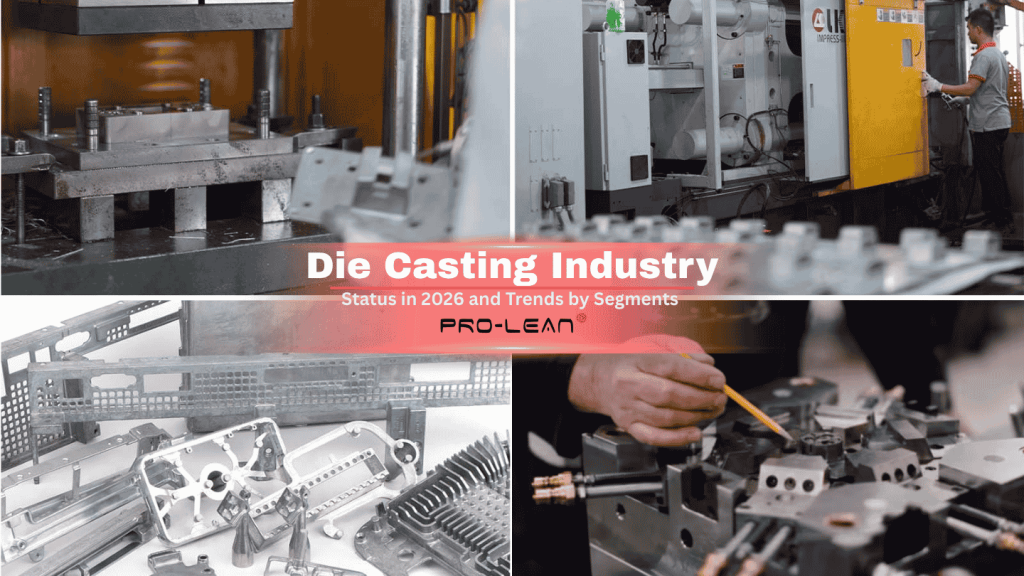
Die casting industry feature image
Die casting is one of the core technologies in modern manufacturing, with an extensive market that is approximately $92.61 billion globally in 2026, and is expected to exceed $130 billion by 2031[1]. The die casting industry is known for supplying lightweight and complex detailing parts/products in high volumes for automotive, aerospace, industrial machinery, consumer electronics, and other sectors.
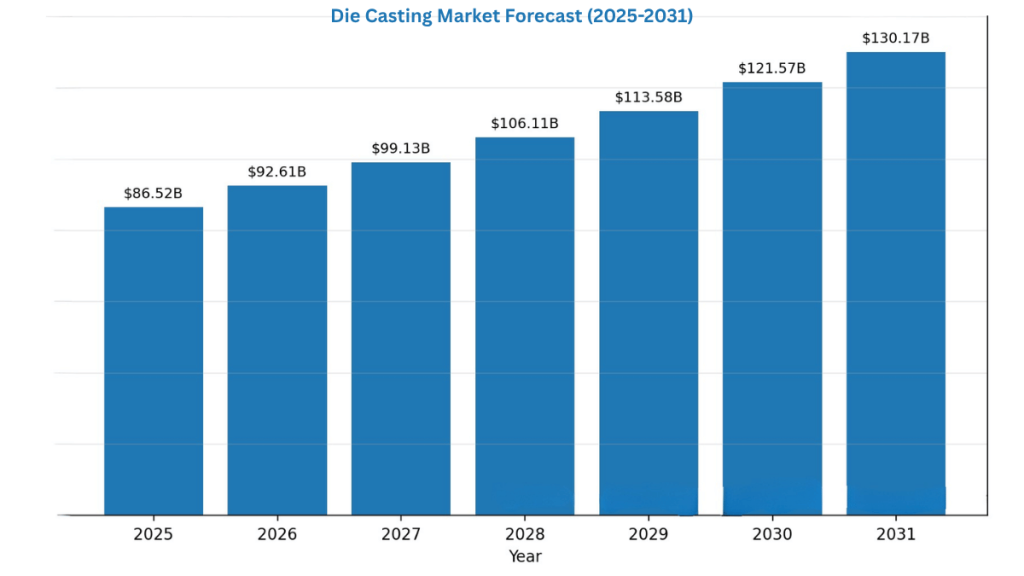
Die casting market forecast
The use of lightweight components across industries, continuous process innovations, innovations in alloy compositions, and diversification of end-use demand are fueling growth in the die casting market.
Key Takeaways
- The global die casting industry is valued at ~$92.61 billion in 2026 and is expected to reach $130 billion by 2031. The growth is driven by demand for lightweight, complex, and integrated components.
- Asia-Pacific leads the market with ~56% global market share, fueled largely by China’s expanding EV, electronics, and automotive manufacturing.
- Automotive dominates the demand for die casting components, which account for about 61.73%.
- Analyzing process segments, pressure die casting contributes about 55% of industry share due to fast cycle times, thin-wall geometry capability, and repeatability.
- Analyzing the die casting materials, aluminum holds 65.10% of the material share due to its low density, corrosion resistance, and HPDC compatibility.
- Giga-presses, ultra-high clamping force machines, industrial automation, and AI-based quality monitoring are the current trends in the die-cast industry.
What is Die Casting Technology?
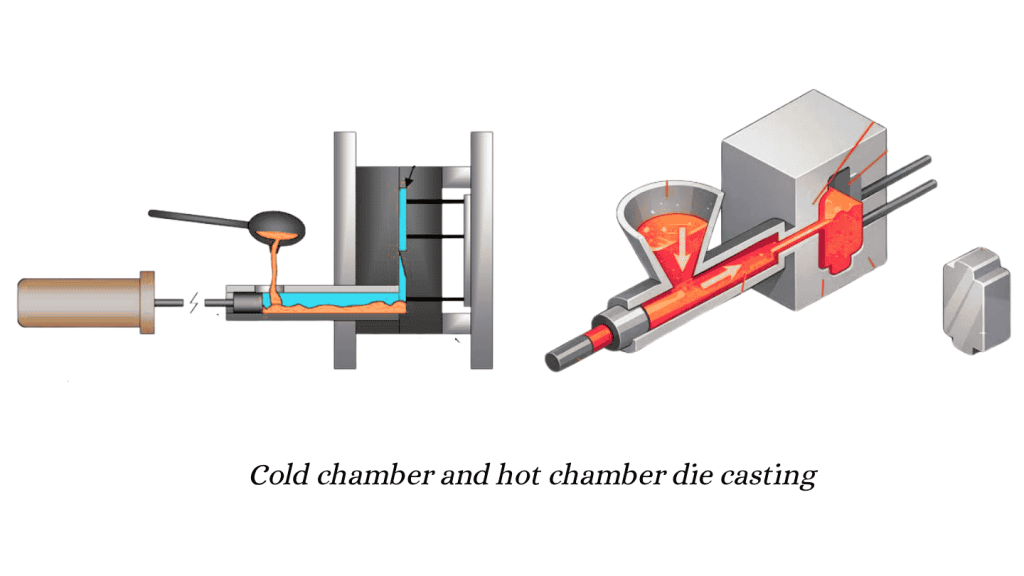 Die casting technology
Die-casting is a process of creating metal components by forcing molten material into a reusable mold (called a die), where it fills the cavity and takes the shape upon solidification. The mold cavity shape defines the outer geometry, and the core section forms internal geometry, such as interior walls, holes, slots, ribs, and other details. Die casting technology is typically used for non-ferrous metals and alloys, such as aluminum, magnesium, and zinc.
Pressure die casting, vacuum die casting, gravity die casting, and squeeze die casting are the major types. However, each of these types follows the same basic steps: die creation, molten metal filling, die cooling, ejection, and post-processing.
The evolution of the die casting industry started in 1849 with the development of a manual pressure casting machine, which was initially used to create movable printing type. Primarily, it was for tin and lead, until zinc and aluminum were introduced in die-casting in 1914 and magnesium and copper alloys in the 1930s [2].
In the late 20th century, modernization started in die-casting equipment with automated cold & hot chamber machines, which can process several metals and alloys to produce thin-walled, complex parts/products. The current status in 2026 is the use of giga-presses, machines with ultra-high clamping forces, industrial automation, and consolidated components casting.
Currently, the Asia-Pacific region dominates the die-cast industry market with a share of ~56 % in 2025 [1]. This is mainly due to the expansion of EV, electronics, and automotive manufacturing markets in China. Chinese die-cast manufacturers also lead in supplying precise high-end die-cast parts for industries worldwide, while being cost-competitive. Consequently, other major regions in the global die-cast market are North America, South America, and Europe.
The Demand for Finished Die-casting Parts
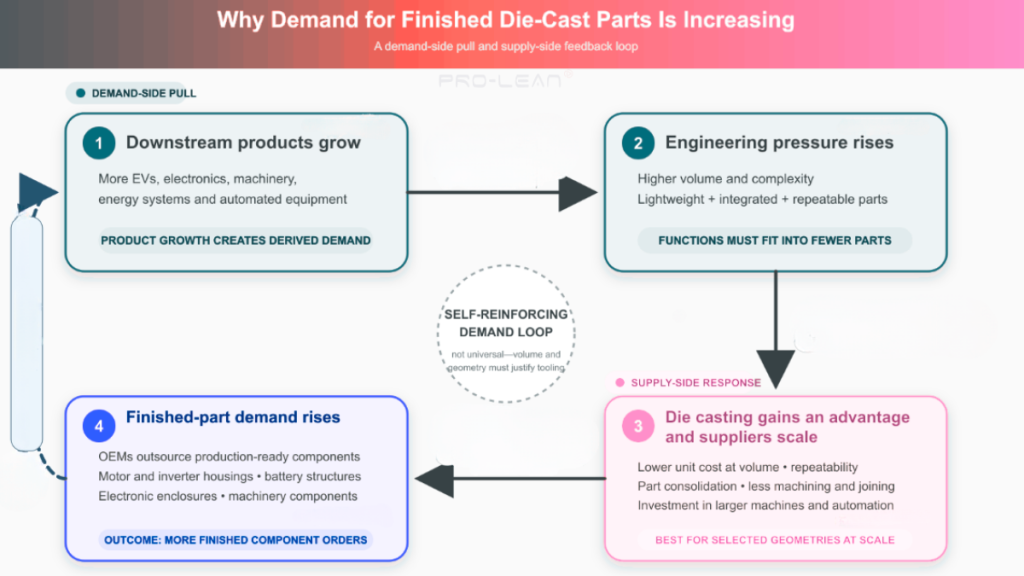
Die-cast demand
Automotive (IC), EV, electronics, aerospace, and industrial machinery industries have an extensive demand for finished die-casting parts. For complex, lightweight, thin-walled, and integrated components, die casting delivers near-net-shape production. The high tooling expense is justified and economical for large-volume production.
Depending on the design, die casting can be more precise and cost-effective than CNC machining & multi-step stamping. However, it does not replace them completely. You must make a decision by analyzing the part geometry and production volume. For parts with ribs, bosses, deep 3D features, internal channels, mounting points, curved surfaces, and multiple integrated functions, die-casting can be a better option than stamping.
Try Prolean Now!
Major Processes in the Die Casting Industry: Pressure, Vacuum, Squeeze, and Gravity Die Casting
Pressure die casting is a major contributor to the die casting market revenue, with a share of ~ 55 % in 2025 [1], followed by vacuum casting, squeeze casting, and gravity die casting. High-pressure injection of molten material allows faster cycle times, complex and thin-walled geometry, excellent repeatability, and lower per-part cost.
Pressure Die Casting
The pressure in low-pressure die casting (LPDC) ranges between 0.1 and 1 MPa, whereas it can be as high as 175 MPa for high-pressure die casting (HPDC). HPDC is best for complex and repetitive parts, requiring tight tolerances, such as engine blocks and electronic housings. On the other hand, LPDC is suitable for structural and relatively large-sized components, such as wheels and suspension parts.
Vacuum Die Casting
It is a subtype of HPDC, where the die cavity is vacuumed using a vacuum pump, so air entrainment can be removed. So, the porosity can be reduced. Tooling cost is slightly higher for vacuum die casting, but it enhances the quality of load-bearing and thin-wall components.
Squeeze Die Casting
In squeeze die casting, the molten metal is poured into a pre-heated die, followed by pressure application through a punch press. It covers ~ 25 % of the industry share [3], and it is suitable for casting high-stress components, such as automotive wheels and knuckles.
Gravity Die Casting
As the name suggests, gravity is the driving force for pouring molten metal into the die, where it flows and fills the cavity without any external pressure. It reduces the turbulence and eases the subsequent heat treatment. Gravity die casting is suitable for casting parts with lower complexity in medium volumes.
Die Casting Market Segments by Application Industries
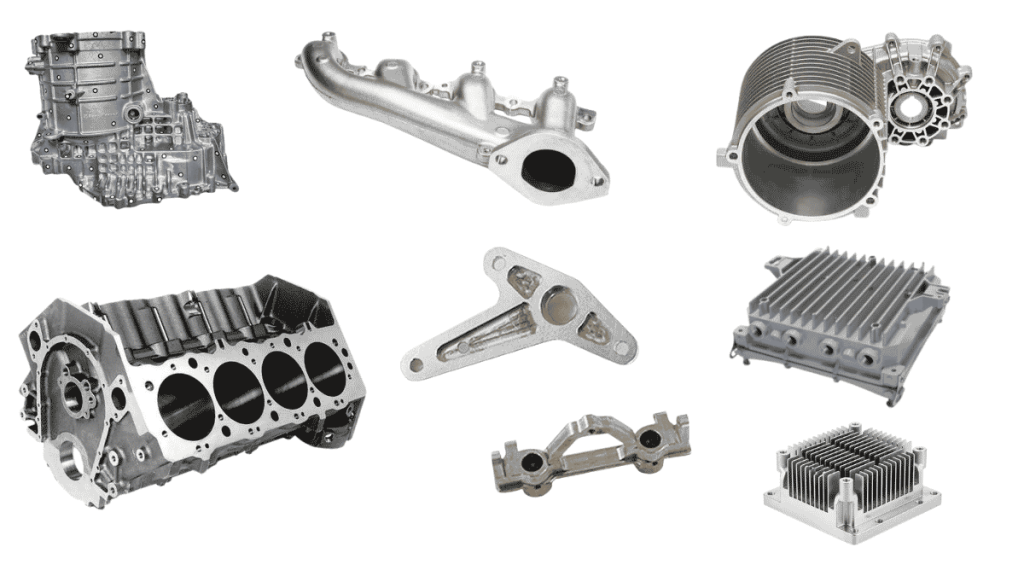 Die casting applications
The majority share of the metal casting market is covered by the automotive die casting segment, with a contribution of about 61.73%, followed by industrial machinery, aviation, medical, and energy. All other industries account for 38.3% [1].
Let’s look at the common die-casting trends and application examples across the industries in the table below.
|
Industry |
Latest Trends |
Application Examples |
|
Automotive |
– EV lightweight parts – Mega/ giga casting – Structural integration – Advanced Al alloys – AI-based quality monitoring -Automated casting cells |
EV battery trays and enclosures, e-motor & inverter housings, front/rear structural sections, chassis nodes, suspension components, gearbox housings, brackets |
|
Aviation |
– High-strength and lightweight parts – High-integrity casting – Thin-wall and complex casting – Near-net-shape manufacturing – Use of advanced Al/Mg alloys |
Avionics housings, mounts & brackets, cooling components, structural fittings |
|
Heavy Machinery |
– Larger and integrated castings – Automated HPDC – Cast-and-machine integrated production |
E-motor housings, transmission housings, hydraulic valve bodies, pump & compressor enclosures, machine frames, pneumatic components |
|
Energy |
– Power-electronics integration – Lightweight equipment – Use of recycled materials – Automated monitored production |
Generator/motor housings, power-module enclosures, heat sink and cooling components, and renewable-energy equipment housings |
Try Prolean Now!
Market Segments by Die Cast Metals
Analyzing the total revenue of the die-cast industry, aluminum materials dominate the market in 2026 with a 65.10% share, followed by 21.8 % of magnesium, and 13.1 % of zinc [3]. However, the projected growth rate is higher for magnesium alloys in the 2026-3031 period.
Why Aluminum Alloys Dominate the Die Casting Industry?
Aluminum alloys offer low density, corrosion resistance, good structural performance, thermal & electrical conductivity, and are highly compatible with high-pressure die casting processes. For instance, automotive die casting components heavily use A380, A383, and A360 alloys. Demand for aluminum die casting is increasing in both IC vehicles and EVs to improve the overall efficiency.
Why are Magnesium Die Casting Applications Growing Faster?
The growth of magnesium die casting applications is driven by several factors, including the need for extremely lightweight components across the industry, the rise of EVs, weight reduction for longer battery backup time, complex thin-wall casting needs, automotive lightweighting regulations, and electronics miniaturization.
Need Die-cast Parts for Your Project? Contact ProleanTECH
ProleanTech is an experienced on-demand manufacturer with over 10 years of experience in the die casting industry, providing complex and high-precision casting solutions from prototype to production. We have integrated trimming, CNC machining, finishing, and dimensional inspection with die casting.
Our automated die casting facility with digital monitoring systems allows us to create complex and near-net-shape components based on the provided design.
Why choose our Die casting service?
✓ Different die-cast metal options, including aluminum, zinc, magnesium, and copper alloys.
✓ Pressure, vacuum, squeeze, gravity, and other die-casting types are available.
✓ Both hot- and cold-chamber die-casting equipment
✓ Trimming, machining, and surface finishing (beadblasting, polishing, alodine, plating, anodizing, etc.)
✓ Close partnership with a reliable logistics network
✓ Expert engineering support from part design and die tooling to mass production
✓ Rapid response and seamless communication throughout the project
So, if you need die-cast components for your project, send us your design with specific requirements. We will provide the engineer-reviewed quote with DFM feedback.
References
[1] Mordor Intelligence, “Die Casting Market Size and Share: Growth Trends and Forecasts (2026–2031),” Mordor Intelligence. Mordor Intelligence
[2] North American Die Casting Association (NADCA), “Die Casting: Frequently Asked Questions,” NADCA. NADCA – Die Casting FAQ
[3] Coherent Market Insights, “Die Casting Market Size, Trends and YoY Growth Rate, 2033,” Coherent Market Insights. Coherent Market Insights

0 Comments