
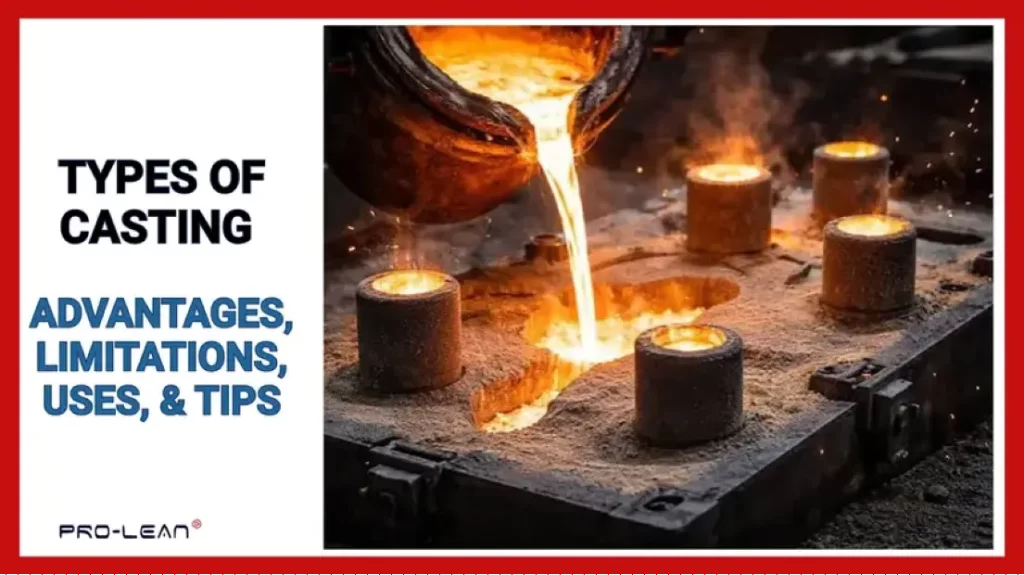
Types of casting
The types of casting are sand, investment, die-casting, permanent mold, centrifugal, vacuum, plaster, low-pressure, squeeze die, high-pressure die, lost-foam, shell molding, continuous, and gravity die casting. These metal casting processes use a mold cavity to shape molten metal into the desired parts. Manufacturers and buyers considering types of casting are faced with questions concerning part complexity, material type, process cost, and surface finish.
You don’t want to choose the wrong method because that would mean weak parts, rejected parts, and lost revenue. With about 14 types of casting actively in the market, a decision has to be made carefully, preferably with the help of an expert.
Usually, sand casting is for cost-effective prototypes, investment casting for complex geometries, and die casting for high-volume, precise parts. Miss these fundamentals, and you are looking at scrap or tooling replacements.
What is Metal Casting?
Metal casting is a manufacturing process that entails pouring molten metal into a mold cavity to produce parts. The mold bears the reverse shape of the desired part. The mold material should be refractory, so sand is a popular option.
After the molten metal has filled the cavity, cooled, and solidified, it is removed from the mold. Some finishing processes are often necessary before the part can be ready for use. Casting is a popular industrial process because it is economical, versatile, suitable for isotropic parts, and ideal for complex shapes.
The Types of Casting Discussed
The types of casting covered below are: Sand casting, investment casting, die casting, permanent mold casting, centrifugal casting, vacuum casting, plaster casting, low-pressure casting, squeeze casting, high-pressure die casting, lost-foam casting, shell casting, continuous casting, and gravity die casting.
As outlined below, each of these processes should be matched with your material, volume, and tolerance requirements.
Sand Casting
Sand casting is a versatile and economical casting method that entails producing a sand mold and pouring molten metal into the mold to produce parts.
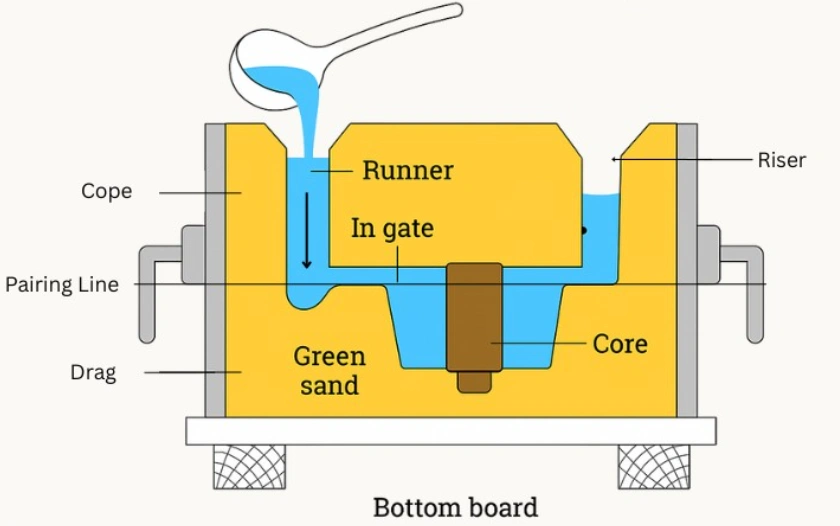
Sand casting
Other materials used alongside sand in this process are additives and binders. Sand casting is widely used in the automotive and construction industries.
|
Advantages |
Limitations |
|
|
Investment Casting
Investment casting, also called lost wax casting, is an ancient type of casting that uses a wax model. The model is covered in a ceramic layer that forms a mold. The wax is melted out, leaving a mold that can be filled with molten metal. This casting method is based on standard air and pressure conditions.
Materials for lost-wax casting include copper and copper alloys, aluminum and aluminum alloys, steel, and precious metals such as gold and silver. [1]
|
Advantages |
Limitations |
|
|
Die Casting (Metal Die Casting)
Metal die casting entails pouring or injecting molten metal into a metal die to produce parts. It is mostly done for nonferrous metals such as aluminum casting, Magnesium Casting, and zinc casting. Applications of metal die casting include appliance heat sinks, automotive engine blocks, aerospace fittings, and laptops.
The two categories of metal die casting are hot chamber die casting and cold chamber die casting, the difference being where the metal is melted. For hot chamber die casting, the metal is melted in a furnace within the casting equipment.
Pressure in casting can reach 1,200 bar. However, this depends on the die design complexity and the locking force.
|
Advantages of die casting |
Limitations of die casting |
|
|
Permanent Mold Casting
Permanent mold casting method comprises a pair of metallic molds. It is a gravity-fed process, meaning that gravitational force alone is used to pour molten metal into the mold. Common mold metals are steel, cast iron, and refractory alloys. CNC machining is typically used to produce the cavities in the molds. The mold surface is covered with hard refractory material, for example, clay. A lubricant such as silica is also used.
|
Advantages |
Limitations |
|
|
Centrifugal casting
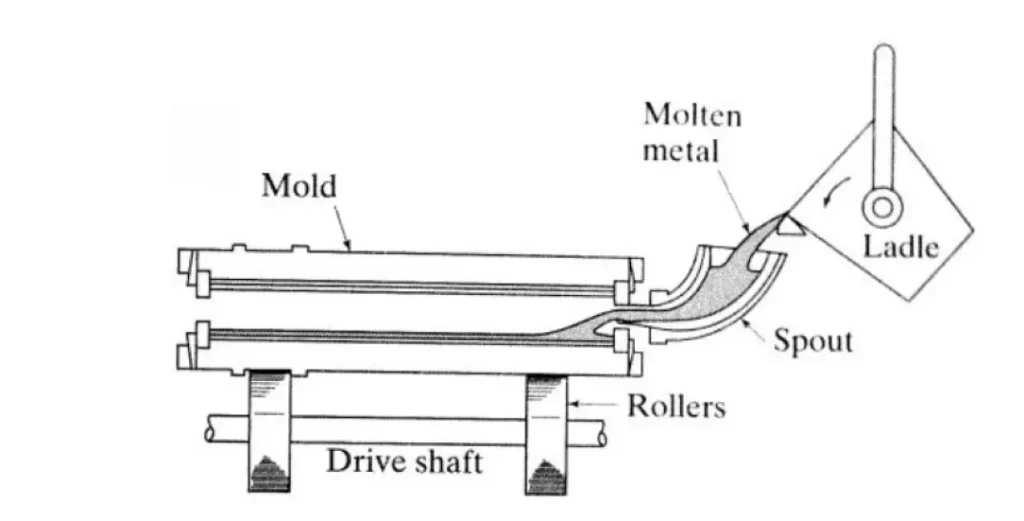
Centrifugal casting
Centrifugal casting entails a permanent mold rotated along its axis at 300 to 3000 rpm.[2] Molten material is poured as the mold rotates. Due to centrifugal forces, the molten material concentrates on the outer walls of the mold. Since most impurities are lighter than the metal, they are closer to the inner diameter where they can be machined away.
|
Advantages |
Limitations |
|
|
Vacuum Casting
Vacuum casting, also referred to as counter-gravity casting, is similar to investment casting, but the mold filling mechanism is different. For vacuum casting, a vacuum pump is used to suck the material upwards into the mold.
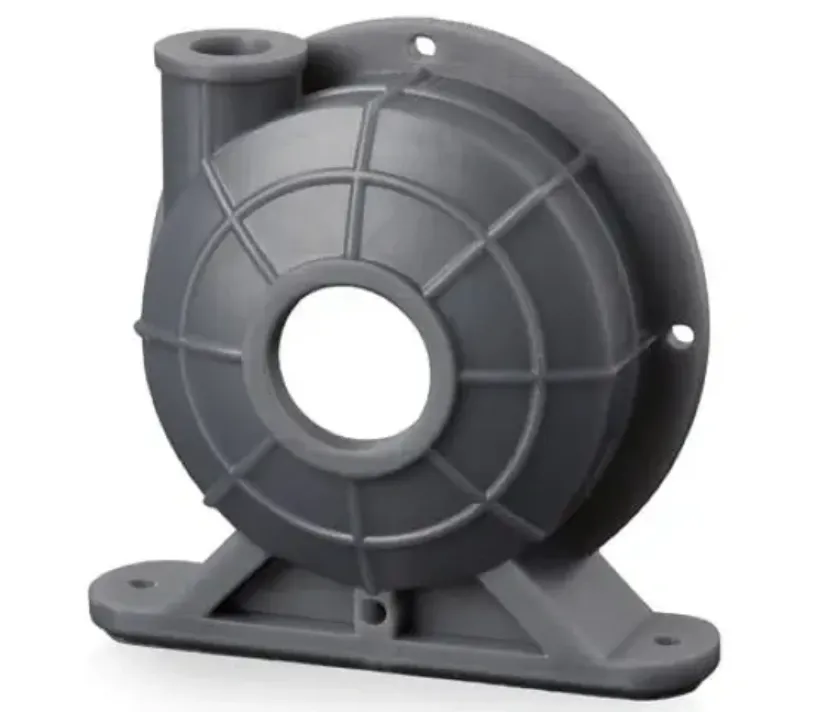
Vacuum cast part
|
Advantages |
Limitations |
|
|
Plaster-Mold Casting
The mold for this technique contains plaster of Paris (CaSO4), silica flour, and talc. This type of casting creates a perfect pairing with nonferrous metals such as aluminum, magnesium, zinc, and copper.
|
Advantages |
Limitations |
|
|
Squeeze die casting
Squeeze casting is a mix of forging and casting. Molten metal is put in a pre-heated die, then a ram steadily applies pressure on the molten metal head. This pressurization is important for a balanced flow of the metal. It minimizes microshrinkage porosity. Controlled cooling further ensures a fine microstructure. [3]
|
Advantages |
Limitations |
|
|
Low-Pressure Die Casting
The low-pressure die casting machine is vertically aligned. It comprises a moving and fixed machine plate. With the holding furnace below the fixed plate, a pressure of up to 1 bar is applied to the furnace, pushing the molten metal.
|
Advantages |
Limitations |
|
|
Lost-Foam (Expendable-Pattern) Casting
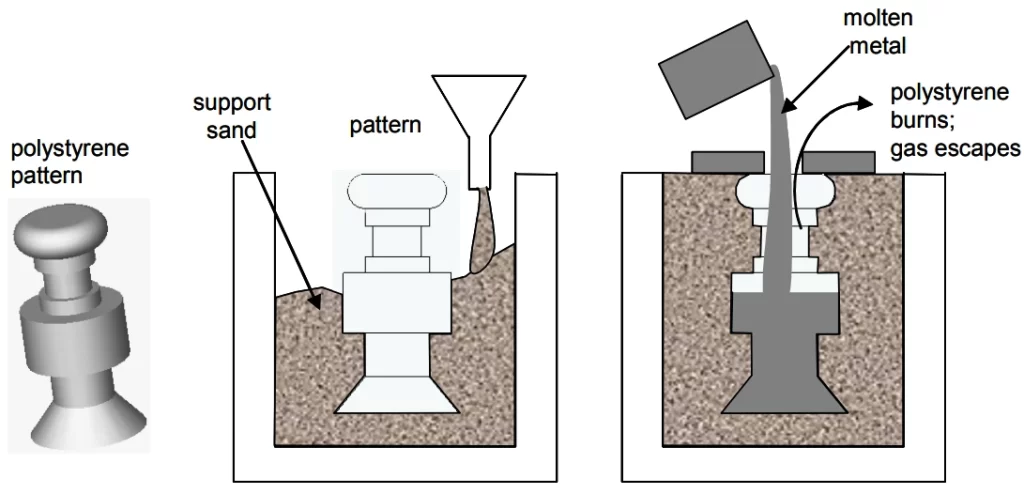
Lost-foam casting
This casting process uses a polystyrene pattern. Since this material is 95% air, it evaporates when molten metal is poured on it. [2] The pattern is produced by molding. Examples made through lost-foam casting include engine shafts and blocks.
|
Advantages of Lost-foam casting |
Limitations of Lost-foam casting |
|
|
Shell-Mold Casting
Shell casting comprises a silica sand and resin shell molded around a hot metal pattern. Molten metal is poured into the resulting mold cavity.
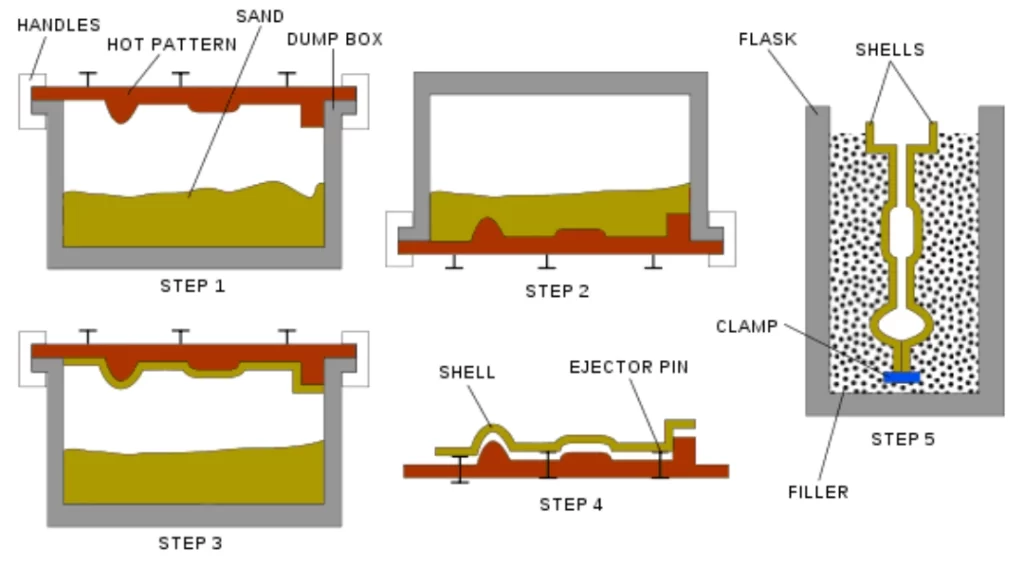
Shell mold casting
While the process is comparable to sand casting and relatively more expensive, it produces parts with smoother surface finishes and more accurate dimensions.
|
Advantages of Shell casting |
Limitations of Shell casting |
|
|
Continuous casting
Continuous casting is used to produce continuous strands of metal. The main component in the setup is a water-cooled mold, which helps draw a billet or bloom. The majority of the semi-finished aluminum and steel stock available worldwide is made by continuous casting.
|
Advantages |
Limitations |
|
|
What is the Most Popular Type of Casting?
Sand casting is the most used type of casting globally. Manufacturers prefer this type of casting because it is economical, versatile, and capable of producing complex components. It applies to both ferrous and nonferrous metals across a wide range of sizes. Aerospace and automotive are among the most common industries for sand casting. In the automotive space, for instance, gray iron castings, cast in sand molds, are specified. [5] Typical applications of gray iron for automotive castings include exhaust manifolds, diesel engine blocks, clutch plates, and transmission cases.
How To Choose a Type of Casting Process
The four variables to consider when choosing a metal casting process are material type, quantity/volume, desired properties, and part complexity.
- Material Type: Different materials require unique casting methods.
- Quantity/Volume: Some casting types are designed for low volumes, while others are for high volumes.
- Desired Properties: These include mechanical properties and surface finish. Some types of castings yield better mechanical properties or smoother finishes than others.
- Complexity of parts: Intricate parts may require casting methods with matching capabilities. For instance, investment casting is typically specified for complex designs, whereas sand casting is suited for simpler designs.
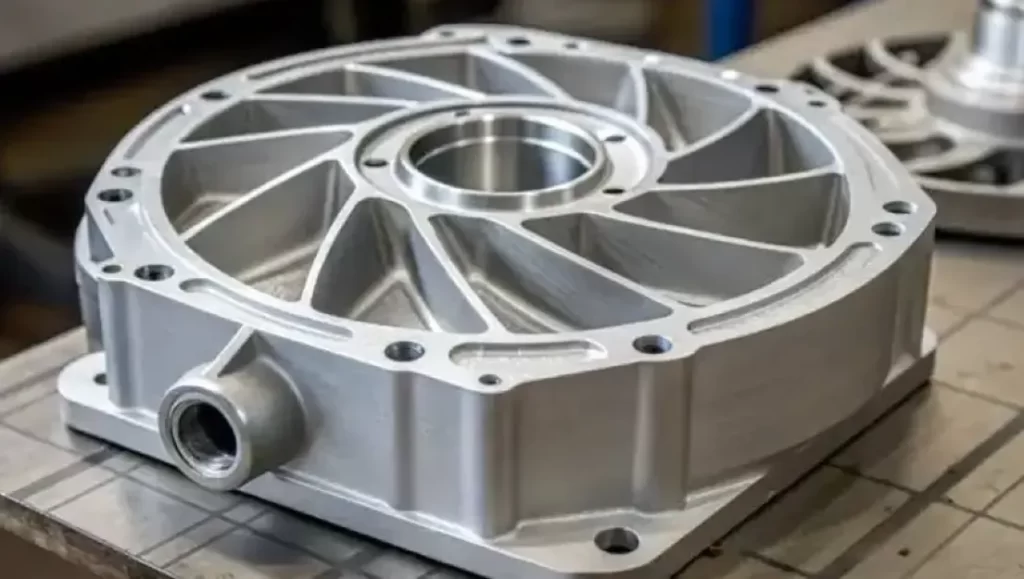
Investment casting complex part
Consider the following table as a guide to choosing the ideal type of casting.
|
Type of casting |
Production scale |
Material types |
|
Sand casting |
Low to Medium |
Aluminum, bronze, iron |
|
Investment casting |
Low to Medium |
Stainless steel and alloys |
|
Die casting |
Medium to High |
Aluminum, magnesium, zinc |
|
Permanent mold casting |
Medium |
Aluminum, copper |
|
Centrifugal casting |
Medium to high |
Iron, steel, alloys |
|
Vacuum casting |
Low to medium |
Aluminum, precision alloys |
|
Plaster-mold casting |
Low |
Aluminum, copper, zinc |
|
Squeeze die casting |
Medium to high |
Aluminum, magnesium |
|
Low-pressure die casting |
Medium |
Aluminum, magnesium |
|
High-pressure die casting |
High |
Aluminum, magnesium, zinc |
|
Lost-foam casting |
Medium to High |
Aluminum, steel |
|
Shell-mold casting |
Medium |
Aluminum, iron, steel |
|
Continuous casting |
High |
Aluminum, copper, steel |
|
Gravity die casting |
Medium |
Aluminum, copper, zinc |
Note: These are general guidelines. Actual Production scales and Material types can vary based on wall thickness, tolerance, and part geometry
What do you make of these casting options? Share your part specs with our engineers for a prompt recommendation of which casting process to use.
What Materials Are Used in Casting?
Metals dominate the materials used in casting, but the process is not limited to them. Here is the list of materials used in casting.
- Metals: Metals are the primary casting materials. Both ferrous and nonferrous metals can be cast, but the method used depends on the metal.
- Ceramics: These are used for heat-resistant and refractory components.
- Rubbers: Rubber, usually urethane rubber, is used for flexible tooling or prototypes.
- Plastics: Plastics are cast for low-volume or prototype parts
- Composite Materials: These are ideal for lightweight structural parts
- Glass: Cast glass parts typically serve optical and artistic purposes
- Alloys: Metal alloys suit applications where specific properties – thermal, corrosion resistance, strength – are required.
Try Prolean Now!
Industries that Use Casting
The most common industries using cast products are automotive, aerospace, consumer goods, jewelry, and building, with products ranging from transmission housings in automotive to architectural fittings in the building industry.
The table below summarizes application examples.
|
Industry |
Examples of Cast Parts |
|
Automotive |
Suspension parts, transmission housings, engine blocks |
|
Aerospace |
Landing gear components, turbine blades |
|
Consumer goods |
Appliance housings, fittings |
|
Jewelry |
Intricate designs using investment casting |
|
Building |
Architectural fittings, structural hardware |
Designing a Part for Manufacturability (DFM) in Metal Casting
Designing for Manufacturability (DFM) in metal casting means pursuing uniform wall thicknesses, generous radii, draft angles, and parting lines. These factors ensure the part not only solidifies evenly but also ejects smoothly from the mold.
- Uniform Wall Thickness – Designers should apply uniform wall thickness to ensure balanced cooling and shrinkage, which prevents part defects.
- Generous Radii – This prevents stress concentration at the sharp corners of the part
- Draft Angles – Well-designed draft angles allow clean release of the part from the mold
- Parting Line – This feature should be placed strategically because it affects the mold complexity and flash formation.
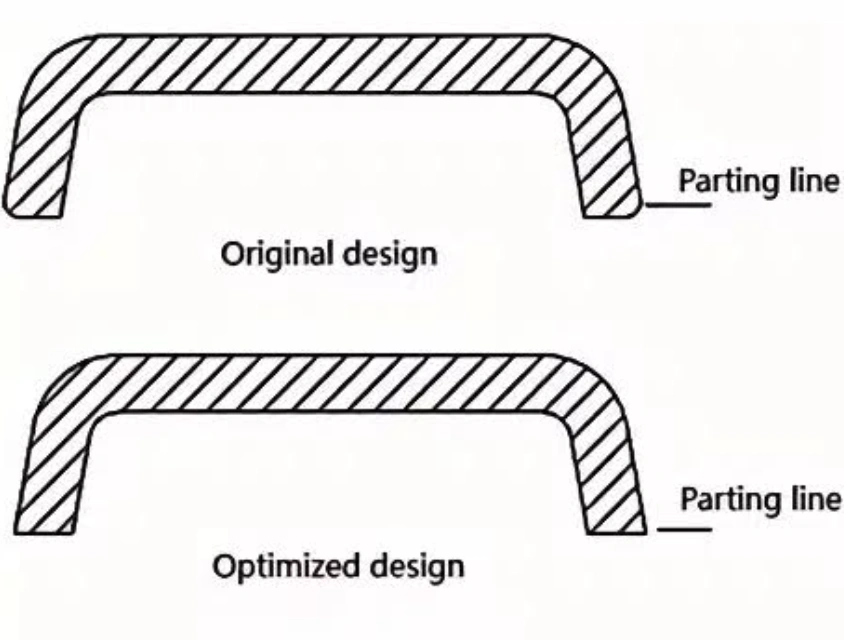
Parting line
Try Prolean Now!
Different Heat Treatment Methods for Metal Casting
Annealing, normalizing, and tempering/quenching are the main heat treatment methods for metal cast parts. The post-solidification processes are used to enhance the mechanical properties of the material.
- Annealing – This is a material softening method that relieves internal stresses
- Normalizing – This method helps attain uniform mechanical properties through grain refinement
- Quenching – This is the rapid cooling of the cast part using air, water, or oil. The process enhances the part’s strength and hardens the microstructure.
- Tempering – Tempering is the subsequent controlled reheating of the quenched part below the critical temperature. The heat treatment process reduces brittleness but retains most of the hardness.
The Future of Casting
Casting technologies are leaning towards shortening the development cycles and reducing scrap rates. Computational fluid dynamics models will increasingly be used to predict part defects. [4] 3D printed cores and molds are increasing the prototyping speed. Simulation software is also being used to detect defects early in the design process – before tooling.
The industries are increasingly using hybrid casting processes and lighter alloys to make lighter, stronger parts. Whatever the future of casting holds, the main types of casting and other fundamentals discussed above still hold.
Summing Up
Getting reliable products from casting comes down to matching volume, part complexity, desired properties, and material to the type of casting engineered for the job. Die casting is used for high-volume precision, sand casting for economical versatility, and investment casting for complex details. Specialized casting methods such as vacuum casting fill niche performance requirements.
Since no single type of casting fits every part, the versatility of casting in manufacturing is unmatched. There are DFM principles to incorporate, including proper draft angles, adequate radii, and uniform wall thickness. Don’t forget about post-process heat treatment.
For your transition from design to production, upload your part design today for a DFM review and instant quote. If there are any casting issues, the engineers will flag them before tooling to save you costs.
FAQ
How does the type of casting affect costs?
Costs vary with the types of casting. Some options may be cheaper, but require more rework than more expensive options.
Why is the knowledge of material type crucial in casting?
Knowledge of material type makes sense because it determines the matching of material properties to the application. For instance, aluminum and steel have distinct properties, and this affects the application’s suitability.
What is the role of production volume in selecting a casting method?
The production volume determines the economic sense of a casting method. The relationship between per-unit cost and upfront tooling cost differs from one method to another. For low volume, investment casting and sand casting are preferred. Centrifugal casting and permanent mold casting are the best fits for medium volume. In high volume, die casting is the dominant method.
Resources
[1]https://aristo-cast.com/wp-content/uploads/2020/09/ICI_Metal_Standards_Spec_Manual.pdf
[2]https://www.uobabylon.edu.iq/eprints/publication_1_1951_6172.pdf
[3]https://www.sciencedirect.com/topics/engineering/squeeze-casting
0 Comments