Sand vs Die vs. Investment Casting
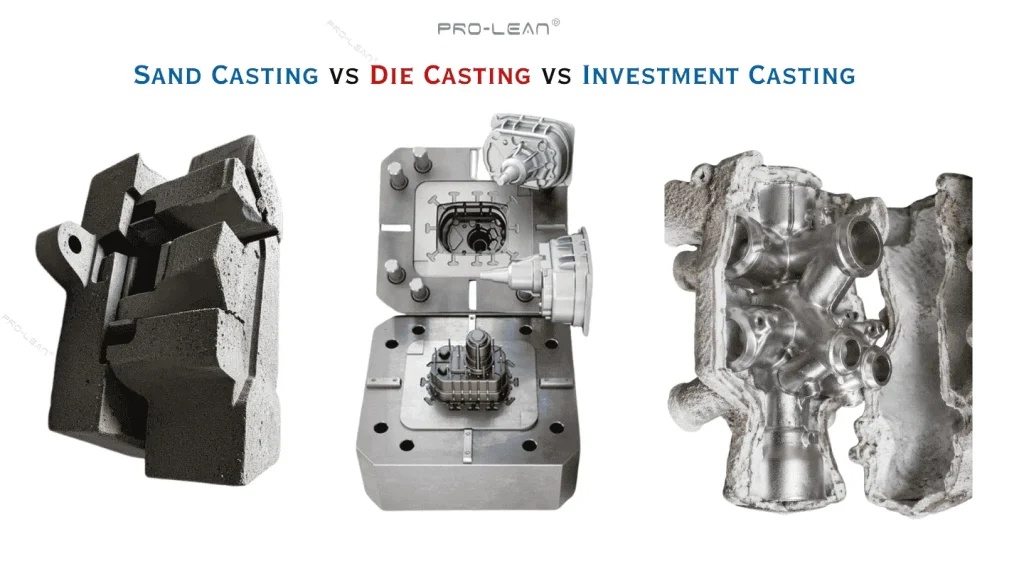
Investment casting, die casting, and sand casting are three casting processes, defined by the types of tooling (molds) they use. However, each of them uses a fundamental principle: shaping molten metal by solidifying it into a predetermined cavity.
Sand casting uses a mixture of sand, base aggregate, binders, and additives to make the mold. It is compatible with both ferrous and non-ferrous materials, supports large-sized components & products, but produces a rougher surface, and the assembled mold is not reusable. You can cast bases for industrial machines, engine blocks, large valves, impellers, and other similar structures.
Die-casting uses reusable dies that are made with Tool Steel H13, H11, tungsten, and molybdenum alloys, and other tough, durable materials. The molten metal is injected into the die with suitable pressure. Once the die cools, the material solidifies and captures the shape of the cavity. It is typically used for non-ferrous metals, and the mold is reusable for repeated cycles.
Investment casting is also known as low-wax casting because wax is used to make a pattern, and it melts inside the ceramic refractory molds to form a cavity. Although the mold is non-reusable, it can be cost-effective for small- to medium-scale production.
Sand vs Die Vs Investment Casting: Comparison Matrix
| Factor | Sand Casting | Investment Casting | Die Casting |
| Tooling (Mold) | Packed-sand mold, cavity made with a pattern | Wax pattern with ceramic shell | Machined metal die |
| Surface Finish (Ra) | Rough, 12.5–25 µm | Excellent, 1.6–3.2 µm | Excellent, 1.6–3.2 µm |
| Tolerance (% of nominal dimensions) | ±0.05% to 0.30% | ±0.20% to 0.50% | ±0.50% to 1.50% |
| Tooling Cost (Typical range) | $2,000 to $8,000 | $4,000 to $16,000 | $5,000 to $50,000+, |
| Economic Batch Size | Below 5k | 5k to 25K | Over 10K |
| Typical Production Range | 1,000–100,000+ units | 100–10,000 units | 5,000–1,000,000+ units |
| Production Speed | Relatively Slow | Medium | Very fast |
| Cycle Time | 10 minutes to a few hours | 15–30 min | 15–90 sec |
| Materials | Almost all metals & alloys | Any castable metal and alloy | Non-ferrous |
| Minimum Wall Thickness — Range 1 | 3–6 mm | 1.5 to 3 mm | 1 to 3 mm (in some cases as low as 0.5 mm) |
| Post machining Need | Extensive ( milling, boring, reaming, etc.) | Moderate | Minimal |
| Complexity Limit | Moderate | Extremely high | Moderate |
| Internal Features | Possible using cores | Excellent capability for intricate internal features | Possible, but depends on the slides, cores, and die design |
| Best For | Large-sized parts in small volumes | Precise and complex parts in medium volumes | High-volume repeatable casting of non-ferrous components |
Sand Casting vs Die Casting Vs Investment Casting: Tooling Cost Comparison
The tooling used to manufacture the wax pattern is reusable, but all other upfront investment casting mold components are usable for a single time. An investment mold costs more than sand casting but less than a die casting mold. However, the per-part tooling cost can vary based on production volume.
Sand Casting Tooling- Cost Factors
- Cost of mold core box
- Pattern cost
- Sand mixture Cost (base aggregate, binders, additives, etc.)
- Mold making cost (labor and equipment)
An approximate price range of sand cast tooling is $2,000 to $8,000; it varies based on pattern complexity and size.
Die Casting Tooling- Cost Factors
The upfront tooling cost for die casting is higher than that for sand molds and ceramic investment casting molds. The reason is that dies are made with precision machining of durable metals, followed by heat treatment. But the per-part tooling cost decreases with each additional casting cycle.
- Design and Prototyping cost
- Die material cost
- Die machining and quality verifications cost
- Surface finish and Heat treatment costs
- Cost of mold fixtures
Costs range from $5,000 to $50,000+, depending on mold size & complexity, desired precision & finish, and mold material.
Investment Casting Tooling- Cost Factors
A separate die is used to make the wax patterns for investment casting molds, which are then attached in a central spure, resembling a wax tree. The next steps are applying a ceramic coating to the wax tree and dewaxing.
The key cost factors of an investment mold are;
- Cost of wax pattern die
- Wax pattern cost
- Ceramic shell materials
- Cost of gates and feeding systems,
- Mold making cost (labor and equipment)
The Upfront tooling cost for the investment casting process is midway between sand and die casting.
Sand Casting vs Die Casting Vs Investment Casting: Tolerance and Surface Finish (Ra)
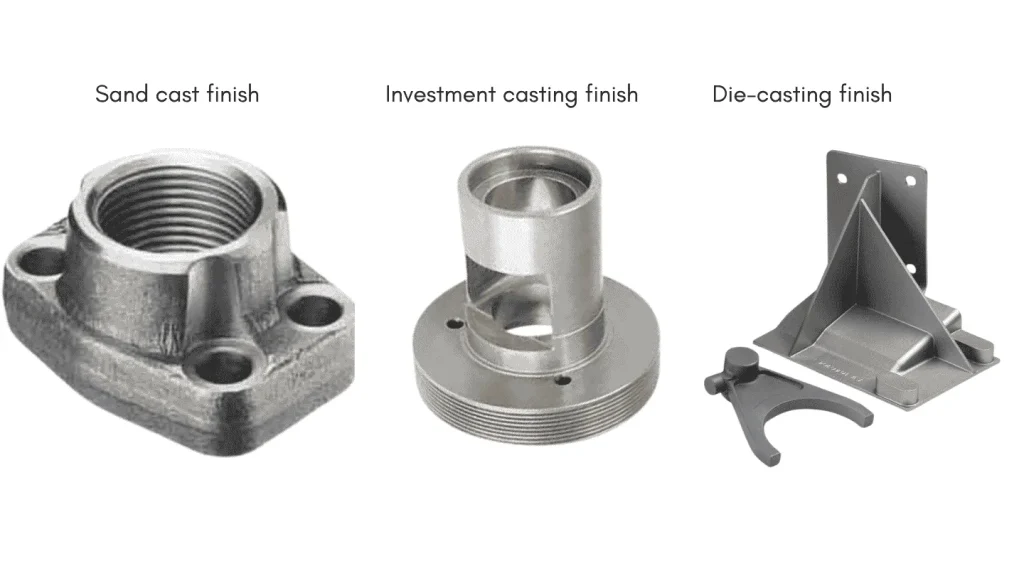
Surface finish comparison
Sand casting provides loose tolerances, but as-cast tolerances can be improved with post-machining operations. ISO 8062-3 defines the post- machining allowances on casting parts. On the other hand, die and investment casting provide much tighter as-cast tolerances.
Let’s look at the table below, comparing the typical linear tolerance according to ISO 8062 CT grades (CT1 to CT14).
| Casting Method | Linear Tolerance (% of nominal Dimension) |
| Die Casting | ±0.05% to 0.30% |
| Investment Casting | ±0.20% to 0.50% |
| Sand Casting | ±0.50% to 1.50% |
Sand Casting Produces a Rougher Surface
Die casting and investment casting produce smoother surface finishes than sand cast parts. It is mainly due to the surface texture of the cavity wall. Pouring pressure, metal/alloy type, cycle time, and process control also influence the surface finish quality.
The precision-machined die-cavity walls provide a smooth exterior to the part. The dewaxing process also leaves an ultra-smooth internal ceramic cavity in the investment mold. But the molten metal captures the sand mold’s coarser-grain details during solidification, producing a rougher surface.
| Casting Process | Typical Ra Range | Surface Texture |
| Sand Casting | 6.3 to 25 μm | Rough and grainy texture. Parts need machining, grinding, beadblasting, or other post-processing. |
| Die Casting | 0.5 – 3.2 μm | Smooth surface, often needs no machining. |
| Investment Casting | 1.6 – 6.3 μm | Near-net-shape/smooth |
Sand Casting vs Die Casting Vs Investment Casting: Wall Thickness & Part Weight
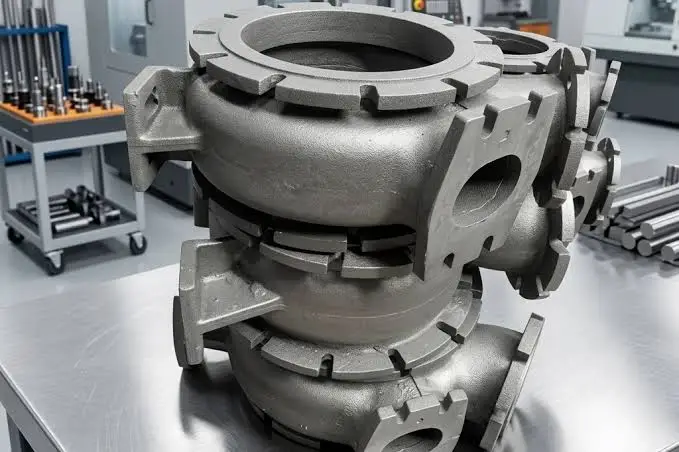
Sand casting part
A common industry practice for the minimum wall thickness of a die-cast part is 1–3 mm. With high-pressure die casting, a thickness of as low as 0.5 mm is achievable. The ceramic-shell mold can also cast thin parts with a minimum thickness of 1.5 – 3 mm, but the wall thickness must be at least 3-6 mm for sand casting parts.
Die casting cannot produce heavy parts (above 50 kg) because injecting a large volume is difficult to control and affects cooling uniformity. Consequently, it increases the velocity inside the die and surface imperfections as well. Most of the time, the die-cast part weight is below 10 kg.
Sand casting can produce large structures weighing several tons because mold size is limited only by the mold box size, pattern size, and the clamping capability of the mechanical presses used.
Investment casting can cast heavier parts than die casting, but not as heavy as with sand molds. The size and weight are limited because dipping a large wax tree in the liquid ceramic to form a stable shell is challenging.
Sand vs Die Vs Investment Casting Process: Material Compatibility
| Metal/Alloy | Common Grades | Sand casting | Die casting | Investment casting |
| Aluminum alloys | A356, A357, 319, 355, A380, A360, A413 | ✓ | ✓ (A380, A360 and A413) | ✓ |
| Zinc | Zamak (2, 3, 5) and ZA (8, 12, 27) | ✓ | ✓ | ✓ |
| Magnesium alloys | AZ91D, AM50A, AM60B, WE43 | ✓ | ✓ | ✓ |
| Alloy steels | AISI 4140, 4340, 8620, 8630, 4130 | ✓ | — | ✓ |
| Carbon steels | AISI 1020, 1030, 1045, 1060; ASTM A216 WCB | ✓ | — | ✓ |
| Stainless steels | 304/CF8, 316/CF8M, 304L/CF3, 316L/CF3M, 17-4 PH | ✓ | — | ✓ |
| Nickel alloys | Alloy 625, 718, 825; ASTM A494 grades such as CW-6MC, CY40 | ✓ Used in a few cases | — | ✓ |
| Titanium alloys | CP Ti, Ti-6Al-4V, Ti-6Al-7Nb | Compatible but rarely used | — | ✓ |
Unlike sand and investment casting, die casting is often limited to non-ferrous metals & alloys. The high melting point of ferrous metals ( typically above 1,150° C ) causes warping or softening, high thermal stress, and rapid tool wear, making die casting unsuitable.
The ceramic mold withstands high temperatures (1,540°C), so investment casting can process iron, steel, stainless steel, nickel, superalloys, and non-ferrous materials.
Volume Is the Tiebreaker: The Break-Even Thresholds
We have discussed how the upfront tooling costs and reusability differ among die casting, sand casting, and investment casting processes, and that production volume determines their cost competitiveness. Now let’s take a real-world example to evaluate the break-even thresholds.
Example of Part and Economic Model
Aluminum electronic housing (200 x 140 x 60 mm)
Nominal wall thickness: 3 mm
Part weight = 0.72 kg
Material: A356 for sand and investment castings, A380 for High Pressure Die Casting (HPDC)
| Cost factors | Sand (A356) | Investment (A356) | HPDC (A380) | Basis | |
| Upfront mold tooling | $4,000 | $12,000 | $50,000 | ||
| Variable cost | Equipment cost per cycle | $1.25 | $2.0 | $1.00 | $30/h on avg |
| Wax or sand cost | $0.25 | $1 | not applicable | ||
| Labor cost per cycle | $2.00 | $2.33 | $0.42 | $19/hr avg. | |
| Material cost ( scrap & process loss included) | $3.27 | $3.17 | $2.92 | Considering the respective alloy type and loss | |
| Post-machining Cost | $5.75 | $2.25 | $2.70 | ||
| Variable cost | $12.52 | $10.75 | $7.04 |
Considering the fixed tooling costs and their variable costs, let’s calculate how much each part costs with sand, die, and investment casting processes. The costs are assumed for the breakeven illustrations and differ from one project to another.
| Production volume | Per part cost (Sand) | Investment | HPDC | Economical |
| 100 | $52.52 | $130.75 | $507.04 | Sand |
| 1,000 | $16.52 | $22.75 | $57.04 | Sand |
| 2,500 | $14.12 | $15.55 | $27.04 | Sand |
| 5,000 | $13.32 | $13.15 | $17.04 | Investment |
| 7,500 | $13.05 | $12.35 | $13.71 | Investment |
| 10,000 | $12.92 | $11.95 | $12.04 | Investment |
| 12,500 | $12.84 | $11.71 | $11.04 | HPDC |
| 15,000 | $12.79 | $11.55 | $10.37 | HPDC |
| 17,500 | $12.75 | $11.44 | $9.90 | HPDC |
| 20,000 | $12.72 | $11.35 | $9.54 | HPDC |
| 22,500 | $12.70 | $11.28 | $9.26 | HPDC |
| 25,000 | $12.68 | $11.23 | $9.04 | HPDC |
| 27,500 | $12.67 | $11.19 | $8.86 | HPDC |
| 30,000 | $12.65 | $11.15 | $8.71 | HPDC |
| 32,500 | $12.64 | $11.12 | $8.58 | HPDC |
| 35,000 | $12.63 | $11.09 | $8.47 | HPDC |
Under 5k
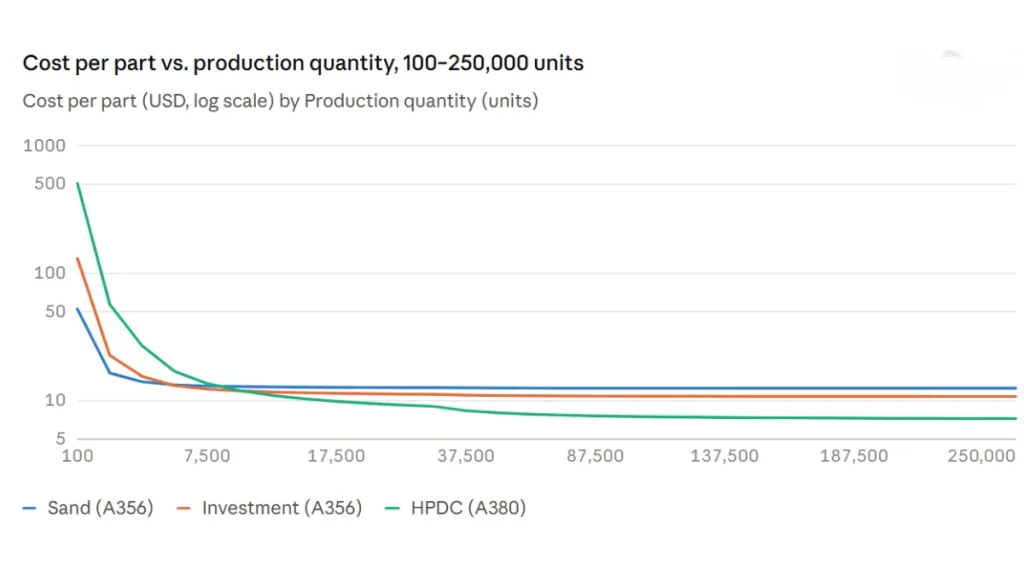
Per part casting cost vs production volume
At this production volume range, sand casting is the most economical, and the breakeven point is 4520 units at a per-part cost of $13.41. Above 4520 units, both die and investment castings are more cost-effective. In terms of CapEX for tooling, the 0-5K range is considered a break-even point for sand casting.
5k to 25K
At the 5k to 25K zone, investment casting is most economical until about 10,000 parts. At that point, per-part casting cost is only $11.95 compared to $12.04 of die casting. This is mainly due to the cost of wax and the ceramic shell, and other variable cost factors that are cheaper for die casting. But the investment casting process can be optimized for over 16,000 units.
Above 25K
In this region of production volume, the high CapEX on die tooling reduces the per-part cost significantly. The breakeven is about 10,240 parts in the previous zone.
Don’t Forget the Machining After the Pour
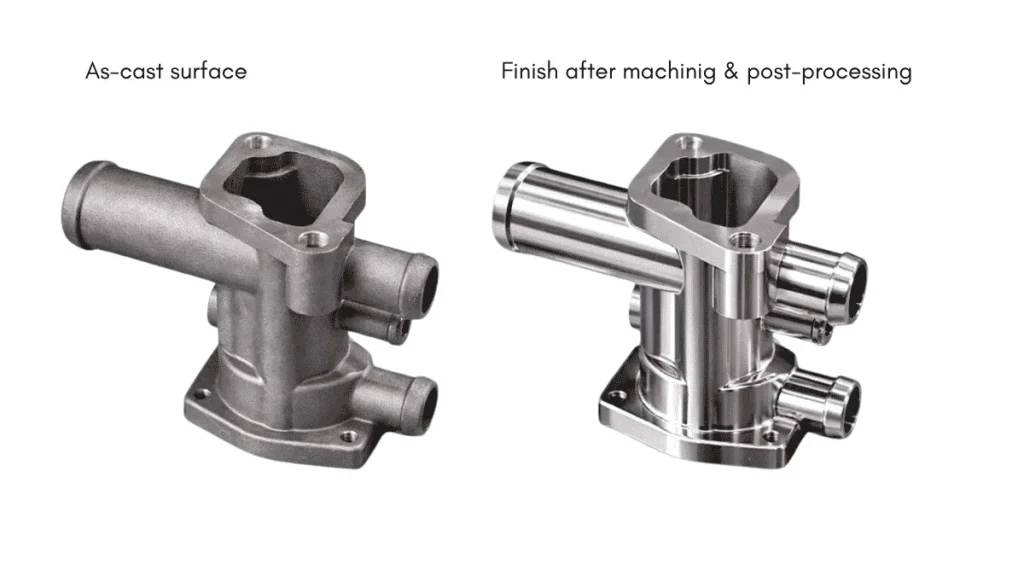
As-cast vs post-machining finish
Sand-cast parts require more post-machining operations to correct dimensional variation and improve finish quality. After detaching the sprue, parts typically undergo milling, grinding, boring, and other processes based on their features. On the other hand, investment-cast and die-cast parts undergo media blasting, reaming, grinding, etc.
Producing Net-shape Parts vs Cast Then Machine Approach
You cannot neglect machining and post-processing costs when comparing tooling costs across casting processes. It evaluates does low cost in tooling justify the post-machining expenses?
Choose a strategy of casting first and refining later with machining processes (milling, drilling, grinding, turning, etc.) if it is more economical than producing parts with near-net-shape casting.
Here is a comparison table showing the differences in the economics of net-shape casting and cast-then-machine strategies.
| Factor | Net-shape casting | Cast-then-machine |
| Initial tooling cost | High | Low |
| Process control | High | Low |
| Machining Cost | Low ( often surface refinement only) | Higher requirements |
| Material wastage | Low | High |
| Production Speed | Low | High |
| Achieved largely during casting | Achieved primarily by machining | |
| Low-volume economics | High volumes | Small batches to medium volumes |
You can calculate the breakeven volume with the given formula:
Breakeven quantity (QBV) = Additional cost on tooling ÷ Cost saved on after-cast machining
Where does an As-cast Tolerance Stop Being Enough?
As-cast tolerances stop being enough when parts have tight dimensional and geometric tolerances, such as in a range of ±0.0051 to 0.0254 mm. The casting tolerances can be insufficient for precision bearing journals, interlock interfaces, sealing surfaces, O-ring seats, and complex internal cavities.
Choosing between Sand vs Die vs Investment Casting Process: Factors and Selection Flow Chart
There are several factors deciding which casting process is the best fit for your parts, including metal/alloy type, part complexity, production volume, and desired tolerances & finish.
Consider the Raw Material Type
Die-casting is not compatible with ferrous materials, but the other two methods can cast them as well.
Part Complexity and Size
Consider the minimal wall thickness of the part, part size, and geometrical complexity of the design. For instance, complex internal features are difficult with the investment casting process. Additionally, sand molds possess the higher risk of porosity in casting .
Production Volume
Consider the production volume and which can offer the best economic value. The economic batch size is small for sand casting, whereas die casting is compettitve for large volumes.
Desired Precision & Finish
When your part’s tolerances are looser than ±0.75 mm, sand casting can provide that with little machining; otherwise, you need extensive machining and surface refinement operations. Next, you need to choose investment or die casting for parts requiring a smoother finish than 3.2 μ m.
Next, look at the flow chart for the die casting process selection
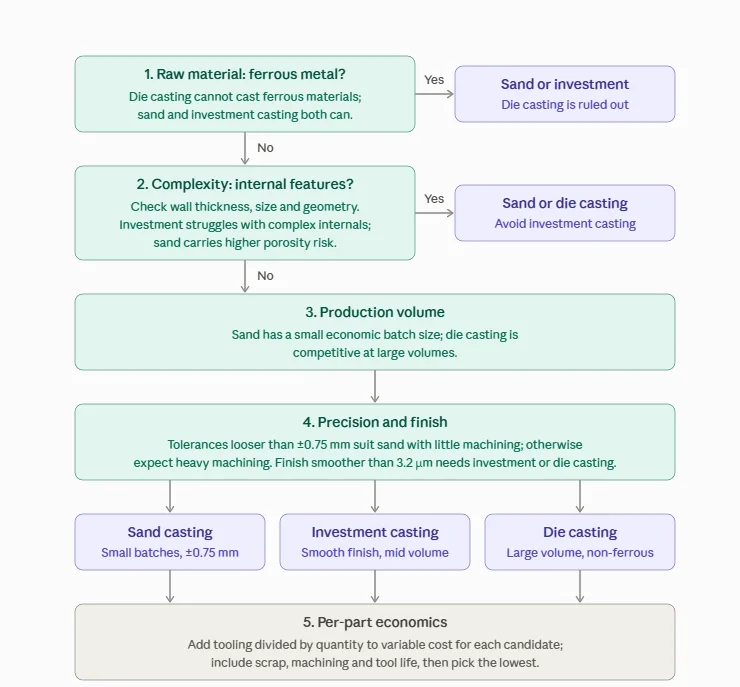
Flow chart for die casting process selection
How to Choose a Die-casting Supplier?
Start with the process capability and engineering expertise of the manufacturer/supplier. For instance, mold-making capability, die-casting equipment & automation, factory size, quality control facility, and experience in the relevant field. Once you confirm the capabilities, check whether the manufacturer provides the inspection and quality certifications you need.
Next, analyze the price differences among multiple die casting suppliers for the same offerings. You can ask for quotes from the top die casting companies and compare them to find the best deal. But, ensure you are not trading quality and intended functionalities of casting parts for lower prices.
Can I Make Plastic Parts with Die Casting?
No, you can not use the die casting process to make plastic parts; it is exclusively for non-ferrous metals & alloys. Higher viscosity, lower melting points, and different shrinkage rates from metals are the key reasons why plastic die casting isn’t a good idea.
Instead of die-casting, you can choose injection molding, vacuum casting, or these processes designed for plastic material. Injection molding uses a permanent injection mold like die-cast tooling, and is suitable for high-volume production. Vacuum casting is economical for prototypes and low volumes. If you are interested in plastic parts, read the article on vacuum casting services in China.
Do you Need Precise and Repetable Die-casting Parts? Contact ProleanTech One-stop Solutions
Once you decide which casting process is the best fit for your project, technically & economically, choosing a supplier is another immediate challenge. The production capabilities and engineering expertise of the manufacturer must be able to meet your requirements.
At ProleanTech, we have magnesium, zinc, and aluminum die-casting facilities to produce custom parts based on your engineering design. Our one-stop solution approach provides die tooling, die-cast production, post-cast machining, and surface treatment solutions. We have precision CNC machines and EDM equipment to make the dies.
- Detailed design review before tooling
- In-house facility for die machining and heat treatment
- Casting and Machining combination
- 10 + surface finishing options, including beadblasting, powder coating, and anodizing.
- Quote within 24 hours with DFM feedback
Our precise yet cost-effective die casting services provide die tooling and full-scale production of automotive, aerospace, medical, electronics, and industrial machinery components. You can upload your design and mention production volume to get an engineer-reviewed quote.
FAQ
Which casting process is most accurate?
Die casting is an accurate and repeatable casting process for non-ferrous alloys, but investment casting wins for complex parts and difficult alloys. Investment casting offers tolerances of ±0.1 to 0.5% to nominal dimensions, whereas tolerances can be as low as ±0.05% of nominal dimensions for parts made with the HPDC process.
My volume will grow later — where do I start?
If you are in the early phase of product development or producing a limited number of batches, start with sand casting (followed by machining). Once volume grows, you can move to investment casting or die casting with engineering refinement in your product.
Why can’t steel be die cast?
Most of the steel alloys melt at 1,370°C to 1,530°C, and a die-cast mold can not withstand this much thermal stress for repeated cycles, and tool life is compromised significantly. The mold material starts to soften and causes dimensional instability. Additionally, injecting high-temperature molten liquid into the die is also challenging.