
 Plasma cutting metal
Generally, there are two types of metal cutting processes, mechanical cutting and thermal cutting. Plasma cutting is a thermal cutting process. It converts gas into plasma by using an electric arc to melt out the metal and remove it from the cut.
Plasma cutting metal is primarily used for cutting steel, stainless steel, aluminum, and other conductive metals. It can cut sheet metal and thicker plate materials, which are used for CNC cutting, sheet metal fabrication, repair, and other operations.
Here, in this article, we’ll take a look at the operation of plasma cutting, the various types, which materials it can cut, the pros and cons of plasma cutting, and the other cutting techniques that may be used for various jobs.
What Is Plasma?
Plasma is an ionized gas (also known as a fourth state of matter), where some electrons have been removed from the atoms. This results in a gas that has electrically charged particles and can conduct electricity and respond to electromagnetic fields.
It can be produced when the gas is energized by heating or by an electrical spark. Plasma is found in nature, for example, in lightning and stars. This also applies to some equipment, such as plasma torches and various cutting systems.
The property that is important in plasma cutting is that it can be made to carry an electrical current and attain a very high energy level. This activated gas is used in the cutting system to transfer heat to the workpiece.
What Is Metal Plasma Cutting?
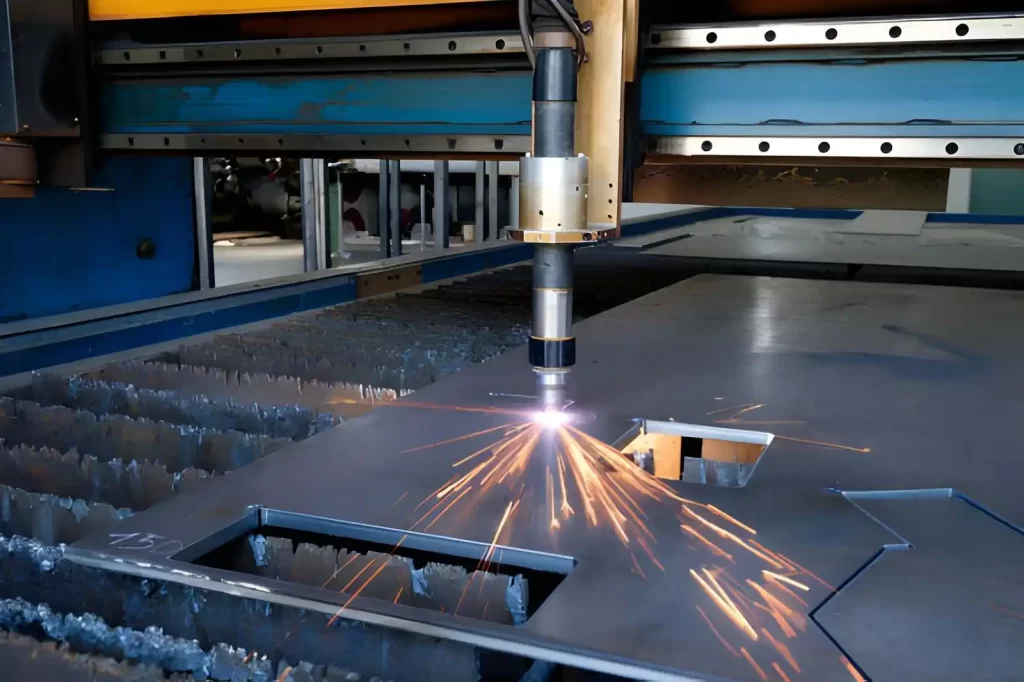
Metal sheet plasma cutting
Plasma cutting is a method of cutting electrically conductive metal by means of an electric arc and a high-velocity gas stream. The arc melts the part being cut, and the arc of gas blasts the molten metal away from the cut.
Many early plasma systems had relatively simple torch designs and were primarily regarded for the ability to cut various types of metal more quickly than thermally cutting systems. Later, torch designs were developed that gave higher cutting speeds and better control. Eventually, computer-controlled systems were developed to enable the torch motion and cutting parameters to be controlled more precisely.
Plasma cutting machines are used in various industries for cutting sheets, plates, and fabricated metal parts. The actual cutting result will be affected by cutting parameters for the job, material type, and thickness, gas supply, torch, and consumables used.
Plasma Cutting Basics: What You Need Before Cutting
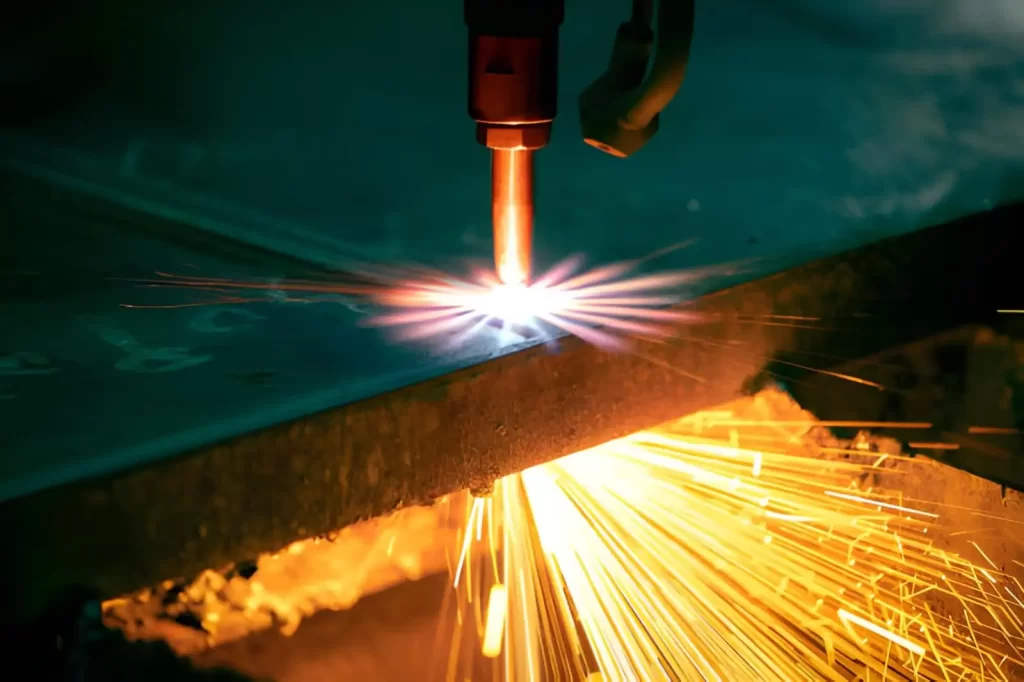
Metal plate plasma cutting
Before using a plasma cutter, inspect the cutting system, compressed air, electrical supply, consumables, and PPE. The following requirements relate to the ability to start up properly and to get a good cut.
1. Choose a Plasma Cutting System
There are various models of handheld plasma cutters with varying amperage and input-voltage options. Smaller systems are typically available in the 20 to 50 A rating, some of which operate on a 110-120 V input and others on a 220-240 V input.
When choosing a machine, make sure to verify the maximum cutting capacity, input voltage, duty cycle, and power supply capabilities. The cutting capacity published should be the thickness of material that you intend to cut, not for the amperage alone.
2. Provide Clean, Dry Compressed Air
The plasma system needs an adequate supply of compressed air. The air should be clean and dry, as oil or moisture in the torch may affect plasma operation and reduce the life of consumables. The pressure and flow of the plasma cutter may vary depending on the plasma cutter. Some systems require a minimum of 80 psi and 3.5 SCFM, and other machines can require around 115 psi and 6.7 SCFM. Thus, refer to the manufacturer’s air-pressure and flow specifications for the compressor before connecting it.
3. Check the Electrical Supply
The larger the plasma cutter, the more power it needs. Smaller, handheld units may be used on a 15 to 20 amp, 110 to 120 VAC circuit, and higher-output units on a 30 to 50 amp, 220 to 240 VAC circuit. Some machines can have more than one input voltage. With these models, look at the electrical specifications for the equipment and use the correct circuit for the desired operating condition.
4. Keep the Correct Consumables Available
The components of a plasma torch include: electrodes, nozzles, swirl rings, retaining caps, and shields, which are all replaceable. They can be damaged due to incorrect use or contact with the workpiece and wear during cutting.
Have spares on hand before work. Electrodes or nozzles that are worn may impact the plasma arc and/or cut quality; check the condition of the electrodes and nozzles frequently and change them as they wear or as recommended by the equipment manufacturer.
5. Use the Required PPE
Plasma cutting generates a very hot, intense arc, heat, sparks, and molten metal. Use appropriate Eye and Face Protection, Gloves, and clothing that covers exposed skin. According to the reference source, ANSI and AWS, the minimum shade level of 8 is needed for plasma cutting in the range of 20 to 100A. The proper shade should still be chosen based on the requirements of the safety standards and instructions for equipment use.
Use a Cutting Guide for Manual Work
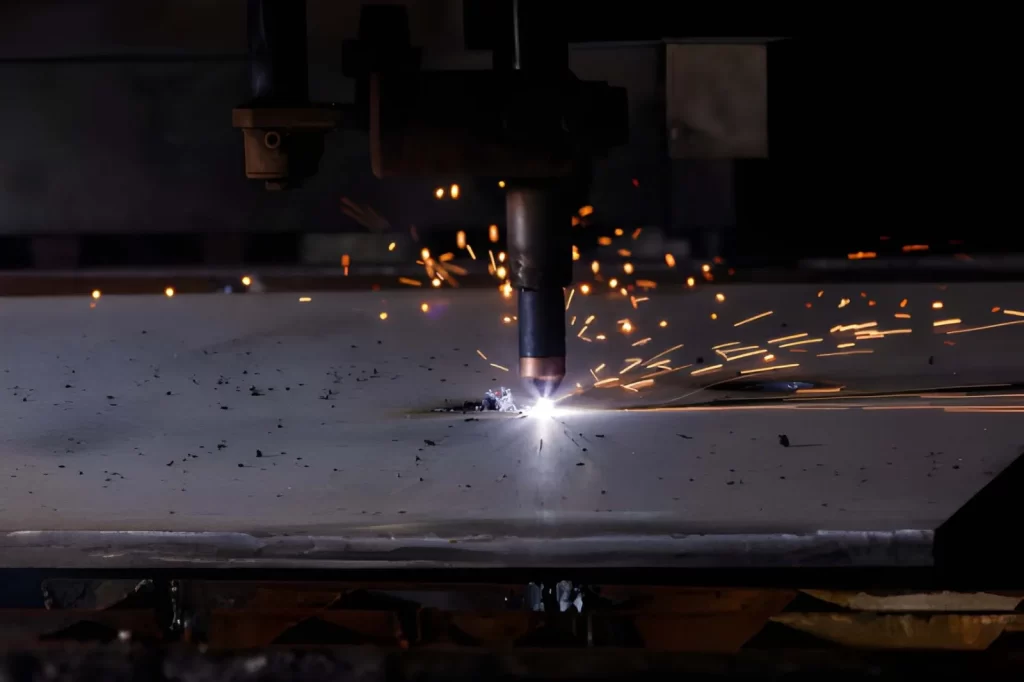
Plasma cutting thick steel sheet
Manual straight cuts may be easier if a straight edge or cutting guide is used to help maintain a consistent torch path. This is especially helpful if the torch is not equipped with a drag shield and the operator is required to keep the correct stand-off distance manually. A circular cutting guide may be useful to keep the radius and torch movement uniform for circular cuts.
Types of Plasma Cutting by Technology, Automation, and Arc Control
There are a variety of plasma cutting processes. The primary differences are the plasma system, cutting gas, torch system, and degree of control. Each setup is applicable to different materials, thicknesses, and cutting applications.
Plasma Cutting Technology Types
Conventional Plasma Cutting
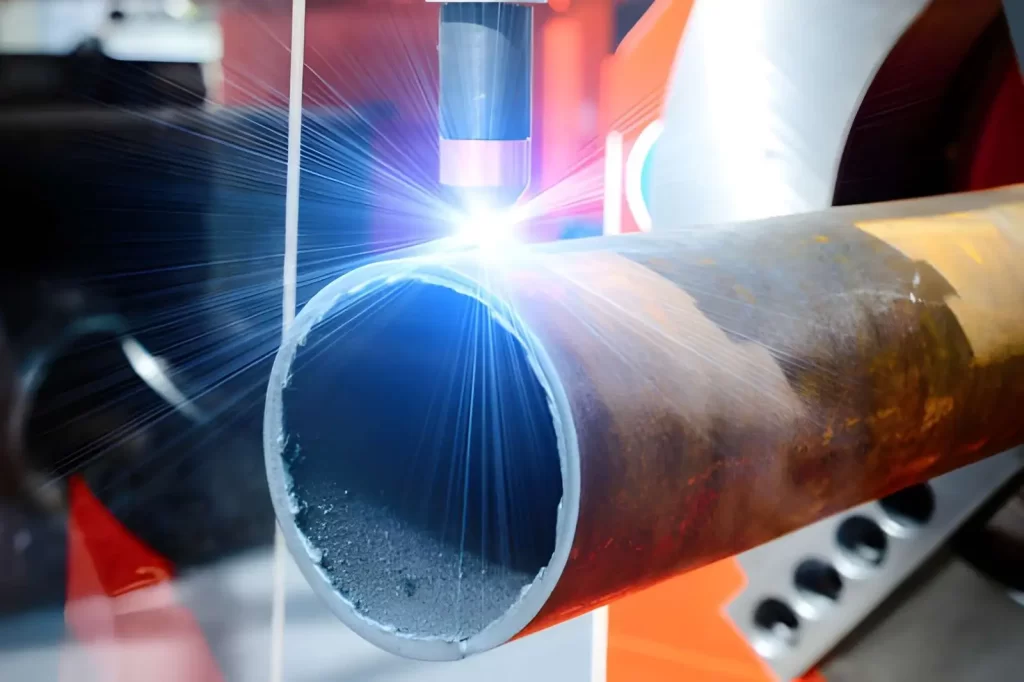
Plasma cutting steel pipe
The traditional plasma cutting method involves the melting of the metal by a plasma arc. The melted metal is then forced out of the cut by a high-velocity gas stream. It is widely used for general fabrication and repair applications. Can cut mild steel, stainless steel, and aluminum. It is suitable for simple cutting applications where a compromise between cutting speed, cutting equipment cost, and edge quality is required.
High-Definition Plasma Cutting
High-definition plasma is a more controlled arc that makes cleaner cuts. It has a torch and a set of consumables that will help to maintain the arc on a small area. This will help to ensure straighter edges and a smaller bevel on the cut. Useful when parts must be held to a closer tolerance than is possible after cutting, with less grinding required.
Water-Injection Plasma Cutting
In water-injection plasma, water is injected into the vicinity of the cutting arc. Water regulates the heat in the cutting area and can influence the shape of the plasma arc. It can result in a narrower cut and less heat dispersion into the surrounding material. For applications that require more control of heat distortion, it is useful.
Underwater Plasma Cutting
Underwater plasma cutting is a method of cutting the workpiece underwater. The water absorbs some of the heat, and the cutting noise is also reduced. The use of this method may be beneficial in production areas where fumes and noise must be better controlled. The cutting setup must, however, have equipment capable of operating underwater.
Precision Plasma Cutting
Precision plasma cutting involves the careful control of torch movement and cutting parameters. The torch is typically controlled by a computer program with the use of CNC equipment. This is a good method for parts that require uniformity in size and smooth profiles. The final cut is affected by the torch height, gas flow, cutting speed, and condition of the consumable.
Air Plasma Cutting
In compressed air systems, the plasma arc is created with compressed air. They are relatively easy to install and do not need a special source of plasma gas for simple cutting. They are commonly used for repair, fabrication, maintenance, and general metal cutting. Clean and dry compressed air is critical as moisture and contamination have an impact on torch consumables and cut quality.
Dual-Gas Plasma Cutting
Dual-gas plasma systems are used with a pair of gases for cutting. The gases may serve various purposes, such as establishing the plasma and shielding the surrounding area of the cutting zone. Gas type will impact the cut edge quality, consumable life, and cutting performance. Thus, the mix of gases must be compatible with the material and the desired cut.
Plasma Cutting Automation Method
Mechanized Plasma Cutting
Mechanized Plasma Cutting is a plasma cutting method that moves the torch over the workpiece using a machine, typically a CNC table. The operator programs the cutting and sets the necessary parameters and oversees the process. The configuration is helpful if the same part is to be made in large quantities. It also helps with making holes, slots, profiles, and other complex shapes with repetitive torch motion.
Arc-Starting and Torch-Control Technologies
Plasma cutting systems also employ various methods of starting the arc and positioning the torch. These features are not a part of the primary cutting procedures.
High-Frequency Arc Starting
In high-frequency starting, a high-voltage signal of high voltage is employed to start the plasma arc within the torch. The arc is then transferred to the workpiece, where cutting begins. The method allows the arc to start without the torch first touching the metal. Due to the potential for high-frequency systems to cause interference with adjacent electronic equipment, proper installation is very important.
Pilot Arc Starting
A pilot arc is an arc that is established prior to the main cutting arc coming into contact with the workpiece. The torch can start cutting without having to make contact with the metal. Pilot arc systems can be used for CNC machines and tasks that involve a lot of starts and stops. They can also be made to work on painted, coated, or roughened surfaces.
Spring-Loaded Torch Head
If the torch is accidentally knocked against the part to be welded, it will have some mechanical movement from the spring-loaded torch head. The full force may be absorbed by the spring mechanism, rather than being taken all. This will keep the torch and mount safe from unintended contact. It is beneficial for use in mechanized equipment where plate surfaces may not be totally level.
Try Prolean Now!
Advantages and Disadvantages of Plasma Cutting
Plasma cutting is beneficial when you want to cut conductive metal and don’t want to waste time moving to a more costly cutting process. It is particularly prevalent in mild steel, stainless steel, and aluminum. However, it is not particularly flexible with regard to the use of heat, edge finish, or very thick materials.
Advantages of Plasma Cutting
- It cuts different types of metal: Plasma can cut mild steel, stainless steel, aluminum, copper, and other conductive metals. This gives the fabrication shop greater flexibility if the material changes from one job to another.
- It handles medium-thickness plate well: If the thickness of the plate is too great for laser cutting to be a cost-effective solution, plasma may be an ideal option. The system is capable of cutting thin material to heavy plate, depending on the machine, material, and power level.
- Cutting is fast: Plasma can travel much faster than oxyfuel on medium-thickness steel. This is helpful if there are lots of profiles in a job or long cut paths.
- Stainless steel and aluminum are easier to cut: Oxyfuel is primarily used for ferrous materials. The plasma doesn’t have this limitation, and that’s why it’s a better option for stainless steel and aluminum.
- Suitable for CNC cutting: A CNC plasma table can execute a program of a drawing and cut out the same profile on many parts. This is applicable to brackets, plates, frames, etc., that are fabricated.
- Relatively narrow kerf: When compared to an average oxyfuel cut, plasma removes less material. In this way, good nesting can minimize plate waste.
- Can be used underwater: In some systems, the workpiece is submerged in water. This can help minimize noise and reduce heat dispersion from around the cutting area.
- Lower cost for some medium-thickness work: Plasma is a suitable option when you are mainly cutting medium-thickness conductive metals and want the production rate without having to invest in a high-end laser or waterjet system.
Disadvantages of Plasma Cutting
- Only works on conductive materials: Plasma can not be used on non-conductive materials such as wood, plastic, glass, etc.
- Leaves a heat-affected zone: During the plasma arc cutting process, the metal is melted, and therefore, the area next to the cut is also hot. Thin parts might bend or buckle; some parts may require additional work if they are sensitive to thermal input.
- Less precise than laser: Generally, laser cutting provides finer control of the edges for thin sheets and for parts with small holes or fine profiles.
- Cut quality drops on thin sheet: There is an optimum cutting speed for plasma cutting that depends on the size of the power source and the type of plasma torch. Oxyfuel or waterjet might be more suitable beyond that range.
- Wider kerf than laser: This is apparent for small slots, small holes, and detailed profiles where the cutting width is impacting the finished geometry.
- Possible formation of dross on the lower edge: Unqualified tooling, improper torch angle, worn tooling, or improper settings may cause material to remain on the bottom of a cut. That means grinding and cleanup activities.
- During the manufacturing process, consumables undergo wear. Nozzles and electrodes cannot be used indefinitely. They may become distorted due to wear, and the cut may deteriorate. Regular inspection is thus an integral part of normal plasma cutting work.
- When plasma is used, a heat-affected area is left behind. Unlike waterjet, water doesn’t perform the same heat-based cutting process, and therefore, is a preferable alternative in cases where there is no heat tolerance around the cut.
The decision is up to the job. Plasma is a good choice for very fast cutting of conductive medium-thickness metal. Another cutting process might be more appropriate if a part requires very fine features, tight dimensional control, or no thermal exposure.
Common Materials Cut with Plasma Cutting
Plasma cutting works on metals that can carry an electrical current. In fabrication shops, mild steel, stainless steel, and plasma cutting aluminum are the main materials you will see. Other metals, such as copper, brass, cast iron, and titanium, can also be cut, but they need more attention to power, gas, and cutting speed.
Steel Plasma Cutting
As far as cutting is concerned, steel and plasma cutting stainless steel are the easiest materials to cut. The process works well on mild steel and carbon steel and can be used to cut a wide variety of thicknesses of plate.
Plasma cutting can also be used to cut stainless steel. The only difference is the gas and parameter setup. Checking the manufacturer’s cutting chart is essential to prevent the edge from forming more bevel or dross if the torch height or cutting speed is not correct.
Plasma Cutting Aluminum
Plates, brackets, frames, and fabricated parts are common uses of plasma cutting for aluminum. It has good heat conductivity, and the cutting parameters must be matched with the thickness of the plate. Plasma can be a viable choice if a laser cannot be used for the desired thickness, for thicker aluminum. Use the prescribed gas and amperage with the plate and ensure the plate is kept clean.
Plasma Cutting Copper
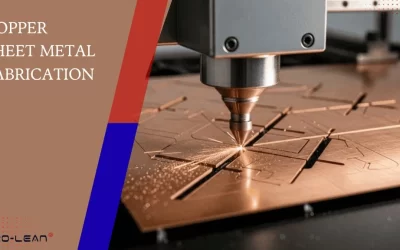
The copper is difficult to plasma cut because it has good heat and electrical conductivity. The heat can thus be removed from the cutting zone in a relatively short time. If the machine can produce the necessary thickness, it is still possible to use plasma. There is a further alternative cutting process that may provide better control for thin copper parts having small features.
Plasma Cutting Brass
The use of plasma is possible for brass, although it is highly dependent on alloy and thickness. It may require some clean-up after the cut has been made. Plasma can be used for simple profiles and thicker sections. In case of small decorations or fine details, it is better to use a laser or another precision process.
Cast Iron Plasma Cutting
For repair, modification, and dismantling work, plasma is beneficial for cutting cast iron. The surface may be contaminated with surface scale, rust, or other material that will impact the arc. Clean the cutting area, and use the proper amperage for the area being cut. The casting situation also needs to be taken into account before selecting the process.
Plasma Cutting Titanium
Titanium is a material that can be plasma cut, but a suitable machine setup and controlled cutting conditions are necessary. Material is prone to reaction with its surroundings at high temperatures. This is why it is crucial to choose the gas and torch type. For thicker parts of titanium, plasma could be used, while for high-precision parts, a different cutting process may be needed.
Try Prolean Now!
Plasma Cutting Metal: Gas Selection Criteria
The gas has a direct effect on the cut. It influences the arc, edge condition, cutting speed, and consumable life. The correct choice also depends on the plasma system and material thickness.
|
Material |
Common Gas |
Practical Use |
|
Mild steel |
Air or oxygen |
Air works well for general fabrication. Oxygen can provide faster cutting and a cleaner edge on suitable steel. |
|
Stainless steel |
Air or nitrogen |
Nitrogen is commonly used when better edge conditions and consumable life are required. |
|
Aluminum |
Air or nitrogen |
Both can be used for general cutting when the machine supports them. |
|
Stainless steel, thick plate |
Argon/hydrogen |
Used on suitable plasma systems when cutting thicker sections. |
|
Aluminum, thick plate |
Argon/hydrogen |
Can provide good results on thicker aluminum with the correct equipment. |
Alternatives to Plasma and Laser Cutting
Plasma and laser can be used for profile cutting, but they are not necessarily the most practical option. If the steel plate is thick, the hardened component, or the part that is hard and cannot withstand cutting heat, may require another process. The choice of material, part geometry, thickness, and the desired finish following cutting are typically the factors involved in the alternative.
Waterjet Cutting
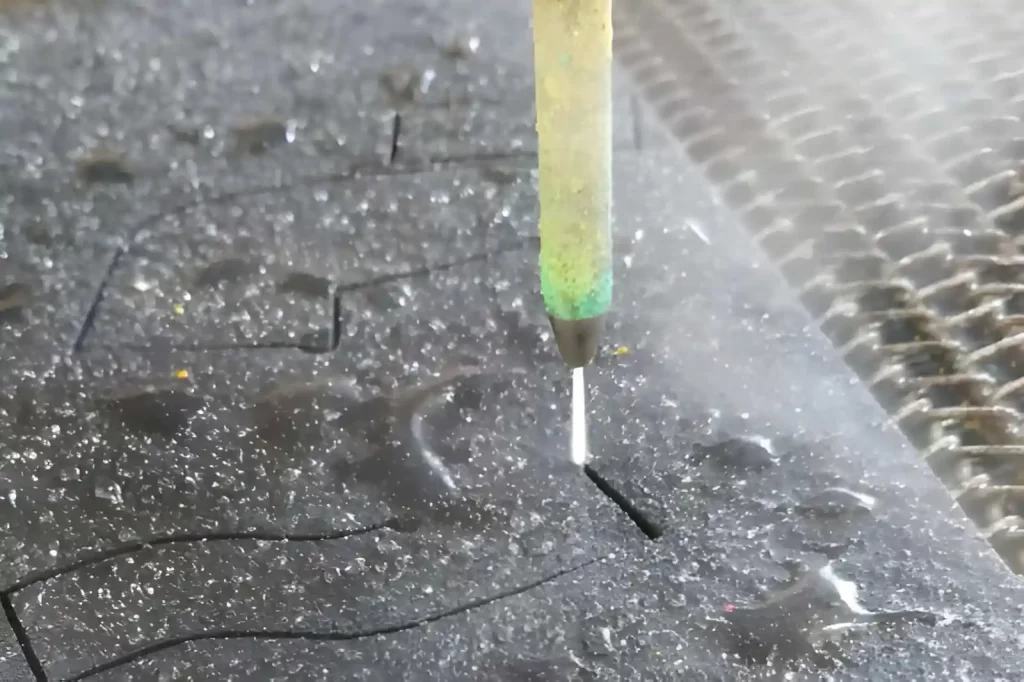
Water cutting
When plasma or laser heat would impact the part, a design that uses a waterjet may be considered. The process involves a high-pressure water stream that is complemented by adding abrasives to the water flow, when necessary, for metals and other hard materials. It can cut materials such as thick steel, aluminum, stainless steel, stone, composites, and a few other materials. There is no heat-affected zone created with the cutting operation, as there is no cutting arc.
There’s just one problem: It takes a long time to produce. For many simple steel parts, it may take a waterjet much longer than a plasma machine. Other operating costs include abrasive consumption.
Abrasive Cutting
Bars, pipes, rods, or structural sections are frequently the easy ones to cut abradatively. The material is removed along the line of cut by the rotating abrasive wheel. If the work involves an almost straight cut and the part does not require a complicated profile, it has its merits. This method can be applied to a shop to shorten material prior to machining or fabrication. Deburring or grinding might be necessary on the cut edge. It also heats the cut area, which is not suitable for all heat-sensitive components.
Electrical Discharge Machining (EDM)
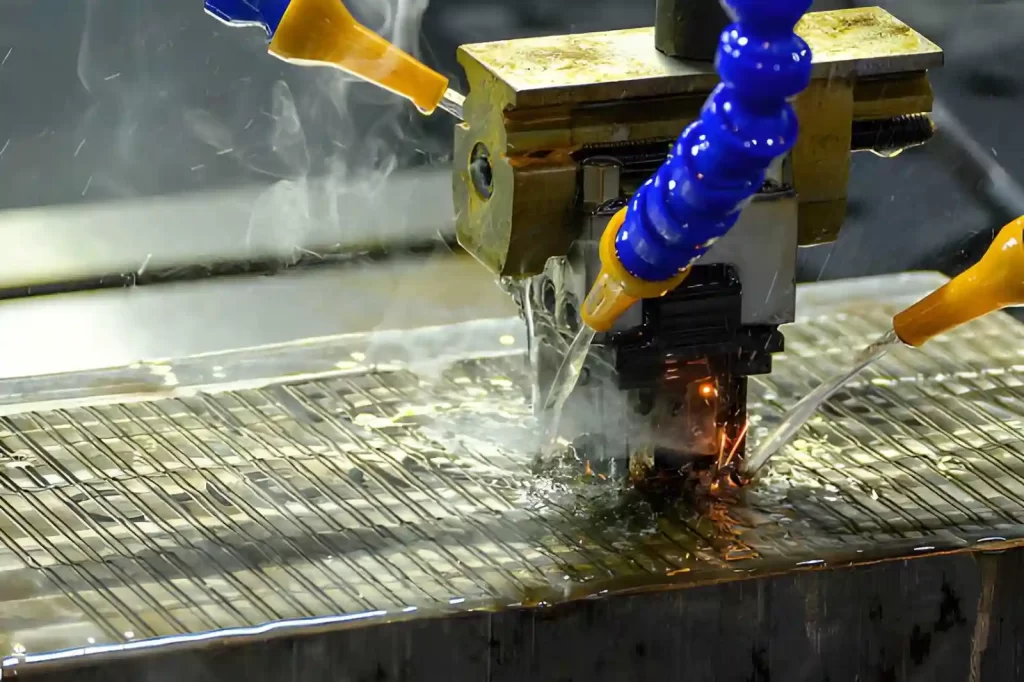
EDM machining
EDM is used for hard materials and parts with complex geometries. The process uses electrical discharges to remove conductive material, instead of a physical cutting edge. Wire EDM is suited for narrow slots and complex shapes in hard materials and for accurate profiles. It is quite common in tool and die work where a normal milling cutter may need to perform a task that it is not designed to take on. EDM is not typically preferred for fast cutting of large plates. The strength is its ability to control the removal of material on a hard or complicated part.
Oxy-Fuel Cutting
Oxy-fuel is still applicable for heavy carbon steel plates. It is a process in which the steel is heated with a fuel gas and oxygen and then cut. It may be more practical than a plasma system for very thick steel when the plasma system does not provide the required cutting capability. Also suitable for structural steel, scrap processing, and site cutting, where portability is required.
The process is primarily applicable to materials that can supply the desired oxidation reaction, such as ferrous materials. Further, cut edges are not as accurate as those made by the laser, which may require additional machining if the required dimensions are critical.
CNC Milling
Unlike plasma and laser cutting, CNC milling involves the removal of material from the material with a cutting tool and not through melting. This is beneficial when the part requires more than just a profile to be milled. Pockets, slots, steps, holes, and machined surfaces may all be found on a milled component in the same setup. Therefore, it is a better option if the cut edge itself is to be a finished machined edge. However, for large plates or simple profiles, milling can be a time-consuming and tool-consuming process. Then, plasma or laser can be used to remove the bulk material, and only milling is required to obtain closer dimensions.
Prolean TECH Helps You Choose the Right Cutting Method: Come and Let’s Connect
At Prolean Tech, we understand that the cutting process should match the part, material, thickness, and required finish. Plasma cutting service may be the right option for one component, while laser, waterjet, CNC machining, or another process may be more suitable for another.
If you provide us with your drawing and material specification, we can take a look at the part geometry and production requirements before deciding on the approach to cutting the part. This prevents using a process that generates an unneeded finishing operation or that doesn’t produce the desired size.
You can also talk to our engineers about material grade, plate thickness, tolerances, edge requirements, and quantities of parts. If you are unsure which cutting process fits your component, Prolean TECH can help you compare the available options before production starts.
Frequently Asked Questions
How thick can a plasma cutter cut?
The maximum thickness is related to the amperage of the machine, torch, consumables, material, and the type of cut being performed. The Severance capacity of a machine can be greater than the clean production cut capacity. When using the machine for engineering use, use the maximum thickness as rated by the manufacturer, not the thickest it can push through.
Why does plasma cutting leave dross?
Typically, dross is associated with cutting speed, torch height, amperage, gas conditions, and/or worn consumables. The slower the cutting speed, the more dross will form on the bottom edge and vice versa. Always review the machine’s cut chart and make one cut change at a time.
Can plasma cut stainless steel and aluminum?
Yes, plasma can be used for cutting stainless steel and aluminum, which are both electrical conductors. But for the material and thickness, the settings and gas would need to be adjusted. The same conditions associated with poor edge quality and excess dross with mild steel can also occur with stainless steel.
What gas is used for plasma cutting?
Depending on the material and the cutting system, air, oxygen, nitrogen, and argon-hydrogen mixtures are used. A common plasma cutting gas is air; oxygen is frequently used for mild steel, and nitrogen or argon-hydrogen is used for certain stainless steel and aluminum applications. For plasma production work, the gas and parameter chart provided by the plasma manufacturer should be taken as the basis.

0 Comments