
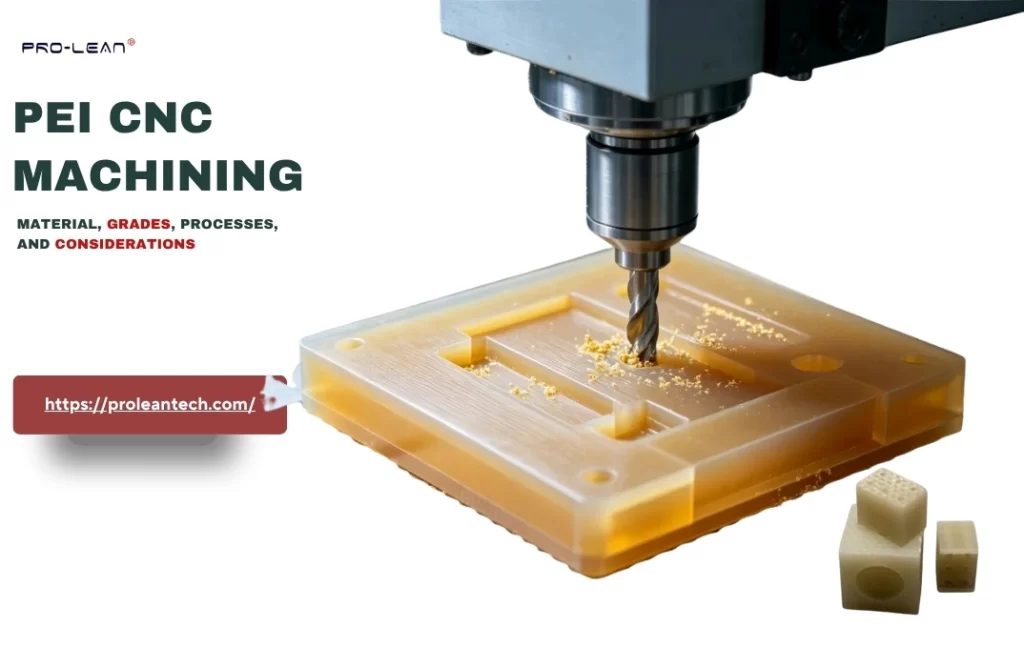
PEI CNC machining
PEI CNC machining converts raw PEI rod, bar, or plate into functional components using cutting, milling, turning, drilling, and other suitable operations using the CAD model & CNC program. Machining PEI uses sharp carbide tooling and speed/feed based on the type of operation.
The PEI CNC machining components deliver thermal resistance, electrical insulation, chemical stability, high mechanical strength, rigidity, and dimensional stability. However, it is not always preferred in machining due to high material cost, brittleness, and machining difficulty.
PEI 1000 is the unfilled material used in general-purpose CNC machining. But, there are specific grades of PEI dedicated to particular machining applications, such as PEI GF20, PEI GF30 / ULTEM 2300, and medical-grade PEI.
Key Takeaways
➤ Different PEI grades are available for machining: PEI 1000, PEI 1010, PEI GF 20, PEI GF 30, and ULTEM 4000.
➤ PEI 1000/1010 is used for general machining; Glass-filled grades are used for parts requiring stiffness and dimensional stability; and ULTEM 4000 is used for low-friction parts.
➤ PEI is more brittle than regular thermoplastics, so heat dissipation, edge chipping, stress cracking, and heat buildup are the challenges.
➤ To avoid PEI machining failures, use sharp carbide tooling, optimal feed & speed, and ensure proper coolant flow.
➤ If you are looking to procure custom PEI-machined parts, specify polymer grade, reinforcement level, color, and applicable certifications (UL94, FAR 25.853, ISO 10993, FDA food-contact).
What is PEI Plastic Material?
PEI is among the super-engineering plastic materials, valued in manufacturing for its excellent mechanical, thermal, and electrical properties. It is also known as Ultem, a dominant commercial brand of PEI polymer produced by sabic®. Both transparent and opaque forms of Ultem are available for CNC machining. Other commercial PEIs are TECAPEI™, SUSTAPEI™, and TEMPALUX®.
Chemical Structure of PEI Plastic:
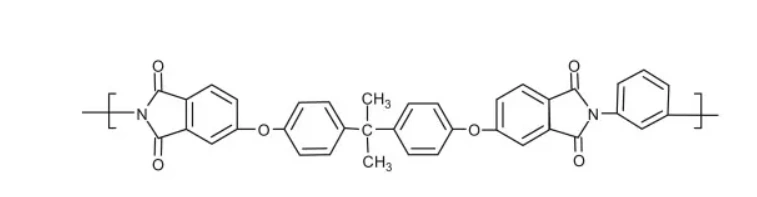
Polyetherimide(PEI) structure
The chemical structure of PEI contains three major components: Imide groups (>𝐶=𝑂), ether linkage, and aromatic rings. The alternating aromatic rings are linked with an ether and a cyclic amide group. Meanwhile, the general chemical formula for repeating chains is C₃₇ H₂₄ O₆ N₂.
What Are the Properties of PEI Plastics?
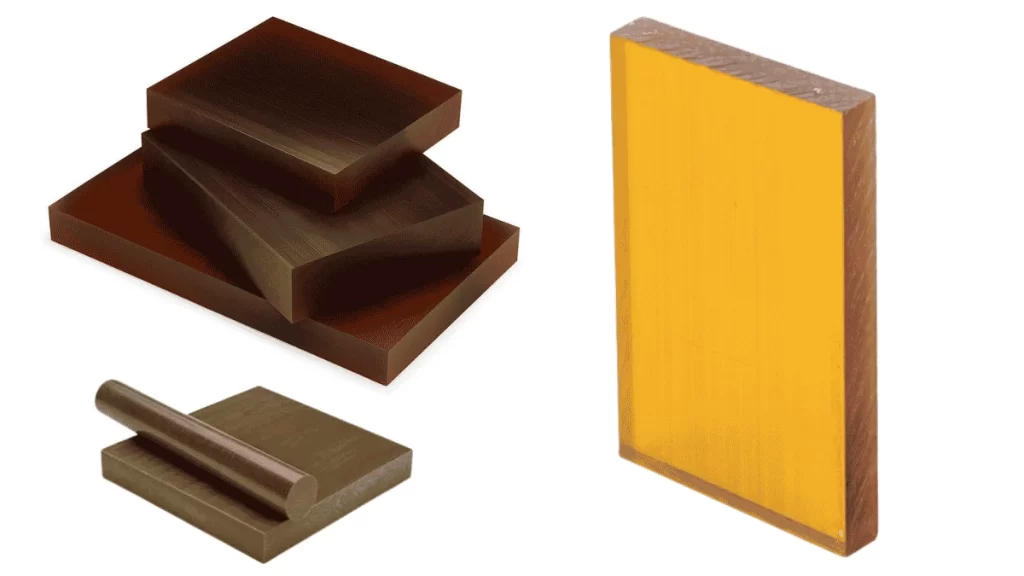
PEI plastic materials
Excellent mechanical strength, rigidity, chemical stability, thermal resistance, superior dielectric strength, stress- cracking resistance, flame retardancy, and dimensional stability are the main properties of PEI plastics. That’s why they are considered part of the family of superior engineering thermoplastics and are used in harsh conditions.
Let’s break down the PEI plastic Properties.
Mechanical Strenght
PEI is a high-strength plastic that offers excellent flexural and impact resistance properties. According to ASTM D 638, unfilled PEI has a tensile strength of 120 MPa (17,500 PSI).
Hardness
PEI is a strong and hard plastic. It resists wear, abrasion, and scratches.
Lightweight
Due to PEI’s high strength and lightweight, CNC manufacturers often use it as a metal replacement. However, unfilled grades still offer a lower strength-to-weight ratio than aluminum alloys.
Heat Resistance
PEI has a glass-transition temperature of 217°C, and CNC-machined PEI components can withstand cyclic thermal loads up to 200°C. It retains the properties and dimensions even when the parts are exposed to elevated temperatures for a long time.
Electrical Insulation
PEI has high dielectric strength ( 33 KV/mm). It can withstand high-voltage electric shocks and is a good material choice for insulation requirements.
Flame Resistance
It inherently exhibits flame-retardant properties and generates minimal fumes, with minimal smoke or gases.
Chemical Stability
PEI plastics exhibit high resistance to acids, alkalies, oils, and certain organic solvents.
Dimensional Stability
The PEI plastic parts maintain their geometry, dimensions, and features over time, even under heat and stress.
Formability/Processability
Raw PEI plastic materials can be shaped into functional parts with CNC machining, extrusion, injection molding, blow molding, and thermoforming.
PEI Plastic Property Table
Let’s look at the numerical values of different PEI plastic properties (unfilled) in the table below [1][2][3].
|
Property |
Unit |
~Value |
Test method / Condition |
|
Glass transition temperature* |
°C |
220 |
ISO 3156 |
|
Density |
g/cm³ |
1.27–1.28 |
ISO 1183 / ASTM D792 |
|
Tensile strength |
MPa |
114–121 MPa |
ISO 527 / ASTM D638 |
|
Compressive strength |
MPa |
152 MPa |
ASTM D695; 10% strain |
|
Flexural strength |
MPa |
138 MPa |
ASTM D790 |
|
Rockwell hardness |
Rockwell |
M112 / R125 |
ASTM D785 |
|
Elongation at break |
% |
40–80 |
ISO 527 / ASTM D638 |
|
Coefficient of thermal expansion (CTE) |
µm/m·°C |
56 × 10⁻⁶ /°C |
ASTM D696 / ISO 11359 |
|
Dielectric strength |
kV/mm |
33 |
ASTM D149; short time, 1/8-in thickness |
|
Dielectric constant |
— |
3.15 |
ASTM D150 at 1 kHz* |
PEI Material Grades Used in CNC Machining
PEI 1000, PEI 1010, PEI GF 20, PEI GF 30, and UlTEM 4000 are the main PEI grades used in CNC machining. Some of these are composite-filled grades and provide enhanced properties compared to unfilled grades.
PEI 1000 (ULTEM 1000)
It is an unfilled PEI polymer used for general precision machining, electrical insulation, and high-temperature parts. Relatively, PEI 1000 grades have lower abrasiveness and can be machined with HSS/carbide tooling.
Application Examples: Medium-load & interior auto parts, medical sterilizable trays, RF/microwave circuit insulators, and food processing components.
PEI 1010 (ULTEM 1010)
It is also an unfilled PEI grade, which makes it different from PEI 1000 is that PEI 1010 is formulated for higher melt flow. So, it is more suitable for molding thin-wall components. Otherwise, mechanical, electrical, and thermal properties are essentially the same.
Application Examples: The machining applications are similar to PEI 1000.
PEI GF 20 (ULTEM 2200)
PEI 20% glass-filled (ULTEM 2200 series) grades increase the material stiffness, dimensional stability, and flexural modulus. It also resists wrapping. But you need diamond-coated tools with lower cutting speeds to machine glass-filled grades.
Application Examples: Lightweight brackets, industrial positioning blocks, and instrument housings.
PEI GF 30 ( ULTEM 2300)
30% glass-filled PEI plastics further improve the rigidity, dimensional stability, and chemical inertness, while lowering the elongation at break. It is chosen for structural components in aerospace, semiconductor handling, and industrial manufacturing. Machining PEI GF 30 is more challenging, and rapid tool wear is the main trade-off.
Application Examples: Aircraft brackets & fixtures, electrical insulators, automotive assembly fixtures, wafer chucks for semiconductor processing equipment, and mechanical tooling plates.
ULTEM 4000
ULTEM 4000 is composed of Glass fiber, PTFE, and graphite-filled PEI. It is engineered for wear-resistant and low-friction applications. Although being relatively costlier than other grades, it offers hydrolytic stability, dimensional stability, and high strength across a wide temperature range.
Application Examples: Sliding components, robotics parts, guide rails, mechanical cams & rollers, bearings, bushings, and gears.
PEI CNC Machining Processes: Milling, Turning, Drilling, Boring, Threading
PEI materials can be processed with CNC milling, turning, drilling, boring, threading, and other machining processes, depending on the shape and features you want to create. As it is a stiff plastic, cutting speed, feed rate, and tooling must be selected based on the properties of the PEI workpiece.
PEI CNC Milling
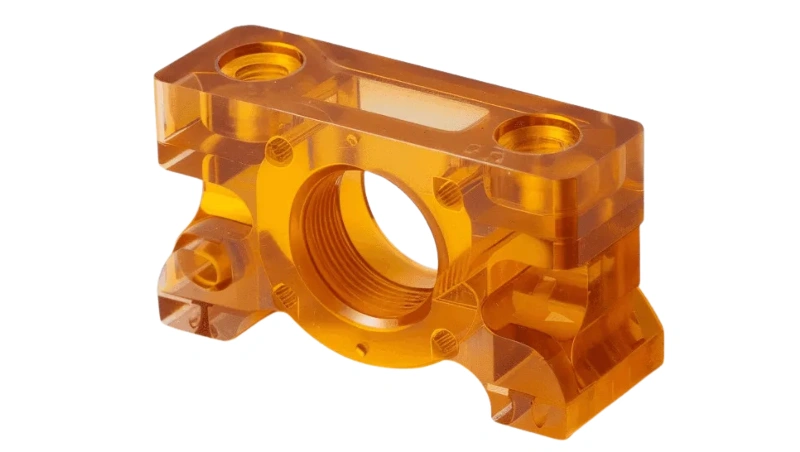
CNC-milled PEI part
Milling is used to create complex contours, profiles, slots, pockets, and other 3D features. CNC machine shops prefer climb milling for PEI workpieces.
- Tooling: Carbide or diamond-coated tooling, 2-4 flutes, and 10-20° positive rake angles.
- Speed & Feed: 0-400 m/min (~20% lower for glass-filled grades) and feed of 0.05-0.15 mm/tooth
PEI CNC Turning
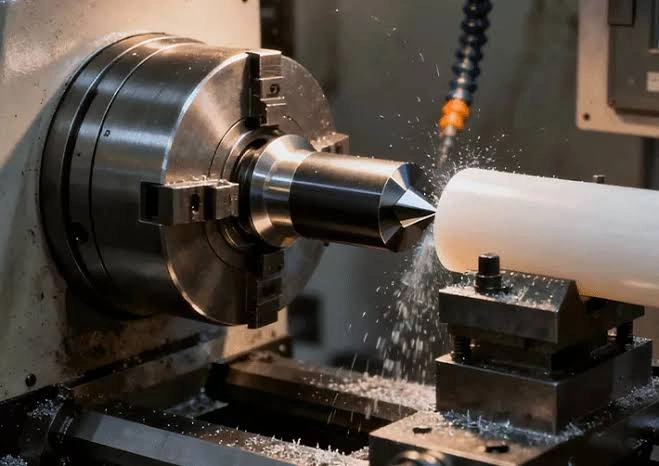
PEI CNC turning
Turning PEI materials is carried out on lathes or turning centers. It is used to shape cylindrical geometries, such as shafts, bushings, and rods.
- Tooling: Solid carbide/PCD tools with 5-10° positive rake and 8-12° relief angle
- Speed & Feed: 150-300 m/min and 0.1-0.3 mm/rev
PEI CNC Drilling
Peck drilling is recommended for creating holes in PEI materials. Without a bore sequence, drilling can make holes that are 3 times deep as the hole diameter (3 x D) using a continuous drilling approach before peck drilling.
- Tooling: Sharp cobalt/ carbide twist drills with polished flutes.
- Speed and Feed: 80-150 m/min and 0.05-0.15 mm/rev
PEI CNC Boring
Boring is used to enlarge and finish pre-drilled holes in PEI workpieces, enabling precise diameter, roundness, and finish.
- Tooling: Rigid single-point carbide boring bars
- Speed and Feed: 150-300 m/min and light feeds with slower finishing passes
PEI CNC Threading
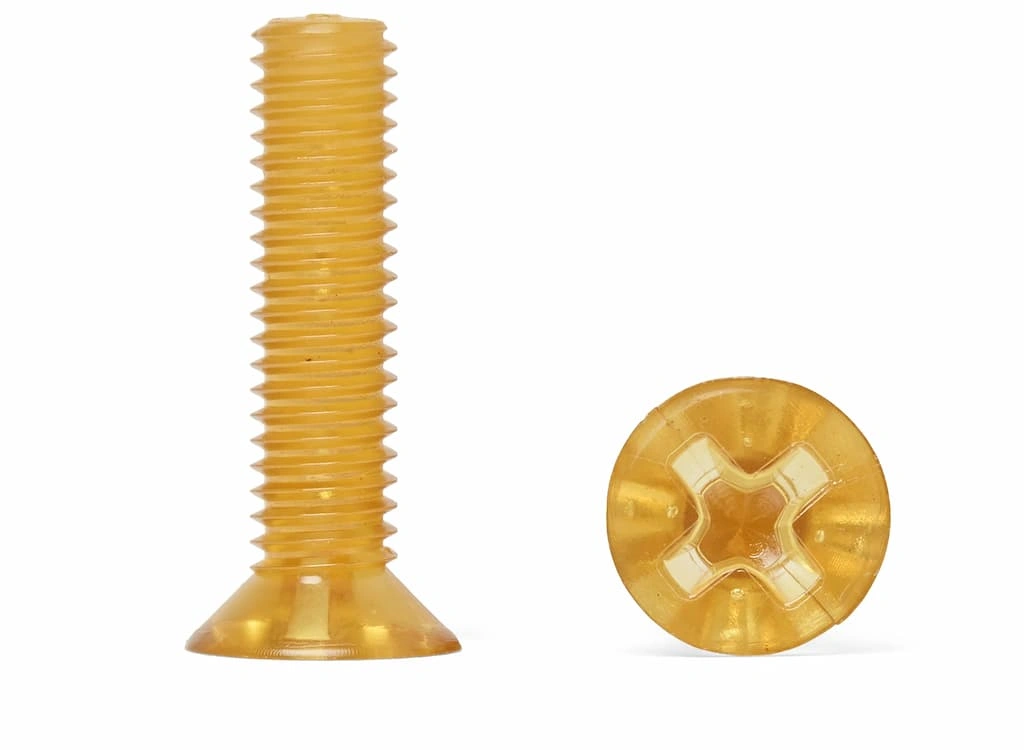
PEI screw
A single-point tool is used to create external threads on PEI cylindrical workpieces, whereas tapping is suitable for internal threads.
- Tooling: Single-point carbide insert for lathe threading
- Speed and Feed: It depends on the pitch of the thread design.
Try Prolean Now!
PEI CNC Machining Considerations
PEI material is amorphous and stiffer than regular thermoplastics, so you need to consider additional factors during machining, such as heat buildup, edge chipping, stress cracking, and efficient chip management.
Heat Generation
PEI materials are highly thermally resistant and abrasive. Due to the low thermal conductivity of PEI and tool-work friction, heat generated during machining does not dissipate easily. It can melt the material, increase the internal stress, and affect the dimensional stability.
For unfilled PEI, heat is generated by material shearing and plastic deformation, resulting in moderate but highly localized thermal loads in the cutting zone. Because PEI’s relatively low conductivity, much of this heat remains concentrated near the machined surface. In contrast, glass-filled PEI generates substantially more heat due to abrasive glass fiber and higher friction, but a significant amount of heat is also transferred into the cutting tool.
Solution:
- Use sharp tools
- Ensure the required flow of water-based or air-blast coolant into the machining area.
- Consider the space for proper coolant flow for thin-wall or other sensitive features.
Edge Chipping
PEI is a brittle, rigid plastic, so it is prone to edge chipping, especially when machining sharp corners, thin edges, and small holes.
Solution:
- Consider corner radii while designing the Ultem machined parts.
- Avoid aggressive cutting & high feed rates
- Avoid sharp transitions
Stress Cracking
Rigidity, brittleness, and excess heat can generate internal residual stresses during the machining of PEI workpieces, leading to stress cracking.
Solution:
- Apply the annealing process to relieve stress before machining
- Apply coolant & lubrication
Chip Management
PEI generates long, continuous, stringy chips at a slower feed rate. It can lead to chip wrapping and localized heating.
Solution:
- Consider the tool geometry and machining parameters
- Apply flood coolant or vacuum suction frequently
- Use the climb milling approach, and peck drilling (while creating holes)
What Are the Applications of PEI CNC Machining?
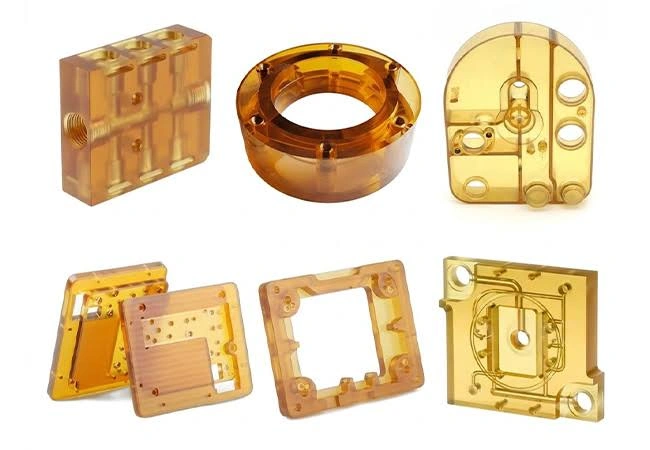
PEI machining applications
PEI or Ultem machined parts are used across industries requiring high-temperature resistance, mechanical performance, chemical stability, dielectric strength, and dimensional stability.
Let’s look at the PEI machining applications in automotive, aerospace, medical, electronics, and industrial machinery industries.
- Automotive: EV cooling systems, Under-the-hood components, mirror covers, LED assembly parts, fuel system valves & fittings, ECU enclosures, Interior trim, structural clips.
- Aerospace: FAR 25.853 FST complied aircraft interior components, ducting, PSU components, instrument housings, and seating components.
- Medical: Diagnostic equipment housings, surgical instrument handles, fluidic manifolds,
Intraoral scanner housings, endoscope components, and sterilization trays. - Electronics: Connector housings, insulators, display device components, circuit board carriers, 5G/RF antenna filter units, and semiconductor wafer carriers.
- Industrial Machinery: Valve seats, guide rails, positioning rings, jigs & fixtures, structural supports for moving machine parts, chemical-processing components, industrial bearings & bushings, pump housings.
IS CNC Machining PEI Different from PEI 3D Printing Material?
Both are polyetherimide materials, but the difference between “CNC PEI vs 3D-printing PEI” lies in how they are produced. PEI materials used in machining are produced from solid, stress-controlled PEI stock and are available in plate, sheet, rod, or block forms. On the other hand, PEI 3D printing materials are formulated through additive processes and are available as filaments.
The Fused Deposition Modelling (FDM) method is suitable for printing PEI material parts & prototypes. Some examples of PEI 3D printing include intake manifold prototypes for automotive applications, sensor housings, and End-of-Arm Robotic Tooling (EOAT).
CNC Machined PEI Parts: A Procurement Perspective
If you are looking to procure CNC-machined PEI parts or prototypes based on your CAD design, simply stating the “PEI plastic material” in the RFQ is not sufficient to get accurate information. You must call out the polymer grade, reinforcement, color, and applicable specifications.
For critical components, it is best to mention required material certifications, supplier traceability, and relevant test data. Some of the applicable certifications for specialized CNC machining PEI parts are UL94, FAR 25.853, ISO 10993, and FDA/food-contact requirements.
Try Prolean Now!
What are the Surface Finishing Options for Ultem Machined Parts?
Machined finish can provide a surface roughness of 3.2 µm; however, it is heavily influenced by PEI grade, tooling, and cutting parameters. Besides the as-machined finish, Ultem machined parts can be finished with bead blasting, tumbling, vapor polishing, and adhesive painting.
- Beadblasting: It provides a uniform surface (matte/satin texture) and is suitable for cosmetic purposes.
- Vapor Polishing: It is suitable for sealing surfaces, optical windows, and semiconductor applications. A fine vapor-polished surface can provide Ra 1.6 to 0.4 µm.
- Tumbling: In tumbling, machined Ultem parts are treated with abrasive media inside a rotating & vibrating chamber, producing a smooth finish.
- Adhesive Painting: Especially for cosmetic, branding, and UV protection, machined Ultem parts can be painted by spray or dipping method.
Need PEI Machined Parts and Prototypes? Send us Your Design
As we discussed, precision machining of PEI requires an extensive understanding of material properties and several critical considerations, which can only be addressed by engineering expertise and industry experience. ProleanTech has 10 + years of experience in plastic machining and an in-house CNC machine shop with multi-axis (3, 5, and more) CNC equipment.
Our PEI machining service includes everything from DFM feedback and machining to post-processing operations. We can provide prototypes, ready-to-use, and ready-to-assemble components based on your CAD design.
0 Comments