
Best plastic for machining
The best plastics for machining include ABS, nylon, Vespel®, acrylic, Polyethylene (PE), Polypropylene, polycarbonate, phenolic, and PTFE (Teflon). Others worth considering are Acetal (POM/Delrin), HDPE, Polyethylene Terephthalate (PET), and PVC (polyvinyl chloride).
When considering which type of plastic to use in a CNC plastic machining project, it is crucial to know the suitability and compatibility of each. Specifically, the plastic should be easy to manufacture and meet the functional requirements of the desired part.
Other important considerations are resistance to factors – heat, temperature, scratches, etc. – and desired surface smoothness. Since each of these plastics offers unique properties, the producer can choose one that meets specific requirements.
This guide explores the key plastics for CNC machining applications. It covers standout characteristics, including advantages, limitations, machinability, and common applications.
Acetal (POM/Delrin)
Acetal is easily one of the most machinable engineering plastics. Key characteristics contributing to this are a relatively high thermal conductivity, a semi-crystalline structure, and high dimensional stability. High thermal conductivity means the plastic’s cutting zone rarely exceeds the thermal degradation point during machining. The dimensional stability is largely derived from the material’s moisture absorption of below 0.25% in 24 hours.
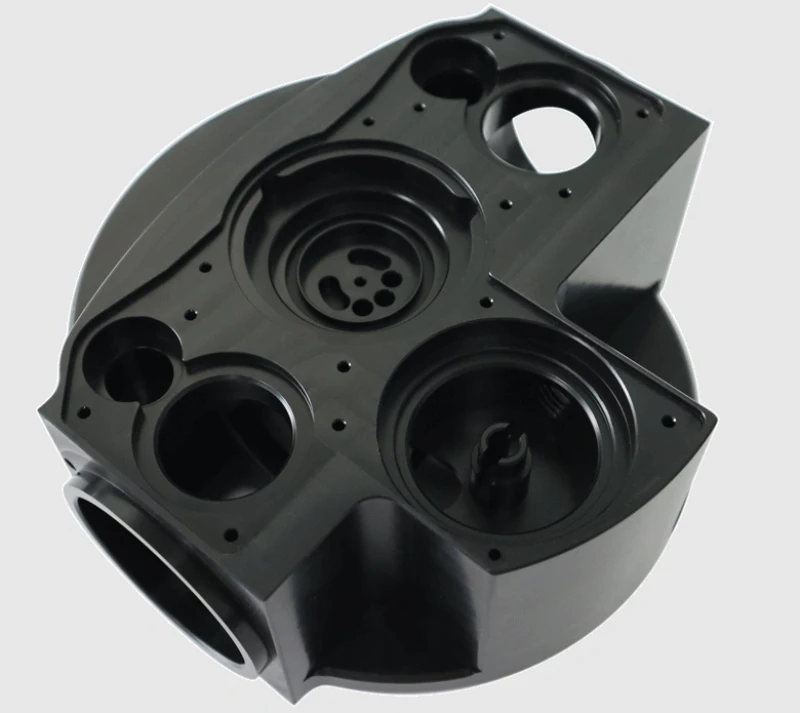
Delrin/POM (Acetal) part
Pros and cons of Acetal (POM/Delrin) machining
| Pros of Acetal (POM/Delrin) machining | Cons of Acetal (POM/Delrin) machining |
|
|
Applications
Acetal machined parts are commonly found in mechanical components such as gears, rollers, springs, and housings. Hinged housings, fuel transmitter units, and door lock systems in automotive applications are also manufactured from acetal.
Nylon/Polyamide (PA)
Nylon/Polyamide (PA) dates back to the 1930s, following extensive research into polyesters and polyamides. The two common nylon grades are Nylon 6 and Nylon 6/6. Nylon 6 is usually used in high-strength applications where low density is a requirement. Nylon 6/6 is often reserved for applications requiring higher stiffness, strength, and abrasion resistance. It generally absorbs less moisture than nylon 6.
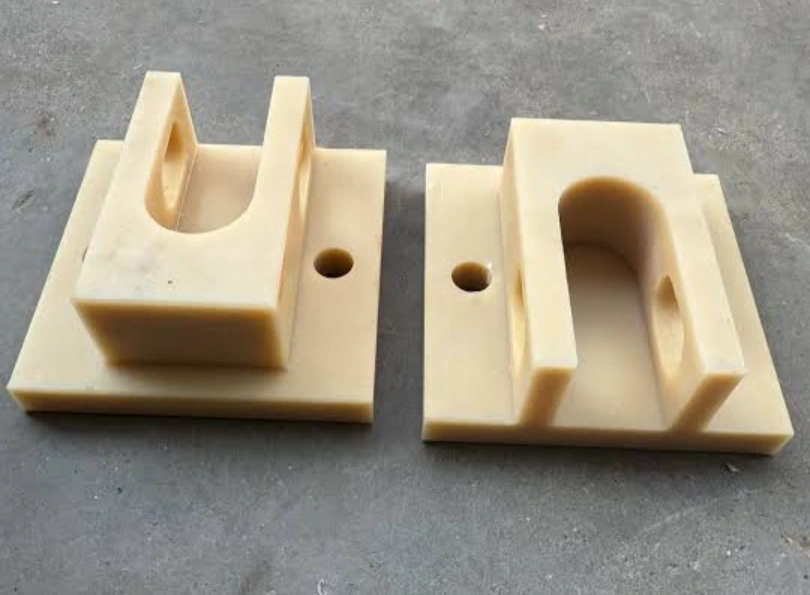
Nylon (PA)
Pros and cons
| Pros | Cons |
|
|
Applications: Bearings, gears, bushings, structural brackets
ABS plastic (Acrylonitrile Butadiene Styrene)
ABS plastic machines cleanly even at high speeds. The tool wear is minimal. However, the machinist should take into consideration the material’s proneness to softening under heat. The two main strategies against this issue are expert feed control and cooling.
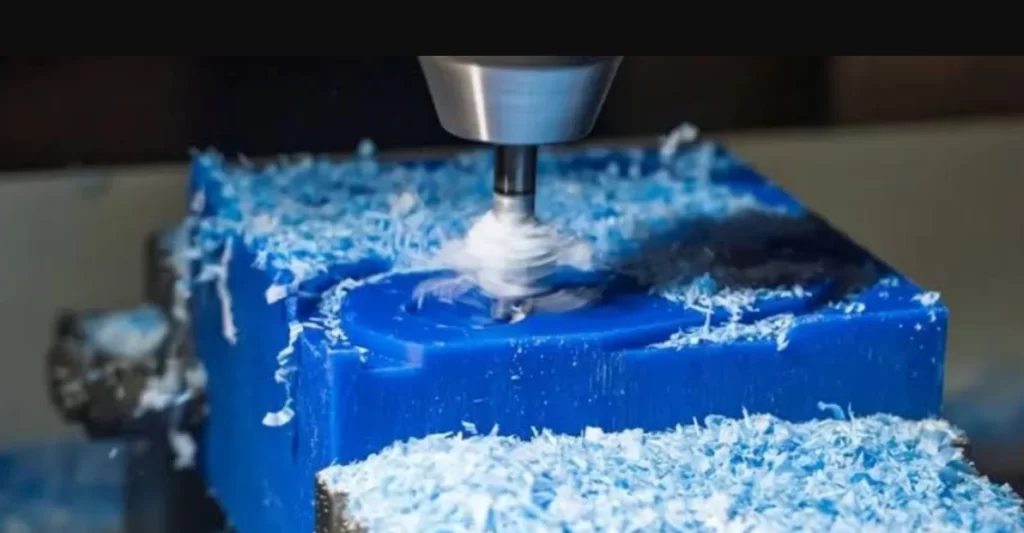
CNC milling ABS plastic
Pros and cons
| Pros | Cons |
|
|
Applications: Prototypes, enclosures
Polycarbonate (PC)
Polycarbonate is on the list of best plastics for machining because it offers an unmatched balance of optical clarity and impact resistance. Machining such a plastic requires controlled speeds and sharp tooling. A common machining challenge is melting.
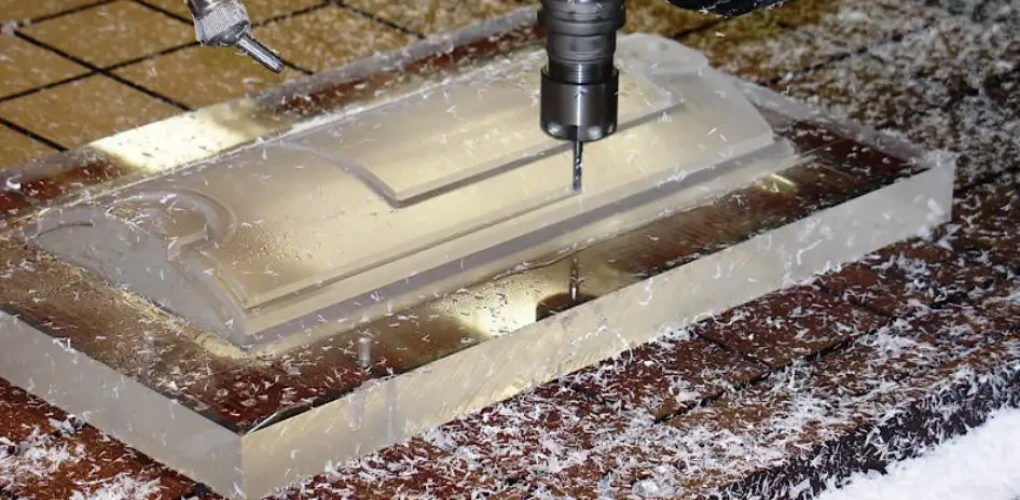
Polycarbonate machining
Pros and cons
| Pros | Cons |
|
|
Applications: Electrical enclosures, lenses, safety guards
Acrylic/Poly(methyl methacrylate) (PMMA)
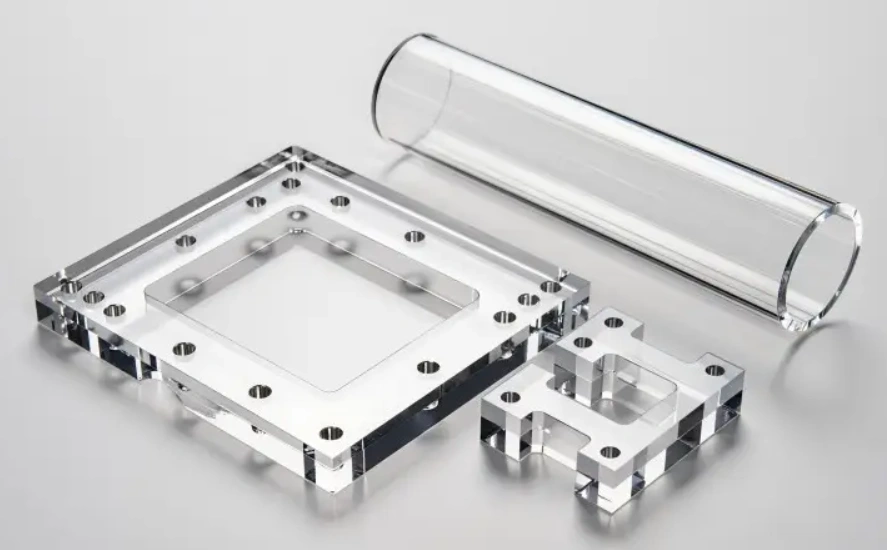
Acrylic CNC machining parts
PMMA is one of the most optically clear machinable plastics available. Machining this material requires sharp tooling and slow feeds because it can easily crack and chip.
Pros and Cons of PMMA
| Pros of PMMA | Cons of PMMA |
|
|
Applications: Protective covers, signage, displays
HDPE (High-Density Polyethylene)
HDPE plastic is easy to machine and offers good chemical resistance and moisture resistance. However, it is not recommended for tight tolerances due to its relatively soft nature. Instead, consider it for workhorse applications.
Pros and cons of HDPE
| Pros of HDPE | Cons of HDPE |
|
|
Applications: Marine parts, tanks, chemical reservoirs
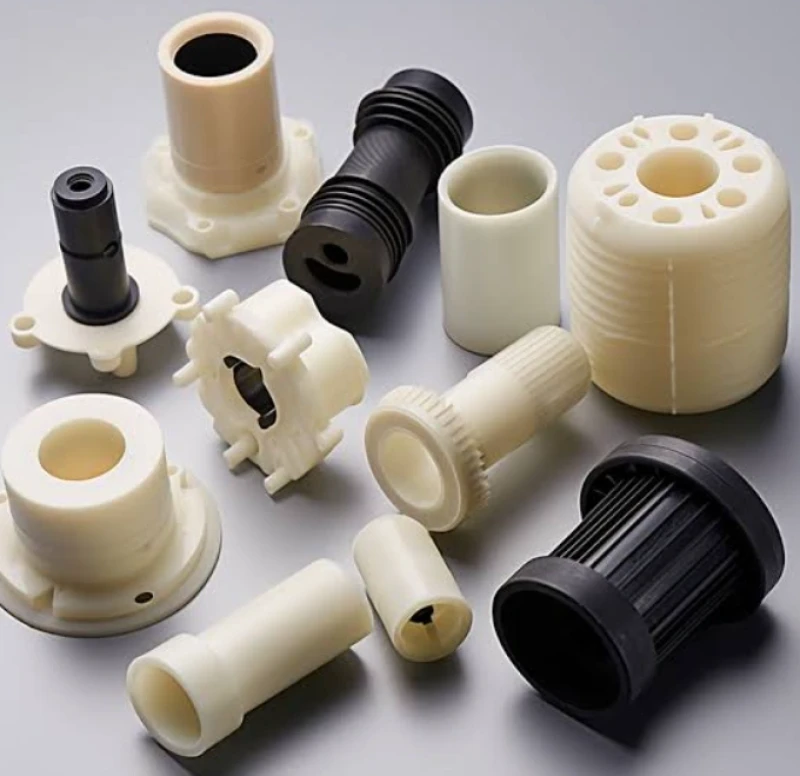
Precision-machined HDPE
PET (Polyethylene Terephthalate)
PET is another plastic that is easy to machine. On top of that, the material has low moisture absorption, good chemical resistance, and good dimensional stability. Some PET grades can be used for food-contact applications if they comply with the relevant FDA requirements.
Pros and cons of machined PET parts
| Pros | Cons |
|
|
Applications: medical devices, food processing equipment
Polypropylene (PP)
While lightweight at a density of 0.89–0.92 g/cm³, PP exhibits good wear, impact, and chemical resistance. With a relatively good heat resistance and electrical insulation capabilities, PP can be used for a wide range of general industrial applications.
Pros and cons of PP machined parts
| Pros | Cons |
|
|
Applications: Living hinges, chemical tanks, lab devices
Phenolic Plastic
Often associated with Bakelite, phenolic plastic is a hard and brittle material. This thermoset plastic tends to produce short fragmented chips accompanied by fine dust during machining. Note that the specific chipping behavior can vary based on the specific phenolic grade, machining conditions, and laminate structure. Phenolic’s thermal stability and electrical insulation are excellent. As expected, phenolic machining wears cutting tools quickly.
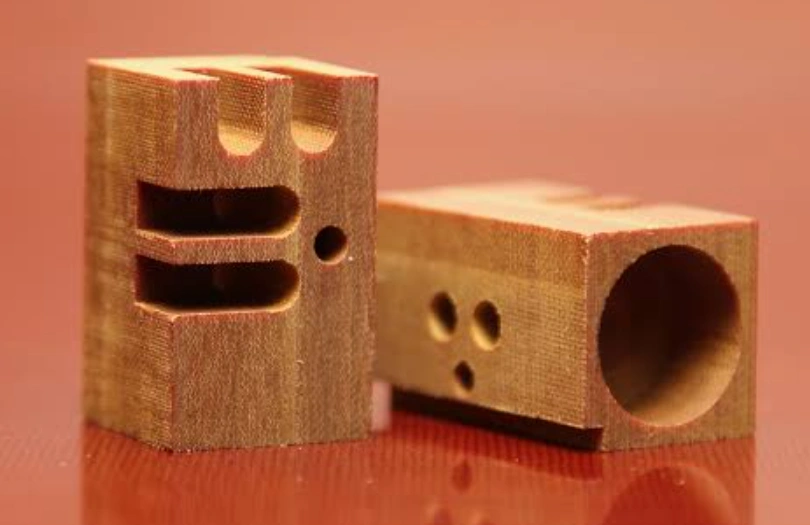
Phenolic parts
Pros and Cons of Phenolic Machined Parts
| Pros | Cons |
|
|
Applications: Phenolic machining is ideal for Insulating spacers, cams, gears, bushings, and washers
PVC Plastic
Machined PVC plastic parts offer durability and chemical resistance. When done expertly, these parts are valuable in a range of industries, including plumbing and chemical handling systems.
Pros and cons of PVC machined parts
| Pros | Cons |
|
|
Applications: Plumbing fittings, valves
Vespel® (DuPont’s polyimide)
Although difficult to machine, Vespel® produces parts with tight tolerances, temperature tolerance, and durability. This unfilled polyimide grade has a glass-transition temperature (Tg) of approximately 249°C. [2] This makes this plastic one of the best for machining for critical applications.
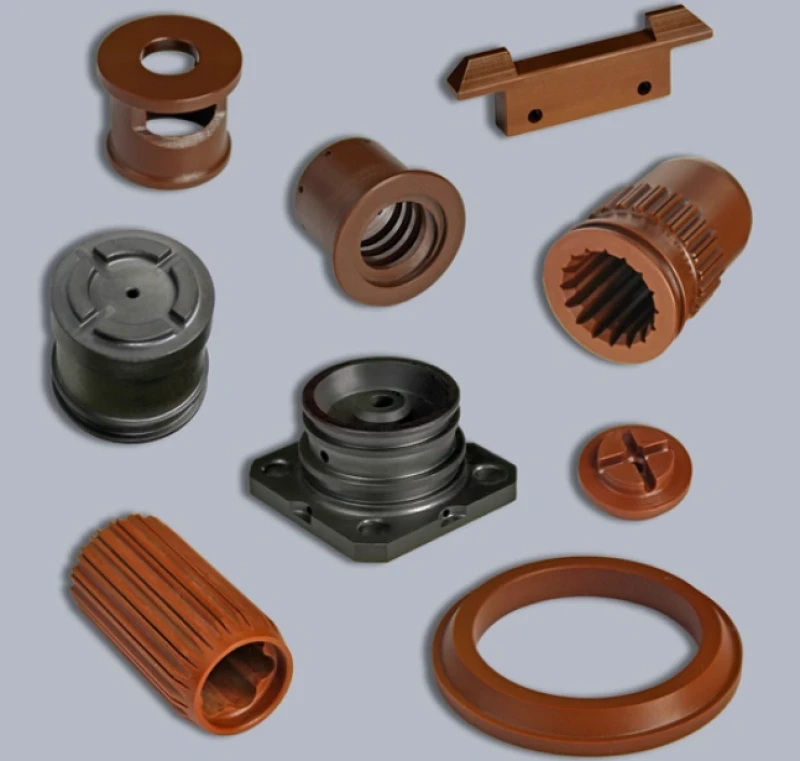
Vespel machined parts
Pros and cons of Vespel machining parts
| Pros | Cons |
|
|
Applications: Defense and spacecraft equipment
Polystyrene (PS)
PS material has excellent optical clarity and is stiff. Its stiffness can be enhanced using rubber – High Impact Polystyrene (HIPS). This cost-effective thermoplastic combines these properties with good dimensional stability and availability in different shapes for stock.
Pros and cons of polystyrene machined parts
| Pros | Cons |
|
|
Applications: Polystyrene material is rarely used in CNC machining; it is ideal for injection molding.
As you consider which one on the list is the best plastic for machining, remember that PS is included for completeness. Procurement teams new to plastics may specify it for its wide availability, unaware that its poor thermal performance and high brittleness pose serious challenges in machining.
Try Prolean Now!
Summarized Selection Table for the Best Plastic for Machining
Below is a material selection table featuring key engineering requirements
|
Plastic |
Dimensional stability |
Wear resistance |
Chemical resistance |
Machinability |
Thermal resistance |
Relative cost |
|
Acetal (POM/Delrin) |
High |
High |
High |
Excellent |
Moderate |
Low |
|
Nylon (PA) |
Moderate |
High |
Good against fuels and oils; poor against acids |
Good |
Moderate – chilling required to prevent gumming |
Low to moderate |
|
ABS |
Low |
Moderate |
Poor weather resistance |
Excellent |
Low |
Low |
|
Polycarbonate(PC) |
Moderate |
Good |
Poor |
Moderate |
Moderate – gumming, melting |
Moderate to high |
|
Acrylic (PMMA) |
Moderate |
Low |
Weather resistant |
Moderate |
Low – slow feeds and sharp tooling |
Moderate |
|
HDPE |
Low |
Good |
Good |
Good, tolerances not tight |
Low to moderate |
Low |
|
PET |
Good |
Good |
Good |
Good |
Moderate |
|
|
Polypropylene (PP) |
Low |
High |
Excellent |
Moderate – warping and gumming |
Low |
|
|
Phenolic |
High |
Good |
Good against oils and solvents |
Poor |
Moderate |
|
|
PVC |
Moderate |
Moderate |
Good |
Good |
Low |
|
|
Vespel® |
High |
High |
Good against most fuels and solvents |
Poor-to-moderate-to-difficult, grade-dependent |
High |
|
|
Polystyrene (PS) |
Good |
Low |
Poor |
Good, but not machined regularly |
Low |
Low |
Try Prolean Now!
Machining Processes for Plastics
As you consider which of the highlighted plastics suit your machining project, take note of the common machining processes: Turning, boring, drilling, milling, tapping, and reaming.
Plastic Turning and Boring
These lathe-based operations work on internal diameters and produce cylindrical components. Turning uses a stationary single-point tool on a rotating workpiece to produce bushings and shafts. Boring precisely enlarges existing holes. For a plastic to withstand these operations, it must have high dimensional stability – the cutting forces can be too much. Acetal and PTFE are some of the plastics with the best dimensional stability. The chip evacuation method should be fast and effective enough to prevent melting. The plastic’s heat tolerance should also be considered when setting the spindle speed.
Plastic Drilling
Plastic drilling produces straight circular holes in the material. The frictional heat buildup in plastics can melt and deform the hole edges in ABS, PS, and other plastics if the speeds are not well managed. The best practice is to use peck drilling, a technique that enhances chip clearance and heat dissipation. Continuous drilling is not a challenge for PET and other plastics with higher melting points.
Plastic Milling
Milling is a process whereby a rotating multi-point cutter is used to produce pockets, 3D geometries, and flat surfaces on the plastic. It is a highly versatile process applicable to hard and soft plastics. The milling strategy used for specific plastic matters. For instance, gummy plastics such as HDPE require sharp tooling and faster cutting speeds to prevent material smearing and enhance surface finish.
Plastic Tapping
Tapping is the production of internal threads in a pre-drilled hole. It is popular for dimensionally stable plastics, including acetal and phenolic. Since softer plastics tend to undergo thread deformation and stripping, metal inserts are used instead.
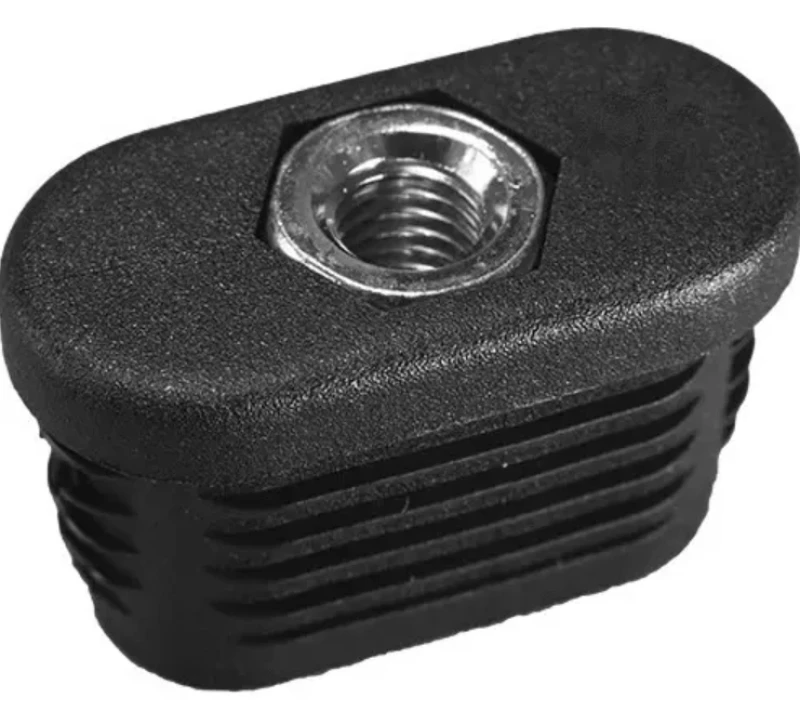
Threaded metal insert in plastic
Plastic Reaming
Reaming helps attain the precise final diameter for a drilled hole – enlarging and smoothening. It is a requirement in the manufacture of bushings and bearing seats, especially in acetal parts where predictable hole diameters are essential in assemblies.
Each of these processes comes with distinct mechanical and thermal requirements. Each plastic should be matched with a suitable machining process to ensure optimal performance of the machined parts.
As you prepare your machining plan, ensure the plastic’s properties match the process parameters. For instance, the material’s heat sensitivity should determine the feed rate, cutting speed, and cooling rate.
Conclusion
The best plastics for machining offer the right machinability, thermal stability, mechanical properties, and other properties, depending on real-world requirements. From acetal’s flawless precision for tight tolerances to PC’s unmatched impact resistance, each of the plastics has a unique suitability for industrial applications. For procurement managers seeking reliable manufacturing partners and engineers expediting plastic material specs, there are nuances that only an experienced plastic processing company can understand.
Your plastic part should be machined right the first time. For a flawless transition from design to production of CNC-machined plastic parts, share your drawings with ProleanTech’s engineering team. You can also review our plastic machining service for more details regarding precision machining for different types of plastics.
FAQs
What is the best plastic for machining?
The best plastic for machining depends on the application requirements in terms of tensile strength, heat resistance, chemical resistance, and impact strength, among others. Each plastic offers distinct properties; no plastic is a one-size-fits-all.
Resources
[1]https://ideambox.com/assets/downloads/engineering-materials-datasheet.pdf
[2]https://www.materialdatacenter.com/ms/en/tradenames/Vespel/DuPont/VESPEL%C2%AE+TP-8311/7e482917/835
0 Comments