
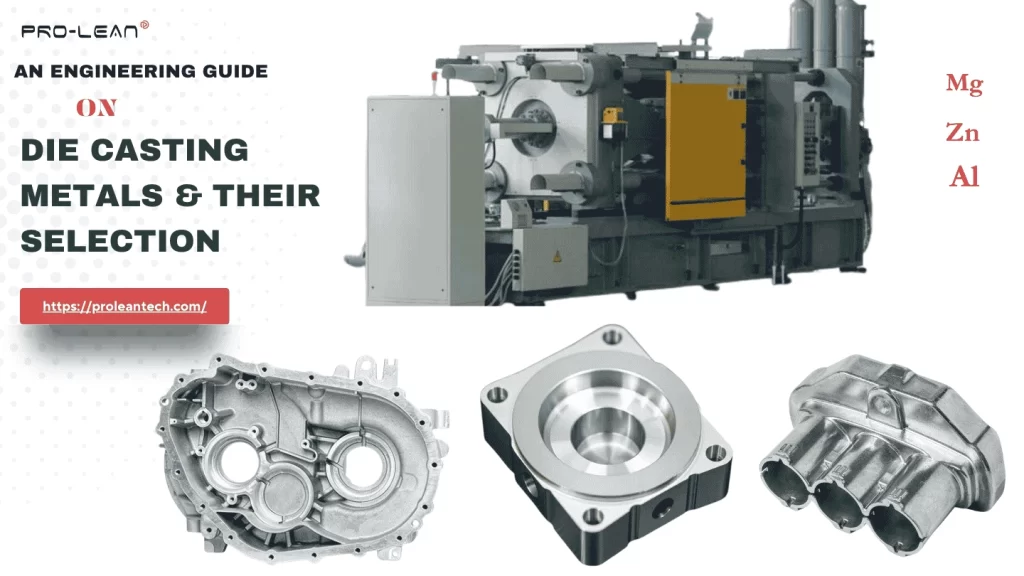
Die casting metals
Magnesium, aluminum, and Zinc are the major die casting metals, whereas bronze, copper, and a few other materials are also used in casting. Magnesium die casting is favorable for low weight and vibration damping; aluminum alloys are preferred for good corrosion resistance & strength; and zinc is preferred for casting small & detailed, thin-walled components.
Die Casting enables the manufacturing of complex components in large volumes while maintaining repeatability & cost-efficiency. However, die-casting ferrous metals can be challenging due to their high melting points, which lead to rapid tool wear.
Electronic frames, instrument panels, automotive wheel frames, and tool enclosures are cast from magnesium alloys because they require low weight and structural support. Aluminum die casting is applied to produce engine blocks, motor housings, heat sinks, transmission housings, and many other components. Zinc is cast for door handles, plumbing items, valve parts, automotive items, etc.
Let’s examine die casting metals in detail, elaborating on their casting properties, limitations, applications, and how you can make a wise decision in die casting material selection.
Magnesium Alloys for Die Casting
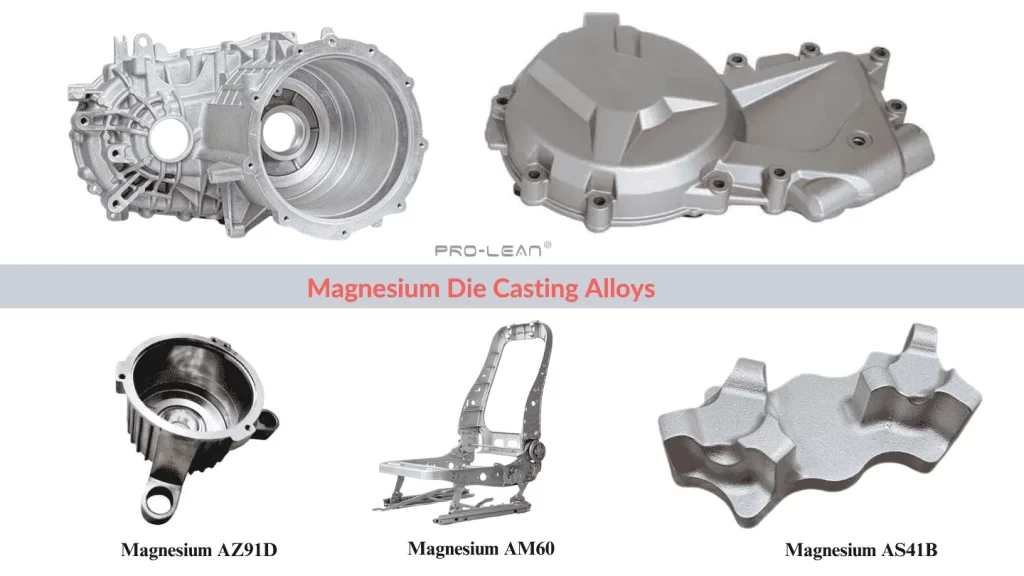
Magnesium die casting alloys
Magnesium is a structural metal that is known for its lightweight and durability. It has a density of 1.74 g/cm³, which is 35 % lighter than aluminum [1]. Therefore, magnesium alloys are used in die-casting metal parts that need a high stiffness-to-weight ratio and vibration damping.
The low melting points and good flowability make magnesium alloys easy to cast, but their reactivity with oxygen requires strict process control.
Magnesium AZ91D
AZ91D is the most common alloy in magnesium die casting, which is composed of ~ 90 % Mg, 8.3 to 9.7 % of aluminum, up to 1% of zinc, along with other metals (Mn, Si, Cu) in minor amounts.
The hot-chamber die-casting method is suitable for AZ91D. It has a low hot-tearing tendency and offers a fast cycle time. Additionally, AZ91D casting parts are more corrosion-resistant compared to other magnesium alloys.
Applications: Automotive transmission housings, CAM covers, steering column brackets, laptop enclosures, smartphone internal frames.
Magnesium AM60
The main difference between AM60 and AZ1D is the aluminum content. It contains <6% aluminum, which is commonly used in HPDC, and can also be processed by squeeze casting to meet specific performance requirements [2]. The lower Aluminum content improves the ductility, impact toughness, and elongation.
Applications: IP beams, car seat frames, instrument panels, and automotive interior structures.
Specialized Magnesium Alloys
Other magnesium alloys for die casting include AS41B, AE42, and ZK60A. Some of these contain rare earth elements and are designed for specific performances. For instance, AE42 contains Cerium, Neodymium, and Lanthanum in small amounts (~2-2.5%). As a result, temperature resistance and creep resistance increase significantly.
Applications: AS41 engine parts, automatic transmission components, front engine cradle, aircraft brake housing & landing gear parts, and missile frames.
Aluminum Die Casting Alloys
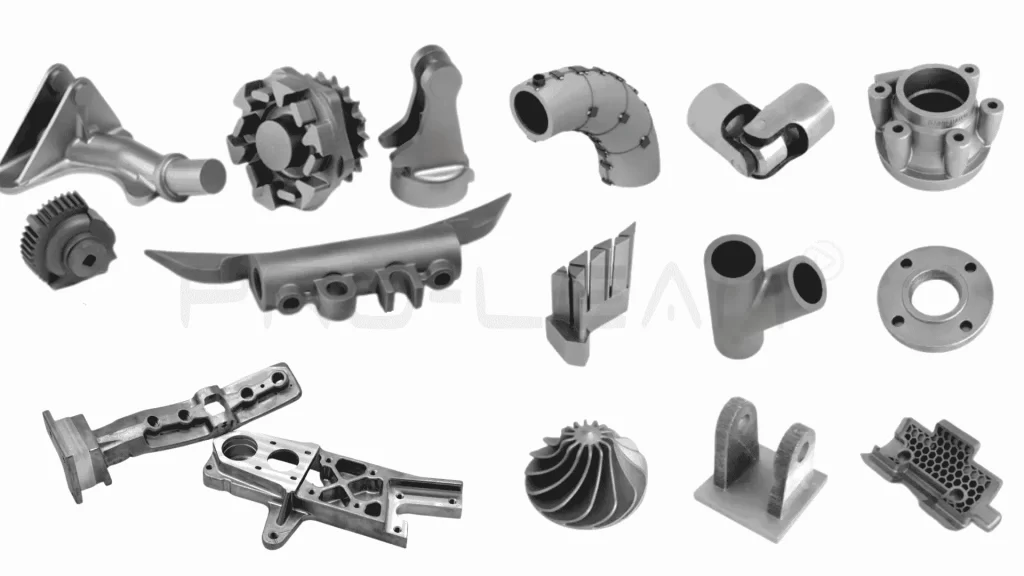
Aluminum die casting alloys
Aluminum alloys are among the lightweight die casting metals, offering strength, conductivity, corrosion resistance, and good EMI & RFI shielding. Although its alloys have a relatively higher melting point (~660°C) than those of Mg and Zn, complex components can be cast using the cold-chamber casting technique.
When molten aluminum flows into the die and solidifies, dendritic structures form, which enhance the strength & ductility of casting parts.
Next, let’s discuss common aluminum die casting alloys under ASTM, EN AC, and JIS standards.
Aluminum 380 (A380)
A380 is a general aluminum casting alloy that provides a balance of castability, strength, and ductility, along with excellent corrosion resistance, wear resistance, and weldability. It is a good choice for casting precise components for use in harsh environments.
Applications: Power tool bodies, electronic housings, gearbox cases, engine brackets & mounts, and home appliance parts.
Aluminum 360 (A360)
Higher silicon & very low copper content in the composition of A 360 improves fluidity and reduces hot-shortness. It offers corrosion resistance in outdoor and marine environments. But A360 is more costly than A380 alloy. Additionally, A360 alloy can be cast into Complex thin-walled shapes that are less prone to hot cracking.
Applications: Hydraulic system enclosures, marine hardware, suspension components & manifolds for automotive, chemical processing valves, and radar equipment casings.
Aluminum 413 (A 413)
Aluminum 413 contains a higher silicon content (~12%) than A380 and A360. It provides the best fluidity and mold filling, which makes it ideal for casting mechanical parts that require pressure tightness and ultra-thin walls. However, the mechanical strength is compromised.
Applications: Hydraulic cylinders, pneumatic components, pressure vessels, high-performance heat sinks, compact enclosures, and food-processing equipment.
Aluminum 383 (A 383)
Aluminum A 383 contains 9.5–11.5 % Si, 2-3 % Cu, and ≤1.3 % Fe, along with other alloying elements in minor amounts. It offers excellent die-filling, hot-cracking resistance, dimensional stability, and better corrosion resistance than A380. You can use it for casting parts with a high length-to-thickness ratio.
Applications: Electronics & communication equipment housings, automotive brackets, cylinder head covers, sensor housing, and general-purpose industrial casting.
AC 46100
AC 46100 casting provides a balance of hardness, strength, and weldability. The composition involves ~12% silicon and ~1.5-2.5% copper as the main alloying elements. It is used in automotive and industrial machinery manufacturing.
Lower melting points favor shorter casting cycles, but they are not suitable for corrosive and high-temperature conditions, especially above 200°C.
Applications: Powertrain components, engine cylinder heads, and industrial fluid lines.
AC 46500
This European standard aluminum alloy is similar to A380 and is commonly used for die-casting strong & lightweight parts, including aerospace and electrical hardware.
ADC 10
ADC refers to Aluminum Die Casting, and ADC 10 is widely popular in manufacturing industries across Asia. It is considered a close equivalent to the A380 (ASTM) and AC-46500 (EN AC ) standards [3]. ADC contains up to 9.5% silicon and provides balanced mechanical properties, structural strength, and machinability.
ADC 12
ADC 12 (closely equivalent to A 383) has a slightly higher silicon content (up to 12%). It has a higher melting point and greater resistance to cracking. This alloy can be used for casting thin-walled and complex parts.
ADC 12 is a better option when you need slightly higher strength, whereas ADC 10 outperforms in fine die-filling.
Zinc Die Casting Alloys
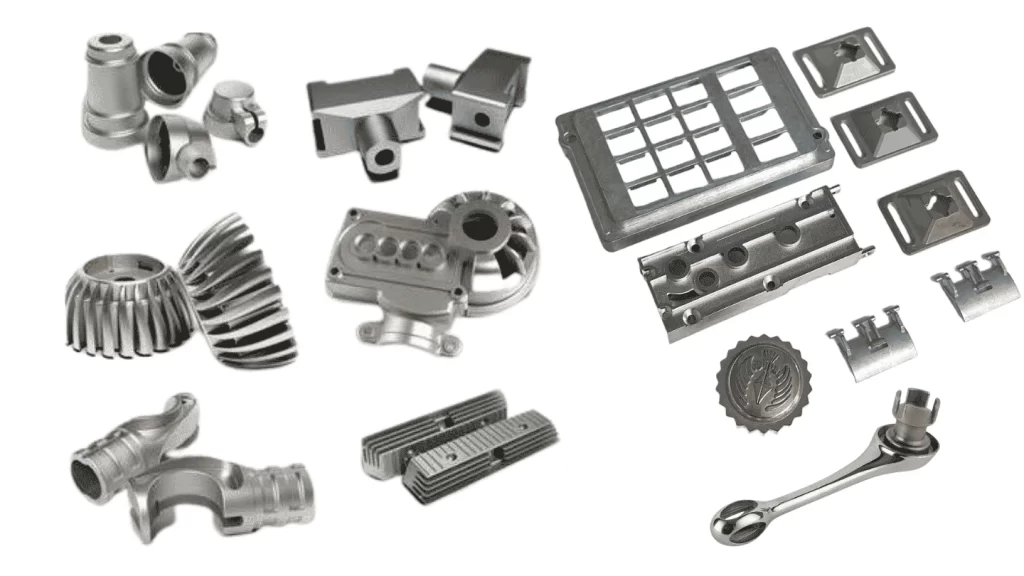
Zinc die casting parts
Zinc is another low-melting-point metal (420°C) with high fluidity in the molten state, allowing it to be shaped into intricate geometries with die casting. Zinc alloys, including Zamak 2, 3, 5, and 7, are used to produce industrial components, requiring a balance of strength, toughness, and conductivity. However, Zinc alloys are considered as deser die casting metals (ρ= 6.6–7.0 g/cm³) and they can not retain their original mechanical properties above 100°C.
Zamak 2
Zamak 2 alloy is composed of 3.7-4.3% of Al and 2.7-3.3 % Cu as main alloying elements, along with Mg, Fe, and other elements in minor amounts. It processes high strength, ductility, and good hardness, and elongation. But long-term brittleness and shrinkage are compromised.
Applications: Small -sized & detailed parts with finish and precision, such as small gears, cams, motor end caps, stamping-die prototypes, tool inserts, light fixtures, and hand tool components.
Zamak 3
The main difference from Zamak 2 is that Zamak 3 contains lower copper content (Cu ≤0.25%), which changes how it behaves in long-term use. Zamak 3 is an industry-referenced alloy and provides dimensional stability, excellent casting fluidity, easy finishing, and is less costly.
Applications: Appliance housings, fitting hardware, ceiling fans, decorative items, plumbing parts, and electrical parts.
Zamak 4
Zamak 4 is a bridging zinc die casting alloy for Zamak 3 and 5, containing a small amount of copper (~0.3 to 0.5%) [4]. It maintains ductility & slightly improves hardness, without sacrificing strength. Additionally, Zamak 4 also has a lower risk of die sticking than Zamak 3.
Applications: Clothing hardware, window locking mechanisms, small electrical switches, and decorative hardware.
Zamak 5
The composition of Zamak 5 includes ~4% Al, ~1 % copper, and up to 0.08% of manganese, along with some other minor alloying items. It is versatile and provides higher tensile strength and hardness than Zamak 3, but the casting fluidity is slightly less.
Applications: Gears, seatbelt mechanisms for cars, hinges & brackets, toggle latches, and electrical connectors.
Zamak 7
Zamak 7 is a tight-impurity control alloy, consisting of 3.5–4.3 % of Al, ~0.1 % of Cu, < 0.02% of Mg, and a minor amount of Nickel. It provides high mechanical strength, low porosity, and the highest fluidity. Zamak 7 can be cast into thin-walled, intricate components with excellent precision.
Applications: Electronic housings, smartphone chassis, SFP & QSFP enclosures, watch Bezels, electrical conduit fittings, and miniature pneumatic valves.
Try Prolean Now!
Other Die Casting Metals
Brass die casting
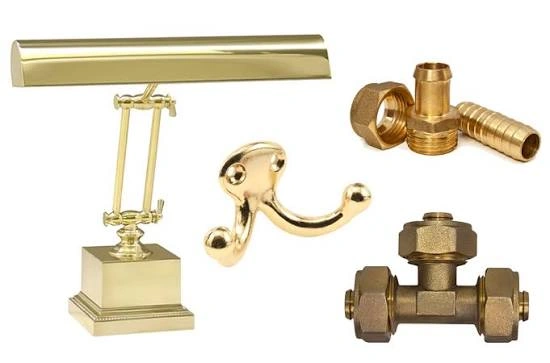
Besides zinc, aluminum, and magnesium, a few other alloys can be used as die casting metals, including brass, bronze, lead alloys, and tin alloys. However, they are less common in die-cast manufacturing.
Copper Alloys( Brass & Bronze)
Brass contains 60-85% copper and Zinc as major alloying elements. You can also die-cast silicone and manganese bronze.
Lead Alloys
These are formulated with tin and antimony as major alloying elements, and can be cast into fine-detailed components, such as radiation-shielding components, decorative items, and sound-damping inserts.
Tin Alloys
Tin-based alloys are among the low-melting-point die-casting metals and can be cast with fine detailing & finish. For example, decorative items and ornaments.
Try Prolean Now!
How to Choose the Right Die-Casting Metal for My Project?
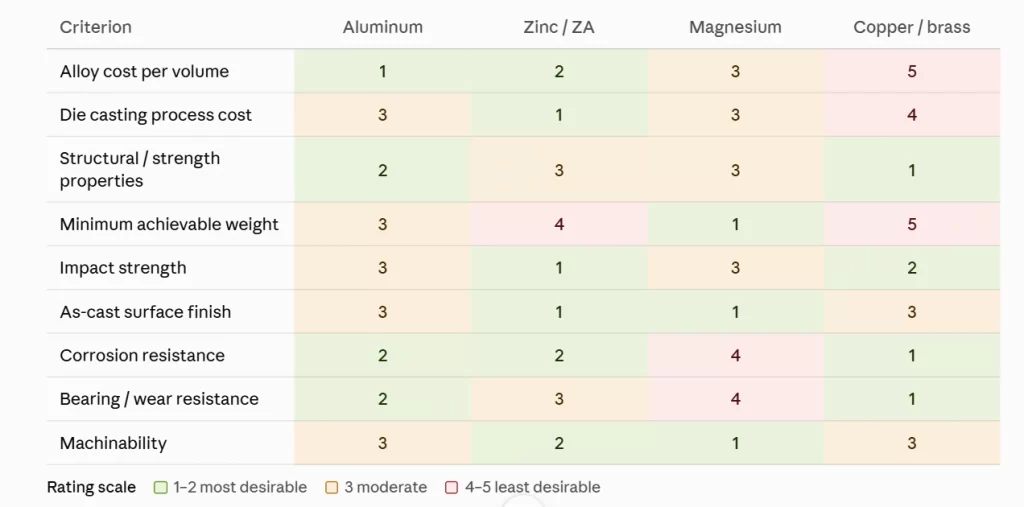
Die-casting metals comparison
The right die-casting metal/alloy mainly depends on the part/product you are making and the end requirements. The melting point, castability, and tooling you use also play a significant role in material selection.
Let’s look at the critical considerations for selecting the right die-casting metal for your project.
1. Identify your Requirements
First, define the part or product characteristics that you are casting. It includes weight, mechanical strength, elongation, toughness, hardness, and electrical & thermal conductivity.
2. Operating Conditions
Consider the operating conditions in which die-cast parts will be used, such as thermal Exposure, humidity, corrosive environments, and heavy loads.
3. Assess the Design Complexity
Assess part complexity, including wall thickness, sharp corners, cavities, wall transitions, and tolerances. Some alloys have excellent fluidity and can be cast into intricate shapes with fine detailing.
4. Tooling and Method of Die Casting
Considering tooling helps to understand whether the metal you choose is compatible with the die material and how many cycles it can withstand. Additionally, you need to consider whether you have cold- or hot-chamber die-casting equipment and low-pressure or high-pressure die-casting equipment.
5. Material Cost
Does your budget justify the raw material cost of the metal you have selected? Often, it is also influenced by the production volume. You can analyze the per-part prices for short-listed materials.
6. Finish and Post-Processing Requirements
Consider the as-casting finish and post-processing requirements. Aluminum alloys might need chromate or other plating for corrosion-prone conditions, whereas copper can provide higher resistance without secondary coating.
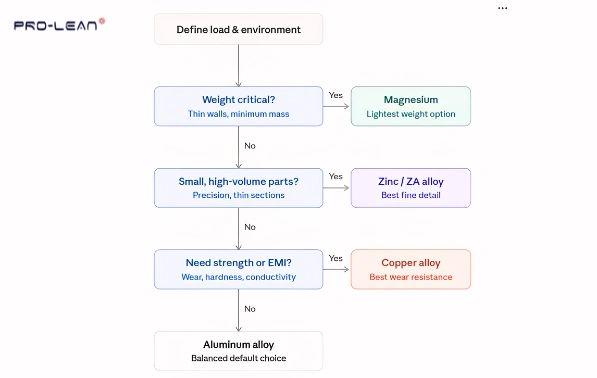
Next, you can use the following flowchart as a basic reference while selecting the die-casting material.
Die casting metal selection
The above decision flow-chart provides a reference for selecting a die casting metal by prioritizing part requirements.
- If weight is critical (thin walls, minimum mass matters most) → Magnesium
- High-volume parts with fine precision → zinc or ZA alloys
- If wear resistance, hardness, or electrical/thermal conductivity are priorities→ Copper or Cu alloys.
- Otherwise (Default Choice) → Aluminum Alloys
Send Your Die Casting Design for an Engineer-Reviewed Quote
The success of your die casting project heavily depends on whether the selected material is the best fit for the designed parts and end requirements. Therefore, at ProleanTech, we not only cast ready-to-use or ready-to-assemble parts, but our engineers also help you with material selection.
For die-casting, we have an in-house production line and quality-control facility. Our die casting service handles everything, from tooling to post-casting processing and surface treatments.
If you have your design ready, upload your CAD file and get an engineer-reviewed quote with DFM feedback.
0 Comments