
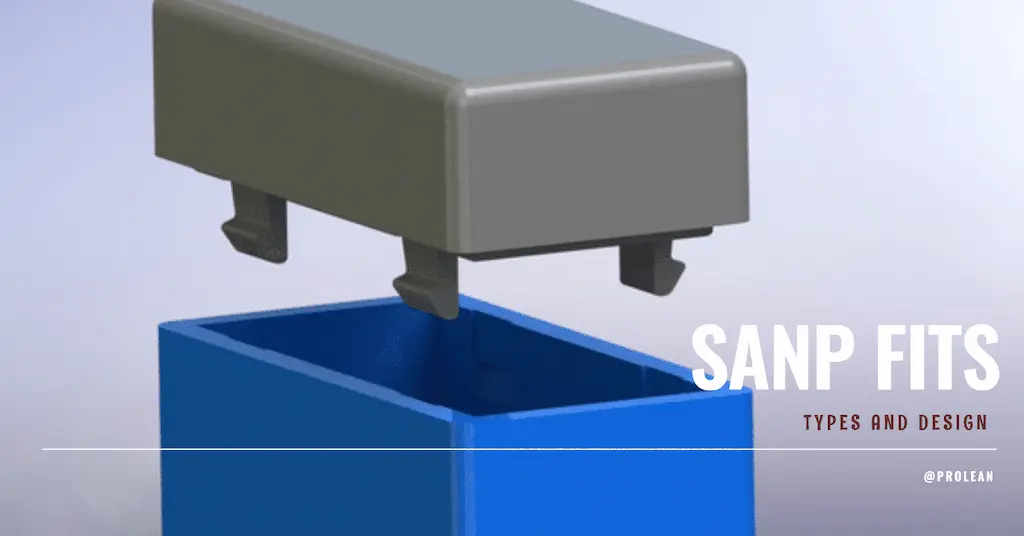
Snap fit feature image
Joints are critical in any assembly of mechanical products or systems having multiple components. Nut and bolts, welding, riveting, and other joints are some examples. Snap fits are one of the popular fastening techniques without any visibility of joining elements. A snap-fit consists of a cantilever or annular hook that snaps into the counterpart groove or undercut and makes a secure joint. Meanwhile, they can be used as both permanent and temporary joints.
Furthermore, we will discuss the type of snap fits, the design considerations, application areas, and benefits.
What Are the Snap Fit Joints?
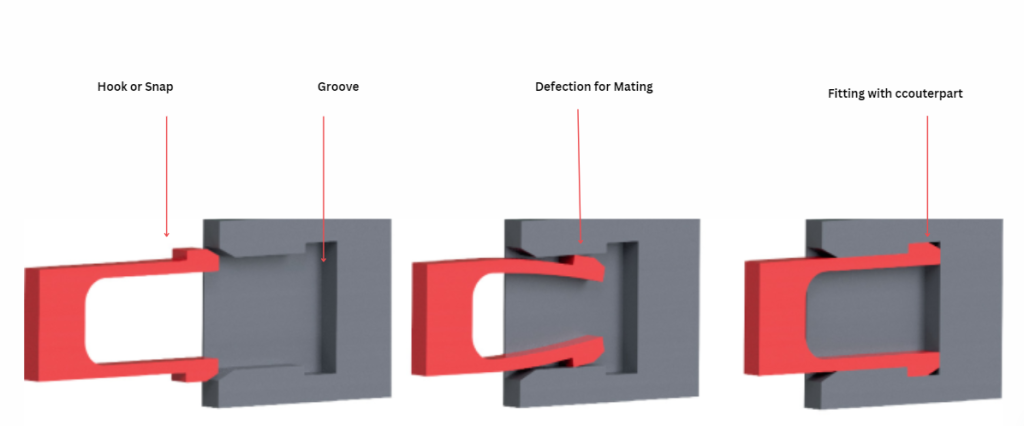
These are the straightforward methods to join the plastic, metal, alloys, and other material components precisely. A snap fit involves extended features, hook, bed, etc., on one part and corresponding recessions ( groove, undercut, cavity, etc) on the other part. In workshop language, they are known as male and female counterparts. You can see these two features illustrated clearly in the schematic diagram of a typical snap-fit design below;
Snap-fit example
The defection of the snap allows it to perfectly mate with corresponding features on another part. Temporary deformation happens at the mating. The snap can be fit permanently or temporarily, depending on the need. It means you can also fit them in a way that they can be disassembled if needed.
Unlike traditional fastening, appearance does not need additional drilling or other operations for fastening components built into assembly arts with precise alignment and positioning.
The correctly aligned and perfect snap-fit joints facilitate a strong assembly without stress concentration. This joining technique is used for basic consumer items made with 3d printing to CNC machining standard industrial components.
Advantages and Limitations of Snap Fit
Snap fits facilitate efficient assembly, reduce cost, and Cantilever snap-fits allow easy disassembly. On the other hand, they have a few limitations, such as stress-concentration, fatigue risk, and material choices.
Let’s compare advantages and limitations in the table below;
| Snap-fit Advantages | Snap-fit Limitations |
| Snap-fit allows disassembly and reusability. | They possess fatigue failure risk, as each disassembly cycle weakens the structural integrity. |
| Snap fit eliminates or reduces the assembly time, as it does not need any additional fastening or welding. | Especially, thermoplastics are prone to creep, so there is a material limitation in high-performance applications. |
| Since snap-fits do not need any adhesion or fasteners, they reduce BOM complexity, material costs, and assembly costs. | Cantilever snap-fits concentrate the stress at the base of the beam. It causes material fatigue and eventual failure. |
Try Prolean Now!
Types of Snap Fits
Snap fits tyes
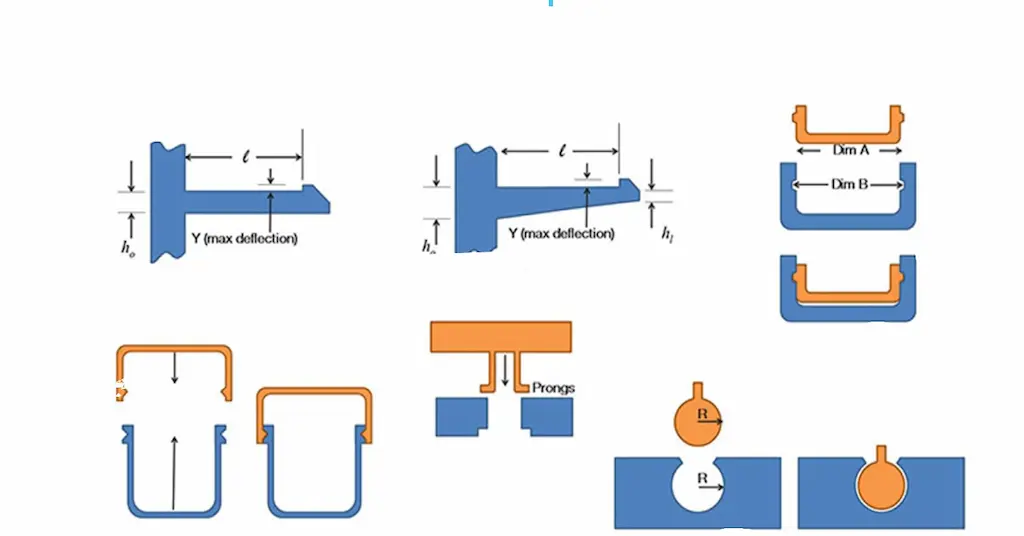
Based on the geometry and interlocking mechanisms, there are four common types: cantilever, U-shaped, torsion, and annular snap joints. Each of them has its own approach to joining. Let’s discuss these snap-fit types shortly;
1. Cantilever
The cantilever snap fit refers to the “ cantilever arm or beam” as a snap, a fee end that interlocks with a groove or channel of negative geometry on the receiving part. During the process, the cantilever deforms slightly to fit into the cavity. Consequently, the cantilever can be a tapered hook at the tip, a sleeve, spherical, etc.
These are popular in injection molded and 3D-printed plastic parts for both permanent and disassemblable joints. Strain, bending, and excessive deformations are three challenging issues that need to be considered throughout the process.
2. Annular Snap Fits
A simple example of annular fits is the pen and pen cap, how a cap fits to cover the tip. The small extended sections on the circumference of symmetrical round or cylindrical components fit with the counterpart when forced into it.
Annular snap fits can handle high stress without misalignment. It uniformly transforms the force across the components. Additionally, they are more complex in design and require an accurate calculation of the pushing force.
3. Torsional Snap Fits
Torsional or torsion snap fits are characterized by their twisting phenomena to securely fit with the cavity. The extended snap is designed for twisting or un-twisting for assembly and separation, respectively. During the fitting, the flexible arm is forced into the cavity, and it perfectly fits together, creating a strong joint. These are the durable joints that can be applied to metal, plastic, and rubber products.
4. L and U- Shape Snap Fits
As the name suggests, these snap-fit types contain either L or U-shapes of cantilever beams that fit to counterpart cavities or grooves. They are common in door-locking systems, electrical enclosure assemblies, etc. L and U-shaped snap-fit joints are strong and also facilitate the easy separation of assembled components. However, it can be easily deformed relative to other types.
How to Make the Sanp Fits?
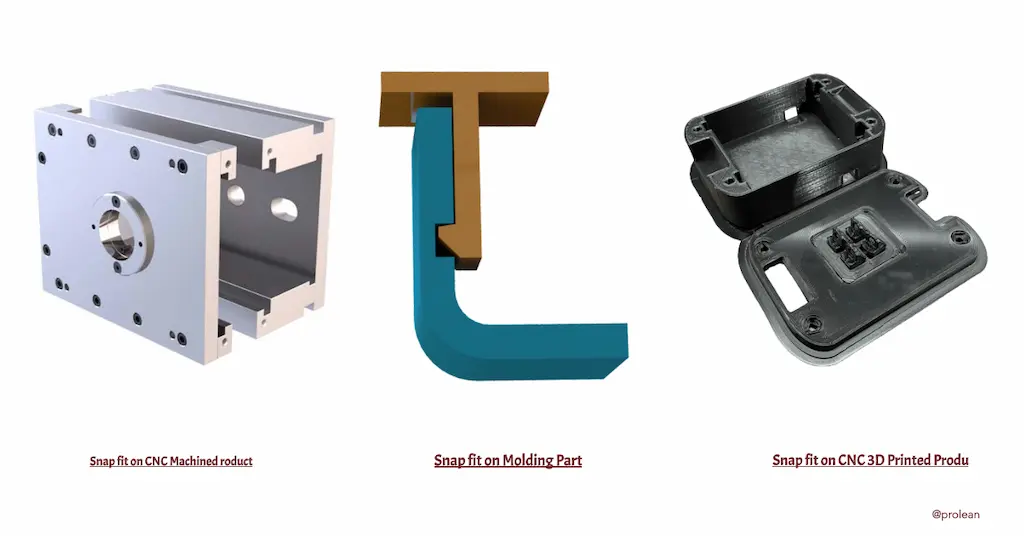
Snap fits are not like nuts and bolts that are separately manufactured to join two or more mechanical parts. Instead, they are integrated into the parts. The male and female parts of snap-fitting are designed along with the individual components themselves.
Snap fits and manufacturing methods
These types of fittings are applicable for CNC machining, injection molding, and 3D printed parts to assemble them into a single item.
CNC Machined Snap Fits
Typically, these fits are used in custom CNC machining parts. If they are complex, it can take more time and cost to machine them. Additionally, small and intricate features can also be challenging to create accurately. If design parts have straight arms and simple grooves, CNC can be a suitable option.
Snap Fits in Injection Molding Parts
It is common to join injection molding plastic parts with snap-fit joints. ABS, PP, Nylon, and various other materials are injection molded with a mold or die, where snap-fit elements are integrated into the design. They are cost-effective for large-volume production due to the efficiency of the process. Furthermore, injection molding accommodates complex snap shapes, undercuts, retaining tabs, etc.
Snap Fits in 3D Printing Parts
Another common use of snap-fit joints is in 3D printed parts. The 3D printers allow quickly assemble the parts with these fittings, especially for prototypes and small-batch production. It also allows higher flexibility items of snap and groove shapes.
Engineering Parameters Used in Snap-fit Design
- Beam Dimensions: Length, thickness, and width of the beam that deflects while fitting.
- Fillet Radius: Radius of the rounded curve at the bottom where the beam meets the main wall body.
- Allowable Strain (ε): Allowable beam deflection per unit length. It is governed by standard beam-bending equations.
- Aspect ratio (L/t): It is the ratio of beam length and wall thickness.
- Q-factor: It is considered that the base wall holding the snap is not completely rigid, especially in cantilever beams. Refined strain e = 1.5(tY)/(L²Q).
- Modulus of Elasticity(E): It represents the stiffness of the material, how much the beam can deflect/bent without any crack or failure.
Try Prolean Now!
Designing the Snap Fit Joints
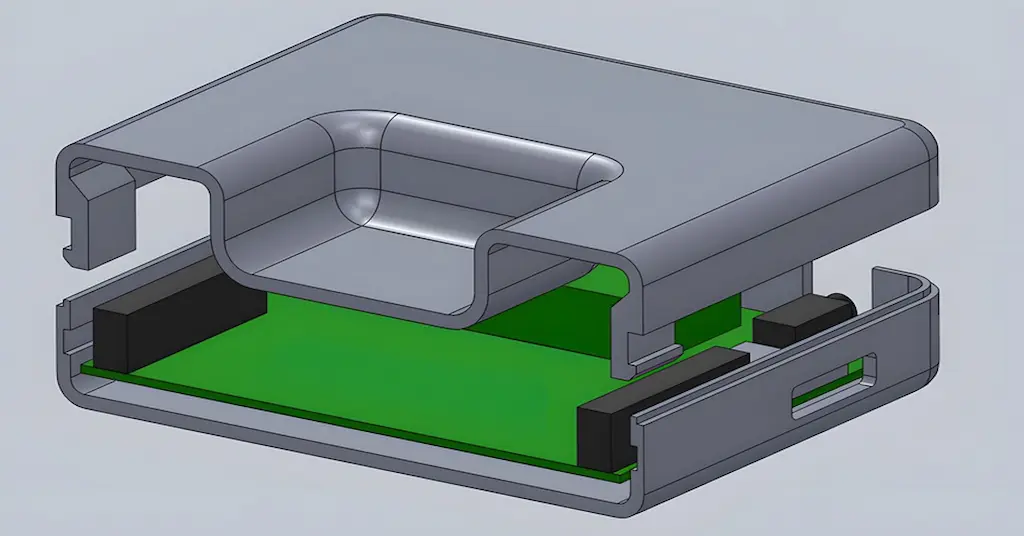
Snap fit design
Here are some snap fit design tips you can consider for better manufacturability and performance;
- Use Correct Clearance
Sufficient engagement between mating interfaces is essential for a strong interlock, whereas too tight can also cause overdeformation. Therefore, correct clearance is essential between them.
- Add a Fillet Around the Cantilever Corner
The sharp cantilever corners concentrate the joint stress, which can lead to cracking or joint failure. So, add fillets around the sharp corner to distribute the concentrated stress.
Fillet size = 0.5 x base thickness
- Variable Calculation
According to the snap-fit types and material, calculate and use the optimal variables like possible defection, retention force, etc.
- Tapering the Male Part of the Snap Fit
Again, tapering the snap allows for the distribution of the stress more uniformly and controls the deformation of mating interfaces.
- Permanent Joints
If the snap fits need to be made permanent, you can use a 90° hook and recess to achieve this.
- The Clip Width
Maintain the 5 mm minimum length of the clip to avoid excessive deformations and surface cracking.
Snap-fit Vs Other Fastening Methods
| Parameter | Snap-Fit | Screw | Nut & Bolt | Welding | Adhesive Bonding |
| How does it work? | A beam is pushed to engage the undercut/groove. | A driver applies torque to join two surfaces/parts | A bolt is driven into the material, and the nut is tightened. | Material-level bonding through controlled melting & solidification | An adhesive agent joins two surfaces by simply applying and curing. |
| Assembly Speed | Very fast assembly | Low-moderate speed | Moderate, two-sided access is required | A fast, but skilled operator or automation is needed. | Moderate due to cure time |
| Disassembly | Cantilever is reversible, but annular is permanent | Fully reversible | Fully reversible | Non-reversible | Non-reversible |
| Part count reduction | It eliminates fasteners entirely | Adds a discrete fastener | Adds two components | None | None |
| Load-bearing capacity | Low-moderat | Moderate-high | High | Very high | Moderate |
| Material compatibility | Thermoplastics, such as Nylon, POM, PP, ABS | Plastics and metals | Primarily; Metals | Metals and weldable thermoplastics | Dissimilar materials, metals, plastics, and composites |
| Fatigue resistance | Good if the strain is below the elastic limit | Prone to loosening | Good with lock washers | Excellent | Good |
| Cost | High upfront for mold tooling | Low | Low | Moderate | Moderate |
| Typical applications | Enclosures, consumer electronics, automotive trim | General assembly, sheet metal, plastics | Structural, high-load, serviceable joints | Structural steel, chassis, pressure vessels | Composite panels, electronics, dissimilar-material joints |
Applications Examples of Snap Fitting in Various Products
The use of snap-fit joints is everywhere, in electronic enclosures, furniture, automotive parts, medical diagnostic equipment, and many more. The table below highlights the common application examples;
| Industry | Application Examples |
| Electronics |
– Electrical connectors – Consumer electronics – Battery covers – Laptop and smartphone housing |
| Consumer Goods |
– Bottle caps and Pen caps – Container lids – Product packaging – Home appliance housing – Toys |
| Automotive |
– Interior components – Panel assembly – Headlight and lighting fixtures – Dashboard parts |
| Furniture |
– Plastic hinges – Drawer runners – Modular furniture assembly |
| Others |
– Ball-and-socket joints – Articulation points in action figures – diagnostic devices |
Snap Fit Materials
Thermoplastics are the primary material choices for snap fits, as they offer elasticity, tensile strength, fatigue strength, and flexibility. ABS, PP, Nylon, PC, and other plastics can be used based on load requirement and desired application. In some cases, spring steels and other metals are also chosen for snap-fit design.
Let’s look at the list of snapfit materials below;
- ABS: It is relatively rigid than other plastics and is also susceptible to stress whitening.
- Polypropylene (PP): PP has excellent fatigue resistance, and also provide maximum strain.
- Nylon: Nylon reduces stiffness in snap-fit design and also absborbs the impacts.
- Polycarbonate(PC): It provides excellent impact strength and is more thermally stable.
- Acetal / POM: It is known for low-friction, good springback, and wear resistance.
Try Prolean Now!
Summing Up
The snap fits are an easy way to join parts together, as no additional operations or components are needed to fit them together. They can be used for metal, plastic composites, and rubbers made from various techniques, such as CNC machining, 3D printing, and Injection Molding. Moreover, their different types or variations allow manufacturers to tackle different complexities and requirements.
If you need mechanical parts with snap fits or other assembly features, ProleanTech is a reliable partner for your project. We have an advanced manufacturing factory with technology experts. For further information, you can send us your design and get a quote!
FAQs
What is the appropriate force for snap fits?
The appropriate force for snap fits depends on material properties, joint design, and the application. Moreover, it needs to balance the ease of assembly and disassembly with the required retention strength.
What is the snap fit principle?
The snap-fit uses flexible geometries that temporarily deform during assembly, allowing two parts to lock together.
How to choose the right snap fit types?
Choosing the right snap fit type depends on factors like material, load requirements, ease of assembly, and disassembly frequency.


0 Comments