
Different stainless steel grades
Stainless steel is a widely used carbon steel alloy in modern manufacturing, available in 5 types and 150+ grades. Some popular grades are SS 304, 304L, 316, 410, 316L, and 430. Most grades differ in their sets of properties. A slight change in composition can result in a significant improvement in performance.
You can get distinct combinations of strength, hardness, corrosion resistance, machinability, and resistance to chloride exposure across different stainless steel grades. Consequently, some grades are even different in their metallurgical structures.
Choosing the right grade is critical in stainless steel machining to determine the feasible machining route, machining difficulty, cutting parameters, cooling strategy, and project cost. It also influences whether the machined part will fulfill the end-use requirements.
This article will elaborate on different types of stainless steel grades, their properties, machining characteristics, and how you can choose the right type of grade for your project.
Key Takeaways
- The choice of stainless steel grades depends on corrosion environment, chloride, exposure, machining/fabrication method, and desired mechanical properties.
- Grade 304 is the default/general-purpose grade, whereas 303 has higher machinability, but comes with a trade-off of corrosion resistance.
- 316 is chosen over 304 when chlorides, marine environments, de-icing salts, or mild chemical exposure are present.
- 304L and 316 L are low-carbon variants, which are chosen for selected for improved weldability and resistance to sensitization
- 410 and 420 are martensitic, heat-treatable grades chosen when hardness, wear resistance, and edge retention matter more than corrosion resistance.
Stainless Steel Introduction and Why There Are So Many Grades?
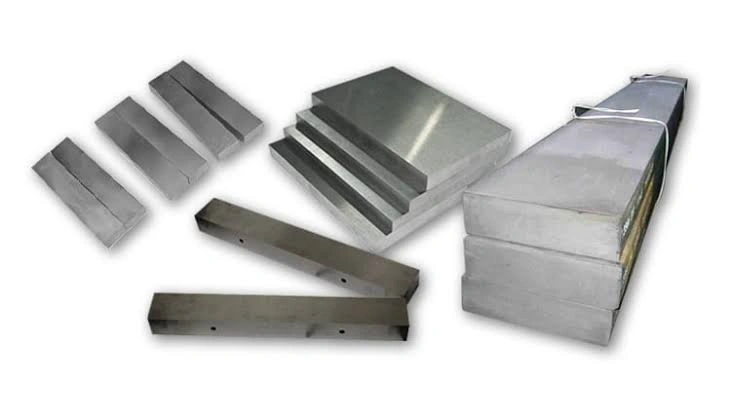
Stainless steel materials
Stainless steel is an engineering alloy made with iron, chromium, nickel, and other elements. Chromium is the major alloying element, which is added in the composition, a minimum of 10.5% by weight. Chromium forms a passive oxide layer on the surface and provides corrosion resistance. The level of resistance depends on the type of stainless steel and the particular grade.
There are five types of stainless steels.
- Austenitic Stainless Steel: It is characterized by austenitic micro-structure (FCC lattice), contains high chromium, and is highly corrosion resistant.
- Ferritic Stainless Steel: It involves a ferritic microstructure and contains high chromium with little or no nickel content.
- Martensitic Stainless Steel: It is characterized by high carbon content in the alloying composition along with 11.5–18% chromium.
- Duplex Stainless Steel: Duplex SS is composed of a mixed microstructure, austenite and ferrite.
- Precipitation hardening (PH) Stainless Steels: A high-strength, corrosion-resistant alloy, known for exceptional mechanical properties, achieved through precipitation hardening
Beyond the stainless steel types, there are different stainless steel grades, categorized based on grouping the different alloy compositions, the strengthening mechanism, and specific applications.
Having too many grades means engineers and manufacturers do not need to sacrifice one property to achieve another. They can select an alloy grade that provides the desired combination of corrosion resistance, strength, hardness, toughness, weldability, temperature resistance, machinability, and cost.
Now, let’s discuss different stainless steel grades individually.
| Grade | Family | Key Distinguishing Element | Corrosion Resistance | Machinability | Application Examples |
| 201 | Austenitic (Cr-Mn-Ni) | Low-Ni, N-strengthened | Lower than 304 | Work-hardenes, needs sharp tools | Low-cost kitchenware, appliances |
| 202 | Austenitic (Cr-Mn-Ni) | Higher Mn/Ni than 201 | Good (indoor) | Difficult, work-hardens | Appliances, food-processing equipment |
| 205 | Austenitic (Cr-Mn-Ni) | Very low Ni, high Mn/N | Moderate | Long, gummy chips | Structural fabrication, conveyor chains |
| 301 | Austenitic | Low Cr/Ni, high springback | Moderate | Moderate–difficult, work-hardens | Springs, wire-form products |
| 302 | Austenitic | Higher C than 304 | General | Moderate–difficult | High-stress stampings, springs |
| 302B | Austenitic | High Si (2–3%) | Good + oxidation resistant | Moderate | Furnace components, heat-resistant fixtures |
| 303 | Austenitic (free-machining) | Added S (0.15–0.35%) | Poor–moderate | Excellent | Fasteners, fittings, high-speed CNC parts |
| 303Se | Austenitic (free-machining) | Se instead of S | Poor–moderate | Excellent | Screws, bushings, screw-machine parts |
| 304 | Austenitic | General-purpose baseline | High | Moderate | Pressure tanks, food equipment, and general parts |
| 304L | Austenitic | Low-C version of 304 | High (weld-stable) | Moderate | Welded assemblies |
| 304N | Austenitic | N-strengthened 304 | High (better pitting) | Moderate | Structural/pressure components |
| 305 | Austenitic | High-Ni, low work-hardening | Good | Comparable to 304 | Deep-drawn parts, fasteners |
| 308 | Austenitic | Low-C, high-Cr filler alloy | Good | Moderate (heat buildup) | Welding rods, food vessels |
| 310 | Austenitic | High Cr-Ni, heat-stable | Good | Difficult | Furnaces, high-temp fixtures |
| 316 | Austenitic | Mo-added (“marine grade”) | Excellent (chloride) | Difficult (~40% of free-machining steels) | Marine, chemical, pharma equipment |
| 316F | Austenitic (free-machining) | High S/P, lower Mo | Slightly less than 316 | Better than 316 | CNC fasteners, valve parts |
| 316H | Austenitic | Higher C, boron added | Good | Moderate | Boilers, high-temp chemical parts |
| 316L | Austenitic | Low-C version of 316 | Excellent (weld-stable) | Moderate | Marine hardware, desalination |
| 321 | Austenitic | Ti-stabilized | Excellent (elevated temp) | Difficult | Aircraft exhaust, high-temp piping |
| 384 | Austenitic | High-Ni, low work-hardening | Moderate | Moderate | Cutlery, cold-drawn flanges |
| 409 | Ferritic | Ti-stabilized | Poor (chloride) | Better than 304/316 | Automotive exhaust systems |
| 410 | Martensitic | Basic Cr, heat-treatable | Moderate | Easy (annealed) | Blades, surgical tools, turbine blades |
| 420 | Martensitic | Higher C than 410 | Moderate | Improved via annealing | Knives, valves, gears, bearings |
| 434 | Ferritic | Mo-added | Good | Better than 304/316 | Automotive trim, appliance parts |
| 904L | Austenitic (super) | High Cr-Ni-Mo-Cu | Excellent (pitting/crevice) | Difficult, tool wear | Chemical/petrochemical, desalination |
| 17-4 PH | Precipitation-hardening | Cr-Ni-Cu-Nb | Good | Easy pre-aging, hard post-aging | Aerospace, pumps, medical instruments |
Try Prolean Now!
201 Stainless Steel
Stainless Steel 201 (AISI 201 / UNS S20100 / EN 1.4372) is an austenitic Cr-Mn-Ni alloy often used as a low-cost alternative to 304. However, it is more prone to corrosion and work-hardening.
Alloy Composition: 16–18% Cr, 3.5–5.5% Ni, 5.5–7.5% Mn, 1% Si, 0.15% C, and 0.25% N.
Useful Properties: High strength, good ductility & formability, and material strengthening with nitrogen while reducing nickel.
Machining Characteristics: Work-hardening tendency, sharp tools are required.
Limitations: Lower corrosion resistance than 304.
Application Examples: Kitchen equipment, sinks, appliances, architectural & decorative items.
202 Stainless Steel
Stainless steel 202 (202 AISI/1.4373 EN) alloy that contains relatively more nickel and manganese. It is more cost-effective than 300-series alloys and still offers good corrosion resistance in indoor environments.
Alloy Composition: 17–19% Cr, 4–6% Ni, 7.5–10% Mn, 0.15% C, 1% Si, and 0.25% N
Useful Properties: General corrosion resistance, good strength, and cold-forming capability.
Machining Characteristics: Similar to 201, work hardening risk, and difficult to machine.
Limitations: It is not selected when higher machinability is required.
Application Examples: Kitchen appliances, architectural components, and food-processing equipment.
205 Stainless Steel
In 205 stainless steel (AISI 205 / UNS S20500 ), the nickel content is reduced 1.75%, and instead it contains a higher amount of manganese and Nitrogen. It offers excellent tensile strength and yield strength, compared to SS 201 and 202.
Alloy Composition: 16.50 to 18% Cr, 14 to 15.5% Mn, 1 to 1.75% Ni, 0.12 to 0.25 % C, 0.030% P, 0.030 S, 0.50 % Si, and up to 0.4 % N
Useful Properties: Relatively high strength, good ductility, and an austenitic structure despite very low nickel content.
Machining Characteristics: High strength and work hardening can increase cutting forces and make chip control challenging.
Limitations: Less commonly available and long & gummy chips while machining.
Application Examples: Structural fabrication, conveyor chains, cooking appliances, and beverage equipment.
301 Stainless Steel
Compared to other 300-series Cr-Ni austenitic grades, 301 stainless steel has the lowest chromium and Nickel content: 16-18% and 6-8%, respectively. It offers high tensile strength while retaining formability. Standardization specifications are AISI 301, UNS S30100, and EN 1.4310.
Alloy Composition: 16-18% Cr, 6-8% Ni, 2 % Mn, 1 % Si, 0.045 % P, and 0.030 % S.
Useful Properties: High ductility, formability, and cold rolling/drawing capability while retaining the springback.
Machining Characteristics: Moderate-to-difficult machinability and high work-hardening tendency.
Limitations: High work-hardening rate and susceptibility to sensitization during welding
Application Examples: Spring items, utensils, conveyor parts, and wire-form products.
302 Stainless Steel
302/UNS S30200 stainless steel has high chromium and carbon content. It provides higher mechanical strength than other austenitic grades with a lower carbon content. 302 contains a higher % of carbon and provides more toughness than SS 304.
Alloy Composition: 17-19% Cr, 8-10% Ni, 0.15 % C, 2.00 % Mn, 0.045% P, 0.030% S, and 1 % Si.
Useful Properties: Corrosion resistance (general), excellent toughness, ductility, thermal resistance with retained toughness, and good cold-working response.
Machining Characteristics: Moderate-to-difficult machinability; strong tendency to work harden; controlled cutting conditions are mandatory.
Limitations: Higher susceptibility to sensitization than 304 and stress corrosion cracking
Application Examples: High-stress parts and springs, household appliances, and metal stamping production
302B Stainless Steel
What makes 302B (AISI 302B / UNS S30215) different from 302 is the higher silicon content (2 to 3%) in its alloying composition. It is a specialized grade with improved high-temperature oxidation resistance while retaining the austenitic stainless steel combination of corrosion resistance, ductility, and toughness.
Some common applications of 302B grade include furnace components, heat-resistant fixtures, bars, coils, and structural strips.
303 Stainless Steel
303 stainless steel is an excellent choice for high-speed CNC machining projects, as the sulfur content (0.15 – 0.35% ) provides machinability and easier chip breaking. It is commonly specified under ASTM A582/A582M for cold-finished bar products.
Alloy Composition: 17- 19% Cr, 8-10% Ni, 0.15 % C, 2% Mn, 0.15 – 0.35% S, 0.20 % P, 1% silicon, and a minor amount of Cu.
Useful Properties: Good corrosion resistance (indoor), dimensional stability, ductility, and moderate thermal resistance.
Machining Characteristics: Excellent among different stainless steel grades under the austenitic family, better chip control, and can be processed with high-speed machining.
Limitations: Poor weldability and compromised corrosion resistance.
Application Examples: Industrial hardware, fasteners, automotive fuel injectors, hydraulic fittings, and instrumentation bushings.
Try Prolean Now!
303Se Stainless Steel
Like 303, 303Se is also a free-machining austenitic grade; the only difference is that it uses Selenium (0.15%) as an additional machinability-enhancing element. The inclusion of selenium improves the chip-breaking properties. Some useful standardizations for 303Se are UNS S30323 and EN 1.4948.
303Se is suitable for high-volume turning, drilling, tapping, and screw-machining operations. Some application examples are screws, fittings, bushings & shafts, and small-sized industrial components.
304 Stainless Steel
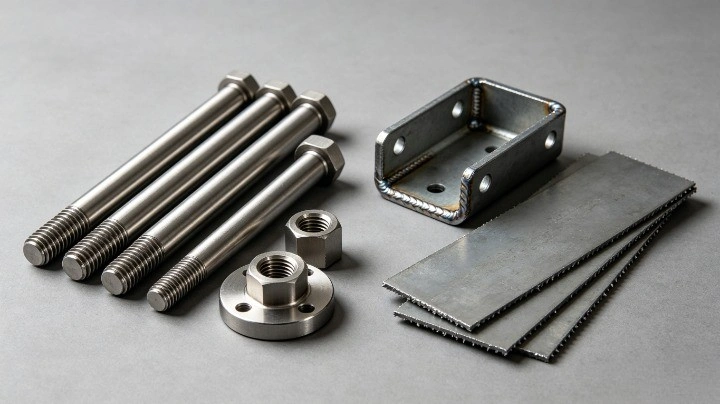
303 and 304 stainless steels
Type 304 stainless steel is a general-purpose corrosion-resistant stainless steel alloy. This austenitic alloy contains high chromium (up to 19.5%), which helps form a passive self-healing layer on the surface, thereby achieving excellent corrosion resistance.
Alloy Composition: 17.5 to 19.5 % of Cr, 8.0 to 10.5 of Ni, 0.07 % C, 2.0 % Mn, 0.75 % Si, 0.045 % P, and 0.030% S.
Useful Properties: High corrosion resistance, good ductility, excellent thermal resistance, weldability, and resist oxidation up to 870 °C.
Machining Characteristics: Moderate machinability, and 304 possesses the risk of work hardening at low feed rates and shallow cutting depth.
Limitations: Chloride-induced pitting and work-hardening
Application Examples: Pressure tanks, food-processing components, fasteners, and general-purpose machining parts
Read more: 4140 vs 4340 Stainless Steel
304 L Stainless Steel
The main difference between 304 Vs 304L stainless steel is the carbon content: 304L contains ~0.030% carbon, and Nickel content can be as high as 12%. Otherwise, all other alloy chemistry is the same.
The reduced carbon content lowers the tendency for chromium carbide formation during welding. Therefore, it is preferred over type 304 stainless steel when parts need to be assembled with welding joints.
304 N Stainless Steel
304N / UNS S30451 stainless steel contains added nitrogen content in its composition (~0.10–0.16% N). Here, nitrogen acts as a strengthening agent, improving yield and tensile strength. Additionally, 304N provides enhanced resistance to pitting compared to 304 and 304L.
When to Choose 304 N over 304 and 304 L?
Choose 304N over 304 and 304 when your applications require higher strength without compromising corrosion resistance. For instance, structural and pressure components.
18/8 Stainless Steel
18/8 Stainless steel refers to the alloy that contains 18% chromium and 8 % Nickel, rather than specifying all the compositions. The 18 8 stainless steel properties are similar to the 304 grade. But the main difference between 18-8 Stainless Steel Vs 304 is that 304 is the standardized grade, but not every alloy marketed as 18-8 necessarily meets the complete specification for 304.
305 Stainless Steel
305 stainless steel (AISI 305/ UNS S30500/ EN 1.4303) is a high Nickel content alloy, which increases the austenite. It offers excellent cold-working properties and corrosion resistance under moderate oxidizing conditions.
Alloy Composition: 17 to 19% Cr, 10.50 to 13% Ni, 2% Mn, 1% Si, 0.12 % C, 0.045% P, abd 0.030% S
Useful Properties: Comparable elongation and tensile strength, slow work-hardening rate, good pitting resistance, good fusion weldability, and good workability for forming operations.
Machining Characteristics: No free-machining properties and machinability comparable to 304.
Limitations: No cost advantage over type 304 stainless steel.
Application Examples: Deep-drawn components, fasteners, shells, and utensils.
308 Stainless Steel
308 stainless steel (AISI 308/1.4303 DIN/1.4316 EN) is a low-carbon, high-chromium alloy. The structure is austenitic (face-centred cubic).
Alloy Composition: 19 to 21% Cr, 10 to 11% Ni, < 2% Mn, 1 % Si, < 0.08 % C, 0.045% P, 0.030% S, and balanced Fe.
Useful Properties: Excellent thermal resistance, toughness retention at elevated temperatures, and excellent weldability (conventional techniques).
Machining Characteristics: Ductile chips and heat buildup. It requires controlled feeds and coolant flow
Limitations: Workhardening and prone to chloride corrosion.
Application Examples: Filler wires, welding rods, food-processing vessels, and automotive trims.
Try Prolean Now!
310 Stainless Steel
Stainless steel 310 (AISI 310 / ASTM 310 / UNS S31000) is a high-Cr-Ni alloy primarily used for elevated-temperature applications due to its austenitic stability.
Alloy Composition: 24 to 26% Cr, 19 to 22% Ni, 2% Mn, 0.25 % C, 1.50 % Si, and 0.030% S.
Useful Properties: Excellent thermal stability, good ductility & corrosion-resistance, and good weldability.
Machining Characteristics: Difficult to machine than 308 and risk of hot-cracking
Limitations: Reduced formability and high material cost
Application Examples: Heat furnaces, recuperators, cement plant components, heat-treating fixtures, and refractory support parts.
316 Stainless Steel
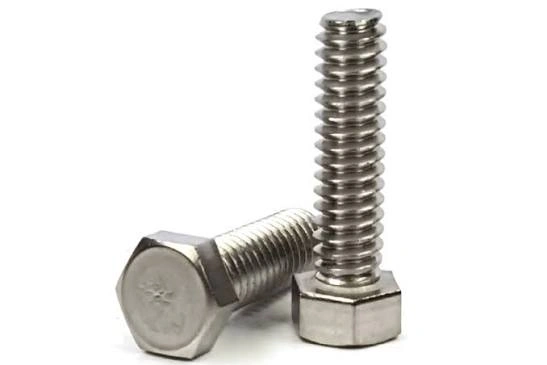
316 stainless steel bolts
Stainless steel 316 (AISI 316 / EN 1.4401) is known as “marine grade” because the added molybdenum provides excellent corrosion resistance in marine and corrosive environments. But it has only 40% machinability compared to free-machining carbon steels.
Alloy Composition: 16 to 18 % Cr, 10 to 14 % Ni, 2-3 % Mo, 2 % Mn, 1 % Si, 0.08% C, 0.045 % P, and 0.030% S.
Useful Properties: Strength retention at elevated temperatures, good chloride resistance, good weldability, and chemical resistance.
Machining Characteristics: Work hardening, heat buildup tendency, and gummy chips.
Limitations: Chloride stress-corrosion under high temperature and stress, costlier than 304, and machining difficulty.
Application Examples: Nut & bolts, marine equipment, chemical processing components, offshore piping & structural components, pressure vessels, and pharmaceutical equipment.
316F Stainless Steel
Stainless steel 316F ( AISI 316F/1.4427 EN) contains a higher amount of sulfur and phosphorus than 316. It includes 0.20% P, 0.10% S (min.), and reduced molybdenum (1.75 to 2.50%). All other compositions are similar to 316.
316F is easier to machine than 316, but is slightly less corrosion-resistant. Some common application examples are CNC-turned fasteners and fittings, threaded bushings, valve parts, and pulp/paper processing components.
316H Stainless Steel
Compared to 316 stainless steel material, 316H stainless steel (AISI 316H/EN 1.4919) contains a higher carbon content (0.04% to 0.10%) and additional Boron (up to 0.005%). This alloy can maintain the strength and creep resistance at elevated temperature (up to 500°C).
Some common applications of 316H alloy include boilers, chemical processing components, refining plant parts, and power generation plant parts.
316L Stainless Steel
It is a low-carbon alloy, containing only about 0.03% carbon at most, whereas it is up to 0.08% for 316 stainless steel material; otherwise, the amounts of all other alloying elements are nearly identical to those in 316. C316L provides excellent weldability along with corrosion resistance in welded joints.
Common applications of 316L stainless steel include marine hardware, coastal infrastructure, petroleum refining, and water desalination plants.
321 Stainless Steel
The alloying composition of 321 stainless steel includes titanium at least ~5 x C to stabilize the carbon, along with other common alloying elements. The inclusion of titanium is intended to achieve high mechanical strength and intergranular corrosion resistance at elevated temperatures.
Composition: 17 to 19% Cr, 9 to 12 % Ni, 2% Mn, 1 % Si, 0.030% S, 0.045% P, and Ti ~5 x C (min.).
Useful Properties: Strength and corrosion resistance up to 900 °C, high weldability, toughness, and creep strength.
Machining Characteristics: Difficult to machine, tool-edge wear, and high work-hardening
Limitations: Prone to work hardening, higher cost than 304 and 316, and low resistance to chloride pitting.
Application Examples: Aircraft engine & exhaust components, chemical processing components, high-temperature piping, and expansion joints.
Try Prolean Now!
384 Stainless Steel
384 Stainless Steel (AISI 384 / UNS S38400) is a high-nickel alloy, known for ductility and low work-hardening rate. It provides excellent cold-forming capabilities.
Composition: 15 to 17 % Cr, 17 to 19 % Ni, 2% Mn, 0.08% C, 1% Si, 0.030% S, and 0.045% P.
Useful Properties: Ductility, resistant against mild corrosive conditions, cold working properties, and moderate weldability with conventional techniques.
Machining Characteristics: Moderate machinability, stringy chips, and risk of heat buildup.
Limitations: Relatively higher cost and unsuitable for severe chloride environments, and
Application Examples: Cutlery, industrial valves & shafts, fasteners, steam turbine blades, and cold-drawn flanges.
409 Stainless Steel
409 stainless steel (AISI 409 / UNS S40900) is a ferritic stainless steel stabilized with titanium. This alloy grade provides excellent resistance against exhaust-gas corrosion and withstands thermal cycling.
Composition: 10.50 to 11.75% Cr, 0.50 % Ni, 1 % Mn, 0.08% C, 1 % Si, 0.045 % S, 0.045 % P, and Titanium (6xC/0.75).
Useful Properties: Oxidation resistance at elevated temperatures, thermal fatigue strength, magnetic properties, and considerable mechanical strength.
Machining Characteristics: Higher machinability than 304 & 316, low work-hardening tendency, and lower risk of heat build-up.
Limitations: Poor corrosion resistance with chloride exposure, surface discoloration, and staining.
Application Examples: Automotive exhausts, catalytic converters, industrial exhausts, and heater tube fins.
410 Stainless Steel
Stainless Steel 410 (AISI 410/ EN 1.4006) is a martensitic steel alloy, including Chromium as the main alloying element. It offers good strength and hardness, and can be further strengthened through heat treatment.
Composition: 11.50 to 13.50 % Cr, 1 % Mn, 1% Si, 0.15% C, 0.040 % P, and 0.030% S.
Useful Properties: Moderate corrosion resistance, easy to machine, wear resistance, and magnetic. Type 410 is hardened by austenitizing and quenching, followed by tempering, whereas annealing is generally used to soften the alloy and improve machinability.
Machining Characteristics: Annealed 410 is easy to machine.
Limitations: It becomes brittle after quenching, is prone to pitting in chloride exposure, and loses temperature at elevated temperatures.
Application Examples: Blades, surgical tools, steam turbine blades, springs, and components for petrol refinery plants.
420 Stainless Steel
Stainless steel 420 (AISI 420/ UNS S42000) is a martensitic alloy with relatively higher % of carbon (0.15 to 0.42 %) that offers enhanced strength & hardness compared to 410.
Composition: 12 to 14% Cr, 1 % Si, 1 % Mn, 0.15 to 0.42% C, 0.040% P, 0.030% S
Useful Properties: Higher hardness & dimensional stability after heat treatment, high tensile strength, and moderate corrosion resistance.
Machining Characteristics: Machinability can be increased through annealing.
Limitations: Unsuitable for chloride & marine exposures, difficult to weld, and poor resistance to heat (long exposure).
Application Examples: Valves, shafts, gears, bearings, cutlery & knife blades, and surgical instruments
434 Stainless Steel
Stainless steel 434( UNS S43400 / EN 1.4113) is a high-chromium ferritic alloy that provides high corrosion-oxidation resistance and good strength at elevated temperatures.
Composition: 16 to 18% Cr, 1 % Mn, 0.75 to 1.25% Mo, 1 % Si, 0.12 % C, 0.040% P, 0.030% S
Useful Properties: Good corrosion resistance, magnetic, bright surface, good formability, better dimensional stability than most other ferritic grades.
Machining Characteristics: Better machinability than 304 & 316 stainless steel material, longer, stringier chips.
Limitations: Not heat-treatable, poor weldability, reduced strength after 815°C, and low impact toughness.
Application Examples: Automotive trims & fittings, home appliance components, medical equipment, and decorative items.
904L Stainless Steel
904L Stainless Steel is a low-carbon austenitic grade with high chromium & nickel, along with the addition of copper. It offers excellent resistance to chloride pitting, stress-corrosion cracking, and crevice corrosion.
Composition: 19–23% Cr, 23–28% Ni, 4–5% Mo, 1–2% Cu, and ≤0.02% C
Useful Properties: High resistance to pitting, good ductility & formability, resistance to many mild acidic environments, and good weldability.
Machining Characteristics: High rate of work hardening, increased cutting-force requirements, and tendency to rapid tool wear.
Limitations: Higher material cost, difficulty machining, low yield strength, and limited availability.
Application Examples: Chemical-processing, petrochemical, and desalination equipment.
17-4 PH Stainless Steel
17-4 PH stainless steel(UNS S17400/AISI 630) is a martensitic precipitation-hardening stainless steel alloyed primarily with chromium, nickel, copper, and niobium. This alloy provides higher strength and hardness than conventional austenitic grades, along with good corrosion resistance.
Composition: 15–17.5% Cr, 3–5% Ni, 3–5% Cu, 0.15–0.45% Nb + Ta, ≤0.07% C, ≤1% Mn, and ≤1% Si, balanced Fe.
Useful Properties: High strength-to-weight ratio, high hardness, good toughness, and general corrosion resistance.
Machining Characteristics: 17-4 PH can be machined in the solution-treated/condition, but is difficult after aging.
Limitations: Low corrosion resistance in aggressive chloride or acidic environments, and properties vary with heat-treatment conditions.
Application Examples: Aerospace components, pumps and impellers, valves and fittings, shafts, gears, fasteners, medical instruments, and industrial tooling.
Try Prolean Now!
Factors to Consider while Choosing the Right Type of Stainless Steel Grade
The right type of stainless steel grade depends on the requirements of your project, application environment, manufacturing method, and decorative needs.
The table below gives a general reference for the consideration factors and which grade is optimal for different conditions.
|
Requirement |
Considered Grades |
|
General corrosion resistance |
304 |
|
Chloride/corrosion resistance |
316 |
|
High formability |
301, 304 |
|
Machinabilty |
303 |
|
High hardness/Heat treatment |
410, 420 |
|
Welded components |
304L, 316L |
|
Elevated-temperature |
309, 310, 321 |
|
High-strength applications |
17-4 PH |
|
Decorative Needs |
304, 316 |
|
General low-cost applications |
201, 409, etc. |
What Are the Common Service Finishing Techniques for Stainless Steel Parts?
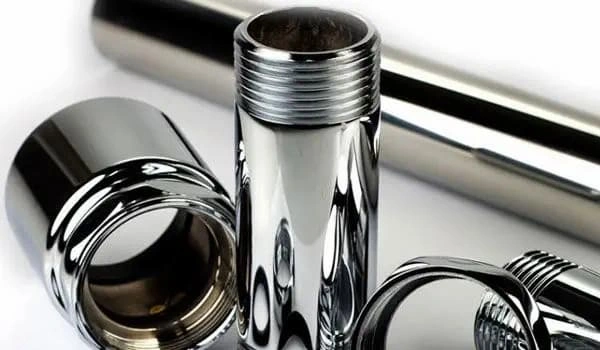
Chrome-plated steel
Manufactured Stainless Steel parts ( CNC-machined, Cold-formed, Casted) are often processed with surface finishing methods to improve surface uniformity, smoothness, and aesthetic appearance.
- CNC Grinding: It is used to remove surface marks, welds, scratches, and defects.
- Polishing: Polished surface reduces roughness significantly and can provide a bright to mirror finish to stainless steel parts.
- Electroplating: Nickel, Chrome, Zinc, and other secondary metals can be plated on stainless steel parts. ( Read more: Electroless Nickel Vs. Stainless Steel)
- Beadblasting: It is suitable to achieve a uniform, low-reflectivity texture on stainless steel parts.
- Passivation: It is a chemical treatment approach to achieve a clean passive surface and improve corrosion resistance.
Need High Quality Stainless Steel Parts? Get an Engineer-reviewed Quote Today
If you are looking for outsourcing stainless steel parts or prototypes, ProleanTech can deliver high-quality results with the customization you need. Our stainless steel service includes multi-axis CNC machining, sheet metal forming, casting, laser cutting, and waterjet cutting.
Our services include everything from DFM optimization and grade selection to post-processing of manufactured items. Regardless of your industry and production volume, our experience and advanced technologies can turn your design into functional parts/products.
Before moving into production, review the key requirements for your stainless steel parts, including grade selection, machinability, dimensional tolerances, production volume, and finishing requirements. These factors can influence the appropriate manufacturing process, material condition, cost, and final part performance.
To get started, upload your design and request a quote today.
References
- https://www.nciclean.com/documents/Stainless%20Steel.pdf
- https://www.atlassteels.com.au/documents/Atlas%20Grade%20datasheet%20-%20all%20datasheets%20rev%20Aug%202013.pdf
- https://steel-sci.com/assets/outokumpu-stainless-steel-handbook.pdf
- https://store.astm.org/a0380_a0380m-17.html
- https://www.secotools.com/article/challenges_in_stainless_steel
- https://worldstainless.org/wp-content/uploads/2025/02/Module_05_Corrosion_Resistance_of_Stainless_Steels_en.pdf
0 Comments