
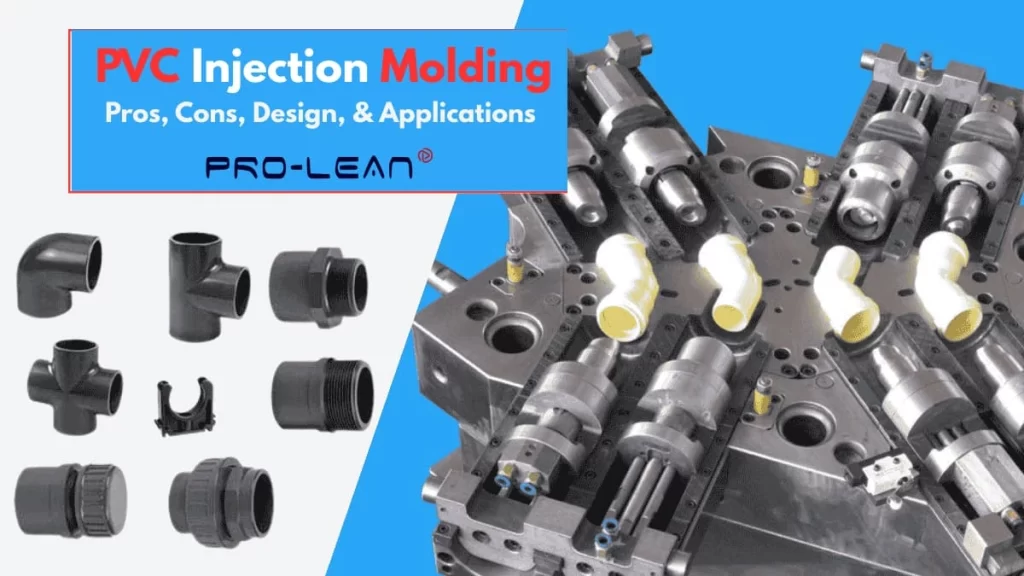
PVC injection molding
Injection molding is one of the key methods in plastic part manufacturing, enabling the production of desired parts in large volumes while maintaining consistent accuracy, finish, and quality. You can shape a wide range of thermoplastics with molding, including polyvinyl chloride (PVC).
Both flexible and rigid PVC pellets can be utilized for injection molding to produce strong, durable, impact-resistant, and flame-retardant parts.
The upcoming sections will cover PVC materials, processing characteristics, pros and cons, preferred applications, and associated molding challenges.
Let’s get started.
What is PVC Plastic?
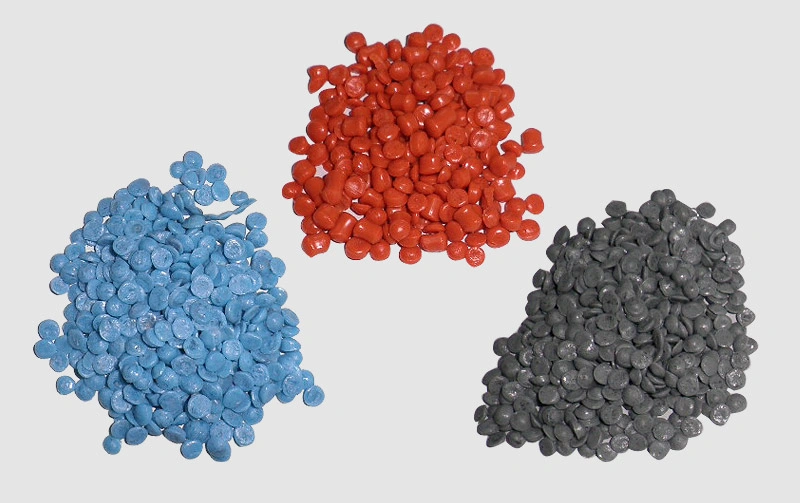
PVC plastic pellets
Polyvinyl chloride, or PVC, is a thermoplastic polymer developed by B.F. Goodrich in the 1920s. This material is known for excellent chemical resistance, mechanical strength, durability, and electrical insulation.
PVC plastics are used across automotive, medical, consumer goods, pipe & fittings, electronics, and other industries.
Next, there are two common types of PVC pellets: flexible and rigid PVC.
- Flexible PVC: PVC that contains a plasticizer, known for its flexibility, impact resistance, and ease of molding.
- Rigid PVC (uPVC): It refers to the unplasticized form and offers higher stiffness, tensile strength, chemical resistance, machinability, and structural rigidity.
Moreover, PVC can be colored and opaque, based on mixed additives in its composition.
Properties and Characteristics of PVC
Durability, chemical resistance, good mechanical strength, electrical insulation, and self-extinguishing are the key characteristics of PVC. Additionally, PVC is versatile and available in rigid and flexible grades.
Next, let’s look at the table below for PVC’s properties.
|
Property |
~ Value |
|
Density (g/cm³) |
1.1–1.6 |
|
Tensile Strength (MPa) |
40–80 |
|
Elongation at Break (%) |
Up to 330 |
|
Flexural Modulus (GPa) |
0.22–6.43 |
|
Flexural Yield Strength (MPa) |
50.7–104 |
|
Melting Temperature (°C) |
100–260 |
|
Dielectric Constant |
3–8.00 |
|
Water Absorption (%) |
0.04–0.4 |
Can PVC be Injection Molded?
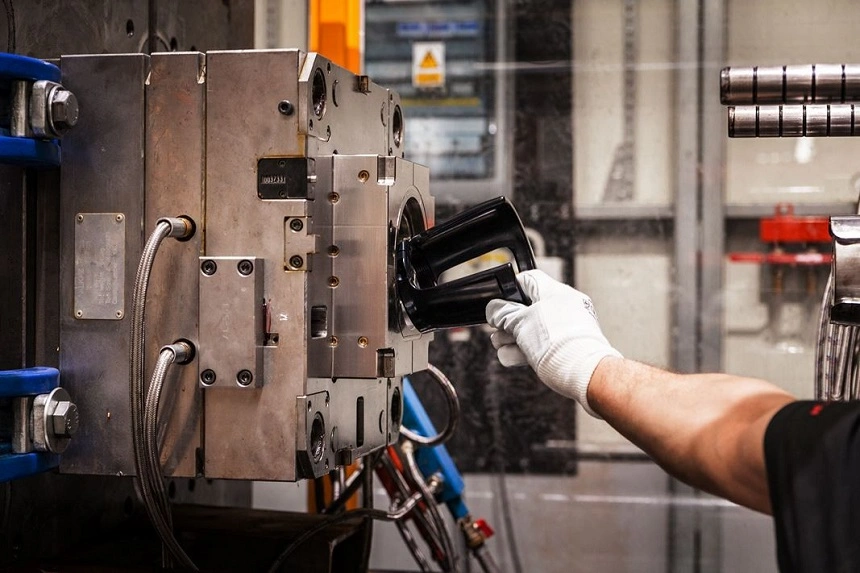
PVC molding process
Yes! You can use PVC as an injection molding raw material to produce diverse parts & products. Being a thermoplastic polymer, it can be melted and reshaped into the desired form by solidifying in a mold.
The PVC Processing difficulty depends on whether you are using rigid or flexible PVC pellets. Flexible PVCs are considered more injection-molding-friendly than uPVC. You can shape complex parts of PVC with wall thicknesses of 0.85 to 1.25 mm, with tight tolerances, repeatability, and a textured or high-gloss finish. Additionally, they maintain dimensional stability over a long time.
What Are the Applications of PVC Injection Molding?
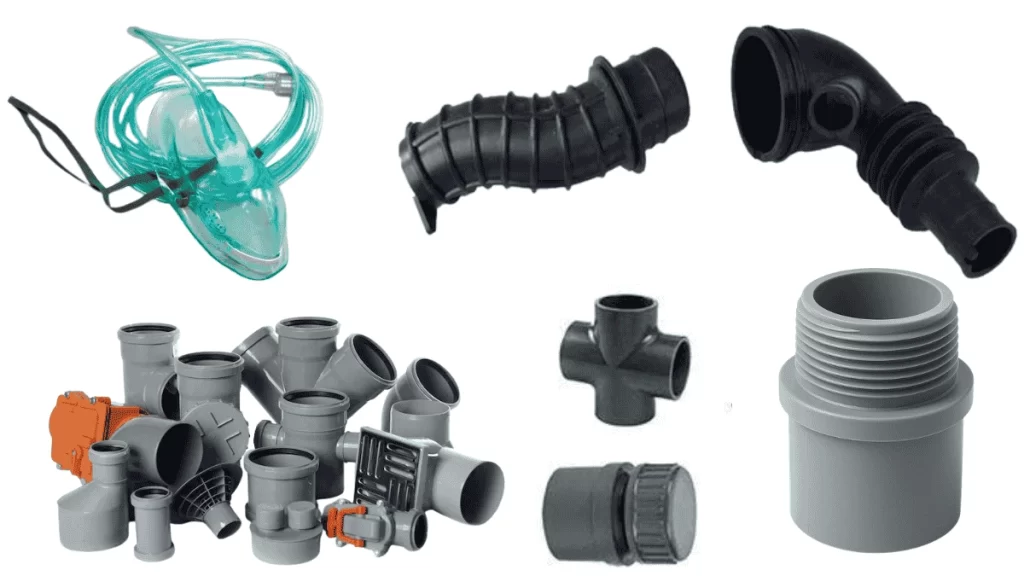
PVC processing items
PVC injection molding parts and products are used across multiple industries, including construction, medical, automotive, electronics, pipe & fittings, and consumer goods.
Let’s break down the PVC injection molding applications with examples.
Construction
Rigidity, impact resistance, and weather resistance make PVC a good material choice for construction applications. E.g, window profiles, flooring, drain traps, swimming pool components, and conduit fittings.
Automotive
Flexibility, vibration damping, corrosion resistance, and lightweight of PVC are beneficial for auto parts. You can injection mold car interior parts, dashboards, trims, door panels, grommets, battery caps, and many other components using PVC injection molding.
Medical
Various medical-grade PVCs are used to mold medical tubing, catheters, oxygen masks, IV bags, fluid adapters, and components of diagnostic equipment.
Electronics
In the electronics industry, insulators, connector housings, plug tops, socket covers, instrument housings, solar panel casings, and many other components can be made from PVC polymers.
Consumer Goods
Common injection-molded PVC consumer goods include bottles, bottle caps, storage containers, shower fittings, appliance knobs, light shades, and garden hoses.
Pipe and Fittings
The water resistance, impact strength, durability, and chemical resistance of PVC benefit pipe & fitting applications. Common applications include water supply lines, sewer pipes, rainwater gutters, and vent fittings.
What Are the Advantages of PVC?
Flame retardancy, chemical resistance, durability, versatility in use, minimal environmental impact, electrical insulation, and cost-effectiveness are the main advantages of PVC.
Let’s briefly look at each of these PVC advantages:
- Flame Retardancy: PVC resists flames, providing enhanced safety in electrical insulation and construction applications.
- Chemical Resistance: PVC does not react with many acids, alkalies, fuels, oils, alcohols, and many other chemicals.
- Durability: Injection-molded PVC components can last 5 to 20+ years, depending on the PVC grade and application environment.
- Versatility: Since PVC is available in flexible and rigid forms, it offers design flexibility and versatility in use.
- Recyclability: PVC is 100% recyclable and has minimal environmental impact.
- Cost-benefit: PVC injection molding can produce large volumes of designed parts at competitive rates.
- Electrical Insulation: Due to its high dielectric strength, PVC can withstand high-voltage shocks and insulate electrical current.
What Are the Disadvantages of PVC?
Heat sensitivity, a low-temperature limit for material deformation, loss of strength over time, and brittleness in cold environments are the four main disadvantages of PVC.
- PVC has relatively low thermal stability, typically < 60°C.
- The PVC material starts to deform above ~ 80°C.
- Over time, injection-molded parts start to lose mechanical strength.
- PVC becomes brittle in cold environments, which poses the risk of cracking.
Try Prolean Now!
Design Guidelines for PVC Injection Molding Parts
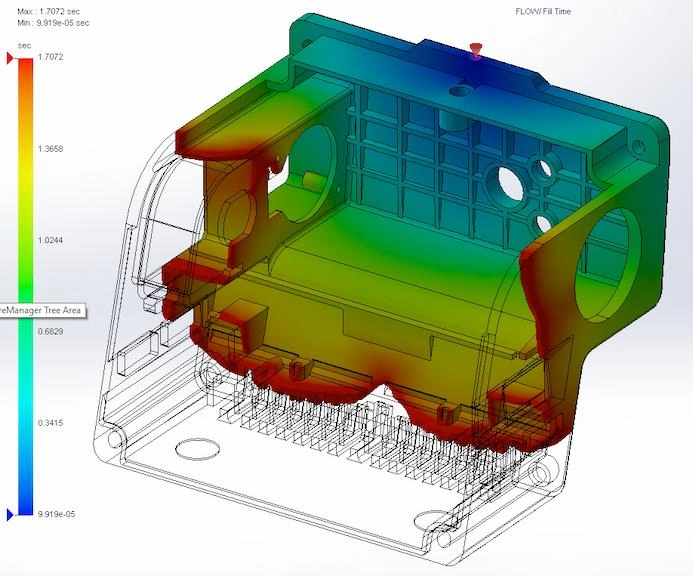
Injection molding design
The design of the injection-molded PVC part directly impacts manufacturability, defect risk, and cycle time. Therefore, you must follow design rules, including a minimum wall thickness, thickness transitions, shrinkage rate, outside & inside corner radii, draft angle, and tolerancing.
1. Maintain a Minimum Wall Thickness
Maintaining a minimum wall thickness is essential to prevent warping and surface depressions. The wall must be thicker than 0.85 mm for flexible PVC and 1.25 mm for rigid PVC, but it cannot exceed 6 mm.
2. Use Appropriate Thickness Transitions
In the sections where the thickness changes, the transition should not exceed 15% of the nominal thickness.
3. Consider the Shrinkage
Although PVC has a relatively low shrinkage rate of ~0.2 to 0.6%, consider this when choosing the wall thickness and gate size. It is essential to avoid warping, dimensional inaccuracy, and other defects.
4. Apply Inside and Outside Corner Radii
To distribute stress concentrations and reinforce the strength at sharp corners of PVC injection molding parts, the inside and outside corner radii must be 25-75% of the thickness.
5. Set a Suitable Draft Angle
Consider a draft angle of 0.5 to 1° on the vertical wall of the designed part. So, it can be easier to eject from the mold and also help to prevent scratches and drag marks.
6. Use Right Tolerances
When setting dimensional, positional, and other types of tolerances, consider the capabilities of the mold and injection molding equipment you are using. Try to make them uniform and do not set a tighter tolerance than needed. Otherwise, both production cost and time are increased.
PVC Injection Mold Design Considerations
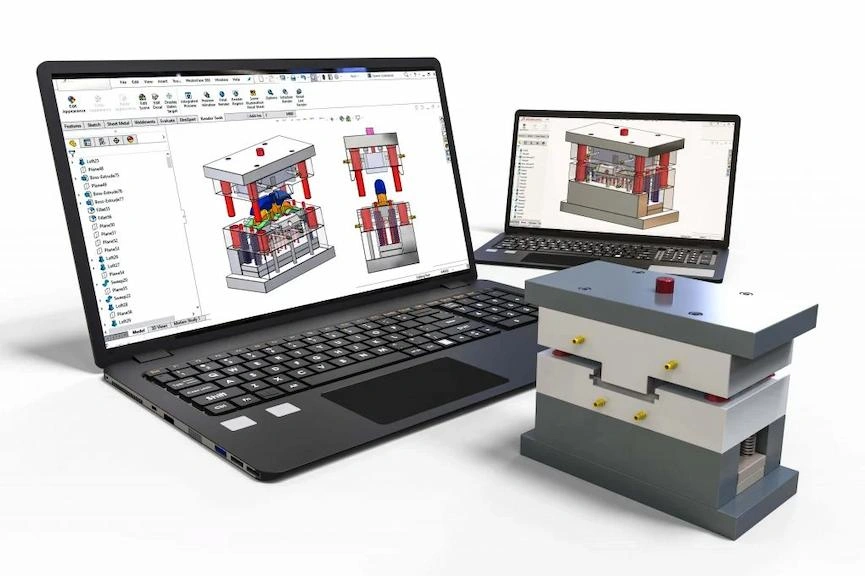
Injection mold design
A PVC mold must be designed to capture the cavity details and shape the parts without any defects. Consequently, correct mold design is also crucial for molding precision and speed.
Here are the key injection mold design rules for PVC parts:
- Choose the appropriate mold material based on the desired number of production cycles, such as aluminum and H13 tool steel.
- Select the right type of injection mold gate.
- Include a suitable cooling system for uniform mold cooling.
- Use air vents to prevent gas & air from becoming trapped inside the mold.
- Polish or add texture to the cavity wall, based on the surface finish requirements.
Step-wise Guide for PVC Injection Molding Process
There are multiple steps in PVC injection molding, including part design, tooling, material preparation, injection, packing & holding, part ejection, and post-processing.
Let’s break down the steps.
- Part Design: Create a detailed engineering design of the PVC part you want to mold, outlining dimensions, position, orientation, tolerances, etc.
- Tooling & Setup: Create the mold and install it on the injection molding machine with correct alignment with the injector.
- Material Preparation: Dry the PVC pellets and put them into the hopper.
- Feeding & Injection: Feed the pellets into the screw injector, where they melt, and the screw pushes through the injector nozzle, and ultimately into the mold cavity.
- Packing & Holding: Pack the mold and hold it for a pre-determined time for cooling, so the molten PVC can fill and capture the cavity’s details.
- Part Ejection: Open the mold after solidification using the ejection pin or other mechanism the mold has.
- Post-processing: Process molded PVC parts with trimming, polishing, or other techniques to remove surface imperfections and improve finish
Factors to Consider for PVC Processing
Precise control of PVC processing at every stage of molding is essential for production efficiency, quality, and part accuracy. There are several factors to consider when processing PVC using injection molding, including moisture content, back pressure, screw speed, PVC grade, and pellet melting temperature.
Moisture
Ensure there is no moisture on the pellet by drying it before passing it into the injector from the hopper.
Back Pressure
Maintain a minimum backpressure of 0.35–0.86 MPa (50-125 psi) to achieve better molten flow. A correct backpressure relative to screw speed helps improve cycle time without compromising part quality.
Screw Speed
Choose the correct screw speed to push the pellets. If the speed is too high, it causes pellets to overheat. On the other hand, a slower speed can result in incomplete mold filling.
PVC Grade
While setting the PVC processing variables in the injection molding machine, consider which PVC grades are used and how they respond to the process.
Melting Temperature
The pellet melting temperature and mold temperature must be chosen carefully. For melting, < 195 °C, and 20 to 60 °C for the injection mold.
Try Prolean Now!
PVC Melting Point and Why it Matters?
Based on the type of PVC (rigid or flexible), the presence of additives & plasticizers, and other factors, the melting temperature for PVC ranges from 100–260°C. It means the PVC has a fluctuating melting point, and you must identify the precise melting temperature during injection molding.
So, the melting point matters in PVC injection molding due to the following reasons.
- If the PVC pellets are heated below their melting point, it results in poor molten flow inside the mold.
- Overheating the pellets can lead to feed burning.
- The melting point also impacts the temperature control in the molding process.
- Setting incorrect melting points causes surface imperfections and defects.
Common Issues and Imperfections Caused by the Incorrect Melting Point of PVC
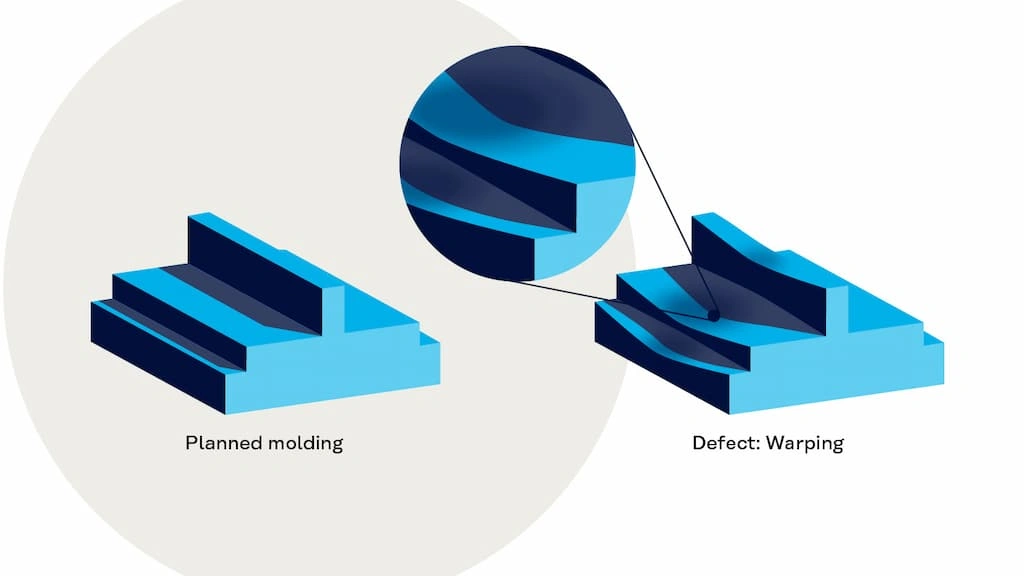
Injection molding defect
Setting an incorrect melting point (barrel temperature) in PVC injection causes issues like short shots, dimensional inaccuracies, warping, and feed overheating. Consequently, molding parts suffer from different defects and surface imperfections, such as burn marks, flow lines, sink marks, and poor finish.
| Issue/Defect | Description |
| Short Shots | Low melting temperature reduces the viscosity and causes short shots |
| Dimensional Inaccuracies | Improper melting causes shrinkage and dimensional inaccuracies |
| Warping | It impacts cooling uniformity and causes warping |
| Burn Marks | High melting temperature leads to burning feed that causes burn marks on the part. |
| Flow Lines | Material cools or flows unevenly, and visible streaks or wave-like marks appear on the part. |
| Sink Marks | Localized shrinkage and surface depressions |
Are there Any Alternatives to PVC?
High-Density Polyethylene (HDPE), Polypropylene(PP), and Thermoplastic Elastomers (TPE) can provide similar characteristics to PVC, such as impact strength, chemical resistance, and moldability.
When choosing an alternative, first decide why PVC is not the best fit and what properties you need for the intended applications.
Why ProleanTech Excels in Custom Injection Molding Services?
PVC processing for custom injection-molded parts requires a strategic execution plan, mold & part design optimization, process variable selection, and continuous process monitoring. At ProleanTech, we have an advanced molding facility and a team of experienced engineers to address these requirements.
Our injection molding service can produce intricate part geometries with fine details, incorporating inserts, hinges, and supports. We can work with multi-cavity molds and modular mold systems for maximum customization.
Summing Up
Overall, PVC polymer can be injection molded with high accuracy, repeatability, and quick production cycles. PVC also retains its original properties, regardless of the shape or form it is converted into during the molding process.
Considering the specific material properties, part & mold design, process variables, and equipment capability, you can achieve high-quality results.
FAQ
What is PVC?
PVC is a thermoplastic polymer available in both flexible and rigid forms.
What is the cheapest plastic to injection mold?
Low-density polyethylene (LDPE) and polypropylene (PP) are considered the cheapest plastics to injection mold, as raw materials are cost-effective and they are easy to process.
Can you melt PVC into a mold?
Yes, you can melt PVC into a mold, but it requires strict temperature control.
0 Comments