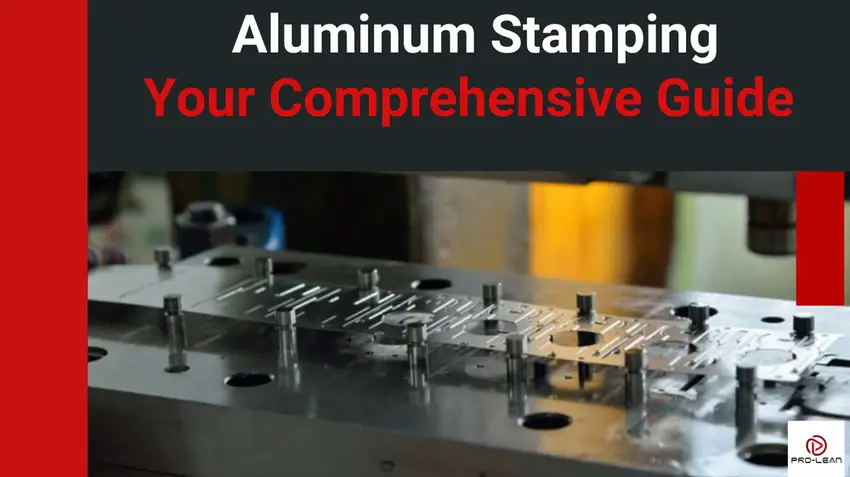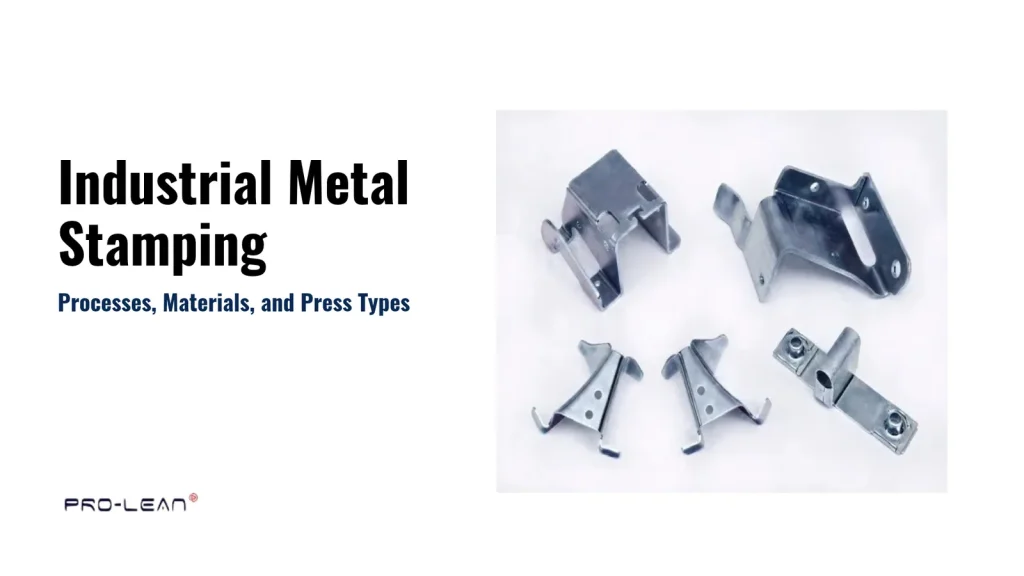
Metal stamping uses a press and a stamping die to cut and form flat metal sheets into parts. The process typically handles sheet thicknesses from 0.2 mm to 6 mm, with press capacities ranging from 20 to 2,500 tons. Depending on the part design and production volume, a stamping run can produce thousands or even millions of parts. Common operations include blanking, punching, bending, and piercing.
You’ll find stamped parts in cars, planes, medical equipment, and many other products. When you need thousands of identical components, a metal stamp can quickly produce them and maintain consistent dimensions from one part to the next.
Before starting manufacturing, carefully review the part design and how it will be stamped. There are a few things that can make a real difference:
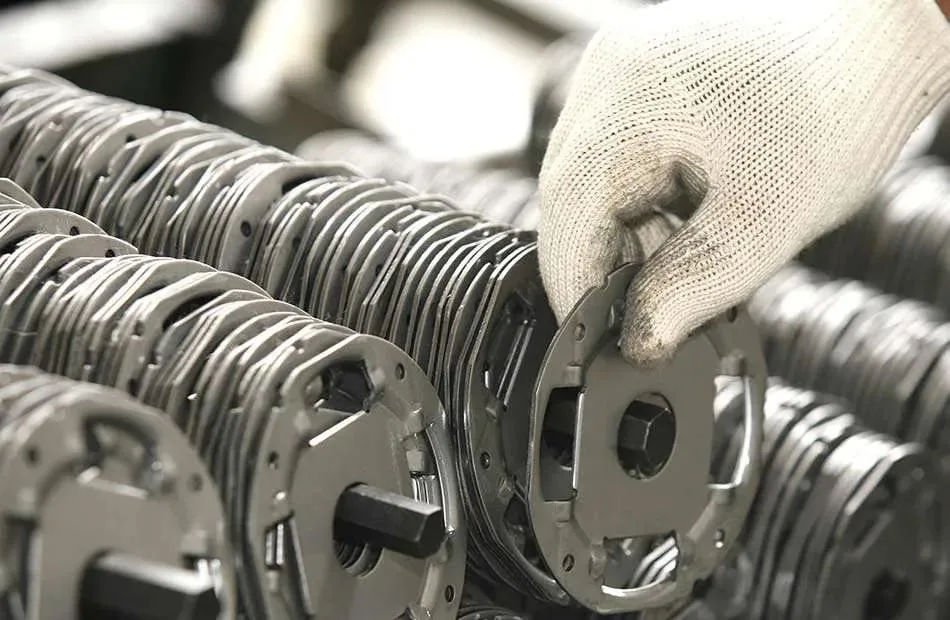
Custom metal stamped parts
- Part geometry: Tight bends, small holes, and narrow features can make stamping harder and increase the risk of cracking or distortion.
- Material selection: The metal must withstand forming without tearing or losing its required characteristics.
- Production quantity: High volumes may justify the cost of custom dies, while smaller batches may require a different approach.
- Tooling and press selection: The correct setup helps produce consistent parts and reduce scrap.
- Manufacturing costs: Material waste, additional operations, and tooling changes can all contribute to final part costs.
A piece may appear simple in a drawing, but it will require several additional stamping operations. A design review before creating tooling will help you identify these problems early and prevent unnecessary manufacturing costs.
How Industrial Metal Stamping Works
Industrial metal stamping uses a press and a stamping die to produce parts from flat metal stock. Coil or strip stock is fed through the press, where the die cuts and forms the material according to the part drawing. With each press stroke, the material moves through the required operation, and the cycle repeats until the required number of parts is produced.
The die must match the part dimensions, material, and thickness. Poorly designed or worn dies can cause:
- Dimensional variations
- Misaligned holes
- Incorrect bend angles
- Inconsistent parts
Types of Metal Stamping Dies
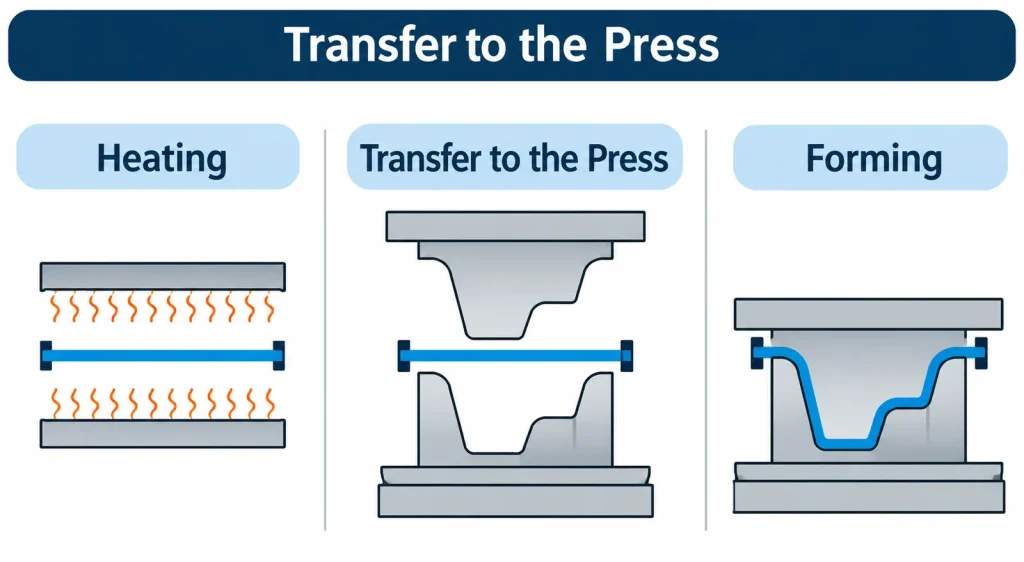
Press forming process overview
The choice of stamping die depends on the part design, size, and production volume.
- Progressive die: It performs several operations at different stations as the metal strip moves through the die. It is a good choice for high-volume production of small parts.
- Transfer die: Moves individual parts between stations for further operations. It is commonly used for larger or deep-drawn parts.
- Compound die: Performs cutting operations, such as blanking and piercing, in one press stroke. It suits flat parts that require multiple cuts.
- Single-station die: Performs one operation per press stroke. It is suitable for simple parts and lower production volumes.
When choosing a stamping service, consider the part geometry, material, production volume, and die type required.
Common Processes Used in Industrial Metal Stamping
Industrial metal stamping uses a press and dies to cut or shape sheet metal into specific parts. The process depends on the part design, material thickness, and required shape. Some parts require several steps, while others need only one operation.
Blanking in Industrial Metal Stamping
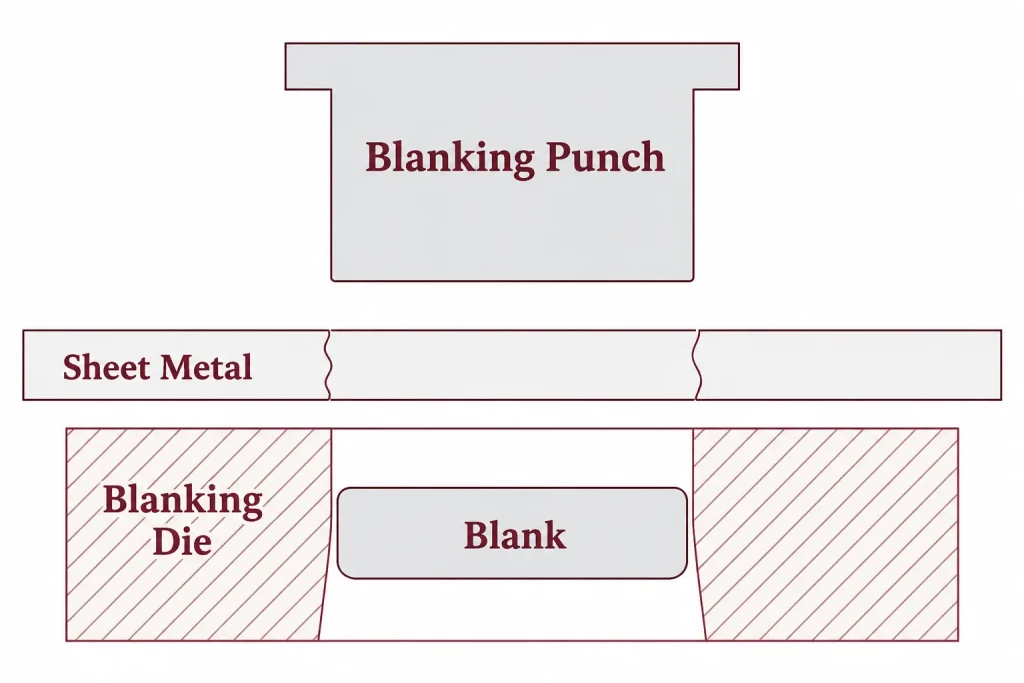
Blanking punch and die diagram
Blanking cuts a flat piece of metal from a larger sheet or spool. The cut piece, referred to as a blank, is the part or the starting material for further stamping. This is a commonly used process for washing machines, brackets, and flat metal components.
Piercing in Industrial Metal Stamping
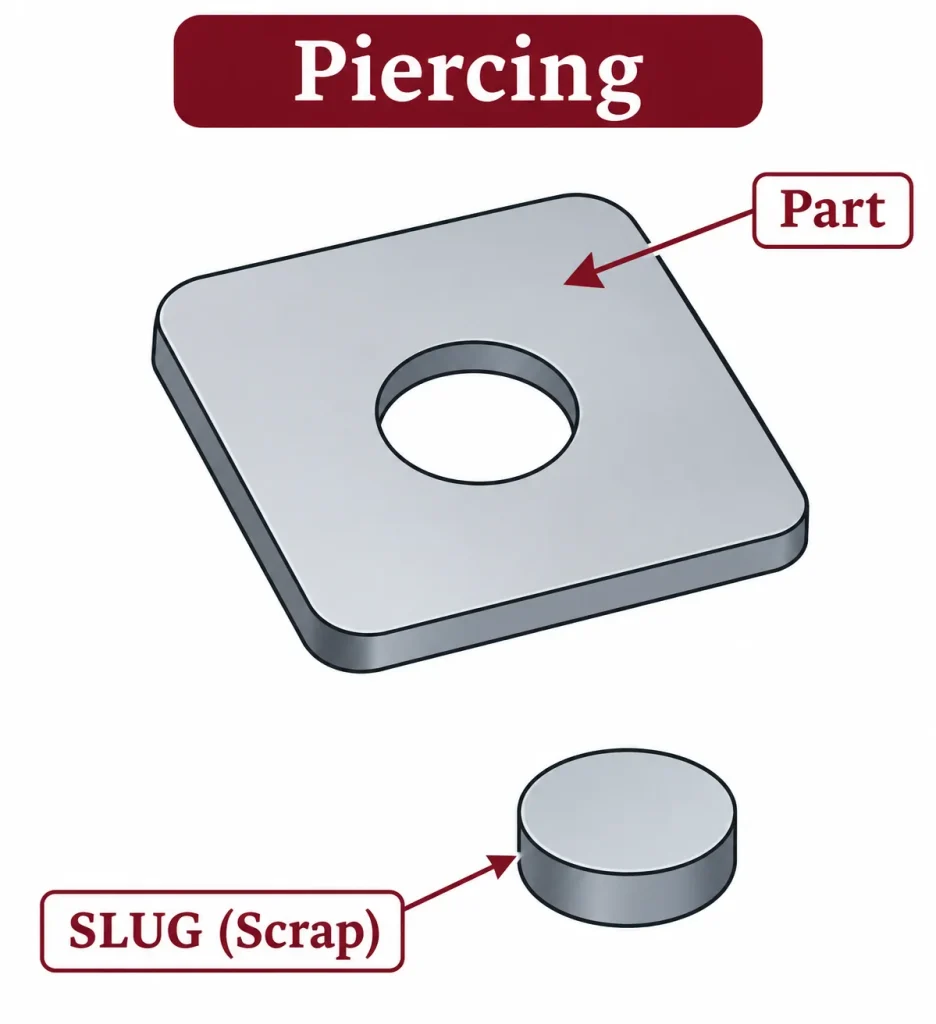
Piercing operation and scrap slug
Piercing creates holes, slots, and other openings in sheet metal, using punches and dies. It is often used to create mounting holes between brackets, panels, and enclosures. Piercing may be performed in the same stamping cycle as other operations.
Drawing in Industrial Metal Stamping
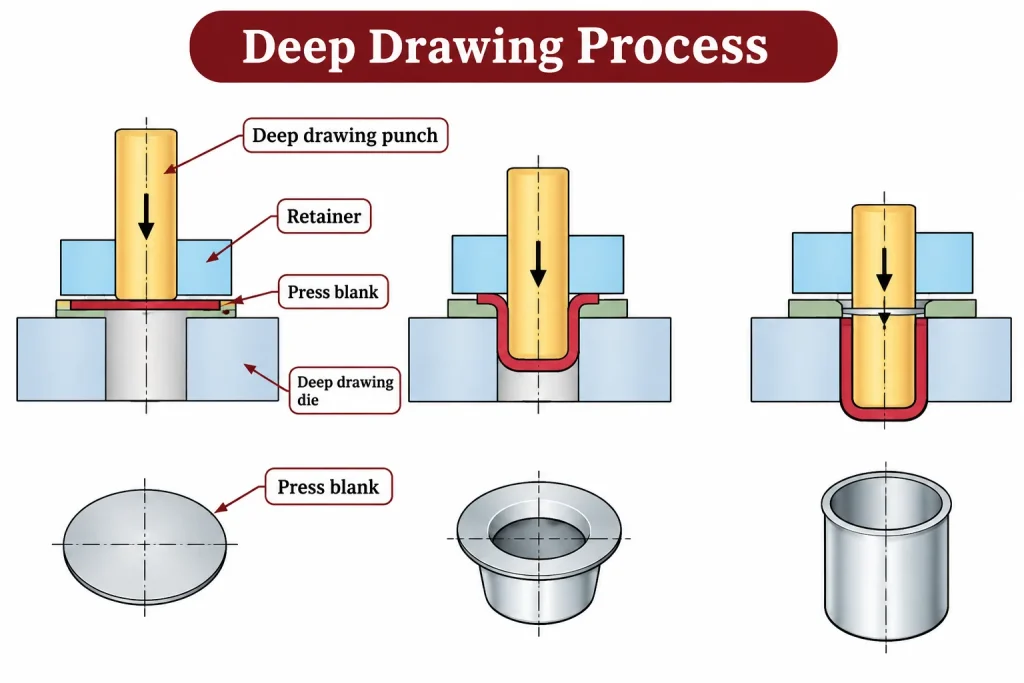
Deep drawing process infographic
Drawing converts a flat metal blank into a hollow shape such as a cup, cover, or housing. While the material flows into the required shape, a punch pushes the sheet into a die. The part’s depth and the metal’s stretchability affect how the process is conducted.
Bending in Industrial Metal Stamping
Bending changes the angle of sheet metal without cutting it. A punch presses the material into a die to create features such as flanges, corners, and edges. It is commonly used for brackets, reference plates, and metal housings.
Air Bending in Industrial Metal Stamping
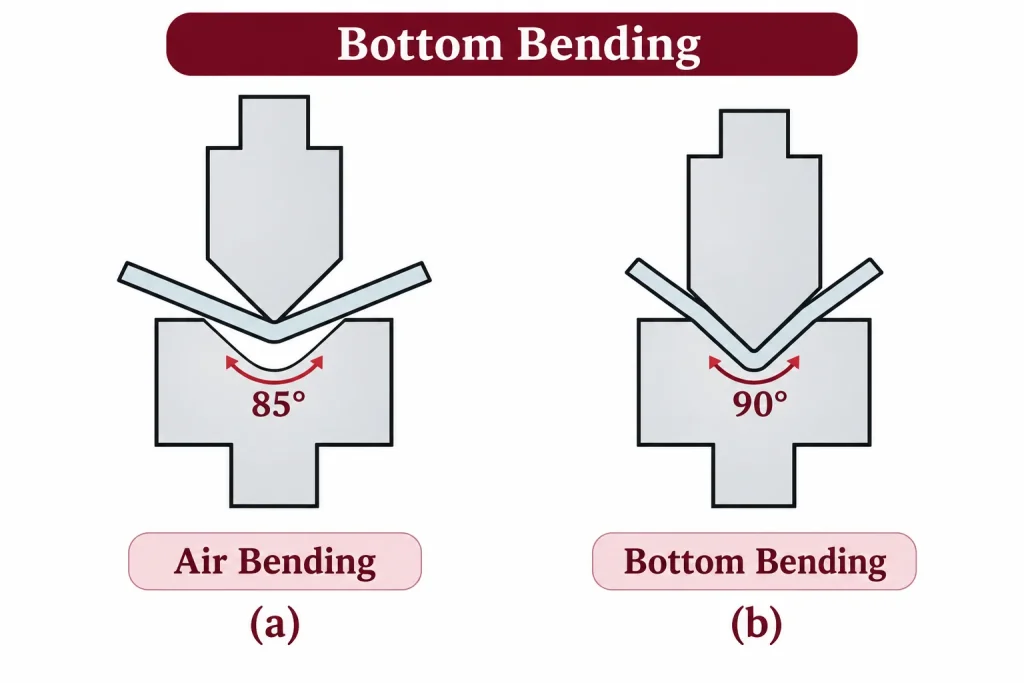
Air and Bottom Bending Diagrams
Air bending forms an angle by pressing sheet metal into a V-shaped die opening. The material touches the punch and the sides of the die, but does not fully touch the bottom. This method applies less force to the sheet metal, allowing different bending angles to be achieved with the same tool.
Bottoming and Coining in Industrial Metal Stamping
To create a defined bend, sheet metal is pushed firmly against the die. Coining exerts higher pressure to compress the metal within a particular area, controlling the shape and reducing springback. These methods require more force than air bending and are chosen when a part needs tighter shape control.
Forming in Industrial Metal Stamping
Forming creates features that go beyond simple curves. It includes ribs, ducts, curves, and offsets. These features can add stiffness and help a part fit with other components. The design of the die depends on the part’s form and material.
Pinch Trimming in Industrial Metal Stamping
Pinch trimming removes excess material from a shaped part by pressing between formed tooling surfaces. It can trim edges on some drawn or shaped components. The tooling must match the part’s shape to create the desired edge.
Lancing in Industrial Metal Stamping
Lancing cuts and bends part of sheet metal without completely disconnecting it from the surrounding material. It is used to develop tabs, vents, and openings where part of the metal stays attached. Because the cut section remains connected, lancing can eliminate scrap compared with material removal.
Tooling in Industrial Metal Stamping
Metal stamping tooling includes the die set and punches used to cut and form metal into the required shape. The tooling is designed according to the part dimensions, material, and thickness. For example, a bracket with holes and bent edges needs a die that can produce these features accurately.
Die material depends on the production volume and the metal being stamped. D2 and A2 tool steels are common choices, while carbide inserts are used for longer production runs where greater wear resistance is needed.
Die clearance also affects the quality of stamped parts. It is usually around 5% to 10% of the material thickness per side. Incorrect clearance can cause rough edges, burrs, and faster tool wear.
A well-maintained die can last hundreds of thousands of press hits, depending on the material and operating conditions. As the die wears, hole positions, cut edges, and part dimensions may become inconsistent.
Tooling is usually the highest upfront cost in a stamping project. A progressive die can cost around $8,000 to $40,000 and take 4 to 8 weeks to manufacture, depending on its complexity. This cost is spread across the order quantity, so the tooling cost per part decreases as production volume increases.
Types of Presses Used in Industrial Metal Stamping
Mechanical Presses: Mechanical presses are widely used in automotive metal stamping because they can quickly produce high quantities of parts. A flywheel-driven engine pushes the ram and drives the punch into the die. This makes mechanical presses suitable for sheet metal blanking, piercing, and bending. They are often used to stamp auto brackets, electrical contacts, device panels, and other parts made in large batches. The main limitation is that the ram’s motion follows a fixed mechanical cycle, so it offers less flexibility throughout the stroke.
Hydraulic Presses: Hydraulic presses use pressurized oil to move the ram. The operator can control press force and ram speed, which is useful when metal must expand and flow into a die without cracking.
Hydraulic presses are often used for deep drawing, when a flat sheet is formed into a beaker, tank section, or metal housing. They can also process large parts that require considerable forming power. Their major drawback is slower production than many mechanical presses, which makes them less suitable for jobs that require very high production rates.
Servo Presses: Servo presses use a servo motor to control the ram rather than rely on a conventional flywheel drive. The ram can slow down when forming and speed up through other parts of the stroke. These are useful when stamping parts with complex shape requirements, deep features, or areas where metal is likely to wrinkle or tear.
Servo presses are used in automotive and appliance manufacturing, especially when the forming process requires more control than a standard mechanical press. Because the ram motion can be adjusted to the production cycle, servo presses can also reduce energy consumption.
Materials Used in Industrial Metal Stamping
We stamp parts from different metals based on your design, operating conditions, and performance requirements.
|
Material |
Why Choose It? |
Example Parts |
|
Stainless steel |
Good corrosion resistance and strength |
Equipment brackets, clips, appliance panels |
|
Aluminum |
Lightweight and corrosion-resistant |
Enclosures, covers, automotive components |
|
Carbon steel |
Strong and cost-effective for many applications |
Mounting brackets, clamps, support plates |
|
Copper |
High electrical and thermal conductivity |
Electrical terminals, connectors, contact strips |
|
Brass |
Good conductivity and corrosion resistance |
Fittings, terminals, electrical contacts |
|
Beryllium copper |
Combines conductivity with spring properties |
Contact springs, connector clips, switch components |
|
Silicon steel |
Suitable magnetic properties for electrical equipment |
Motor laminations, transformer cores |
Need Custom Industrial Metal Stamping?
ProleanTech brings decades of manufacturing experience and ISO-certified quality management to custom part production. We work with a range of materials and manufacturing processes to meet your part requirements, from medium-volume orders to large-volume production runs.
Whether you need metal brackets, clamps, or other stamped components, send us your drawings and material specifications. Our team can review your requirements, discuss suitable production options, and provide a quote for your order.
Contact ProleanTech to discuss your project and request a quote.
FAQs
What affects the cost of metal stamping?
Cost depends on the part size, material, shape, and number of pieces required. Tooling may contribute to initial costs, particularly for custom components. For larger orders, tooling costs are distributed across more pieces.
Can ProleanTech make stamped parts to my design?
Yes, you can share your CAD file or engineering drawing for evaluation. The team can evaluate the dimensions, materials, and tolerances necessary to determine how to produce the part.
What should I provide when requesting a metal stamping quote?
Send your part drawing, materials and thickness requirements, expected order quantity, and critical tolerances where necessary. If you have a target delivery schedule, include it. These details will help the team assess the job and prepare a detailed quote.