
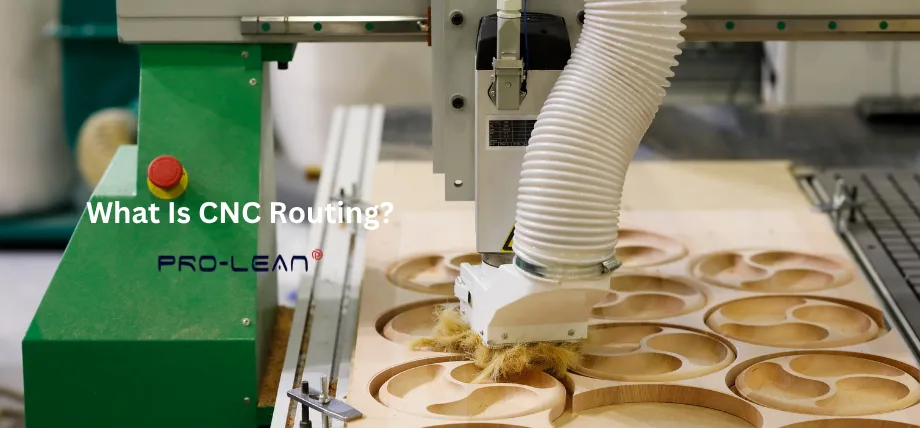
CNC Router in Action
CNC routing is an industrial subtractive manufacturing process in which a rotating cutting tool, usually a router bit, is guided by a computer numerical control (CNC) system. This helps in shaping materials such as wood, plastics, and soft metals.
A CNC routing machine, powered by G-code generated from CAD/CAM software, executes cutting, engraving, or forming of complex shapes on X, Y, and Z axes, with tolerances as tight as ±0.005 inches.
Proleantech offers high-quality, precise cutting through CNC routing machining and can handle large-size cutting with a precision of ±0.005”. We can produce engravings, markings, designs, and complex shapes along with CNC cutting.
Routing is suitable for applications in various industries such as woodworking, prototyping, and fabrication. The machine features a gantry, spindle, and controller, ensuring repeatability. There are desktop and industrial models designed to cater to hobbyists and large-scale industrial production, respectively.
How Does CNC Routing Work? Process of CNC Routing
The CNC routing process transforms a digital design into a physical part through a series of well-defined steps, utilizing computer control for absolute precision and efficiency.
This workflow combines design, programming, setup, and execution, taking center stage in woodworking, prototyping, and fabrication. Below are the detailed routing steps that define the CNC routing process:
Step 1: Design Creation
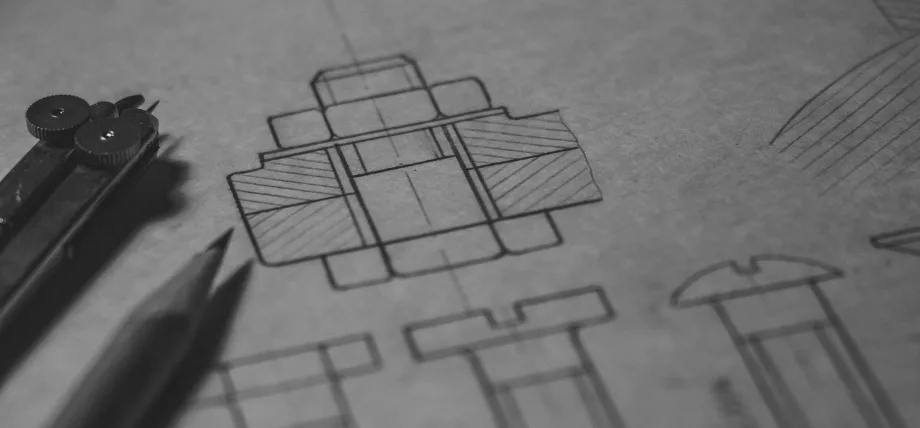
Precision Technical Drawing
First, a digital mock-up is developed using CAD software such as Autodesk Fusion 360 or SolidWorks. Then, engineers or designers generate 2D sketches or 3D models, specifying dimensions, contours, and feature requirements such as holes or engravings.
Parametric modeling techniques enable changes and iterations without requiring the entire modeling procedure to be altered for complex shapes. CAD files define the geometry of the part and must be tailored to the chosen material and required tolerances. For example, ±0.01 inches for wood or even finer for metals.
Step 2: Tool Path Generation
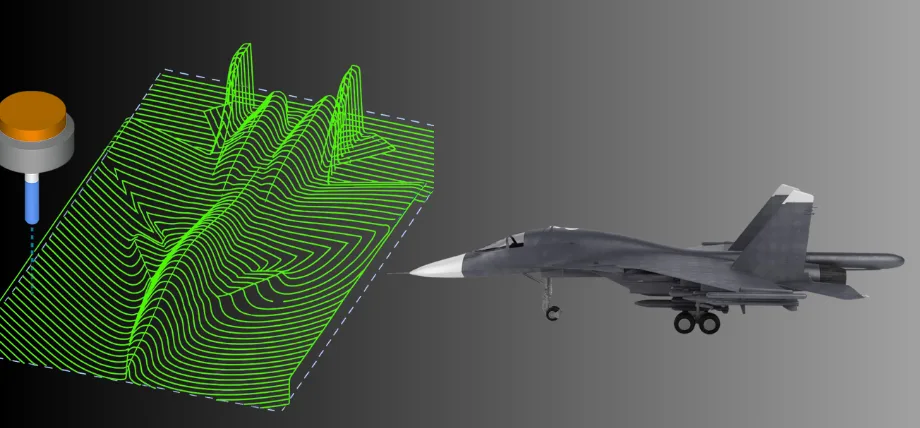
3D Toolpath Simulation
The CAD model is imported into CAM software, such as Mastercam or Fusion 360’s manufacturing module, to generate tool paths.
The tool paths describe the tool route, considering material properties, tool geometry, and different machining strategies employed, such as roughing or finishing.
The CNC router bits, including straight flutes for wood and single-flute end mills for soft metals, are also selected, along with various parameters such as spindle speed, which is set to 18,000 RPM for plywood.
The output is G-code, a machine-readable language that sets out coordinates, tool movement (G01 for linear cuts), and operational parameters. Simulations verify paths to prevent collisions or errors.
Step 3: Machine Setup
With the G-code done, set up the CNC router. The workpiece would then be clamped, using vacuum hold-downs, or supported in T-slots to prevent it from moving during the cutting process. The spoilboard protects the table from cutter overrun and provides a renewable flat surface.
The cutting tool to be used (usually a compression bit for laminates) will be placed into the spindle collet, and the length will be taken using a touch probe for Z-axis zeroing.
Then, the machine undergoes a homing procedure to establish the reference locations of the workpiece origin on the X, Y, and Z axes. Lastly, operators will check parameters such as coolant flow, particularly in metal cutting, and dust collection when working with wood.
Step 4: Program Loading and Verification
On the CNC machine, using its operating software, such as Mach4 or Fanuc, the G-code is sent to the CNC controller, typically via USB or a network.
A dry run is performed by tracing tool paths with no cutting to confirm accuracy and detect problems, such as wrong offsets or unavoidable tool collisions.
Operators may vary feed rates and spindle speeds based on feedback from the material to achieve the best results for a given CNC operation.
Step 5: Cutting Execution
The routing process begins when the spindle triggers the cutter, reaching speeds of 24,000 RPM. The gantry moves back and forth along the X and Y axes, while the Z-axis controls the depth according to the G-code instructions of the machine.
Roughing passes are used to remove bulk amounts of material, and the final pass is made to ensure a smooth surface. A standard 3-axis CNC router can pocket a recess into MDF at a depth of 0.1 inches per pass, while a more advanced 5-axis version can sculpt complex surfaces on composite materials.
Dust collection takes care of the mess, while soft metals sometimes require a coolant to keep heat down.
Step 6: Post-Processing and Inspection
After cutting is completed, the workpiece is removed from the CNC machine, and any excess material, like tabs, is cut off either manually or using secondary tools. The part is inspected using callipers, micrometres, or coordinate measuring machines (CMMs) to check the dimensions against CAD specifications and tolerances.
Surface quality is checked for any exhibited defects, such as tear-out or burrs that may need sanding or deburring. During batch production, quality logs are used to register parameters for traceability.
Step 7: Cleanup and Maintenance
The next step involves cleaning the machine and working area of chips and dust to prevent them from interfering with tool life and bed maintenance. Tool wear is inspected on the CNC router bits, and graphite lubricant is applied to linear rails as needed.
This is followed by lubrication of ball screws and linear guides, as well as verification of anti-backlash nuts. Rack-and-pinion drives are lubricated with the appropriate grease. The CNC controller is checked for software updates to guarantee reliable performance during the next jobs in hand.
This multi-step CNC machining process, controlled by computer numerical control and precision mechanics, ensures that the CNC router produces high-quality, repeatable parts with minimal human intervention and maximum material utilization.
Try Prolean Now!
CNC Routing VS CNC Milling
CNC routing, machining, and CNC milling are subtractive manufacturing processes that work on similar principles but differ in design, capabilities, and typical applications. These differences help in selecting the appropriate machine for a specific fabrication task.
What Is a CNC Router?
CNC routers are high-speed, computer-controlled cutting machines typically used for machining softer materials, such as wood, plastics, and composites.
In CNC routers, the spindle (often an air- or water-cooled unit) moves above a stationary bed that supports work in the X, Y, and Z-axis on top of a gantry-style frame. This design enables the machining of large work envelopes (for example, 4 x 8 ft), which is best suited for sheet goods.
Spindles generally operate in the range of 18,000–24,000 RPM, with speed being preferred over torque for processes such as woodworking and engraving. The CNC router typically achieves ±0.005-inch accuracy in X and Y using rack-and-pinion drives and utilizes ball-screw action for Z-axis positioning.
It performs well in 2.5D operations, such as profiling or pocketing, where tool paths and bits, like V-bits, can be generated using CAM for detailing work with the CNC router.
What Is CNC Milling?
CNC milling involves a heavy-duty milling machine, most often in a C-frame or bridge configuration, where the table moves in the X and Y directions, and the spindle moves in the Z direction. Mills are designed for high torque, operating at 6,000–12,000 RPMs, to handle the toughest metals, such as steel.
Rigid base materials, such as cast iron or steel, allow the machine milling tolerances to be maintained to within ±0.001 inches. Milling machines use end mills or face mills to slot, drill, and 3D contour with sophisticated CAM for multi-axis tool-path programming.
Enclosed designs with flood coolant add safety and finishing suitability to mills for precision metalworks.
What Materials Can Be Cut Using a CNC Router?
CNC routers accommodate a wide range of material properties, with variations in tool paths, cutter types, and machining parameters. The choice of specific materials determines the spindle speed, feed rate, and bit selection, enabling the creation of defect-free, clean cuts with no chipping or melting.
Wood
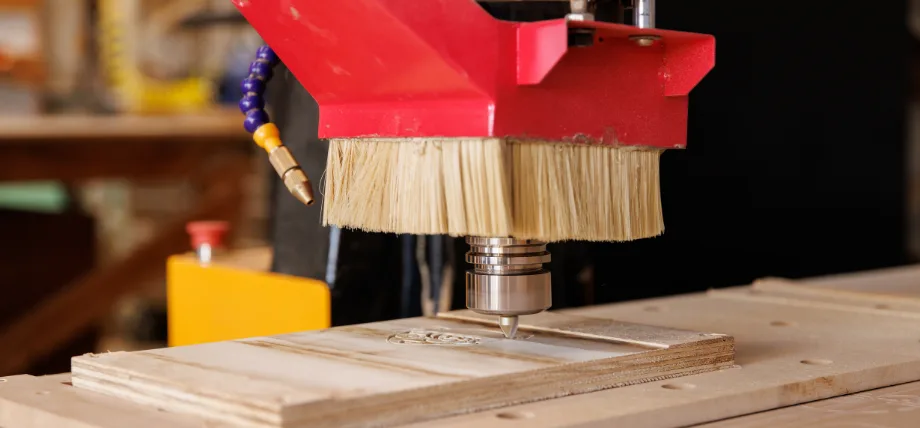
Engraving Wood Detail
This includes hardwoods (e.g., oak, maple), softwoods (e.g., pine), and engineered products such as plywood and MDF. For hardwoods, the feed should be slow (200–400 IPM) with 1/4-inch straight bits to avoid burning.
This makes them well-suited for furniture components. For plywood, suitable cutting speeds range from 300 to 600 IPM, with the use of compression bits to minimize tear-out, particularly for cabinetry applications. MDF being isotropic enables high-speed routing of up to 800 IPM for prototyping. To avoid gumming, resinous woods require frequent cleaning or the use of carbide tools.
Plastics
Plastics for CNC machining include acrylic, ABS, polycarbonate, and PVC. Acrylic is routed at 600-1,000 IPM with highly polished single-flute bits that minimize melting and produce translucent signs. ABS, used for structural parts, is run at medium feed (300 IPM) to maintain edge quality.
Polycarbonate is machined at low speeds to prevent cracking. Compression spirals are suitable for laminated plastics, ensuring clean top and bottom edges.
Soft Metals
These include aluminum (e.g., 6061 alloy) and brass for lightweight components. Aluminum routes at 100–200 IPM with single-flute end mills and mist coolant to manage heat, suitable for enclosures. Brass, ideal for engraving, is suitable for use with 10,000 RPM and fine-tipped bits for signage.
Dust collection is critical for handling conductive chips, and multi-pass strategies (with a 0.01-inch depth) prevent tool overload.
Composites
Covers fiberglass composites and G10. These extra-abrasive materials require diamond-coated bits that resist wear while still managing to cut composites at 100-150 IPM to prevent delamination.
Used in molds for aerospace applications, composites also benefit from vacuum tables, which provide stability. High-speed spindles at 20,000 RPM ensure fiber integrity, with dust extraction being essential for health and safety.
Foams
Foams range from polyurethane to EPS for dies or packaging. Carving with the ball nose bits at 800 IPM creates smooth contours for architectural models.
Additionally, a considerably low clamping force is required with high feed rates to prevent deformation of low-density foams after fabrication.
Other Materials
Leather, rubber, and soft composites, such as cork, can be routed using other methods, including V-bits or oscillating knives, for use in gaskets or crafts. These softer materials are cut at 500 IPM, with light passes applied to prevent tearing.
CNC routers are similar to milling machines, but they struggle with hard metals like steel, which CNC mills typically excel at machining. The proper setup of the machine includes the fastening down of wood or composite parts that have been held in place by tabs to keep them steady.
Where Can You Use CNC Routing Manufacturing?
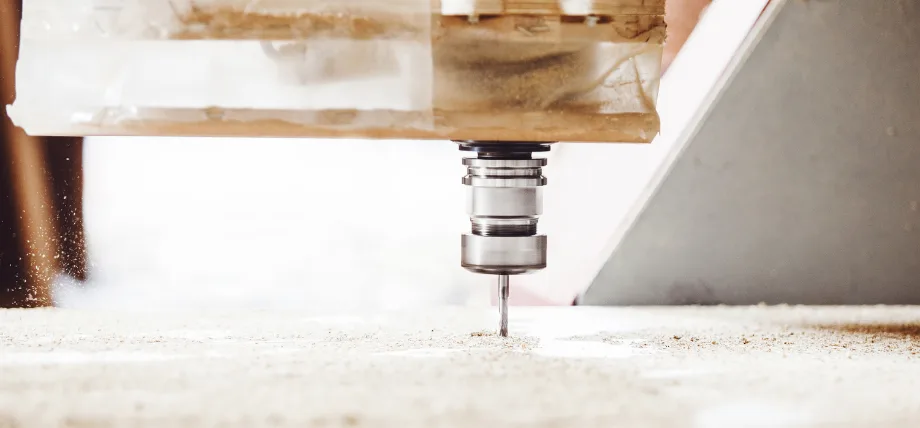
High-Speed Cutting Close-Up
CNC routing is indispensable in manufacturing fields that require precision, repeatability, and versatility.
Its ability to automate complex cuts and integrate with CAD/CAM systems makes CNC invaluable for producing parts ranging from prototypes to mass-produced components.
Furniture and Cabinetry
CNC router machines facilitate the production of parts for furniture, such as cabinet doors, tabletops, or chair backs. They process plates of plywood or MDF sheets, nesting parts for the maximum yield possible (up to 30% savings).
For example, a 3-axis router cuts dovetails or rabbets at 600 IPM while 5-axis machines contour ergonomic shapes. Integration with edgebanders provides flexibility for high-volume custom orders while reducing manual labor by 50% in the process.
Signage and Advertising
For signage applications, CNC routers etch and cut acrylics, aluminum composites, and foams to make dimensional letters and displays. High-speed spindles (24,000 RPM) profile ACM panels, and V-bits etch intricate designs.
Vacuum beds hold the material in place during engraving, enabling the fast prototyping of trade show graphics with ±0.01-inch precision.
Aerospace and Automotive
Aerospace applications include routing composite panels, such as carbon fiber, for wing spars or interior trims. Gantry-mounted routers with 5-axis capability handle curved molds, cutting at 150 IPM with diamond tools to prevent delamination.
In the automotive industry, routers shape trim templates or foam mockups, supporting lean manufacturing with just-in-time delivery.
Architectural Millwork
CNC routers are used in architectural projects to produce moldings, panels, and decorative facades. They profile hardwoods for crown details or mill MDF for ornate designs, aligning with BIM workflows for precise site fits. You can use desktop routers to create scale models for client approvals. These machines cut foam or wood at up to 800 IPM.
Marine Fabrication
Marine applications involve routing marine plywood for hull patterns or teak for deck accents. Oscillating knives in hybrid routers trim upholstery foams, while vacuum tables secure the material. Routers ensure water-resistant joints, cutting at 400 IPM with sealed bearings for durability.
Education and Prototyping
Desktop CNC routers are used in educational laboratories and prototyping facilities to carry out STEM projects, such as engraving PCBs or prototyping using Delrin.
Hobbyists use the low-cost units to create projects, such as personalized cutting boards, with stepper motors to an accuracy of ±0.02 inches.
CNC routing boosts productivity and quality, with proper dust collection ensuring regulatory compliance.
Problems like tool wear in composites are solved by automatic tool changers (ATCs), which make routers an integral part of modern fabrication projects.
Try Prolean Now!
Benefits of CNC Routing
- High precision and repeatability of parts: CNC routers work much like any other CNC machine and follow pre-programmed tool paths, producing consistent, accurate cuts that have a tolerance often smaller than 0.1 mm.
- Speed of cutting: CNC routers are fast, efficient and produce intricate 3d designs quickly on large flat materials like wood.
- Materials: CNC routing can work for wood, plastics, metals and adjust cutting parameters for different materials
- Reduced errors: Because CNC routing is an automatic cutting process, it doesn’t require manual toolpaths and cutting. Reduced human intervention reduces errors.
What Are the Limitations of CNC Routing?
- Cost of machining: A CNC router can be expensive to machine certain shapes, materials, and geometries, because it does not replace a CNC milling machine. New tools, holders, and upfront costs are disadvantages of CNC routing.
- CNC Machinist: CNC routing requires a CNC machinist, and operators need to be skilled to use CNC routers effectively.
- Machine maintenance: CNC routers require regular maintenance and tool replacement to maintain precision.
- Requires a larger space: CNC routers are large, bulky, and take up a lot of space on the shop floor. In contrast, other specialized CNC mills are compact and can replicate routing operations.
Try Prolean Now!
Types of CNC Routing Part Manufacturing
CNC routing encompasses various configurations tailored for specific manufacturing purposes, differing in terms of axis numbers, sizes, and automation capabilities.
Different types of CNC machines optimize themselves for specific part geometries, materials, and scales of production, thereby enhancing the efficiency of fabrication.
CNC routers are classified primarily by the following parameters:
3-Axis CNC Routing
A 3-axis router is a common type of CNC router that moves along X, Y, and Z axes for the ideal 2D and 2.5D operations, such as cutting a flat panel or pocketing.
They are widely used in woodworking for cabinet parts, typically featuring moving gantries on rack-and-pinion drives at a ±0.005-inch accuracy. There are drawbacks to this process; for example, it doesn’t allow for undercuts and requires several setups.
5-Axis CNC Routing
5-axis CNC routers add A and B rotational axes, enabling multi-angle machining for complex shapes like turbine blades or sculptural furniture. Tilt-trunnion tables or swivel heads reduce setups by 40%, cutting composites at 150 IPM.
High costs are suitable for aerospace or high-end prototyping, with CAM ensuring precise tool paths.
Desktop CNC Routing
With a footprint of under 2×2 ft, compact desktop routers serve the hobbyist and small manufacturing sectors by engraving PCBs or milling acrylic prototypes using stepper motors and offline controllers.
One limitation is that Z-axis travel is typically under 3 inches, restricting thicker workpieces. However, the price range of $1,000-$5,000 makes them accessible for educational and DIY router applications.
Industrial CNC Routing
Industrial CNC routing machines have large beds of about 5×10 feet for sheet nesting. These beds come with high-power spindles of 15 HP and vacuum pods for zero-point fixturing.
For cabinetry, these machines process plywood stacks. They also integrate barcode systems for lean production. Additionally, the feed rates of industrial CNC routing machines reach 1,800 IPM and have ATCs for multi-tool tasks.
Nested-Based Routing
Nested-based routing optimizes material yield by arranging parts on sheets for cabinetry or signage using specialized software.
Additionally, T-slot tables with clamps secure the material. This helps minimize the scrap in high-mix production. Also, vacuum zones enhance hold-down for composites, which supports batch runs.
Rotary Axis Routing
Rotary 4th-axis routers add cylindrical machining, ideal for table legs or balusters. Tailstocks support long stock, integrated with 3-axis bases for seamless transitions. They cut wood at 500 IPM, expanding versatility for decorative elements.
Hybrid Multi-Tool Routing
Hybrid routers integrate routing with drilling or tangential knife cutting. It uses oscillating blades for foam or leather in signage applications. ATCs can handle different materials and swap tools mid-job. Mixed-material machines such as these prove to be an asset in flexible production.
For example, each type of CNC router uses G-code for repeatability, but is chosen by part complexity and production scale, ensuring that CNC routers can meet any manufacturing demands.
Best CNC Routing Machine Based on Type of Material
The ideal CNC router is chosen based on material properties, matching frame rigidity, spindle power, and drive components, as well as the hardness and abrasiveness of the material, to achieve quality finishes. The following are recommended machines with respect to specific applications:
Soft Metals
The Shapeoko 4 by Carbide 3D is a CNC router featuring an aluminum frame and a 1.25 HP spindle, designed to cut aluminum at approximately 200 inches per minute using single-flute end mills.
It is usually priced at $1,800 and includes Carbide Create CAM for tool paths. On the other hand, the Tormach PCNC 440 has a cast-iron base and a spindle of 7,500 RPM. It engraves brass with a tolerance of ±0.002 inches while using coolant for heat management.
Hard Metals
True hard metals (e.g., steel, titanium) require dedicated CNC mills or mill-router hybrids. The Haas VF-2, having 30 HP at 7500 RPM, routes mild steel using carbide tooling, achieving an accuracy of ±0.0002 inches. At 150 IPM, the Syil X5 is a balance of speed and rigidity in small steel parts. It is priced at $15,000.
Additionally, DATRON neo also supports micro-features in alloys with its 60,000 RPM spindle.
Composites
The CR Onsrud 96L8, with a 24,000 RPM HSD spindle and 5×10-foot phenolic table, cuts carbon fiber at 150 IPM without delamination, utilizing diamond bits. The Thermwood M70 offers 5-axis capability for aerospace molds, with vacuum zones for stability.
Wood
The Laguna SmartShop II, with a 5×10-foot bed and 13 HP spindle, nests plywood cabinets at 1,800 IPM, utilizing vacuum hold-downs. The ShopBot PRSalpha, expandable to 5×12 feet, cuts hardwoods with rack-and-pinion drives, making it ideal for custom furniture.
These machines optimize performance for specific materials, striking a balance between cost and capability for efficient fabrication.
Custom CNC Machining Services
Turn your digital designs into flawless parts with Proleantech’s CNC machining capabilities. Whether you need rapid prototyping in plastics or high-volume routing machining, our expert engineers deliver end-to-end solutions, with manufactured parts delivered directly to your doorstep.
Request a free quote today!
Try Prolean Now!
Conclusion
CNC routing is a cornerstone of precision manufacturing, transforming digital designs into physical parts with computer-controlled accuracy. From CAD modeling to multi-step execution, it delivers repeatability across various materials, including wood, plastics, and composites.
By matching routers like Shapeoko or Laguna to material demands, manufacturers achieve efficiency and quality, solidifying CNC routing’s role in innovative fabrication.
FAQ
What Is A CNC Router?
A CNC router is a machine that uses a computer to direct its actions. These actions include firing the spindle to carve, mill, and engrave on materials such as wood and plastics along programmed axes.
What Is a CNC Router Machine?
A CNC router machine is a router that is built with CAD/CAM integration, automating the entire fabrication process.
Its working principle involves the use of stepper motors or servo motors and gantries for making accurate cuts on multiple workpieces, often with the aid of vacuum tables to stabilize the material.
What Is CNC Routing?
CNC routing utilizes a computer-controlled router to shape materials through subtractive methods, following G-code tool paths for precise fabrication.
What Is A CNC Router And How Does It Work?
A CNC router is a type of precision machine that moves a cutting tool across a workpiece via computer instructions, executing the full multi-step workflow from design to post-processing for repeatable, high-quality results.


0 Comments