
Aluminum stamping
Modern manufacturing in many industries and aluminum stamping are intertwined. The process entails transforming thin sheets of aluminum metal into precise 3D parts of varying complexity, based on the design requirements.
Whether you require stamped aluminum parts for automotive, aerospace, electronics, packaging, construction, or any other industry, understanding the aluminum stamping process can help in design and cost optimization strategies.
This article discusses the basics of the process, including the aluminum stamping steps, methods, suitable aluminum grades, and applications.
What is Metal Stamping for Aluminum?
Aluminum stamping is the application of force on metal stamping dies to shape sheet metal and produce usable 3-D parts. It is a popular cold-forming process that produces precise finished parts without heat application or removal of material.
Is Aluminum Good for Stamping? – Properties
Aluminum is one of the most commonly used stamping materials because it is lightweight, ductile, and corrosion-resistant. With a density about three times lower than steel and excellent formability, it is a popular choice for a wide range of sheet metal stamping applications.
Lightweight – Aluminum is preferred in many engineering applications for its low weight, which adds benefits, for instance, fuel efficiency in cars. It is also relatively strong, depending on the grade, hence a high strength-to-weight ratio.
Ductile – Aluminum has a low melting point (About 650 °C for 3003 aluminum alloy), so it can be easily formed into desired shapes.
Corrosion resistant – Aluminum has the natural capability to produce a protective coating against corrosion. Its stamped parts are therefore suitable for corrosive environments, such as saline and chemical-ridden ones.
Easy to recycle – Aluminum is one of the most recyclable industrial metals, something that manufacturers and users of stamped parts value.
Non-combustible – With its high thermal conductivity (162 to 193 W/m·K for 3003 aluminum alloy), this material makes stamped parts that can be comfortably used in applications where thermal conductivity is critical, eg, in heat exchangers.
Types of Aluminum Used for Metal Stamping
Aluminum sheet metal stamping is largely focused on 1xxx, 3xxx, 5xxx, and 6xxx series, which are wrought alloys. Wrought means that the aluminum has been drawn, extruded, forged, or rolled into shape.
Each of these categories of aluminum has unique properties that would be suited to certain sheet metal products.
1XXX: This is pure aluminum, which has the best formability
3XXX: Their workability is excellent, and blends well with medium strength. An example is 3003 aluminum alloy.
5XXX: This series is renowned for its superior corrosion resistance, which is essential in marine and other corrosive environments. 5052 aluminum stamping is common in such industries.
6XXX: This series is heat-treatable and slightly formable. It includes options such as 6061 aluminum alloy.
However, the harder alloys can be stamped with annealing as part of the process.
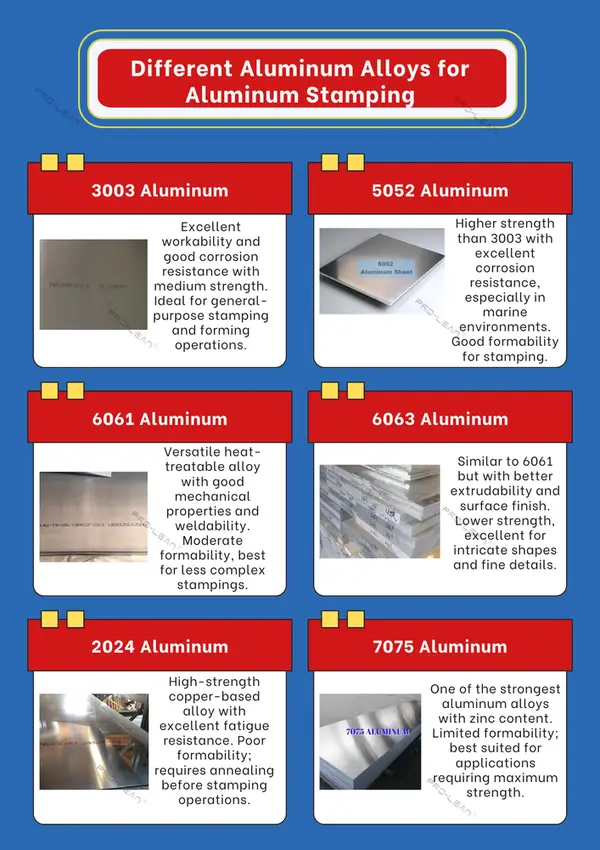
Aluminum alloys for stamping
Alt text: An infographic showing images and descriptions of different aluminum alloys that can be stamped. The following table shows the main aluminum alloys used in metal stamping, along with their characteristics and features.
| Aluminum Alloy | Main Characteristics | Common Applications |
| 1100 aluminum | Commercially pure aluminum, excellent ductility and corrosion resistance | Food industry and chemical equipment |
| 3003 aluminum | Excellent formability, good workability | Panels and cookware |
| 5052 aluminum | Good formability, high corrosion resistance, and strength | Marine parts |
| 6061 aluminum | Good corrosion resistance and strength-to-weight ratio. Moderate formability | Structural components |
| 7075 aluminum | High strength, limited corrosion resistance, and formability | Aerospace-grade parts |
| 6063 aluminum | Good formability, average corrosion resistance | Architectural applications |
| 2024 aluminum | Very strong, low corrosion resistance | Aerospace and automotive parts |
Basic Aluminum Stamping Process
Like for stainless steel stamping, the aluminum stamping process comprises material preparation, setting it up on the press, and stamping it as designed. The stamping force is controlled. But before these processes can start, the tool would have already been designed. As the punch forces the sheet metal into the cavity, plastic deformation occurs, and the desired part is produced. It is then ejected, ready for any secondary processes.
The general aluminum stamping steps are as discussed below:
Step 1: Tool Design
The aluminum stamping process starts with tool design, with engineers at ProleanTech using CAD/CAM software to produce die designs.
Step 2: Material Preparation
The next step is to select the aluminum grade and determine its parameters. Since the raw material is usually in coils, it is leveled and cut into suitable strips, ready for stamping.
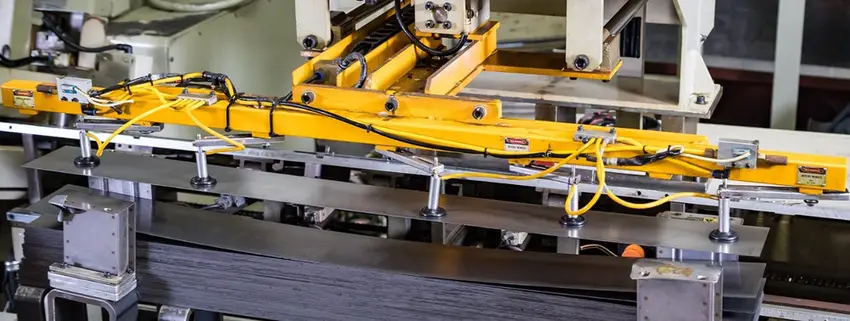
Aluminum strips
Alt text: Aluminum strips being fed through an automated stamping press
Step 3: Stamping Operations/Processes
The aluminum stamping step is now on, with several operations making up this stage. Blanking is usually the initial process, with others following progressively until the final geometry is attained.
Step 4: Secondary Processes
Secondary processes on stamped aluminum parts include deburring, powder coating, and painting.
Step 5: Quality Inspection
Finally, the best aluminum stamping companies subject the stamped aluminum to quality checks to ensure compliance with requirements. Sheet metal stamping is incomplete without these inspections, which involve statistical process control (SPC) charts, coordinate measuring machines (CMM), and special gauges.
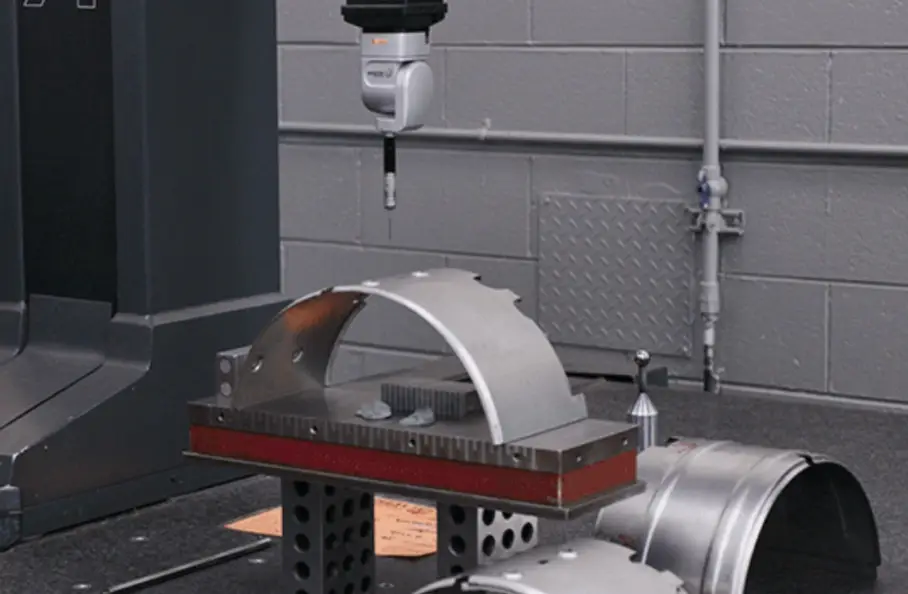
Stamped aluminum inspection
Get a quote to learn more about this critical step that ensures quality parts at ProleanTech.
Try Prolean Now!
Four Stamping Operations
The four main stamping operations are aluminum progressive die stamping, aluminum transfer die stamping, aluminum four-slide stamping, and aluminum fine blanking.
Aluminum Progressive Die Stamping
This is a fast and relatively low-cost stamping operation that entails the parts passing through a “progressive” set of machine stations.
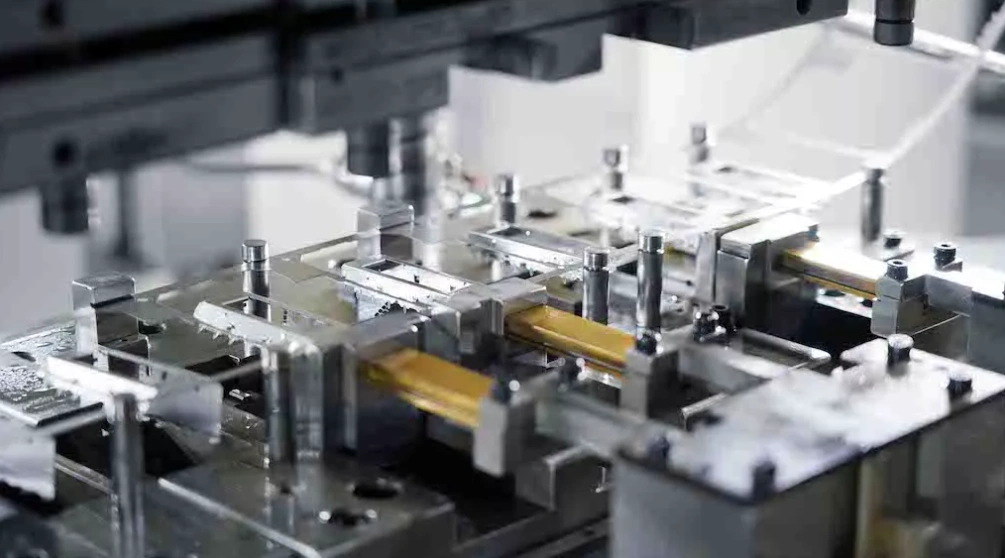
Progressive die stamping
As the metal strip moves along the different stations within the machine, its shape is altered until the final shape is achieved in the last station.
Advantages of Aluminum Progressive Stamping
- Fast
- Low-cost
- Less scrap
- Highly repeatable
Limitations of Aluminum Progressive Die Stamping
- Limited part manipulation
- Limited operations
- Usually more expensive than transfer die systems (discussed next)
Aluminum Transfer Die Stamping
Transfer die stamping is defined by metal parts undergoing stamping individually, not as strips, as for progressive die stamping. Also, this operation can be done on one-press or aluminum multislide stamping presses. However, most of the modern transfer die stamping is done on a single press.
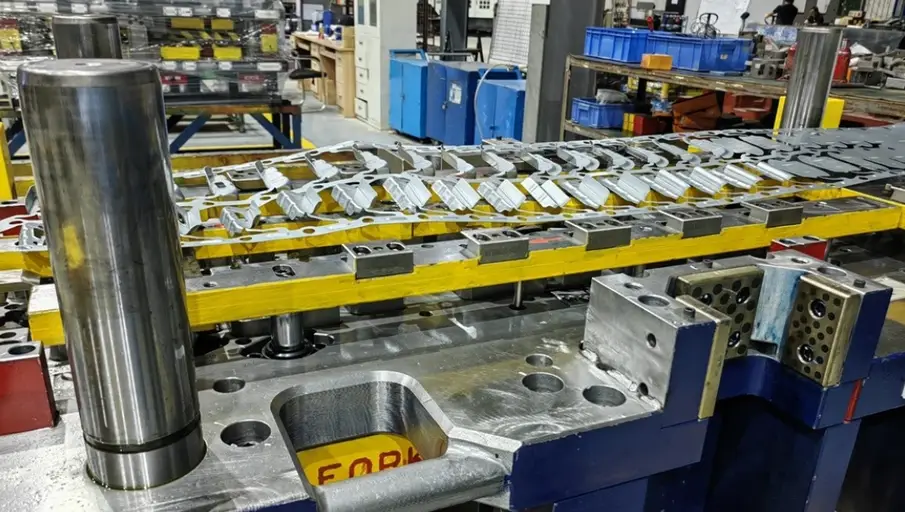
Transfer die stamping
Advantages of Aluminum Transfer Die Stamping
- Fast production of large parts
- High versatility
- Allows for high manipulation of parts
Limitations of Aluminum Transfer Die Stamping
- Less cost-effective for smaller parts
- Only cost-effective for short production runs
Aluminum Four-slide Stamping
The four-slide stamping method comprises a horizontal stamping press with cam-controlled tools. Laterally moving slides perform the stamping operation, unlike the standard vertical-moving motion.
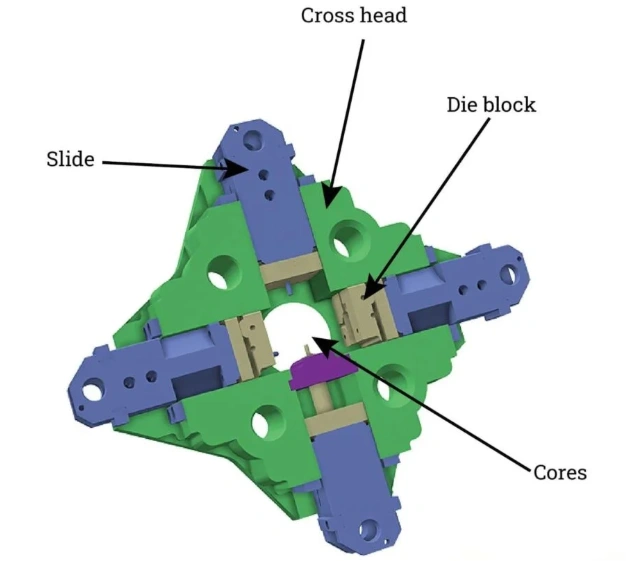
Four-slide die
Advantages of Aluminum Four-slide Stamping
- Reduced material wastage
- Less material handling
- Fewer secondary operations
- Fast production of identical parts
Limitations of Aluminum Four-slide Stamping
- Not suitable for complex parts
- Works best on flexible, thinner sheets
Aluminum Fine Blanking
The aluminum fine blanking stamping operation that uses the hydrostatic pressure principle, with stamping pressure applied from both top and underneath. A very minimal clearance is allowed.
Advantages of Aluminum Fine Blanking vs Standard Stamping
- Suitable for micron-order precision stamping
- Smooth and clean surface – post-processing unnecessary
- Forms complex shapes
- Versatile across aluminum grades
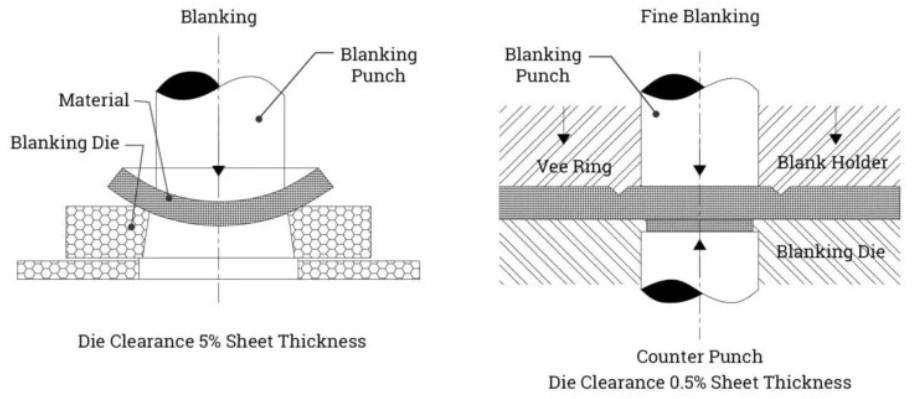
Fine blanking vs blanking
Limitations of Aluminum Fine Blanking
- Limited material thickness
- Higher tooling cost
Types of Aluminum Stamping Processes
Aluminum stamping can take different approaches involving these popular techniques: Bending, drawing, coining, blanking, punching, and embossing. Often, stamping uses various techniques together to achieve the desired part.
Aluminum stamping techniques at ProleanTech result in parts with tight tolerances that meet the requirements of various industries. Here are more details about the common aluminum stamping processes or techniques:
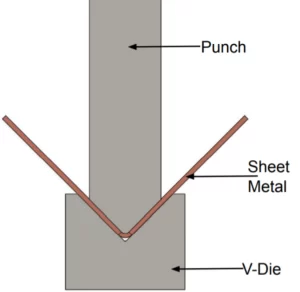
Bending
Bending entails placing an aluminum sheet between a die and a punch and forming it into the desired angles. Popular angles are L, U, and V.
Coining
Coining is the pressing of a die on a sheet of metal to produce recessed or raised patterns. The process can enhance the visual appeal and durability of the part.
Coining
Deep Drawing
Deep draw stamping is the process of using a die to stretch a flat piece of aluminum sheet into complex or deep components.
Blanking
Blanking refers to the process of using a die to cut an aluminum sheet into specified sizes. It produces the fundamental outline of the expected part.
Piercing
The combination of die and punch can also be used to make cuts or holes in a process called piercing. Despite aluminum’s high flexibility, top custom metal stamping service providers can provide crack-free results.
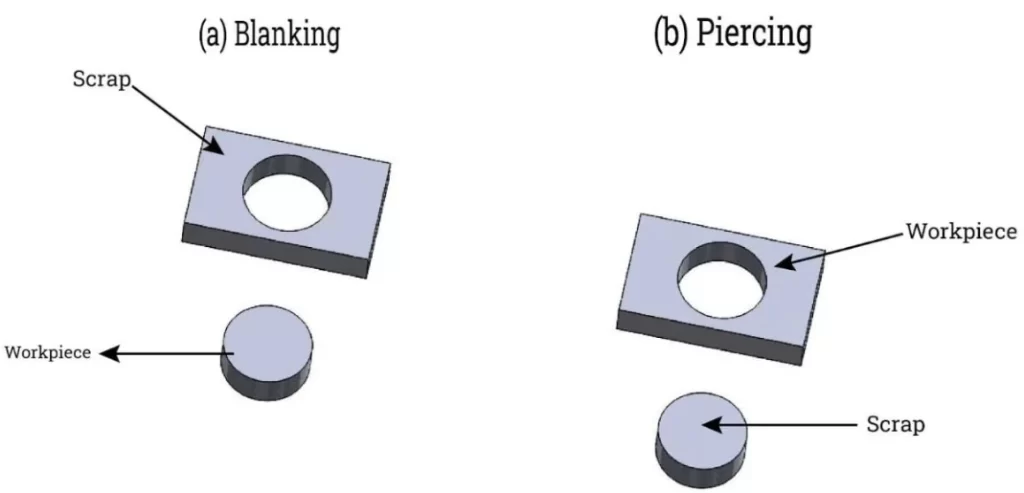
Blanking and piercing
Flanging
Flanging is the process of bending an aluminum sheet metal along a curved axis. The flange can extend inward or outward, usually at a 90-degree angle.
Try Prolean Now!
Are There Specialized Dies for Stamping Aluminum?
Yes, aluminum stamping dies have specialized designs to accommodate the unique properties of the material. Aluminum stamping should be done with appreciation of the material’s likelihood to spring back, edge-crack, and gall. Dies are built for such challenges, incorporating design features such as relief angles, polished surfaces, and well-calculated clearances.
Are there Specific Aluminum Stamping Lubricants?
Yes, there are specific types or categories of lubricants for aluminum stamping. The conventional ones, which have been in use for years, are soluble oils (emulsions), mineral-based soluble oils, and dry-film lubricants. Emulsions are the most preferred for their capability to support a free-flowing stamping process. Modern options include VOC-free disappearing lubricants and renewable-resource-based soluble oils.
Challenges and Solutions in Aluminum Stamping
As hinted in the earlier section, aluminum stamping presents springback and other challenges. It is a soft material that can make stamping problematic in various ways, including perforation, tool wear, and galling.
The good thing is that these challenges usually have remedies, for instance, the application of automotive aluminum stamping lubricants. Expert aluminum stamping companies have many tricks that ensure the stamped parts are always of the highest quality.
Metal stamping services comprise solutions for these challenges as discussed below.
Springback
Springback is the partial restoration of the deformed part’s shape when the load is removed. While plastic deformation is the basis of stamping, some elastic deformation also happens. Proper product and process design and use of stiffening darts can solve this defect.
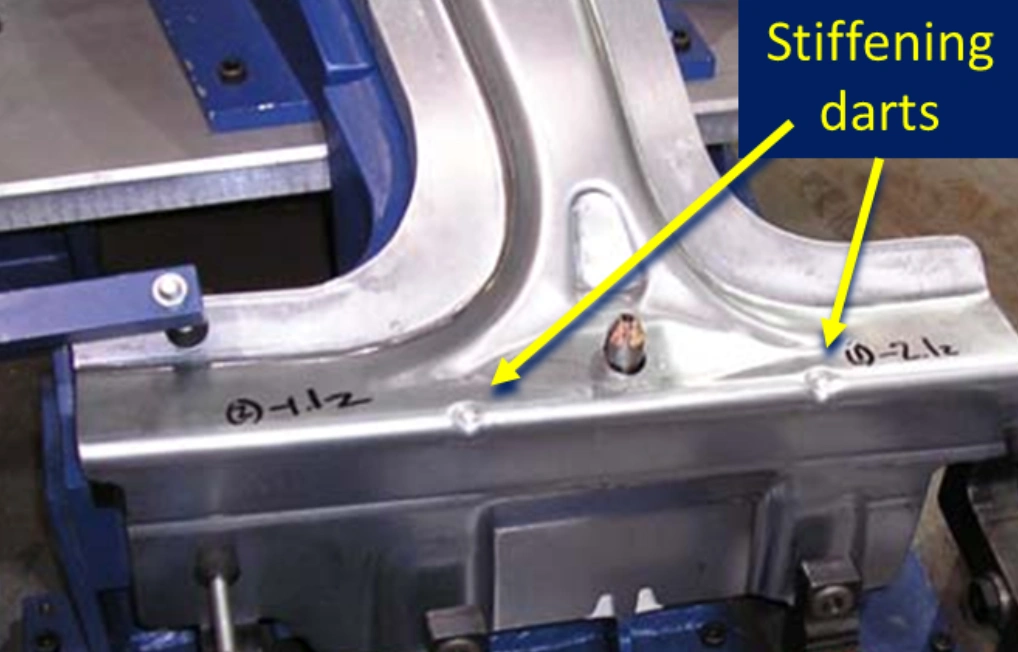
Stiffening darts
Galling
Galling is a situation whereby the aluminum part sticks to the tool, resulting in surface defects, for instance, in automotive parts. The best remedy is to use clean aluminum stamping tools and automotive aluminum stamping lubricants.
Tool Wear
The soft and sticky nature of aluminum alloys can cause wear on dies. Using high-quality lubricants, PVD coatings, and harder tools often solves this problem.
Perforation
The 4XXX series aluminum alloys tend to deform or shrink during the stamping operations. A popular solution is to avoid shear angles on flat punches and use a larger die clearance.
Examples of Aluminum Stamped Parts
Common examples of aluminum stamped parts are electronic enclosures, structural brackets, HVAC ductwork, and car heat shields. Others are mounting hardware and lighting reflectors. Some of these stamped parts are simple and small, but others can have multiple bends and features, all of which must be expertly and accurately produced in custom aluminum stamping. Such differences can determine the metal stamping cost.
Common Industries for Aluminum Stamped Parts
Undoubtedly, the automotive industry is a leading area for aluminum stamped parts, benefiting mostly from the lightweightness of these parts.
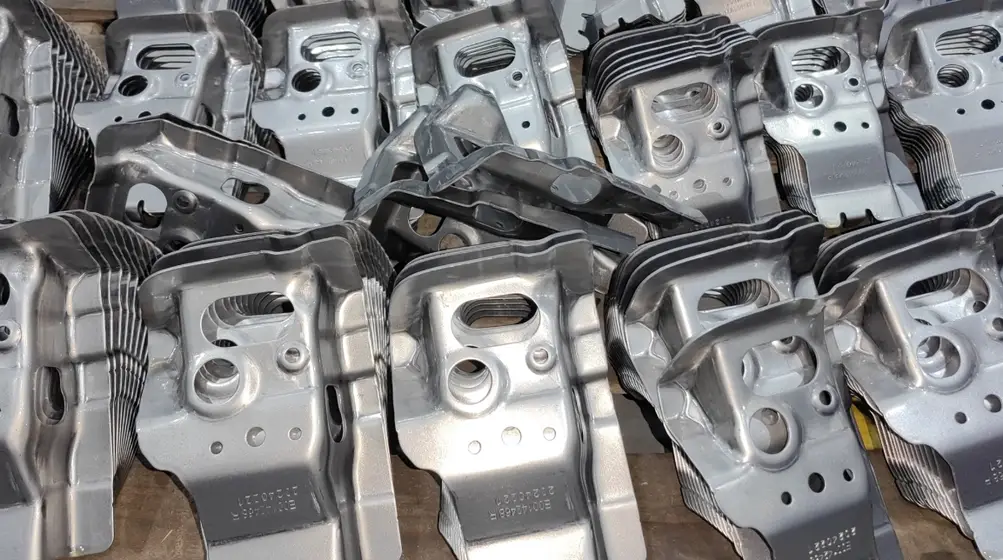
Stamped automotive parts
Other industries that use these parts are aerospace, packaging, electronics, construction, and telecommunications.
Here’s a summary of these applications in a table:
|
Industry |
Application examples |
|
Automotive |
Engine mounting brackets, body panels, component straps, and structural reinforcements |
|
Aerospace |
Support brackets, panel fasteners, and mounting hardware |
|
Packaging |
Food container closures, beverage can ends |
|
Electronics |
Heat sinks, chassis components, mounting brackets, housings |
|
Construction |
Gutter parts, HVAC ductwork, mounting brackets |
|
Telecommunications |
Junction box covers, component enclosures, and heat dissipation parts |
Common Surface Treatments for Aluminum Stamping Parts
Aluminum stamped stamps can be surface-treated through anodizing, brushing, electroplating, powder coating, sandblasting, and polishing. The table below summarizes the details of these surface treatments:
|
Surface treatment process |
Process |
Purpose |
|
Anodizing |
The stamped part is dipped in an electrolytic acid bath |
Form a protective aluminum oxide layer |
|
Brushing |
Abrasive belts or brushes mechanically abrade the surface |
Create a uniform satin finish to hide minor surface imperfections |
|
Electroplating |
The part is placed in an electrolyte solution with metal ions, and an electric current is applied |
Place a layer of secondary metal on the aluminum |
|
Polishing |
Wheels or buffs with fine, tiny abrasive compounds are used to abrade the surface |
Form a smooth, mirror-like finish |
|
Powder coating |
Dry powder particles are sprayed on the part using an electrostatic mechanism |
Apply a durable protective finish |
|
Sandblasting |
Sand or any other abrasive media is propelled on the aluminum surface |
Deburr and clean for a matte finish |
Further reading:
Conclusion
Aluminum stamping plays a major role in industries that require the metal’s low weight, high strength, good formability, corrosion resistance, and easy recyclability. Given the uniqueness of the material and the potential fabrication challenges, it pays to work with a seasoned CNC machining company.
Here, at our company, the blend of modern machinery, skilled workforce, and world-class production process is incomparable. So, contact us and witness a transformation in your stamped aluminum parts.
0 Comments