
Engineering plastic material guide
Nylon CNC
Machining
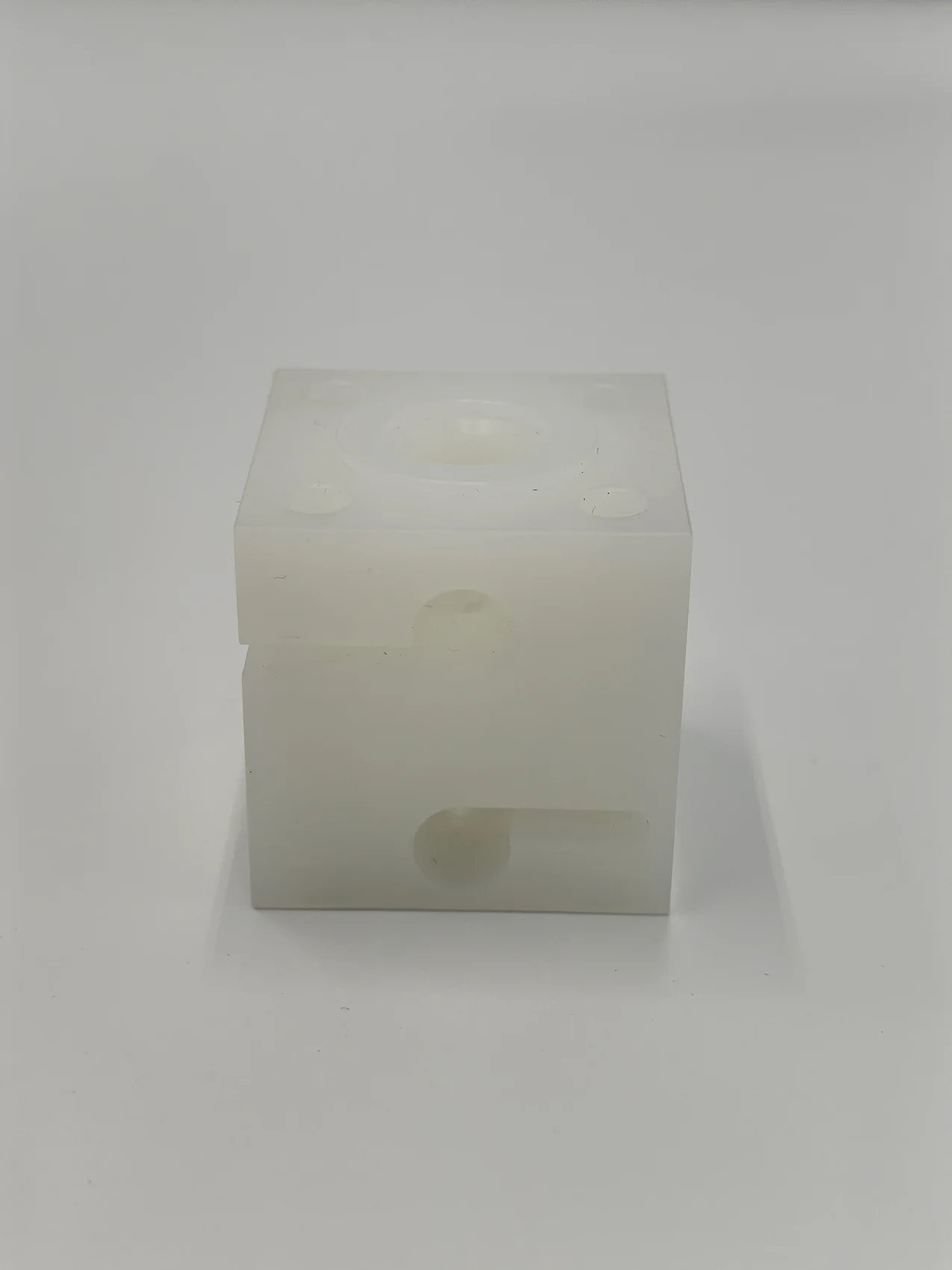
CNC nylon rollers, guides and bushings, with polyamide grade, moisture condition and fitted dimensions reviewed together.
Confidential enquiries. NDA available.
- Specify
- Extruded PA6 or named alternative
- Review
- Conditioned bore and Free-state diameter
- Confirm
- Final condition and acceptance records
Design for the humidity the nylon part will see.
Nylon is considered for loaded and moving polymer components. Moisture uptake can change dimensions and mechanical response, so the stock grade and service condition matter as much as the nominal size.
Rollers and pulleys
Describe bearing interfaces, loading, speed and wear contacts. Identify whether a material-modified or lubricated grade is intended.
Guides and bushings
Specify mating clearances and the humidity or liquid exposure in service. Include the inspection and conditioning state.
Structural plastic components
Mark fasteners, loaded sections and unsupported walls. Assess the grade at the intended environment, not only in a dry laboratory state.
Choose the grade and stock together.
Compare the Nylon options below against the drawing and service conditions. Specify the complete supplier grade, condition and stock form; material examples do not establish current inventory or permit substitutions.
| Grade or stock | Why consider it | What to resolve |
|---|---|---|
| Extruded PA6 | General nylon components using a named extruded stock product. | Define moisture condition, required fits and stock documentation. |
| PA66 | A different polyamide grade family for a specified mechanical design. | Review the exact grade, temperature and environmental requirements. |
| Cast PA6 | Larger or shaped stock where a named cast-nylon product is intended. | Specify supplier product, additives and any conditioning instructions. |
| Glass-filled or lubricated nylon | A formulation chosen for stiffness or a sliding application. | State filler or lubricant package and mating-surface requirements. |
Selection examples are subject to material and drawing review. They are not an inventory list.
Already have a grade on the drawing?
Add it to your quotation checklist ↓Define the free part and its conditioned fit.
Avoid solving an environmental fit problem with a tighter machining number alone. Explain the final assembly and when the nylon dimensions must be accepted.
Moisture and conditioning
State dry, conditioned or another defined inspection state. If the application includes water or humidity changes, provide the relevant exposure.
Deflection under clamping
Show thin sleeves, unsupported arms and broad flat sections. Identify how the free part and assembled part are constrained.
Filled grades and wear faces
Mark contact faces and edge requirements. A reinforced grade needs its own tooling and mating-surface review.
Mark critical dimensions on the drawing. Achievable tolerances, wall thickness, part size and delivery are confirmed for the geometry, material, finish and quantity in the quotation.
Finish nylon for the contact and handling conditions.
As-machined
Specify functional roughness and edges. Identify surfaces where a tool mark could affect rolling, sliding or sealing.
Cleaning and conditioning
Agree compatible cleaning and any conditioning steps before final measurement. Keep the process connected to the material supplier guidance.
Dyes, coatings or marking
Define colour and durability requirements. Confirm compatibility rather than treating every nylon formulation as the same surface.
Put conditioning into the acceptance record.
Grade and additives
Request PA type, supplier stock product and the records required for fillers or lubricant additives.
Inspection environment
Record the agreed moisture and temperature state when measuring critical fits.
Operational checks
Define load, contact and wear tests if required. Use the intended environment for application validation.
Three different checks.
The material record identifies the purchased stock. The inspection report checks the drawing. Application validation checks the part in service.
Review inspection requirements ↗Nylon machining questions.
Answers to the decisions that affect the material, drawing and finished part.
Why can a nylon bore change after delivery?
Nylon can absorb moisture and also responds to temperature and loading. Clarify the inspection state, storage and service conditions when the fit matters.
Are PA6 and PA66 equivalent?
No automatic equivalence should be assumed. Compare the exact products and application requirements, then obtain substitution approval.
Is cast nylon the same as extruded PA6?
The processing route, stock form and formulation can differ. Specify the supplier product rather than using a generic family description.
Can glass-filled nylon replace unfilled stock?
Only after design review. Stiffness, surface condition, wear contacts and machining response can change with the formulation.
Should nylon be conditioned before inspection?
Use the state required by the drawing or agreed acceptance plan. A single conditioning rule is not appropriate for every grade or service condition.
What information helps quote a nylon roller?
Include polyamide grade, additives, shaft and bearing interfaces, loading, speed, humidity or fluid exposure, quantity and inspection state.
Prepare your enquiry
Review the nylon grade and the fit in service.
Send the CAD model and dimensioned drawing with quantities, service conditions and the requirements below. If the grade is undecided, describe the function and the constraints.
Your files stay confidential. NDA available.
Nylon RFQ checklist
Material: [PA6 / PA66 / cast PA6 + supplier grade + additives]
Environment: [humidity, liquid contact, temperature]
Assembly: [shaft, bearing, loading and movement]
Inspection: [free or restrained, dry or conditioned]
Finish: [contact surfaces, edges, colour]
Quantity and documents: [lot size, material and inspection records]
Material references & specification notes
Manufacturer information supports material selection. Use the datasheet for the exact grade, stock form and test conditions. It does not establish Prolean inventory, application approval or a guaranteed machining result.
Prepared October 2026. Final material and manufacturing requirements are agreed in the quotation.