
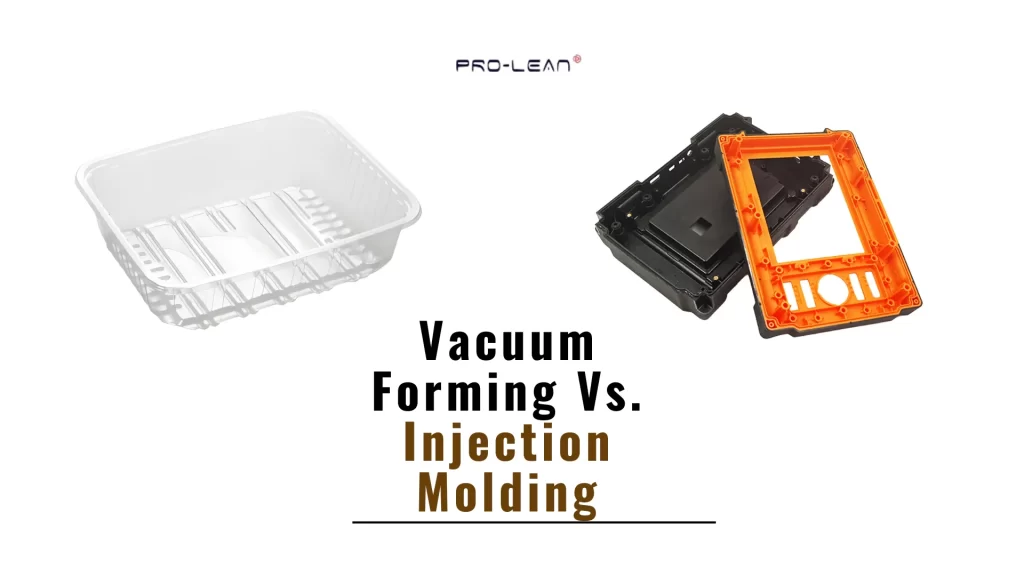
Vacuum forming vs injection molding
In plastic manufacturing, vacuum forming vs injection molding are the two most prevalent methods for making plastic parts. Choosing which one to deploy depends on the material, part design, production speed, and typical cost.
Injection molding uses melted plastic to fill a mold, producing detailed shapes with tight tolerances. Vacuum forming softens plastic and stretches it over a mold, which works well for simpler shapes and shorter tooling lead times.
Injection molding handles complex designs and large volumes but comes with higher setup costs. Vacuum forming is cheaper to start and more flexible, but it cannot create very intricate parts. Knowing the strengths and limits of each method helps you pick the right process.
This article compares vacuum forming and injection molding, looking at how both processes work, their advantages, and when to use each.
Vacuum Forming: How It Works
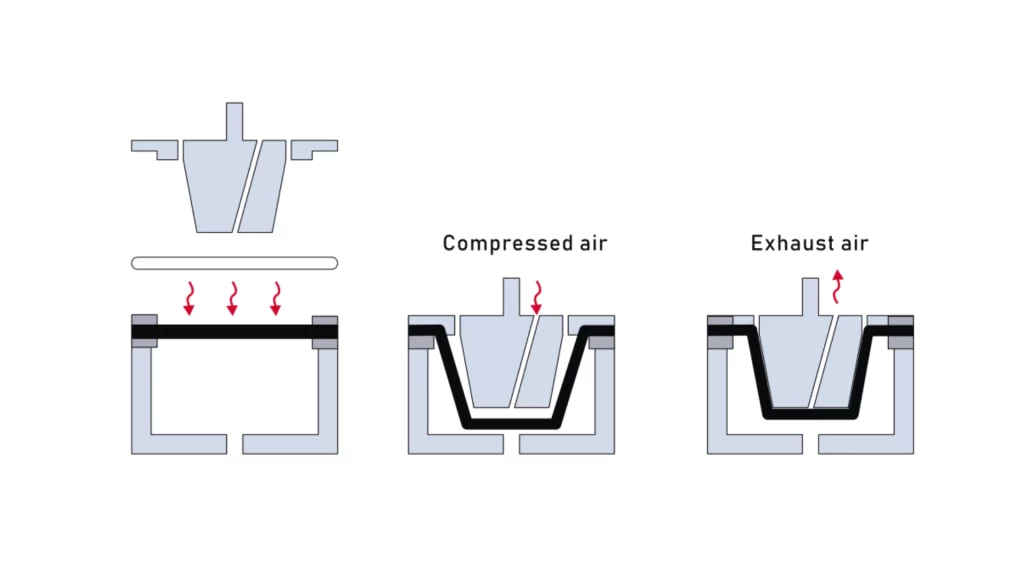
Vacuum forming process
Vacuum forming is used to manufacture basic plastic shapes or parts. Thermoplastics are used to make the initial flat sheets. They are heated to a flexible (soft) state, and a vacuum is created so that they will form around a mold.
As soon as the plastic forms around the mold and has cooled down, it retains the shape of the mold. Afterwards, the product is cut into separate units, and it is ready to be used. Vacuum forming has many advantages compared to injection molding. In general, the molds for vacuum forming are simpler, and they generally require less time to set up.
Therefore, it is best suited to produce larger or shallower parts in relatively low volumes (generally less than 3000 units). Injection molding, alternatively, is more beneficial for making parts that require high complexity; however, it requires expensive molds and longer lead times to set them up.
If you need frequent changes in your design, vacuum forming is the fastest way to do so. It is suitable for applications such as packaging, trays, panels, and simple containers. On the other hand, if you need precision, detailed features, and/or large volume runs, injection molding may be more appropriate.
What are the Benefits of Vacuum Forming
Here are the common aspects where vacuum forming outshines injection molding.
Lower Cost and Easier Tooling
Vacuum forming molds are easier to create and less expensive than building an injection mold. Vacuum forming uses a solid mold instead of deep cavities, making it cheaper to start. This makes it an affordable option.
Quick Start Up for Small Batch Runs
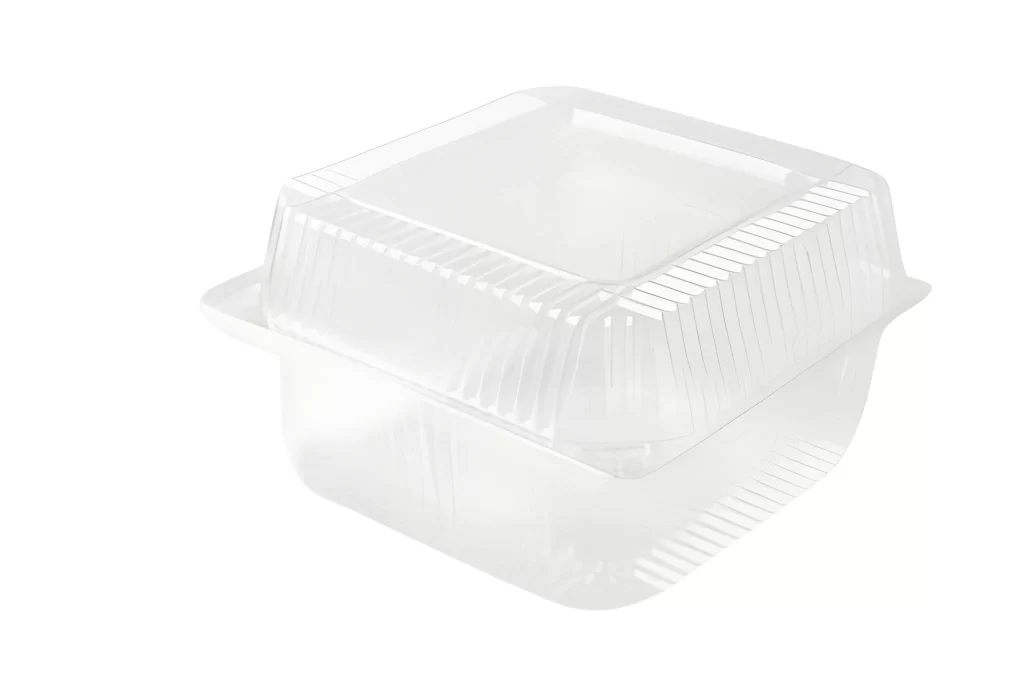
Thermoformed square transparent plastic container
Due to the setup ease, vacuum forming is well-suited for producing prototype parts, as well as small batch runs. In comparison to injection molding, you will be able to have parts created quickly.
Design Flexibility
Unlike injection molding, if there are design changes, vacuum forming allows for rapid iteration. Therefore, you can either modify the existing mold or create new molds from the sheet stock without having to wait long periods of time. As such, this makes vacuum forming relatively flexible to the needs of your project.
Large Sheets of Material
Vacuum forming can accommodate larger plastic sheets (typically up to 2000mm x 1000mm), and as such, can accommodate larger parts such as panels or trays.
Limitations of Vacuum Forming
- Not Suitable for Large Production Volume: Since vacuum forming uses longer cycles and requires machine downtime, it is generally not suitable for high-volume production. For example, injection molding is significantly faster for producing 10,000s of parts.
- Complexity of Part Design: Vacuum forming is not conducive to creating complex designs with features such as deep cavities, channels, etc.
- Less Precise: Generally speaking, vacuum forming does not provide the same level of dimensional accuracy as injection molding; typically, in the range of ±0.25mm to ±1.5mm. Therefore, if your project requires tighter tolerance specifications, then injection molding would be the preferred method.
Injection Molding: How It Works
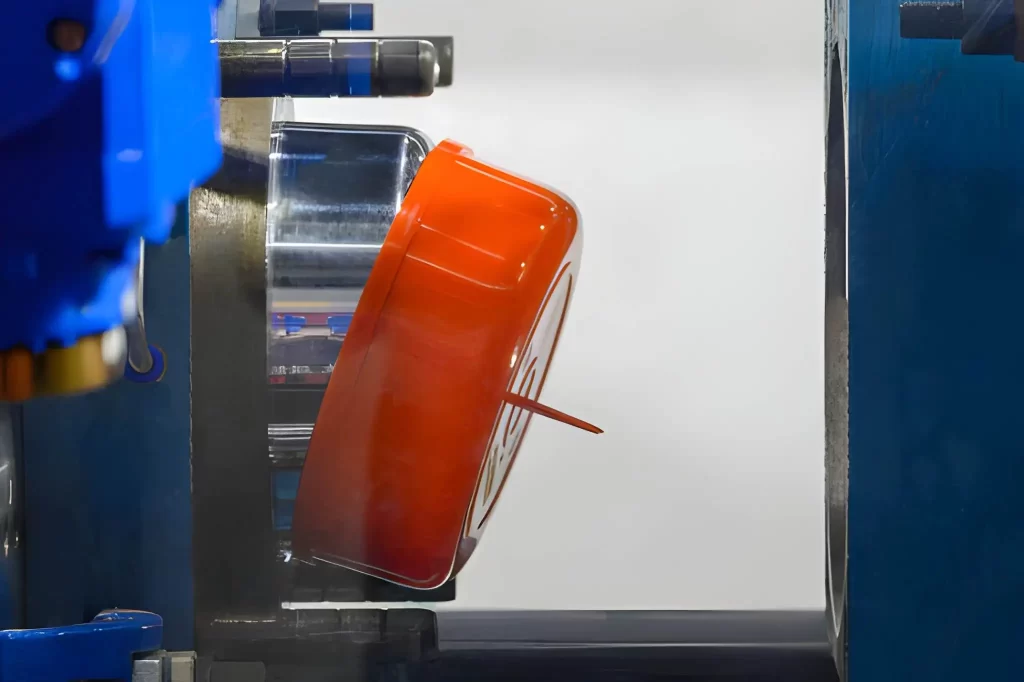
Plastic injection-molded bowl
Injection molding is the manufacturing process that involves melting plastic pellets or polymer materials using heat. The melted (molten) plastic is forced under pressure from a pressurized nozzle into a mold. As soon as the molten plastic enters the mold, it begins to cool down, solidify, and takes the exact shape of the mold cavity. After the part has cooled, the completed part will be ejected and ready to be put to work.
Injection molding has been around since 1872, and was first invented by John and Isaiah Hyatt, who utilized it to produce smaller products such as buttons and combs. Since its inception, injection molding has grown to become a principal manufacturing method for creating complex parts at precise tolerances.
The primary advantage of injection molding is the high-volume production runs capability. In comparison to vacuum forming, it allows for much more complex designs and higher-quality products. The initial costs to set up an injection molding system are higher due to the mold and equipment. Therefore, the upfront tooling cost is high, but the per-part cost decreases significantly as production volume increases.
Advantages of Injection Molding
Injection molding uses a range of plastics to provide complex, detailed, high-precision, repeatable parts.
Supports Complex Designs
Injection molding provides support for complex designs as well as produces fine details, tight-tolerance parts with features such as ribs, threads, etc., which are challenging to achieve with vacuum forming.
Automation and High Efficiency
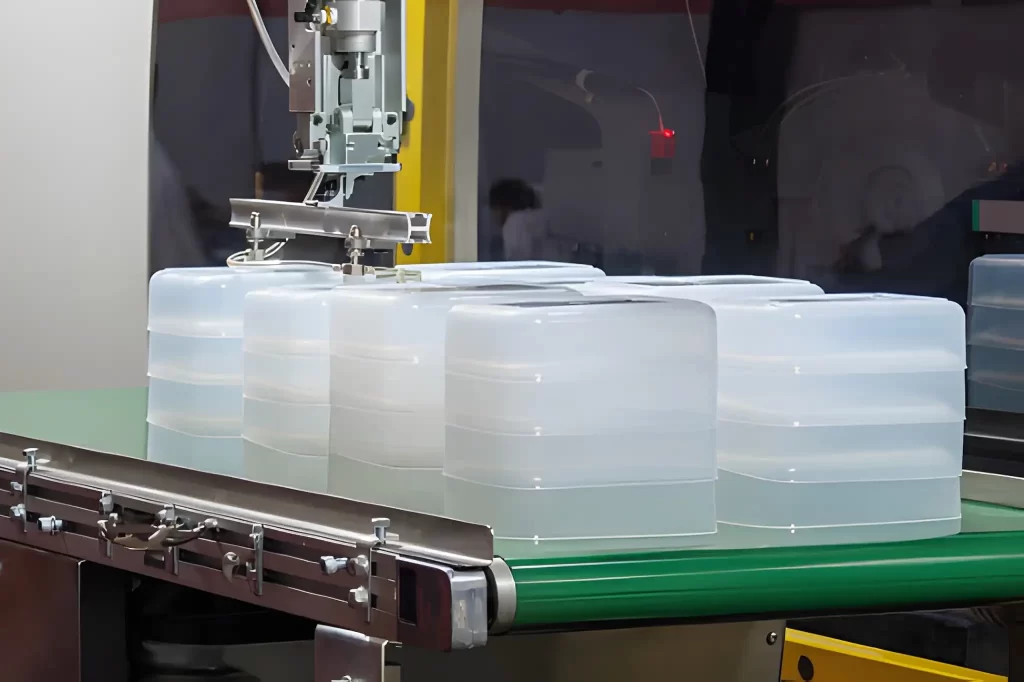
Injection molding robotic handling
Injection molding is capable of being totally automated. This results in reduced labor costs, improved consistency, and increased efficiency during the production of large quantities.
Material Versatility
Due to the versatility of the type of plastic available for use with injection molding (including very strong and/or heat-resistant), it is well-suited for functional parts for many kinds of engineering applications.
Disadvantages of Injection Molding
Injection molding has disadvantages compared to vacuum forming. Some of these disadvantages relate to cost and the part size.
- High Tooling Costs: A mold for an injection molding application can be very expensive, and in most cases will have to be custom-made. Due to this expense, it may not be possible to justify the tooling cost for a small production run. In contrast, vacuum forming typically requires inexpensive, simple molds.
- Limited for Large Parts: Generally, larger parts are more difficult to produce with injection molding than they are with vacuum forming. As previously stated, vacuum forming can handle larger or oversize parts more easily, especially those requiring large surface areas. Some of the common examples of vacuum forming products include panels, covers, etc. Additionally, due to lower tooling costs associated with vacuum forming, it may be more economical for large or oversized parts, even if only one or two units are required.
- Less Flexible for Quick Design Changes: In general, once an injection mold has been created, making changes to the design becomes a significant challenge and leads to various injection molding defects. In some cases, it may be too expensive to do so. If a designer needs to make design changes on short notice or wants to test several different designs before committing to the final version, vacuum forming is generally preferred because of its simplicity, speed, and flexibility in terms of design changes.
Try Prolean Now!
Vacuum Forming Vs Injection Molding: Comparative Outlook
When selecting the appropriate method for manufacturing plastic parts, vacuum forming vs injection molding, you need to consider several factors, including the tooling, speed, design complexity, types of materials available, and the total volume to be produced. By understanding the similarities and differences between these two processes, you will be able to select the appropriate process for your project based on its specific needs and requirements.
Tooling & Setup
The primary distinction between vacuum forming vs injection molding is the type of tooling and the associated setup time. Injection molding requires a large upfront investment to create the tooling. The molds are complex and precise and can be extremely expensive, ranging from thousands to hundreds of thousands of dollars.
On the other hand, the molds used in vacuum forming are relatively simple and inexpensive, typically made from materials like aluminum, wood, or plaster. The reduced tooling costs make vacuum forming more advantageous for prototype development, low-volume production, and/or projects where there may be multiple design revisions.
Production Speed
The setup time for vacuum forming vs injection molding differs dramatically. Vacuum forming molds require less time and effort to develop and prepare compared to the molds used in injection molding. In fact, the vacuum forming mold preparation time is typically a matter of hours, while the injection molding mold preparation time can take weeks. Once the mold is prepared for use in either vacuum forming or injection molding, the production time per unit also differs dramatically.
The vacuum forming process is generally slower, requiring more time per cycle to heat the sheet and shape it into the desired form. However, the vacuum forming cycle time does allow for rapid production of small batches of parts. As such, vacuum forming is well-suited for the development of prototypes and/or small production runs. On the other hand, once the molds have been created, the production time for each unit is typically measured in mere seconds to minutes. Therefore, injection molding is well-suited for high-volume production applications.
Volume Comparison
As previously mentioned, vacuum forming is generally most effective when producing small quantities of parts (typically less than 3000 units). Although vacuum forming can accommodate slightly larger production runs, the molds begin to show significant wear and tear from the constant thermal cycling and mechanical contact during forming.
In contrast, injection molding is well-suited for large-volume production applications (typically greater than 30,000 units) and can accommodate production runs that are many multiples of that quantity. The molds used in injection molding are designed to withstand the repeated thermal cycling and pressure applied during the forming process without showing excessive signs of wear and tear.
Material Options
One of the most significant advantages of injection molding is the wide range of materials that can be molded. Common plastic materials used in injection molding include ABS, PP, PE, PC, Nylon, TPEs, and reinforced plastics. These materials offer numerous functional and aesthetic benefits, including resistance to chemicals, biodegradability, and varying mechanical properties.
In comparison, the vacuum formable plastics are limited. They mostly include thermoplastic sheets such as PETG, HIPS, ABS, PVC, PS, and PP. The selection of a particular sheet material must meet the necessary functional and aesthetic requirements of the part being formed.
Design Complexity
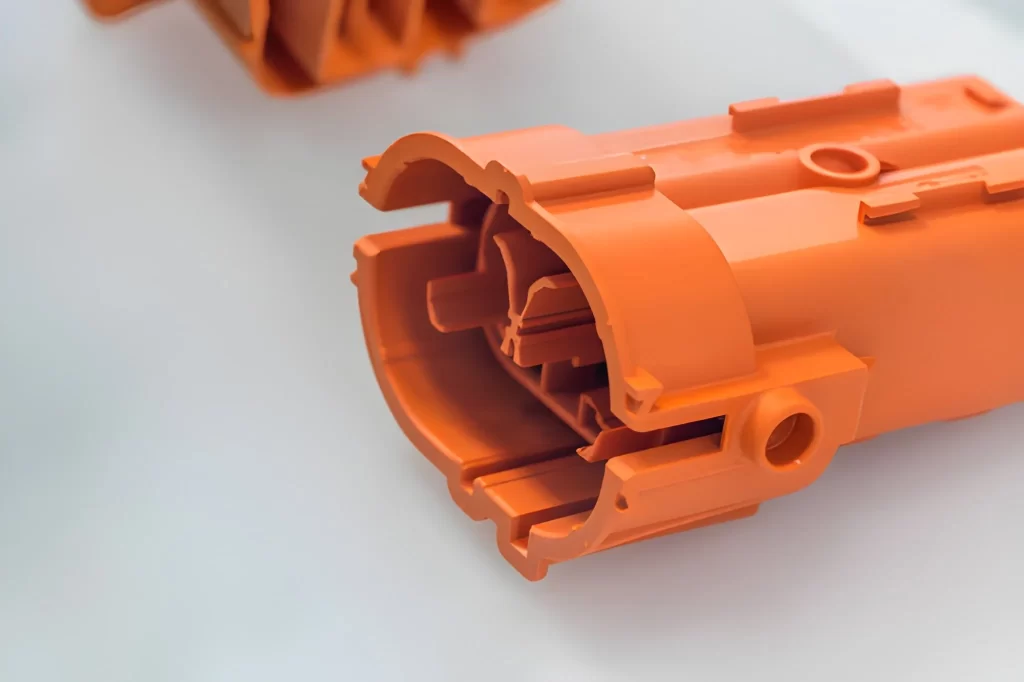
Quick Connect Terminal Connector
Another major advantage of injection molding is its ability to form complex parts with great accuracy. Parts having deep cavities, undercuts, fine details, threads, and intricate geometries can be formed with high accuracy (±0.02-0.1 mm) using the injection molding process.
On the other hand, vacuum forming is better suited for forming simple parts. While vacuum forming can form parts having some level of detail, it is more difficult and/or impossible to form parts having deep cavities or internal channels. The tolerances for parts formed using vacuum forming are generally moderate, typically ±0.05-1.75 mm. Examples of parts that are commonly formed include large panels, trays, and packaging parts.
Surface Finish and Wall Thickness
Both vacuum forming vs injection molding can produce acceptable surface finishes. However, the surface finish achieved through the vacuum forming process is generally not as smooth as that achieved using the injection molding process. Additionally, the wall thickness achievable through the vacuum forming process is typically dependent upon the sheet material selected and is generally limited to a range of 0.5-6mm.
Conversely, the wall thickness is strongly influenced by material flow, shrinkage, and viscosity. It can range from less than 0.5mm to over 10mm, depending upon the part design. Furthermore, the injection molding process produces very little scrap and yields structurally strong parts.
Cost and Lead Time
Finally, one of the last factors to consider when comparing vacuum forming vs injection molding is cost and lead time. Injection molding is a capital-intensive process that entails significant upfront costs for mold development and preparation. Additionally, the first article production time for injection molding is typically measured in weeks rather than days. However, the cost per part drops rapidly as the production run increases.
On the other side, vacuum forming is a lower-cost alternative to injection molding and involves lower upfront costs associated with developing and preparing the molds. Additionally, the production time for vacuum forming is typically measured in days rather than weeks. However, as the production run increases beyond a certain point, the cost per part for vacuum forming begins to increase.
Table Summary: Differences Between Injection Molding and Vacuum Forming
The table below highlights the main differences between injection molding and vacuum forming across design, production, and cost factors.
| Factor | Injection Molding | Vacuum Forming |
| Design Complexity | High | Basic |
| Maximum Part Size | Medium | Large |
| Production Volume | High | Low to Medium |
| Design Flexibility | Limited | Moderate |
| Tooling Cost | High | Low |
Try Prolean Now!
When to Choose Injection Molding Over Vacuum Forming
When compared to vacuum forming, the following factors suggest that an injection molding process will be a better option for your project:
Do you need high-volume production?
The higher your total number of products (over 3000), the lower your unit price for each item will be using injection molding. This makes it ideal for high-quantity productions.
Does your part have complex shapes?
Products having multiple or extreme cavity designs (e.g., channels, undercuts) are best suited for an injection molding process, as they can be difficult to produce in vacuum forming processes.
Do you need high precision?
An injection molding process provides tighter tolerances (typically less than ± 0.25mm) than a vacuum forming process. Precision and repeatable manufacturing are what injection molding offers well.
Are material strength and surface part appearance important?
A variety of high-performance plastic materials (including elastomers & filled polymer resins) can be used in injection molding, along with providing a very smooth and glossy surface finish.
When to Choose Vacuum Forming Over Injection Molding
Here are the scenarios where vacuum forming is the right choice. You need to identify the following.
Is your production volume low or medium?
With less than 3,000 units, vacuum forming will typically be faster & more economical.
Are your parts large and simple in design?
Vacuum forming lends itself to larger flat sheets and simple part designs. (it does not support complex shapes)
Do you need a rapid turnaround?
Because vacuum forming has a much quicker set-up time, it can provide rapid prototypes or get products on the market sooner.
Is your budget limited? Or do you expect to make many design changes?
Tooling is less expensive and easier to modify using vacuum forming. This is ideal when there may be several design iterations before finalizing.
Are tolerances and material options flexible?
Vacuum forming performs well when very tight tolerances are not required, and a narrow selection of sheet materials is acceptable.
Try Prolean Now!
Conclusion
Vacuum forming vs injection molding, each has unique strengths and limits. Vacuum forming is cost-effective, fast, and supports large parts, but it is less precise and struggles with complex designs. Injection molding handles intricate shapes, delivers smooth finishes, and is ideal for high-volume production. However, it comes with higher setup costs and size constraints. Choosing the right method depends on your part’s size, complexity, material, and production needs.
At Prolean Tech, we provide advanced manufacturing solutions for custom plastic injection molding and vacuum forming. Our automated production systems, precision tooling, and experienced engineering team help you produce high-quality plastic parts quickly and reliably. Whether you need rapid prototyping or full-scale production, we ensures your parts meet exact specifications while keeping costs and timelines under control.
0 Comments