
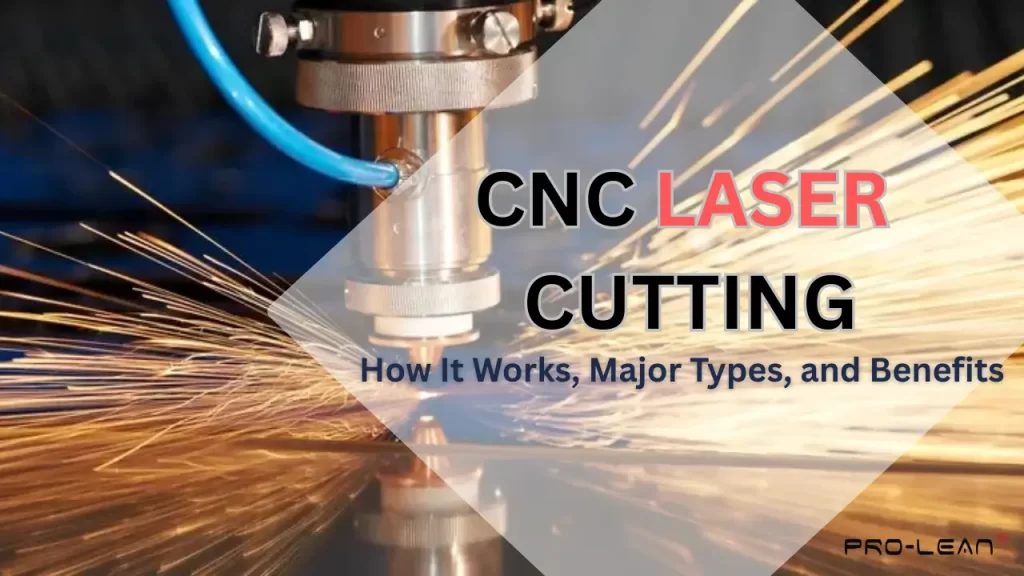
CNC Laser Cutting
CNC laser cutting is an innovative technique to engrave or cut materials by using a powerful laser beam that is directed by computer commands. It produces incredibly accurate and exact intricate shapes and designs. CNC laser cutting technology is used in various sectors such as medicine, automotive, electronics, construction, and aerospace.
ProleanTech specializes in CNC laser cutting machines that provide precise and accurate solutions for unmatched designs. We deal with CNC laser cutting, titanium, stainless steel laser cutting, and other materials. Our experience ensures clean edges for every project.
This guide provides an overview of how CNC laser cutting is transforming the modern industry, including its advantages, disadvantages, and uses.
What Is CNC Laser Cutting and How Does It Work?
CNC (Computer Numerical Control) laser cutting uses a powerful laser beam for CNC cutting. It can cut or etch materials directed by computer commands. The process of CNC laser cutting offers higher levels of accuracy. It can create complex shapes and patterns that are not possible manually.
The CNC laser machines are well-renowned for their high level of precision and accuracy. The tolerances of standard CNC laser cutting range between +/- 0.1 mm and +/- 0.01 mm. It depends on the material, machine, and the complexity of the part. This degree of accuracy helps manufacturers to create stringent dimensional tolerances with precise features.
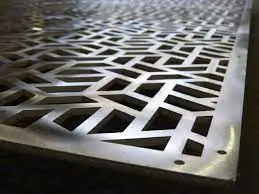
Precision CNC Laser-Cut Metal Design
The precise CNC laser cutting machines are reliable for making custom metal laser cutting components. This technology is applied in many industries like aerospace, electronics, automotive, and medical manufacturing.
A detailed overview of the CNC laser cutting procedure is provided here:
- A design is produced with CAD (Computer-Aided Design) for CNC laser cutting.
- This CAD design is then transformed into a laser-cut program using CAM (Computer-Aided Manufacturing) software.
- The selected material is ready and set out in the work area of the CNC machine.
- After that, the machine is configured to meet the particular cutting needs of the CNC laser cutting process.
- The material is sliced by the laser beam as it is guided by the CNC laser cutting machine along the preprogrammed route.
- The material is chilled as the laser cuts to avoid overheating and promote solidification.
- The components are examined for quality after cutting. Custom metal laser cutting post-processing operations can be performed if necessary.
For all of your production and prototype requirements, ProleanTech offers a broad range of CNC laser cutting services, including stainless steel laser cutting, CNC laser cutting titanium, and other value-added services.
CNC Laser Cutting Programs
Programming is a basic component in the field of CNC laser cutting. Programming guarantees that the CNC machine completes the intended tasks in the right order and style. G-code and M-code are the two main programming languages utilized in this industry.
What is G-code?
The most popular numerical control (NC) programming language is G-code, often referred to as preparation code. It gives the CNC machine’s moving components, such as the laser head, axes, and tool feed, exact control over their speed, placement, and synchronization. Each line of G-code comprises directives informing the computer what to do and how to accomplish it.
What is M-Code?
Alongside G-code, another crucial NC programming language is called M-code, or miscellaneous code.
M-code manages various machine functions, including turning the laser on and off, switching out the tool, or controlling the internal chiller system, whereas G-code manages the machine’s position and speed.
Core Components of a CNC Laser Cutting Machine
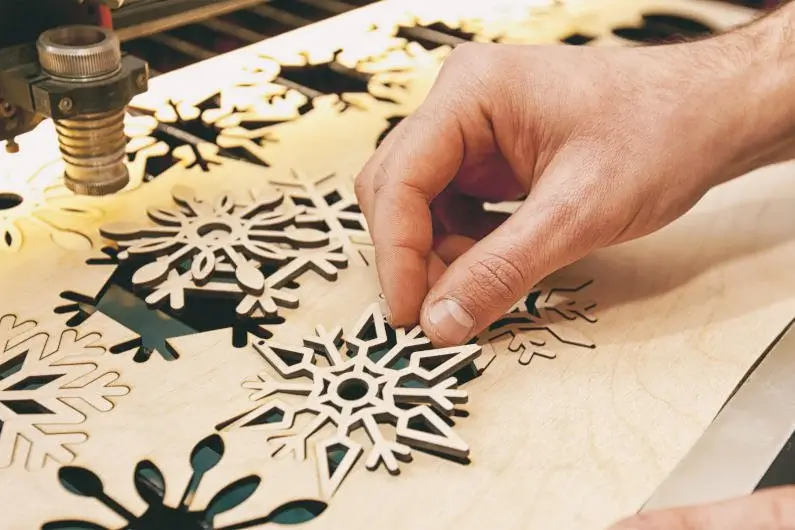
CNC Laser Cutting Decorative Wood Design
There are many core components that one can encounter when exploring the realm of CNC laser cutting. Understanding the activities and procedures in this business requires knowledge of these terms. The following are a few of the most often used terms:
|
Term |
Description |
|
CNC (Computer Numerical Control) |
A computer-based system that automates the control of machining tools to shape materials like metal, wood, or plastic. |
|
CAD (Computer-Aided Design) |
Software used to create precise 2D drawings or 3D models for laser cutting. |
|
CAM (Computer-Aided Manufacturing) |
Integrates with CAD to automate and streamline the cutting process. |
|
Kerf Width |
The width of material removed by the laser beam affects accuracy and part fit. |
|
Focal Length |
The distance between the lens and the material surface influences cut precision and quality. |
|
Assist Gas |
Air, nitrogen, or oxygen is used to expel molten material and improve edge quality. |
|
Cutting Parameters |
Settings like laser power, speed, gas pressure, and focus point are adjusted for optimal results. |
|
Pierce (Dwell) Time |
Time taken by the laser to pierce the material before cutting starts. |
|
Nozzle Design |
Directs assist gas into the kerf to remove molten material efficiently. |
|
Chiller System |
Maintains laser and optics temperature for consistent performance and longer lifespan. |
|
Nesting |
Arranging parts on material sheets to minimize waste and maximize efficiency. |
|
CNC Controller |
The computer unit that reads and executes G-code and M-code instructions to control laser movement. |
|
Laser Power |
Determines cutting speed and material thickness capability, and also influences machine cost. |
|
Laser Wavelength |
Affects how the material absorbs heat and melts; it varies with material type. |
|
Beam Mode |
Refers to the laser’s intensity distribution, impacting focus spot size and edge quality. |
|
Focal Spot |
The precise point where the laser beam is concentrated drives cutting accuracy and speed. |
Laser Cutting vs Plasma Cutting – Which Is Right for You?
The power source is the primary distinction between plasma cutting and laser cutting techniques. Plasma cutters release a focused flow of plasma in place of the narrow, powerful light beam used by laser cutting devices to cut through materials. Although metals are the primary material cut by both techniques, laser cutting can also be used to cut wood and ceramics.
A heated, electrically charged gas, such as nitrogen or argon, is forced through a tiny nozzle in plasma cutting, as opposed to laser cutting. It effectively melts and erodes the material as it travels through the surface due to its tremendous pressure and speed. However, plasma cutting is a thermal cutting technique because the plasma it creates can reach temperatures of up to 20,000°C, like laser cutting.
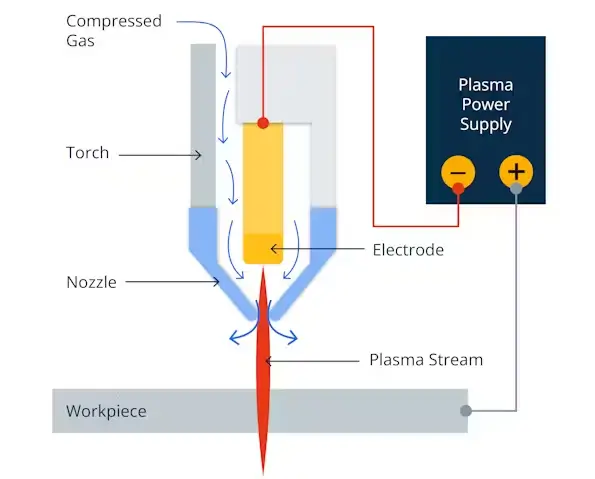
Plasma Cutting Process Diagram
Speed: Laser cutters can cut thin metal sections more quickly than plasma cutters. However, for cutting heavier metal sheets, plasma cutters operate more quickly.
Material: Any conductive metal or material can be cut using plasma; however, non-conductive materials like wood and plastic cannot be cut using plasma. In contrast, metals, like polymers and wood, can be cut using laser cutters.
Cost: Compared to plasma cutting devices, laser cutting equipment requires a larger initial investment. While plasma cutters normally cost $15 per hour to operate, laser cutters typically cost $20 per hour.
Thickness: Most laser equipment lacks the capacity to cut materials thicker than 19 mm; however, this is improving as technology develops. Aluminum is 12.7 mm thick, stainless steel is 19 mm thick, and steel is 25.4 mm thick; all can be cut using laser cutters. In contrast, metal plates up to an inch and a half thick can be cut through by plasma cutters.
Surface Area: Plasma cutters are not very perpendicular. They produce cuts that require more grinding to remove the cutting slag, which raises the labor cost. Whereas laser cutters offer a smoother surface, which makes them perfect for complex patterns.
For example, laser cutters can produce very small slot widths of around ±0.15 mm and great accuracy of ±0.05 to ±0.10 mm, with around 0.1 to 0.3 mm kerf width. The fine plasma cutting produces about 1.5 to 3.0 mm of kerf width.
Pro Tip: The main alternatives to laser and plasma cutting technologies are water jet cutting, oxy-fuel cutting, and wire EDM cutting.
You can consider other techniques like water jet cutting, oxy-fuel cutting, or wire EDM (electrical discharge machining) if, after reading this text, you determine that neither laser cutting nor plasma cutting is for you!
Types of Laser Cutters Used in CNC Manufacturing
The types of laser cutters come in a variety of forms. It depends on the sort of laser they utilize and how many axes they employ. Let’s examine these kinds in more detail:
CO2 laser cutters
Among the most popular and adaptable kinds of lasers for CNC cutting equipment are carbon dioxide (CO₂) CO2 laser cutters. They create a strong laser beam by electrically stimulating a gas mixture that contains a significant amount of carbon dioxide. However, CO2 laser cutters are less effective on reflecting metals like brass, copper, and aluminum.
Fiber Lasers
Fiber laser cutting is renowned for its exceptional beam quality, accuracy, and efficiency. These cutters have solid-state lasers with an optical fiber containing rare-earth elements that serve as the lasing medium. When fiber lasers are compared to CO2 lasers, fiber lasers are more energy efficient than CO2 lasers. They also require less maintenance. Fiber lasers are frequently employed in CNC laser cutting in industry and are especially good at cutting metal.
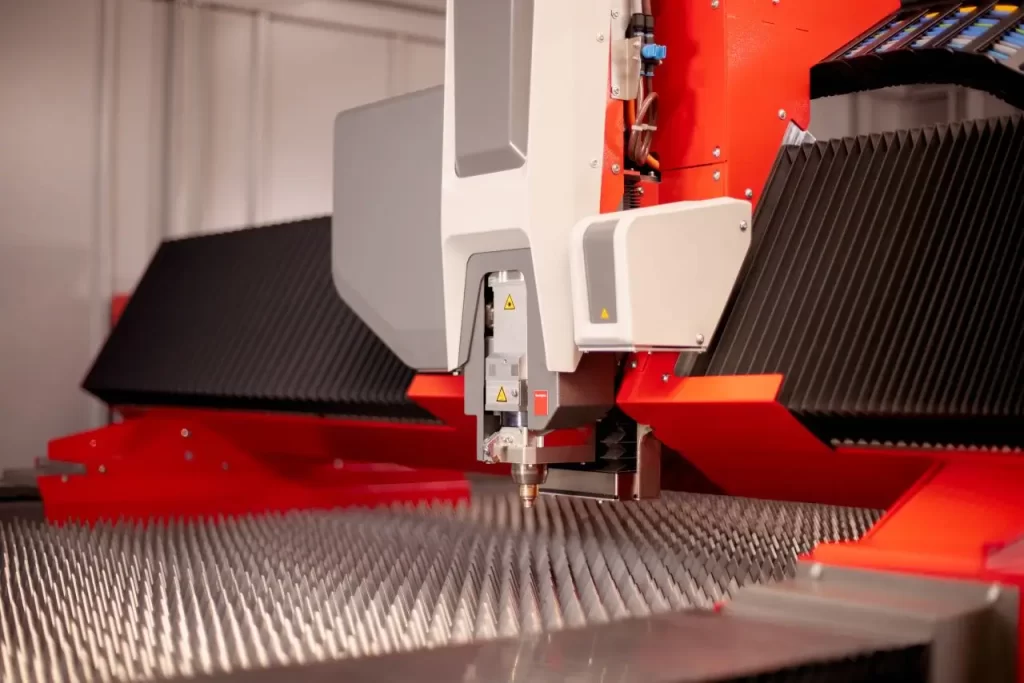
Fiber Laser Cutting Machine in Operation
Neodymium-doped Yttrium Aluminum Garnet (Nd: YAG, or YAG)
Neodymium (Nd)-doped crystals are used as the lasing medium in YAG laser cutters. These lasers work well for cutting and engraving ceramics and metals. They can also be used for welding. The YAG laser can function in both pulsed and continuous modes, produce high-power beams, and ensure high performance in custom metal laser cutting operations.
Based on the axis, the number of directions the cutting tool can travel in is known as the CNC machine’s axis. More axes enable more intricate cutting and complicated forms.
CNC Laser Cutting in 2-Axes
A 2-axis CNC laser cutter works in a 2D plane that is flat. This CNC laser cutter is ideal for cutting flat sheet materials like metal and wood. This machine’s ability to move its laser head both horizontally (X-axis) and vertically (Y-axis).
CNC Laser Cutting in 3-Axes
A 3-axis CNC laser cutter can provide a deeper cut by moving its laser head up and down (Z-axis), apart from the 2-axis machine’s capabilities. This is particularly helpful for applications involving engraving.
4-Axis Laser Cutting with CNC
A 4-axis CNC laser cutter spins the workpiece along one axis, often the X or Y-axis. It can perform all the motions of a 3-axis machine. Complex forms and geometries can be created because of this extra spin.
5-Axis Laser Cutting with CNC
5-axis CNC laser cutters provide even more freedom. Because they can move the workpiece along two other axes at once. This gives you a lot of control and accuracy when making complex, multi-dimensional structures.
6-Axis Laser Cutting with CNC
A 6-axis CNC laser cutter is the most sophisticated laser cutter. It has a rotating axis in addition to all the features of the 5-axis machine. As a result, the machine can produce incredibly intricate and accurate cuts from practically any angle.
Try Prolean Now!
CNC Laser Cutting for Different Materials and Thicknesses
CNC laser cutters can repeatedly and precisely cut a variety of materials. Depending on the material and laser intensity, they can handle varying thicknesses and are often used for both metals and non-metals. A deeper look at what these machines can cut is provided below:
Metals: Steel, aluminum, and other metals are included in this category. Metal sheets can be accurately sliced using laser cutters; the thickness of the metal and the quality of the cut are determined by the laser type and power output.
Plastics: Laser cutting is possible for both thermoplastics and non-thermoplastics, but you must be careful since some can release toxic fumes. However, polycarbonate and ABS are not recommended. Because they can burn quickly and release hazardous gases if not treated under a certain safety system.
Thermoplastics: Polyvinyl, nylon, and polyethene are a few examples of thermoplastics. Thermoplastics are plastics that can be molded when heated.
Rubber: Gaskets, seals, and other specialized rubber parts can be made with precision using laser cutters.
Leather: Laser cutting machines are also used to cut leather. It creates intricate patterns and designs of leather that are used in upholstery, crafts, and fashion.
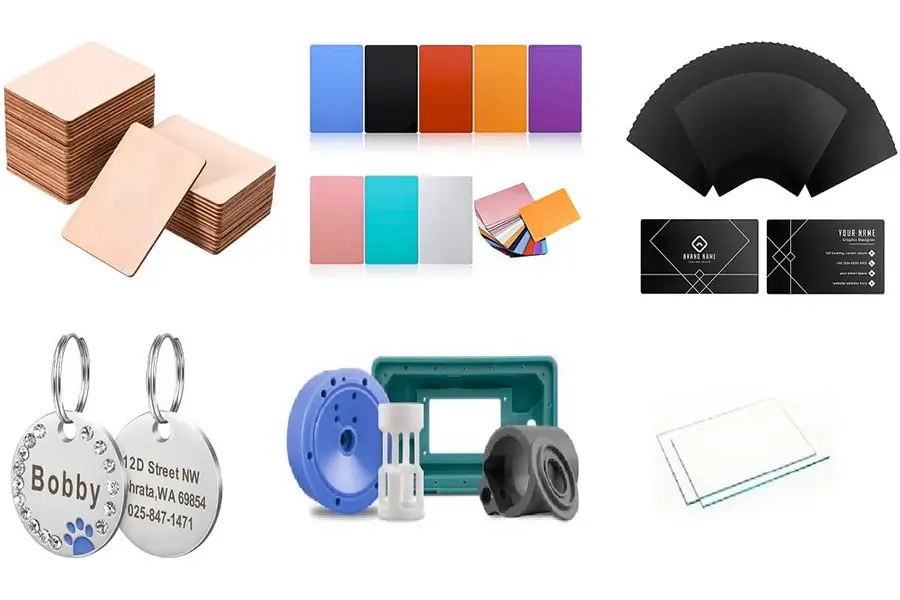
Common Materials for Laser Cutting Projects
Ceramics: Ceramics can also be engraved and cut with CNC lasers. But caution is needed to prevent cracking and breaking.
Wood: Laser cutters can produce accurate cuts and complex patterns on a variety of materials like hardwood, softwood, and plywood.
Acrylic: Laser cutting is an essential technique for working with acrylic for elaborate patterns.
Foam: Foam is ideal for packaging, crafts, and insulating materials. It can be neatly cut with a laser cutting machine.
Textiles: Laser cutters can cut materials such as polyester, cotton, and delicate materials like silk without tearing.
Paper: Laser cutters are ideal for cutting a variety of paper thicknesses used for crafts, model making, and packaging.
Composites: CNC laser cutters are used to cut composites like fiberglass and carbon fiber. However, caution is necessary to avoid the possibility of dangerous particles.
Stone: Stone is also engraved with laser cutters. Although it’s hard and thick to cut through.
Glass: CNC laser cutters are used for engraving glass rather than slicing the material due to its brittleness and hardness. Laser cutters engrave text, images, and intricate patterns of glass.
Maximum Material Thickness for CNC Laser Cutting by Material Type
The maximum material thickness for CNC laser cutting by material type is explained in the table below:
|
Material |
Laser Type Recommended |
Typical Thickness Range (mm) |
Notes / Applications |
|
Stainless Steel |
Fiber Laser |
0.5 – 25 |
Precise cuts, minimal burr; industrial components |
|
Titanium |
Fiber / Nd: YAG |
0.5 – 15 |
Requires controlled gas; used in aerospace, medical parts |
|
Mild Steel |
CO₂ / Fiber Laser |
0.5 – 25 |
Widely used in construction and fabrication |
|
Aluminum |
CO₂ / Fiber Laser |
0.5 – 15 |
Reflective material; needs higher laser power |
|
Acrylic |
CO₂ Laser |
1 – 25 |
Clean, polished edges; signage, displays |
|
Plastics (ABS, Polycarbonate) |
CO₂ Laser |
1 – 10 |
Caution: toxic fumes may be released |
|
Rubber |
CO₂ Laser |
1 – 10 |
Gaskets, seals, industrial parts |
|
Leather |
CO₂ Laser |
1 – 5 |
Fashion, upholstery, craft applications |
|
Wood |
(Hard/Soft/MDF) CO₂ Laser |
1 – 20 |
Intricate cuts, engravings |
|
Foam |
CO₂ Laser |
1 – 40 |
Packaging, insulation, craft materials |
|
Textiles (Cotton, Silk, Polyester |
CO₂ Laser |
0.5 – 5 |
No fraying, precise patterns |
|
Paper / Cardboard |
CO₂ Laser |
0.1 – 3 |
Packaging, models, crafts |
|
Composites (Carbon Fiber, Fiberglass) |
Fiber Laser |
0.5 – 5 |
Proper ventilation is required for fumes |
|
Stone |
CO₂ Laser |
Engraving only |
Cannot cut through; used for logos, decorations |
|
Glass |
CO₂ Laser |
Engraving only |
Full cutting is usually not possible |
Try Prolean Now!
Design Tips for Better Laser Cut Programs
Using this cutting-edge technology, designers can precisely control the cutting process. To make the most of its potential, certain design tips must be considered.
- Strength: To achieve the required cutting effect, it is necessary to select the appropriate laser strength. The material’s thickness and type can influence the laser’s power output. For instance, a CO2 laser cutter is best for cutting materials like wood, plastic, or acrylic. Hence, a fiber laser can be a better choice for cutting metals.
- Gas and Cutting Speed: Secondly, the gas and cutting speed can also be considered by designers. The material, the machine, and the required quality influence the cutting speed. While slower speeds can sometimes result in more precise cutting. The faster rates can sometimes improve cut quality and reduce the heat-affected zone.
- The Compatibility of Material: The compatibility of the material and how it behaves is another important factor. So, it is essential to understand how different materials react to the heat from the laser beam. And how it affects the quality and final form of the components.
- Design File: Finally, design files are necessary for CNC laser cutting. DXF or DWG formats are typically used. Design software like CorelDRAW or Adobe Illustrator can assist with the design process. The design file needs to be clear and precise to guarantee that the laser cutter will know precisely where to cut or engrave.
Furthermore, avoid intricate designs that can result in failure or material damage. Think about the kerf width when designing your components. Take into account the laser’s tolerance when designing for tight fittings. To keep the material from melting or deforming, check to see that your design permits sufficient heat dissipation.
Advantages of CNC Laser Cutting Over Traditional Methods
CNC laser cutting has a lot of advantages because it is used in a lot of different industries. It offers the following additional significant advantages:
- The edges of CNC laser cutters are of better quality. Mechanical distortion is less likely to occur when using laser cutting because it does not involve any contact.
- CNC laser cutters have a much narrower cut width (kerf) than traditional cutting methods, making it possible to make more intricate cuts with less material.
- The CNC laser reduces distortion and HAZ, reducing the likelihood of material thermal distortion.
- Because it is a contactless process, the CNC laser cutter wastes less material and has a lower risk of material contamination.
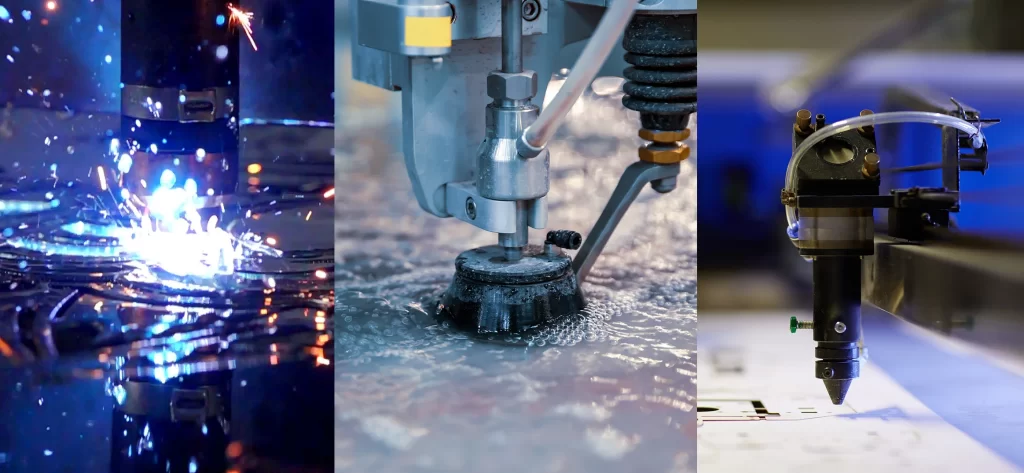
Comparison of Industrial Cutting Technologies
- CNC laser cutting systems require very little maintenance. They frequently need less upkeep than their mechanical counterparts.
- CNC laser cutting machines need less repairing. So, these are cost-effective. Repair costs will be lower when there are fewer mechanical parts to break or wear out.
- The enclosed and automated nature of CNC laser cutter operation reduces operator risks. It improves automation and operator safety in the long run.
Disadvantages of CNC Laser Cutting
Laser cutting still has a few drawbacks, which are outlined below, despite all of its advantages:
- CNC laser cutting necessitates a high power consumption. Electricity consumption is high, particularly for CO2 laser cutting technology.
- Material thickness is limited by laser cutters. They typically only accept plate and sheet materials with a maximum thickness of 25 mm. Although thicker materials can be cut, common fabrication shops rarely do so.
- It is possible for dangerous fumes to be released. These dangerous fumes are released when cutting certain materials, like plastic or wood.
- In some laser technologies (such as CO2), the laser tube is a worn component that must be replaced, frequently at a high cost.
- Laser cutters necessitate a significant initial investment. In some situations, cheaper technology like plasma or flame cutters can be better.
Real-World Applications of CNC Laser Cutting Machines
CNC laser cutting is utilized in a wide range of industries due to its precision and adaptability when shaping various materials. This technology is used frequently in the following sectors:
- Automotive Industry: CNC laser cutting is essential to the automotive industry. It can create tiny parts with intricate patterns and cut car body panels. CNC laser cutting precisely shapes sheet metal components,
- Aerospace Industry: CNC laser cutting machines are used to create precise parts with tight tolerances by cutting unusual metals and composites that are frequently used in the industry.
- Electronics Industry: CNC laser cutters are useful tools that can be used for everything from etching circuit boards to making smartphone parts in the electronics industry.
- Manufacturing of Medical Equipment: CNC laser cutters make it easier to produce orthopaedic implants, surgical instruments, and medical equipment where precision and attention to detail are essential.
- Jewelry Industry: The jewelry industry makes extensive use of CNC laser cutting for cutting and engraving purposes to produce intricate designs with high precision.
- Construction Industry: The construction industry cuts structural elements for bridges, buildings, and other projects with large CNC laser cutting equipment.
How CNC Laser Cutting Transforms Modern Industry
CNC laser cutting technology is developing in response to the increasing demands for production accuracy, speed, and efficiency. The development of artificial intelligence and machine learning in CNC laser cutting in industry is making industrial laser cutting machines more intelligent and self-sufficient. The optimization of the cutting process can now reduce waste and increase output.
Another important trend is the continuous improvement of laser power and beam quality. With an output range of 6 kW to 15 kW, advanced laser systems can cut thicker materials more quickly and precisely. Furthermore, as Industry 4.0 methods gain traction in the manufacturing sector, a more networked and data-driven approach to laser cutting is in store. By sharing, analyzing, and utilizing real-time data from networked CNC machines, the entire production process can be improved.
Why ProleanTech Is Your Trusted Partner in CNC Laser Cutting
ProleanTech stands out as a trustworthy partner for CNC laser cutting by combining cutting-edge technology with skilled experts to provide outstanding accuracy. Excellent performance and less waste on a variety of materials are guaranteed by our advanced laser systems. We tailor our cutting solutions to meet the specific needs of each project, whether they are for large-scale production or prototyping. We emphasize quality and creativity in this process.
ProleanTech is the ideal partner for production with our years of industry experience and dedication to client satisfaction. We guarantee precision, speed, and dependability in every cut. Companies can get accurate and dependable CNC laser cutting of titanium, stainless steel, and other materials by working with ProleanTech. A dedicated staff is here 24/7 to increase production and machine efficiency.
Conclusion
CNC laser cutting technology transformed modern production. The speed, precision, and variety provided by these technologies cannot be matched. ProleanTech provides cutting-edge solutions for a wide range of materials, including titanium and stainless steel, that are both highly accurate and effective. Production can be increased with improved cutting quality. By investing in ProleanTech equipment, businesses can easily manage small and large projects.
FAQ’s
What is CNC laser cutting?
CNC laser cutting uses a powerful laser beam for CNC cutting. It can cut or etch materials directed by computer commands. The process of CNC laser cutting offers higher levels of accuracy. It can create complex shapes and patterns that are not possible manually.
Is CNC cheaper than laser cutting?
Usually, CNC is cheaper than laser cutting. However, a number of factors can affect the price of CNC laser cutting. Depending on the materials and work complexity, CNC laser cutting services cost from $75 to $150 per hour on average.
Is a CNC machine hard to learn?
No. CNC machines are user-friendly. However, training is required for learning G-code and CAM/CAD.
Which is better, a CNC laser cutter or a laser engraver?
A CNC laser cutter is better than a laser engraver. CNC laser cutters can cut and shape thick materials. Whereas laser engravers excel in precise and fine cutting. Hence, CNC laser cutting has both benefits.
0 Comments