
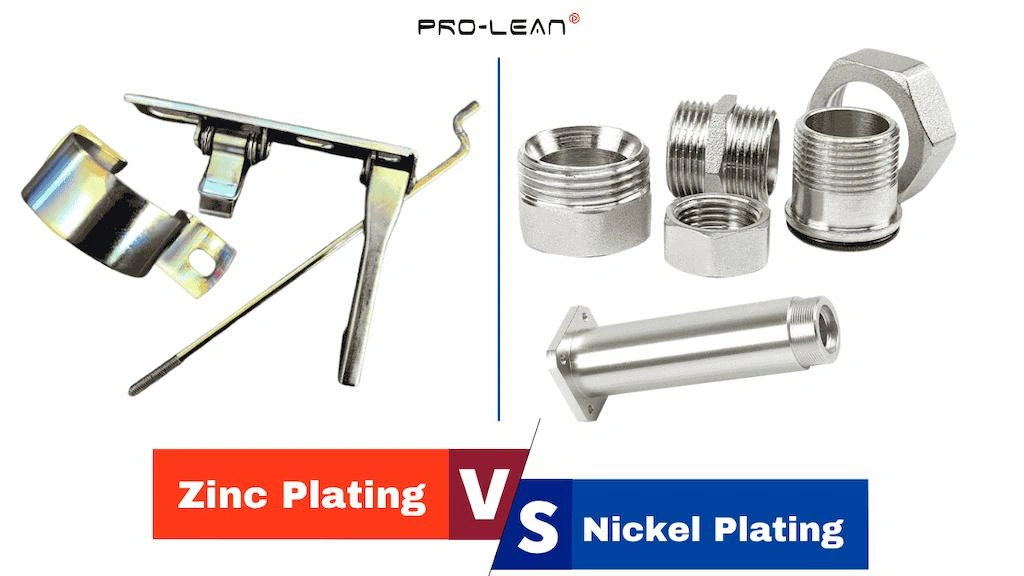
Zinc vs.Nickel Plating
Manufactured parts of iron, alloy steels, cast irons, and other prone-to-corrosion metals require surface treatments and coatings to enhance their performance and durability. Electroplating zinc or nickel on such substrates is a good practice.
Zinc and Nickel plating are used for automotive parts, aircraft components, architectural applications, and electrical & electronic components, among other applications. Meanwhile, plating not only provides the aesthetic, but also improves corrosion-resistance, coefficient of friction, and durability to substrate parts.
You can apply a plating finish on a variety of conductive materials, including carbon steels, mild steels, cast iron, brass, and bronze.
This article provides a comparative overview of Zinc vs Nickel Plating, comparing the process, advantages, and disadvantages.
Let’s get started!
What is Nickel Plating?
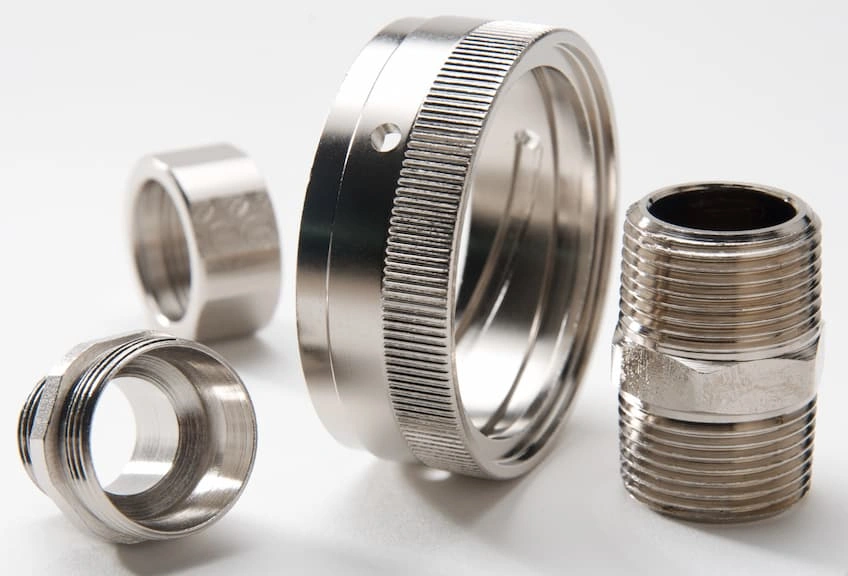
Nickel plating
Nickel plating is a process of coating a thin nickel layer (~5-50 µm) on a conductive surface by electrochemical deposition. The plated nickel layer forms a metallic bond with the parent material. Consequently, it is available in different color options, including dull, matte, and mirror-finished finishes.
So, you can use Nickel plating for corrosion resistance, wear resistance, lubricity, and aesthetics.
How Does Nickel Plating Work?
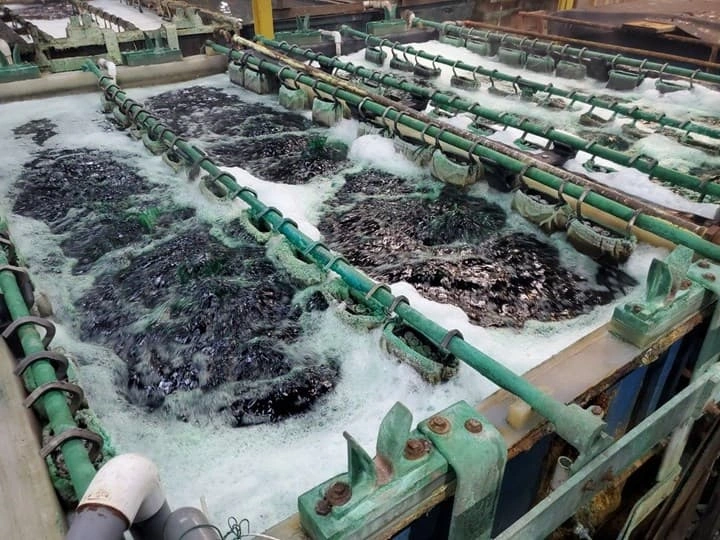
Nickel plating process
The process of nickel plating involves multiple steps, including surface cleaning, activation, process setup, electrolysis, brightening, cleaning & rinsing, and drying.
Let’s further break down theon steps involved in the nickelNickel plating process.
Step 1: Thorough Cleaning
Properly clean the surface to remove debris, oils, dirt, grease, oxides, etc., using techniques such as degreasing and acidic pickling.
Step 2: Surface Activation
This step is critical for improving surface compatibility with electrochemical deposition. You can use acidic or alkaline solutions.
Step 3: Electrolysis Setup
Immerse the substrate (cathode) and Nickel (anode) in a plating tank (electrolytic cell) containing an electrolytic bath. Then connect them with a power source to form an electrolysis circuit.
Step 4: Electroplating Process
Supply the power until desired coating thickness is achieved. Meanwhile, you must continuously monitor the electrolysis process.
Step 5: Brightening
Surface brightening produces a lustrous, bright, and mirror-like surface for decorative purposes. You can perform by adding a brightening agent to the plating bath or by post-treatment polishing.
Step 6: Cleaning & Rinsing
Clean and rinse plated parts to remove process residues. You can use warm-water rinsing or chemical-neutralization rinsing.
Step 7: Drying
Dry the plated parts before quality inspection & packaging.
↪ If you want to read about coating Nickel on Aluminum for enhanced corrosion-protection & aesthetic, read “ Nickel Plating Aluminum” here.
Try Prolean Now!
Will Nickel-plated Steel Rust?
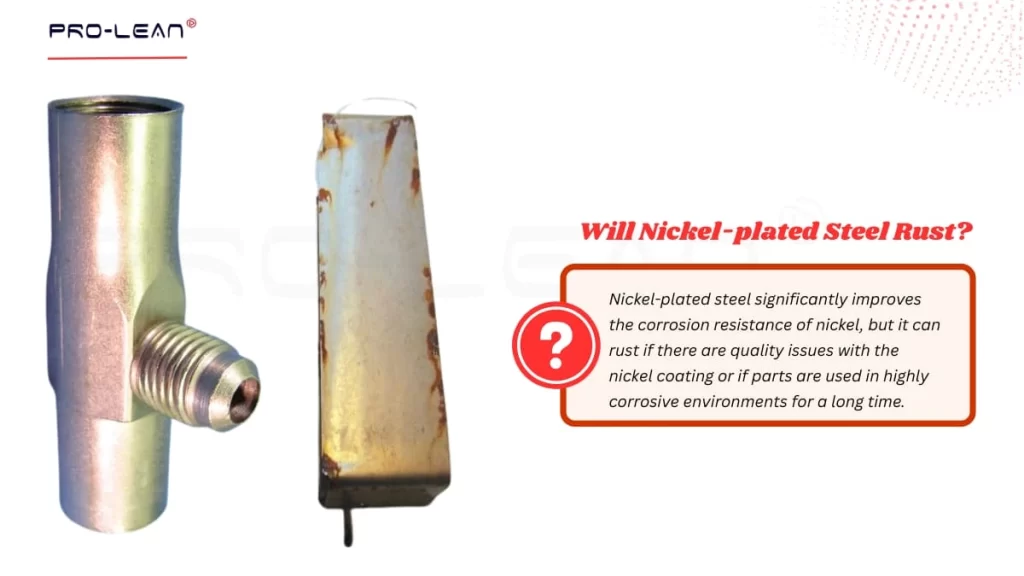
Nickel plating rust
Nickel-plated steel significantly improves the corrosion resistance of nickel, but it’s not universally rust-free. It can rust if there are quality issues with the nickel coating or if parts are used in highly corrosive environments for extended periods.
So, Nickel-plated steel will rust if there is poor adhesion due to impurities on the underlying surface, high porosity, or scratches.
What is Zinc Plating?
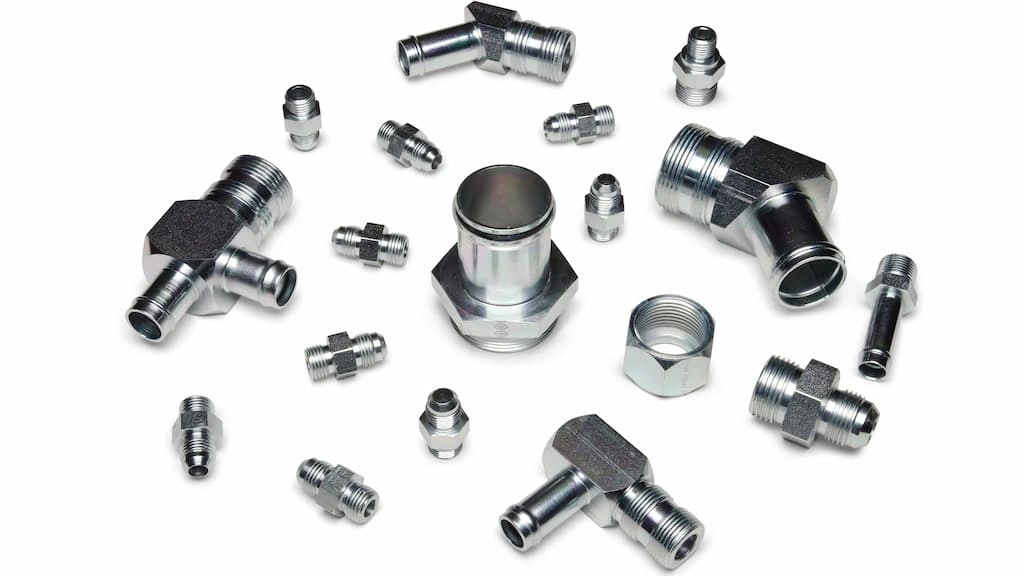
Zinc plating
Zinc is another corrosion-resistant metal that can be plated on carbon irons and different steels using an electrochemical process. It is more cost-effective than Nickel but offers lower hardness and aesthetic variations.
The zinc coating on the surface acts as a barrier and slowly sacrifices itself in harsh & humid environments to protect the underlying part. However, proper passivation of the coating layer helps to overcome this plating erosion.
How Does Zinc Plating Work?
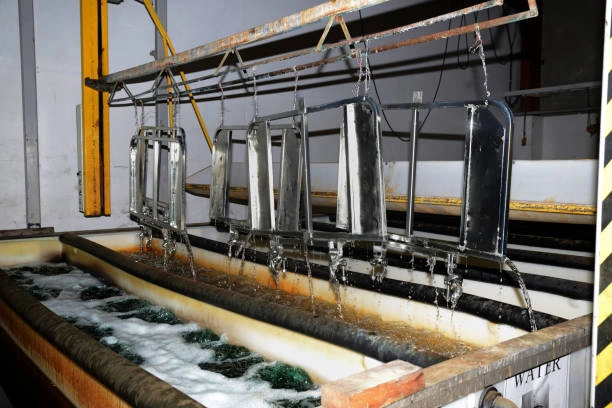
Zinc electroplating process
The core working principle of zinc plating is similar to Nickel plating. The substrate is connected as the cathode, zinc is used as the anode, and a zinc-ion-containing bath is used for electrolysis.
The only key difference is that zinc-plated parts undergo a passivation stage, which seals the pores and makes the coating more corrosion-resistant. Manufacturers typically use chromates soulutions for the passivation of zinc-plated parts.
Here are the key steps involved in the zinc plating process.
- Thorough cleaning of surface parts
- Surface activation
- Zinc plating setup
- Plating process
- Passivation
- Cleaning & rinsing
- Drying
Nickel Plating Advantages and Disadvantages
Corrosion resistance, enhanced surface hardness, wear resistance, low friction, aesthetic appeal, and thermal resistance are the advantages of Nickel plating. On the other hand, it also has some disadvantages, such as finishing cost, risk of brittleness, and waste management.
The table below provides a clear overview of the pros and cons of Nickel Plating.
| Nickel Plating Advantages | Nickel Plating Disadvantages |
| Plating provides corrosion resistance in moist, wet, and harsh environments. | Nickel itself is an expensive engineering material, so plating becomes more expensive as well. |
| Nickel improves surface hardness and reduces the coefficient of friction. | It produces hazardous waste, is difficult to manage, and causes environmental harm. |
| Bright and appealing aesthetic with many color variations. | Energy-intensive process, especially for thicker coats. |
| You can coat a thicker layer of Nickel for heavy-duty applications. | The nickel coating increases the surface brittleness, which can limit the formability. |
| It can be applied to iron, steel, brass, and other metals. | Interaction with nickel-plated parts can cause skin allergies. |
Zinc Plating Advantages and Disadvantages
Corrosion protection, enhanced ductility, low maintenance requirements, and low plating costs are the main advantages of the zinc plating process. On the other hand, low wear resistance and the risk of hydrogen embrittlement are limitations.
The table below provides a clear overview of the pros and cons of Zinc Plating.
| Zinc Plating Advantages | Zinc Plating Disadvantages |
| Corrosion protection for ferrous and some non-ferrous materials. | The risk of hydrogen embrittlement compromises the formability and strength. |
| Lower cost and more environmentally friendly than Nickel Plating. | The wear resistance and lubricity of the zinc-plating surface. |
| Lower maintenance requirements, and the zinc-coating layer can be repaired. | Zinc plating is not ideal for moving (or rotating) parts. |
| The zinc coating process applies to a wide range of components (both ferrous & non-ferrous). | The zinc coating erodes more quickly than the nickel coating. |
Try Prolean Now!
Zinc Vs Nickel Plating: Key Differences
Zinc and Nickel plating differ mainly in corrosion resistance, hardness, wear resistance, thickness flexibility, electrical conductivity, aesthetics, environmental effects, and cost.
Let’s break down the differences between these two types of metal plating methods;
Level of Corrosion Resistance
Although both zinc and nickel plating are corrosion-resistant, Nickel provides superior corrosion resistance. It is also more effective in marine, mildly acidic, and alkaline environments. However, zinc plating process is sufficient for general-purpose applications.
Coating Hardness
Comparing zinc vs nickel plating hardness, Nickel is harder than Zinc (up to 700 HV). However, specific hardness levels vary with layer thickness and underlying material.
Wear Resistance
Consequently, Nickel plating offers better wear resistance and self-lubrication than zinc plating. This makes nickel metal suitable for plating sliding & rotating components.
Aesthetic Appeal
Nickel plating is more suitable for decorative and aesthetically sensitive items. It can provide a range of textures and colors with a sleek, lustrous finish. On the other hand, using zinc for electroplating offers a smooth metallic finish and a wider range of colors. Common zinc-plating colors are matte black, blue, bright silver, and gold.
Thickness Flexibility
A typical thickness range for the zinc plating layer is ~2–30 µm, which means you can achieve very thin, not heavy-duty, coatings. On the other hand, Nickel plating is more flexible, ranging from ~5 to 50 µm.
Environmental Hazards
Zinc is more abundant in nature and is easily recyclable, making the zinc coating process less hazardous than Nickel plating. However, waste from Nickel plating can be managed to minimize environmental impact.
Cost
Nickel plating is costlier due to the cost of Nickel material & processing time. Still, it is cost-effective when surface hardness influences performance, and aesthetics are critical to product value. On the other hand, zinc does not require the strict process control required by nickel and is cost-effective for both small and large volumes.
Factors to Consider while Choosing between Zinc Vs Nickel Plating
You must consider multiple factors while choosing between zinc and nickel plating, such as required corrosion resistance, aesthetic, hardness, wear-condition, substrate type, production volume, and cost.
Let’s further elaborate on these factors.
Desired level of corrosion-resistance
Do your parts need to withstand harsh environments, such as continuous moisture or slight acidity? If so, choose nickel plating for corrosion resistance.
Desired Aesthetic
Consider the importance of aesthetic (both texture & colors) in performance and product value. Nickel is considered a good choice for finishing decorative parts, architectural items, and products that require an attractive finish.
Substrate Material
Consider the type of substrate material you want to electroplate. Some metals are more compatible with Nickel, and some are more compatible with Zinc. For instance, choosing zinc for electroplating is best for cast iron, and nickel is best for mild steels.
Wear-conditions in Applications
Consider whether parts will be subjected to wear-prone conditions, such as high stress, continuous rotation, or sliding. For instance, bearing shafts, gears, and hydraulic pistons.
Production Volume & Cost
Consider production volume and associate per/part finishing cost. Zinc plating is cost-effective for high volumes, whereas Nickel is ideal for low- to medium-volume applications.
Zinc Nickel Alloy Plating: High performance than Zinc and Lower Cost than Nickel
Zinc Nickel Plating
Zinc nickel alloy plating, or zinc – nickel treatment, is another finishing option to overcome the zinc’s sacrificial properties and the high cost of nickel.
The process uses a single mixed plating bath, containing both zinc and nickel ions. As current is supplied to the electrolysis circuit, these ions are deposited on the substrate surface simultaneously. The plated Zn-Ni layer consists of ~15% of Nickel and ~85% of Zinc. As a result, the underlying material remains untouched, even if zinc erodes over time.
It. This coating is widely used in automotive applications due to its performance and moderate prices. Some examples include under-hood parts, fuel system components, and screws. Other industries, such as aerospace, electronics, and energy, also use zinc-nickel treatment.
Conclusion: Deciding between Zinc and Nickel Plating
At the end, deciding between Zinc vs Nickel plating depends on the application environment, stress-conditions, desired appearance, and project budget.
Choose Nickel Plating for parts’ durability, enhanced hardness, and vibrant aesthetic. Similarly, choose zinc to plate parts that will be used in less corrosion-prone environments and budget-constrainedconstarints projects.
If you are still confused, contact ProleanTech and talk to an industry engineer.
Try Prolean Now!
Contact ProleanTech for Custom Metal Finishing Solutions
Whether your parts need finishing for performance or aesthetics, ProleanTech can provide custom solutions that exceed your expectations. Our surface treatment & finishing facility has 50+ pieces of equipment and setups capable of handling 15+ finishing processes, including nickel plating, zinc plating, anodizing, and powder coating.
We have more than a decade of experience working on the finishing of diverse industrial, decorative, and ornamental items. For every project, our engineers work closely with the client to deliver the expected results.
If you need zinc plating services or any other finishing solutions, upload your file and get a quote.
FAQs
Is zinc cheaper than nickel?
Yes, zinc is almost five times cheaper than Nickel.
How long will zinc plating last?
Zinc coating can last up to 5 years, based on coating thickness and application environment.
Is nickel plating worth it?
Nickel plating is worth it if your parts require corrosion-resistance in harsh environments, high surface hardness, lubricity, or a premium finish.
0 Comments