
Sheet metal finishing methods
Finishing is one of the most important steps that determines the function, quality, look, and longevity of any metal part. There are different surface finishes, from basic to sophisticated, for different purposes. Knowing the right finish for every application is important, whether for industrial components or for consumer products that require high-quality metal finishing.
Finishing guides provided by Prolean Tech aid in determining appropriate finishes for your specific needs, considering the quality and performance aspects of parts after custom sheet metal fabrication. This blog focuses on the main sheet metal surface finishes, their respective uses, benefits, and ways to determine the appropriate one for your components.
What is Sheet Metal Finishing
Sheet metal finishing is the steps taken to enhance the look, durability, and functionality of metal surfaces after fabrication. This involves the removal of any flaws, corrosion, and the addition of protective or decorative textures. Fine quality metal finishing protects the metal and readies it for the application that it is destined for, whether painting, coating, assembly, or otherwise.
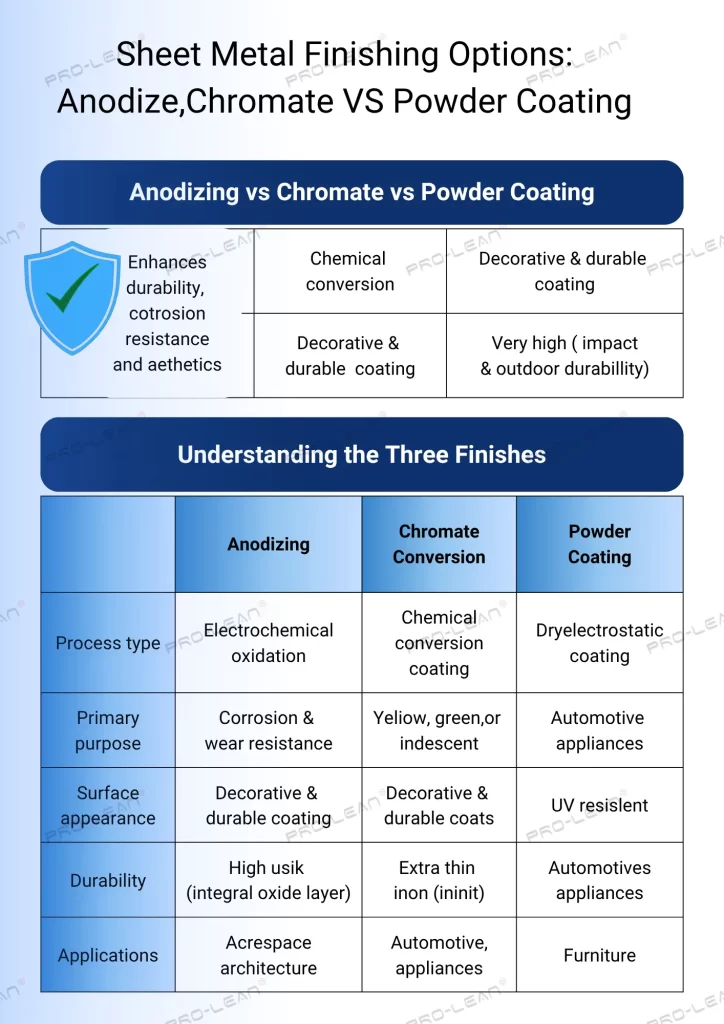
Sheet Metal Finishing Options: Anodize, Chromate, and Powder Coating
Different Types of Surface Finishes
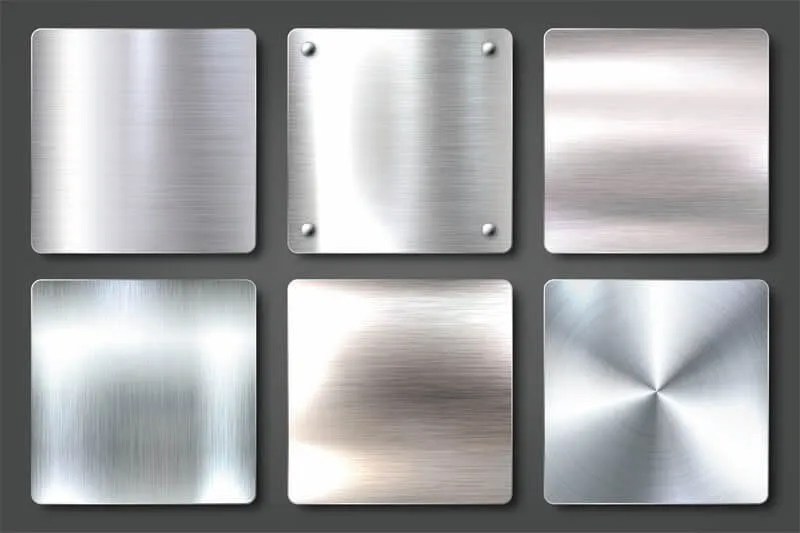
Different Effects of the Same Sheet Metal Finishing Process
The following are various options for finishing after the sheet metal fabrication process. These are some common types of sheet metal finishes:
1. Raw or Rough Finish
Raw or rough finishes occur when no alteration or finishing treatments have been applied to sheet metal. Such finishes can be selected if the base material has the required durability and resistance to the environment. Take stainless steel, for example; it can be left with a raw finish since it is corrosion-resistant in exposed or industrial environments.
These finishes are appropriate in instances and environments when the visual aesthetics are of least importance. They can be found in pharmaceutical and chemical plant equipment, air conditioners, automotive parts, and even jewelry. It is a cost-efficient process.
2. Electroplating
Electroplating or electrodeposition is a process of depositing a metal on the surface of sheet metal using an electric current. This process enhances the visual appeal and increases the corrosion resistance and durability of the base material. Moreover, it is a cost-reduction technique since an expensive metal cover can be placed on a cheap substrate.
Applications
Popular decorative and functional applications for this finish include gold-plated watches, silver-coated cutlery, and chrome-plated bathroom and kitchen fixtures. Electroplating adds a polished and clean look to a product, augments surface hardness, and helps avoid tarnishing.
3. Bead Blasting
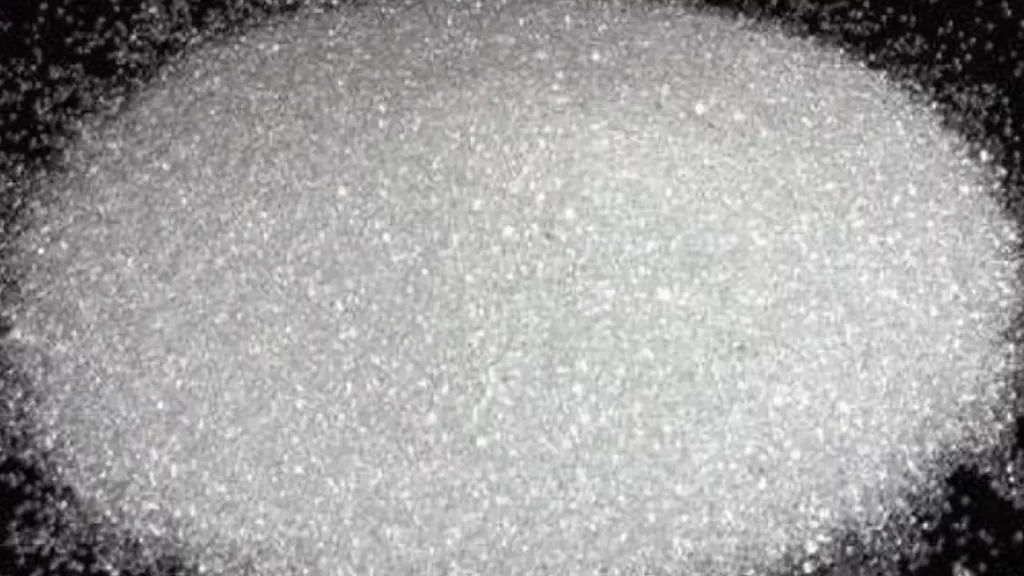
Bead Blast Finishing
Bead blasting is the finishing technique that uses fine glass beads to eliminate surface imperfections and smooth sheet metal. It is a dimmed version of sandblasting, and the technique provides a clean and matte finish. It removes surface imperfections such as tool marks and scratches, thus enhancing the appeal and texture of the metal. The combination of aesthetic and functional applications is common for this technique.
Applications
Automotive components, metal floors, and cabinetry all have bead-blasted surfaces. It enhances the uniformity of the surface and readies the metal for additional layers of coating or paint, if required.
4. Anodizing
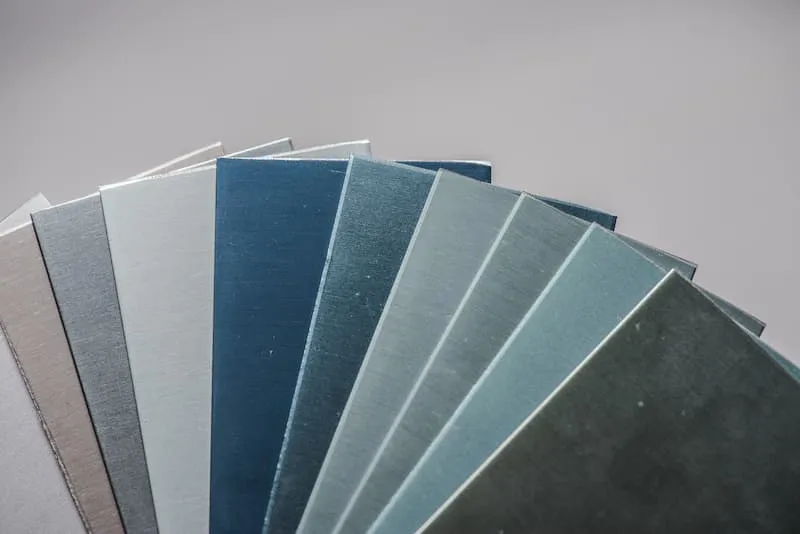
Anodized Aluminium Sheets
Anodizing is a procedure that is mainly applied to aluminum to provide corrosion resistance and durability. It alters the surface of the metal to a robust yet thin oxide layer. The oxide layer of anodized aluminum protects it from wear and tear and various environments. This procedure enhances the paint adhesion and aesthetic appeal of the metal in architectural and decorative applications, making it usable in indoor and outdoor applications.
Types of Anodizing
There are three types of anodizing called Type I, Type II, and Type III. A brief comparison of Type I and Type II vs Type III anodizing is as follows:
- Type I – Chromic Acid Anodizing: Chromic acid forms a thin, corrosion-resistant coating that is used when exact measurements are needed, as in aerospace and mechanical parts. The coating is still lightweight and offers protection.
- Type II – Sulfuric Acid Anodizing: Type II uses sulfuric acid to produce a thicker and more durable finish. It is preferred for decorative purposes, as it provides a higher resistance to corrosion and wear. It is also capable of dyeing to achieve colored finishes for aesthetic and architectural uses.
- Type III – Hard Anodizing: Type III offers the thickest and hardest coating. It is impervious to wear and provides excellent protection from corrosion, making it appropriate for outdoor gear that endures extreme weather, as well as parts for the automobile industry and industrial machinery.
5. Electroless Plating
Also known as auto-catalytic or chemical plating, electroless plating is the process of coating sheet metal surfaces with metal, without requiring an external electric power source. If we specifically talk about electroplating vs electroless plating, a controlled chemical reaction in a reducing bath is used to achieve an even coating in the latter. It provides uniform coating over complex profiles and offers flexibility for coating thickness and type. Depending on the desired specifications, the results can be bright, semi-bright, or matte.
Applications:
This is used in industries for brake pistons, pump housings, pipe fittings, and components for food-processing and injection-molded parts. The process also improves the surface for easier maintenance and adds abrasion resistance, corrosion resistance, and smoothness to the electroless-plated surface.
6. Powder Coating
Powder coating is a dry finishing process in which a mixture of powders consisting of pigments, resins, and additives is sprayed onto the surface of sheet metal. Parts are then baked, which helps the surface smoothen and the powder melts to create a durable shell. The powder coating provides the surface with a durable finish. The finish is also aesthetically pleasing and resists corrosion, scratches, and fading.
Applications
Powder coating is utilized in various consumer and industrial products due to its visible cleanliness and durability. This can be seen in household appliances, automotive parts, metal furniture, and industrial machinery. Powder coating is offered in a wide variety of colors and textures. Unlike many solvent-based liquid coatings, powder coating emits very low VOCs, making it a more environmentally friendly option.
7. Phosphate Coating
Phosphate coating or phosphatization is a chemical treatment mainly on steel to improve its corrosion resistance and adhesion. This process creates a protective coating in the form of a thin, crystalline layer of zinc, iron, or manganese apatite., The coating enhances the protective nature of the surface and paint adhesion.
Applications
These practices are common in the automotive industry for use in body panels and engine components, as well as for fasteners. It helps to reduce wear and rust and aids in surface preparation for coatings and lubrication for prolonging the life of the component.
8. Electropolishing
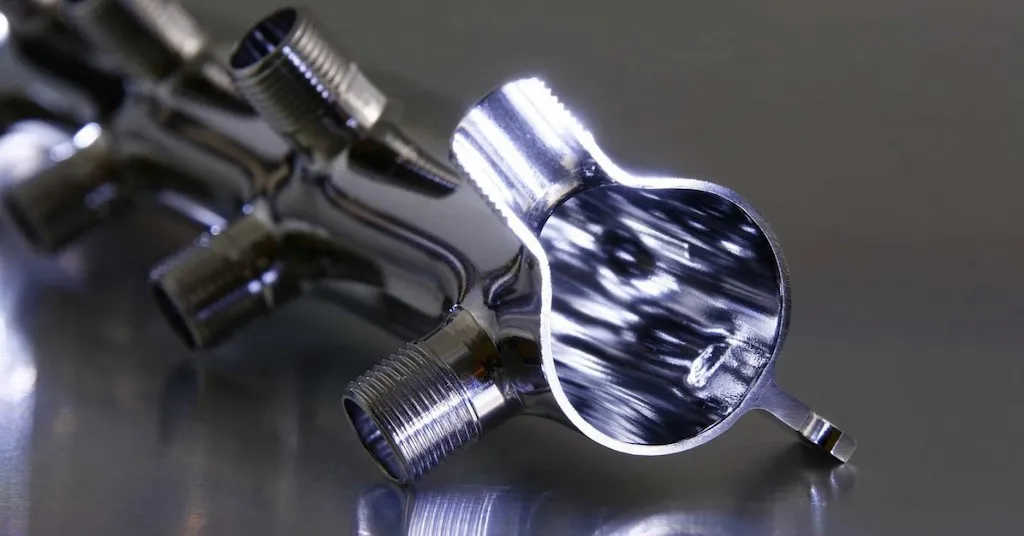
Electropolished Stainless Steel
To brighten and smooth the surface of metal, electropolishing involves removing a layer of metal through an electrical current. The process of anodically polarizing metal involves the elimination of surface irregularities, micro-peaks, and debris. Metals, and most importantly, stainless steel and other alloyed metals, gain improved corrosion resistance and service life.
Applications
Food processing, automotive, medical devices, and home appliances industries employ electropolishing for its aesthetic and hygienic purposes. This polish is needed for parts that provide a high degree of durability and hygienic surfaces.
Try Prolean Now!
9. Buff Polishing
Using a cloth wheel that is rotating, buff polishing smoothens and refines sheet metal, cleans, and performs surface polishing. It improves the surface that is polished to a reflective appearance and helps prepare the surface for other finishing steps, if needed.
Applications
The need for buff polishing in this regard is most common for decorative purposes, especially for high-gloss finishing. This is observed in industries such as pharmaceuticals, food, and consumer goods, where finishing, along with its performance, needs to be appealing.
10. Abrasive Blasting
Abrasive blasting uses high-speed equipment to propel abrasive particles against the metal surface for cleaning and smoothing. It removes rust, old coatings, and surface contaminants quickly, saving both time and cost. The process also provides an ideal base for painting, plating, or coating.
Applications
This technique is common in industries such as automotive, construction, and engraving. It ensures a clean, uniform surface that improves coating adhesion and enhances the durability of finished metal products.
11. As-cut Finishing
As-cut surfaces are the edges and faces of metal parts immediately after cutting. These surfaces have not received any finish smoothing or polishing; the surfaces may have irregularities. Even functional surfaces may have unpleasant and irregular surfaces.
These are for parts that are concealed, are to be put in bigger assemblages, as well as be finished internally by the client. Finishing surfaces may also be needed if a clean surface is desired or the surface is not to be separated, and other methods will be applied. Tabbing is also done in cutting sheets to attach smaller parts.
12. Media Tumbled Finish
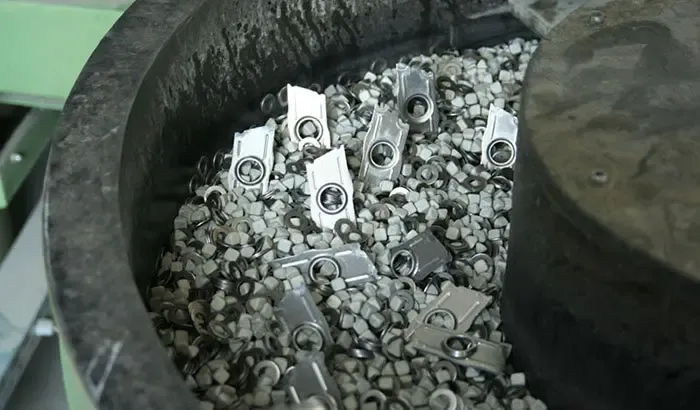
Tumbling Media for Steel
Media finishing involves the use of vibratory tumblers loaded with water and ceramic abrasives to smooth and even all surfaces of small parts for sheet metal finishing. This finishing process prepares further polishing, assembly, or soldering as it removes the burr, removes small surface marks, evens out the appearance, and tones the contrast of surfaces uniformly across the metal.
This finish is effective on parts with a height and width of less than four inches and adequate thickness to endure tumbling. It is seen with small production parts, electrical connectors, and jewelry. The tabs generated by cutting are left smooth, the surfaces uncluttered, and the tumbling process removes tabs during cutting.
13. Sanding Random (Swirl) Finish
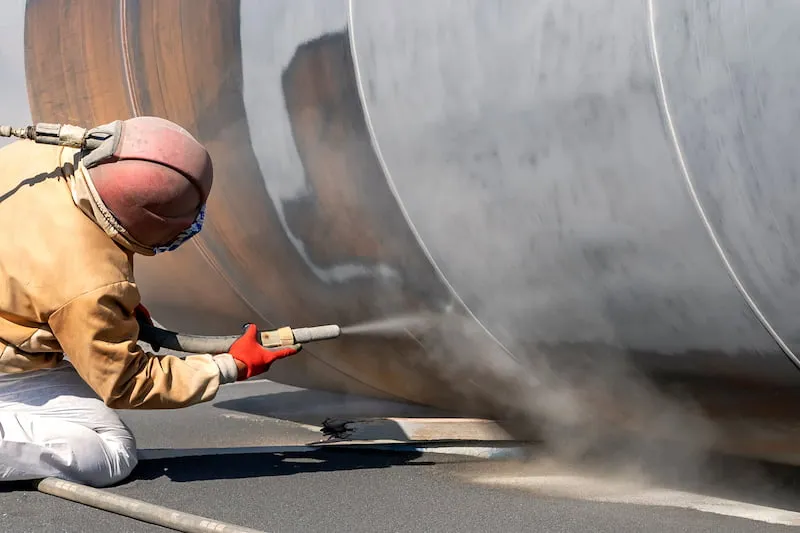
Sand Blast Metal Surface Finish
Sanding random (swirl) finish uses a powered non-woven abrasive pad in a random orbital pattern to smooth both faces of sheet metal. It removes light scratches, mill marks, and burrs while creating a subtle, all-over brushed texture that looks uniform and professional.
This finish is ideal for larger parts, typically over six inches, and provides a good surface for paint or coatings to adhere. It is often used in signage and can also prepare surfaces for anodizing, resulting in a matte, non-reflective appearance.
14. Linear Grain Sanded Finish
Linear grain, also called brushed or Timesaver finish, is achieved by sanding both sides of the metal with a non-woven abrasive on a belt sander or Timesaver machine. This produces uniform, parallel lines that give the metal a polished, decorative look while smoothing surface imperfections.
While attractive and suitable for many applications, this finish is not perfectly consistent like a #4 standard finish due to the manual nature of the process. The sanding usually follows the metal’s natural grain, but custom grain directions can be specified for specific design requirements.
Try Prolean Now!
Handling and Maintenance of Metal Finishes
Proper maintenance and handling of metal finishes is very important. While cutting and finishing the protective oil layers received with stock sheet materials is removed and can expose the surface to tarnishing, fingerprints, and dulling, even after finishing, oil layers left in abrasive finishing can quickly expose a surface to oxidation. This is paoxidationy evident in abrasive finishing, where protective layers are quickly removed, and the surface will need careful finishing after processing.
Different types of metals require different cleaning methods. Non-abrasive cleaners will remove tarnish on your copper and brass items. Fingerprints on stainless steel can be removed with denatured alcohol and other solvents. For stainless steel, dull oxidation can be removed with fine steel or bronze wool, to be used along with the grain. Waxing with clear microcrystalline wax, polyurethane, or paste wax will help surfaces and their finishes sustain over time.
Choosing the Right Process to Best Achieve Your Sheet Metal Finishing
Each specific sheet metal finishing comes with a variety of specific benefits that range from aesthetics to the preparation of the surface. This will help with factors like the prevention of corrosion. Achieving the right one will help with the performance, durability, and quality regarding the appearance of your parts.
To meet the diverse fabrication requirements, Prolean Tech offers a variety of different options. To attain the precise surface features, our staff will assist in determining the right course of action that will provide you with quality results.
Summary
Maximizing your product’s appearance and performance will require you to have the right sheet metal with the right finish. Each finishing process adds a unique benefit, be it resistance to corrosion, protection against wear, or purely aesthetic. The durability, functionality, and maintenance of your product will be determined by the finish you choose.
You can rely on Prolean Tech for professional advice on how to choose the best finishing option for your needs. With the right finishing option, you can have parts that look polished, perform optimally for a long time, require less maintenance, and enhance the longevity of your parts.
Contact us now to get a quote for the best sheet metal service.
0 Comments