
 E-Coatings for Precision Steels and CNC-Machined Components
Surface protection is the main reason for failures of metal components in the field. Corrosion also begins in the areas that are not easily accessible and explored, and these include internal bores and pockets, weld lines, threaded holes, and inset seams. Spray finishes are likely to overlook these spots. This causes premature failure of parts, rework that is expensive, and shortened service life of what would otherwise have been a perfect assembly.
E-coating gets rid of the problem at the source of the problem. A uniform film on the conductive surfaces of all, and a metal part is deposited by immersing the metal part in a uniform film bath. This includes the types of styles that are inaccessible and the ones that cannot be accessed by spraying methods. E-coating is one of the best finishes that is applied to finish the precision production parts. It also boasts of a salt spray resistance that is greater than 1,000 hours, and its film can also be controlled to a nanometer thickness.
The coating process is also important to the engineer who is specifying finishes on assemblies where there is high toleration or to the consumer who is getting assemblies in large quantities. ProLean Tech provides in-house custom machining with precision surface finishing suggestions, enabling the teams to create the proper surface treatment of their part geometry, tolerances, and operating conditions. We offer different forms of precision machining services, which are most appropriate for any program.
What is E-Coating?
Electrocoating or ecoat is also referred to as e-coating. It is a wet electrode process that deposits a paint onto a metal substrate. E-coating, a wet coating technique, is wholly immersed. This is unlike the spray painting, which has to be seen from the line of sight in order to access a surface. The coating can cover internal channels, threads, and cavities that cannot be consistently accessed with spray equipment.
This is particularly applicable to the CNC-machined parts and precision steel components due to the fact that the thin layer formed can be regulated in terms of dimensions without growing in large amounts on delicate surfaces. This control is not a benefit when dealing with parts that are significant with respect to microns. It is based on this that the application of e-coatings has been adopted as opposed to the alternative application of coating.
E-Coat Process Step-by-Step
The e-coat process is a multi-level, repeat process that controls the quality of the manufacturing process of raw metal to the end cure.
- Pretreatment parts are cleaned to remove contaminants, machining oil, and oxides. The part is then deposited with a coating of zinc or an iron phosphate to give it a corrosion-resistant coating as well as improve the adhesion.
- Bath Immersion: Put the moist side of the work into a tank containing 80 or 90 percent of deionized distilled water, and 10 or 20 percent of paint solids (acrylic or epoxy resins).
- Electrodeposition is done with DC. The particles of paint are charged and travel to the oppositely charged surface of the part. They form a standard layer on every surface, such as recesses, internal features, etc. Otherwise, that would not be secure.
- Post Rinsing: Unbonded excess material is removed in the process of post-rinsing. Recycled paint solids can be used as part of the bath. This makes the transfer efficiency more than 95 percent, and it also saves a lot of waste material in comparison with spray application.
- Curing: The elements are heated at 175 to 200 degrees Celsius for at least twenty minutes. The resin is crosslinked by the heat of the oven to give a corrosion-resistant, non-porous surface.
Why E-Coating Suits Precision-Machined Parts
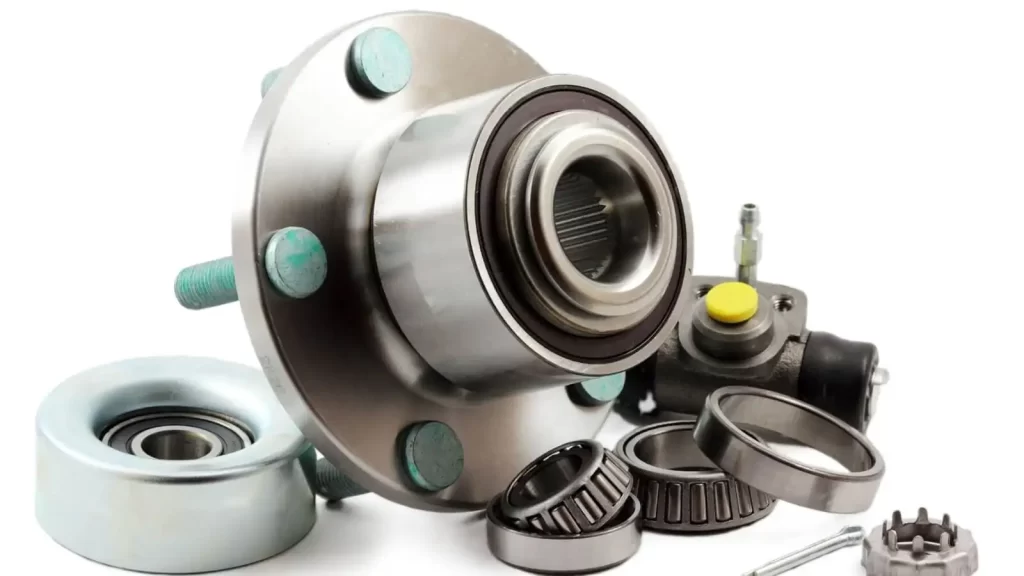
Electroplating machined components
The majority of finishing techniques work with simpler shapes. E-coatings have been developed and are constantly improved in precision-machined parts. It is especially useful with precision parts as it has three performance characteristics.
Asymmetrical Coverage of Intricate Features
The e-coating electrical charge generates what finishing experts call throwing force: the capability to apply paint in places where it could otherwise not be applied via conventional spraying and dipping. This is a great benefit to CNC-machined parts with blind pockets or internal bores. This is the advantage of e-coatings compared to other coatings.
Parts that cannot be sprayed include gear housings and battery enclosures. The E-coating reaches them.
Tight Film Thickness for Tolerance Critical Components
The normal e-coat has a depth of 15 to 35 microns. It is a lot finer than powder coating, which could be up to 60 microns. This is necessary to achieve controlled deposition with components machined using CNC, or bores press-fitted. Adding another 100 or 80 microns of coating will interfere with the fit. A coating of 20-30 microns will not generally affect a fit when uniformly applied. However, it may still affect the fit in certain precision parts, especially those with tight tolerances or delicate features.
The thickness of the film should be decided upon and checked before manufacturing.
Dimensional Risk Fee Corrosion Resistance
ASTM B117 declares that E-coated precision components survive the salt spray test in excess of 1,000 hours. The non-porous surface provides a salt, moisture, and mild chemical-resistant barrier. This type of protection is commonly necessary in parts to be used as automotive underbody, industrial equipment, farm equipment, or as an outdoor enclosure.
Choose the Appropriate Chemistry to Use In the E-Coating Type
Not all e-coatings are similar. The two key parameters have a direct impact on the polarity of electricity and the type of resin.
Cathodic E-Coating vs. Anodic E-Coating
In cathodic electro-coating (CED), the workpiece is the negative electrode. The metal ions are kept from moving through the paint film. This forms a denser and more resistant to corrosion coated layer. Cathodic e coatings are used in over 95 percent of all industrial applications as well as nein nearly all automotive production.
The coating can be used indoors or in ones that have lesser requirements. The migration of the metal ion that takes place in the process is a limitation to the performance of the anodic system. Most precision-machined components should be coated cathodically.
Cathodic e-coating is the right choice for automotive parts, heavy machinery, and any component that needs strong corrosion protection in demanding environments. Anodic e-coating is better suited for indoor applications or parts with lower corrosion resistance requirements, such as light fixtures or interior hardware. Knowing which type to use based on the part’s exposure and performance requirements helps avoid coating failures and unnecessary costs.
When deciding between anodic and cathodic e-coating, consider the following factors:
| Factors | Anodic E-Coating | Cathodic E-Coating |
| Corrosion resistance | Lower corrosion resistance | Higher corrosion resistance |
| Cost | More cost-effective | Higher cost |
| Coating thickness | Thinner coating layers | Thicker coating layers |
| Curing time | Faster curing times | Longer curing times |
| Suitable applications | Decorative, lightweight applications | Heavy-duty applications, harsh environments |
| Edge coverage | Less effective edge coverage | Better edge coverage |
Epoxy Resin Systems vs Acrylic Resin Systems
It is used as a preferred primer in the structural components and parts of the underbody that are subjected to extreme industrial conditions. It has only one drawback, which is its UV stability. The epoxies in the ecoats will also chalk and degrade with long exposure to the sun. Consequently, exterior-facing surfaces must have a UV-resistant plating finish on top of the paint.
Cathodic acrylic e-coating deals with the UV gap. Acrylic products are the best in agricultural machinery, HVAC, and appliance visible paneling. They give good color retention, outdoor performance, and the ability to work in harsh environments. The negative aspect is that the chemical resistance of acrylic is slightly lower than that of epoxy. This is to be compared with the UV requirements of each application.
E-Coating vs. Powder Coating vs. Anodizing
In making a decision on the methods of surface finishing, it is necessary to pay attention to the following issues: coverage, film thickening, corrosion performance, and aesthetics. Here, the key differences between typical CNC- machined parts are compared.
| Criteria | E-Coating | Powder Coating | Anodizing |
| Coverage of complex parts | Full immersion is a great experience | Spray-limited recesses are a good idea | Surface conversion only |
| Film Thickness | 15-35 um | Over 60 um | 5 to 25 u |
| Corrosion Resistance | Excellent, 1,000+ hrs salt spray | Good | The quality of the alloys varies |
| Tolerance impact | Low, thin, and controlled | The thicker the build, the higher it is | Only the low-surface |
| Colors | Black, mostly | Wide range | Clear or limited-dye |
| Best for | Hidden surfaces, seams, cavities | Visible decorative parts | Aluminum components |
These two layers are complementary. These layers complement each other. The E-coat acts as a corrosion-resistant primer for all surfaces, including hidden ones. Powder coating provides both a decorative topcoat and a thicker protection layer for visible surfaces. The duplex system is now a standard for the manufacture of automobiles and heavy equipment.
Try Prolean Now!
Design Guidelines for Electric Coating Precision CNC Parts
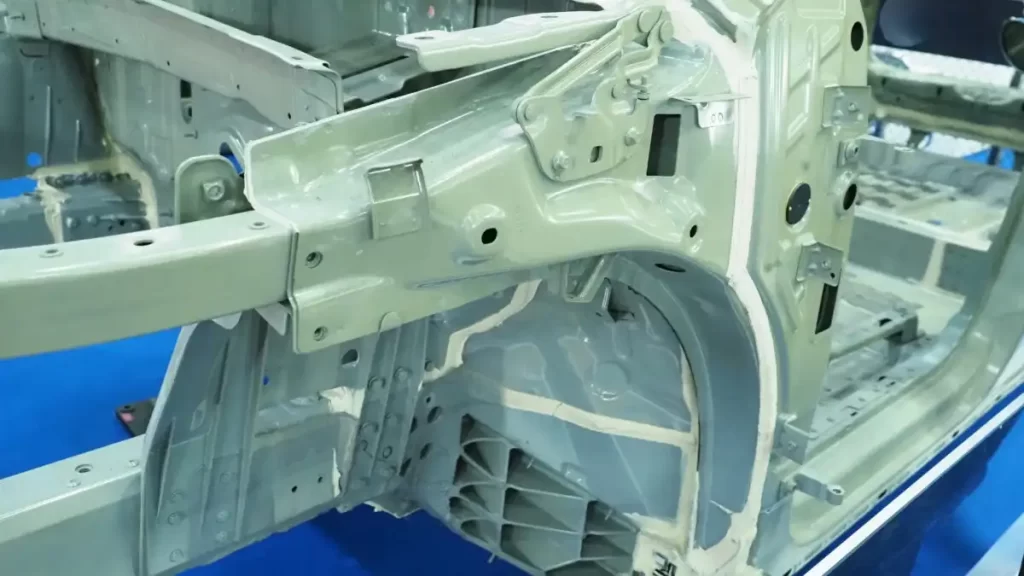
E-coated auto body frame
E-coating is good for complicated geometries, but not immune to geometry problems. It is the design of the component that determines whether it will produce consistent and reliable results.
Drain Holes and Vent Holes
Drainage and ventilation are important details for hollow sections, boxed assemblies, or folded enclosures. Before production, they should be checked. If there are not enough drain holes in the part, it is possible that chemicals used for pretreatment, rinse water, and coating materials get trapped. It can lead to corrosion, contamination, and an uneven film buildup.
At every stage, fluid can freely enter and exit hollow sections. Each hollow section has a small vent hole near the top. This inexpensive addition to the design will prevent expensive quality issues.
Overlap Areas, Lap Joints, and Weld Seams
Surfaces of sheet metal and welded fabrications can collect fluid, causing inconsistent pretreatment. Cleaning can be difficult if the weld seams retain flux or oxide. In the capillary space between folded edges and lap joints, pretreatment chemicals or rinsewater may be retained. This can cause poor adhesion after coating or blistering.
Welds on seams should be continuous, not intermittent. Fluids can get trapped between the weld beads. Sealing or minimizing the edges of lap joints is important in areas where long-term corrosion protection is required.
Sharp Edges and Areas of High Current Density
Sharp edges s cann cause an uneven buildup of film. Internal corners will receive less coating than flat surfaces. Even a small chamfer or edge break, as little as 0.1-0.2mm, can reduce film variation at edges.
E-Coatings Applications
E-coating process on the car body in a factory
E-coatings are a popular finishing for industries using precision-machined components. The combination of corrosion resistance and dimensional control, with its coverage, makes it an industry standard.
Automobile and Transportation
The automotive industry developed electric coating for one simple reason: Complex geometries, such as vehicle bodies, suspension parts, and brake calipers, require corrosion protection. Coating protects CNC-machined parts from corrosion throughout their production life. When a topcoat over a primer is applied, it can provide resistance to salt spray for up to 1,500 hrs.
Heavy Equipment and Machinery
Gear housings, hydraulic cylinders, and motor mountings of all constructions, mining and agricultural equipment are subjected to chemicals, moisture, and mechanical wear. These components are provided with the uniform coating they need without the dimensional variations that heavier coatings can produce on precision mating surfaces.
Electronics and Electrical Enclosures
It is the coating used to offer corrosion protection to CNC-machined enclosures, heat sinks, and other components. This is done without impairing the thermal conductivity, dimensions, and corrosion resistance. The non-porous film of the ecoat provides a consistent platform onto which the EMI can be shielded should other conductive layers be positioned over the ecoat layer.
Health Care Lab Equipment
Health care facilities where equipment is kept must be equipped with carts, support systems, and components of instruments that can withstand strong medical cleaning agents and sterilization without incurring damage. A non-porous and chemically-resistant film that fits such requirements is e-coating. The controlled thickness of the film allows close tolerances in precision-machined parts to be obtained.
Limitations of E-coating: When E-coats are Not the Best Option?
It should be noted that this coating may not be the most suitable. Knowledge of the failure of the coating can be used to eliminate specification errors that introduce downstream quality and cost issues.
- E-coating Non-conductive materials: E-coating must be electrically conductive. It cannot be applied to ceramics, composites, or plastics without an electrically conductive primer. Mixed-material assemblies may have to be finished separately.
- Flexibility in Color: The majority of e-coats are available in a small variety of colors. The most practical and popular is black. Made-to-order colors can be costly and are only applicable in large-scale works.
- Sizes: E Coat tanks are fixed in size. Large welded fabrications can exceed tank capacity and must be finished by other methods.
- Epoxy-ecoat should not be applied to parts that are subject to UV conditions and lack a topcoat. The color will cause degradation as time goes by without a UV-stable surface.
- E-coating volume cost is low when the run volume is low and during prototype runs. Other finishing methods are cheaper in terms of prototypes or small quantities due to the high cost of setting up and racking per part.
Try Prolean Now!
What to Consider When Selecting an E-Coating Supplier for Precision Components
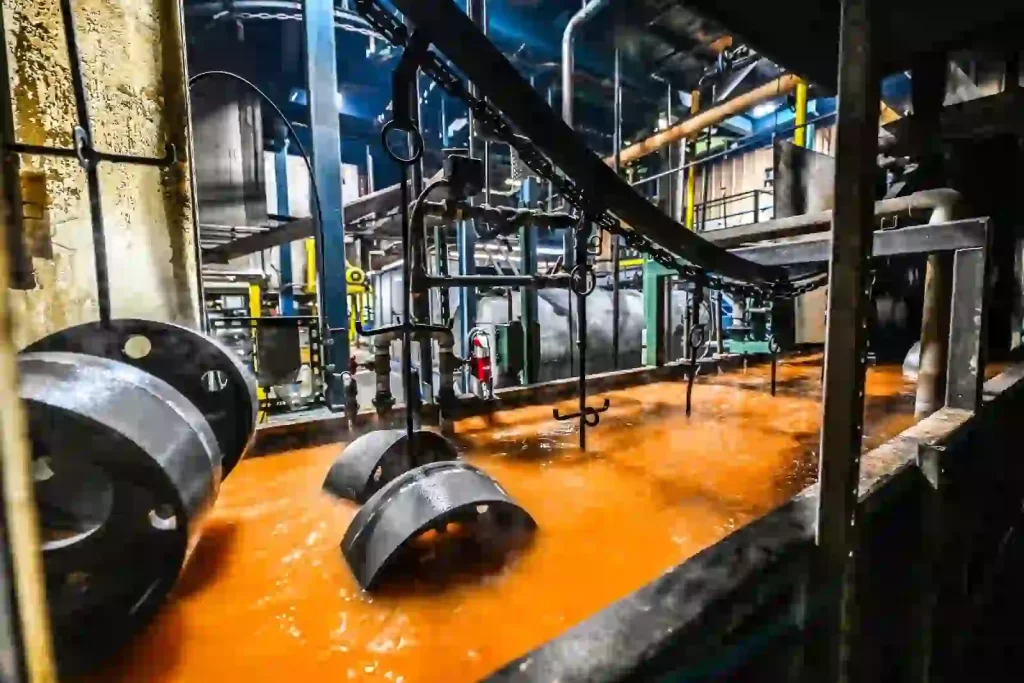
Coating metal items with electroplating
The process is as important to the quality of an e-coating as its s chemistry. When considering precision machining component suppliers with respect to process stability and quality assurance, ask the correct questions.
Technical Capability Checklist
Be sure to check the following before contracting with a vendor:
- Tank Dimensions, such as the largest component that can be processed, and the rack design capability of complex assemblies.
- The supplier can provide guidance on how to make the best choice.
- Thickness measurement equipment, tolerances, and means to control film thickness.
- Important bores and threading. The ground surfaces are not coatable.
- Details of the pretreatment process, including phosphate coating, which improves adhesion
Quality and certification
The ISO 9001 should certify any production programs. Automotive programs and automotive tier suppliers are typically supposed to be certified with IATF 16949. You must also demand further performance information, including data in salt spray tests, ASTM B117, and data in adhesion tests in the form of cross-hatching data or pull-off. Unless the supplier is able to furnish this information, he/she is not the right collaborator for the precise component completion.
CNC and Finishing CNC Supply Chain
Hand-off risks exist in buying electric coating without CNC machining (variable dimensions with handling, coating problems that cannot be easily attributed, and longer lead time because of the logistics of multiple suppliers). The machining and finishing can be provided by the same supplier. It is more visible, the controls are stronger,ter and the distance between inputted material in the process and the final part is smaller.
Conclusion
E-coating does not resemble painting. It is an accurate finishing technology that provides corrosion protection where other techniques cannot provide corrosion protection. An economical technique to solve the problem of machined components that have complicated geometries or complex tolerances is e-coating. It is a wonderful option due to its uniform film thickness. To achieve the best results with ecoating, you must consider the following feasible measures: choosing the appropriate resin, creating parts to drain, venting, and a supplier that can test the quality of the process all the way through.
ProLean Tech offers CNC machining, precision surface finishing service, and precision plating service. This is the ideal choice when team dimensions and guaranteed corrosion protection are required. The ProLean Tech Team may help you identify the optimal e-coating tool to use in a new program, or may review what current finishing options exist on a current component. Contact us to get a quote now!
Frequently Asked Questions
Can e-coat aluminum CNC parts be e-coated?
Yes, to increase the adhesion, a phosphate or chloride pretreatment is normally applied before the ecoat bath. The most popular way of finishing is anodizing in aluminum. However, electric coating has better resistance to harsh surroundings.
Will e-coating affect the size of machined parts?
E-coating is capable of adding 0.015mm to 0.035mm to the thickness of a conventional film. This tolerance stack is critical, and the coating is to be masked prior to processing or when machining a dimension that has a threaded hole, press-fit hole, or precision shaft.
What is the service life of e-coating?
E-coated components in ASTM B117 tests typically last more than 1,000 hours. Factors that relate to the durability of any real-world uses include the environment in which the application will be undertaken, the coating that has been chosen, and the application of a topcoat. Underbody automotive parts utilizing cathodic epoxy as a primer and a powder-topcoat may offer 10 years or longer corrosion protection.
Is it possible to use ecoating on top of other surface finishes?
It is often the case. Most frequently used cathodic epoxy primers are used as duplex systems, then covered with powder, to provide texture, color, and UV protection. It is combined to produce automotive, outdoor power equipment, and heavy equipment.
0 Comments