
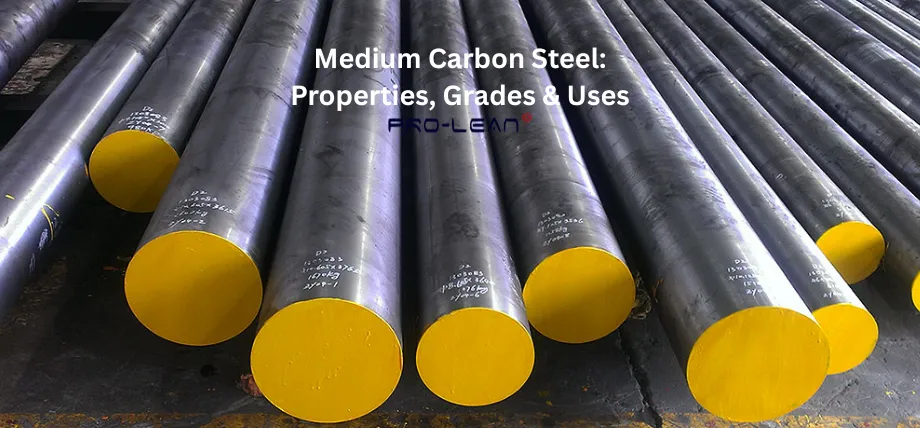
 Medium Carbon Steel Bars
Medium carbon steel is an alloy steel whose carbon content ranges between 0.30 and 0.60% by weight. The carbon allows the steel to have a higher strength and resistance to failure. There are other alloying elements, such as silicon and sulfur, which enable wear resistance and make it suitable for heat treatment, giving it toughness for applications like shafts, gears, axles, and durable, heavy-load applications like railway components.
Proleantech provides many medium carbon steel alloy machining services for precision components and forged parts. In this article, you will get to know everything you need to know about medium-carbon steel.
What is Medium-Carbon Steel?
Before moving deep into medium-carbon steel, it is important to have a solid understanding of steel classification, which will help you clarify many common confusions regarding steel types and the difference between alloy steel vs carbon steel. As you can see in Figure 1, carbon steel is further classified into three main subclasses based on carbon content. Medium carbon steel occupies the middle position among them; therefore, it kind of bridges the gap between low- and high-carbon steels.
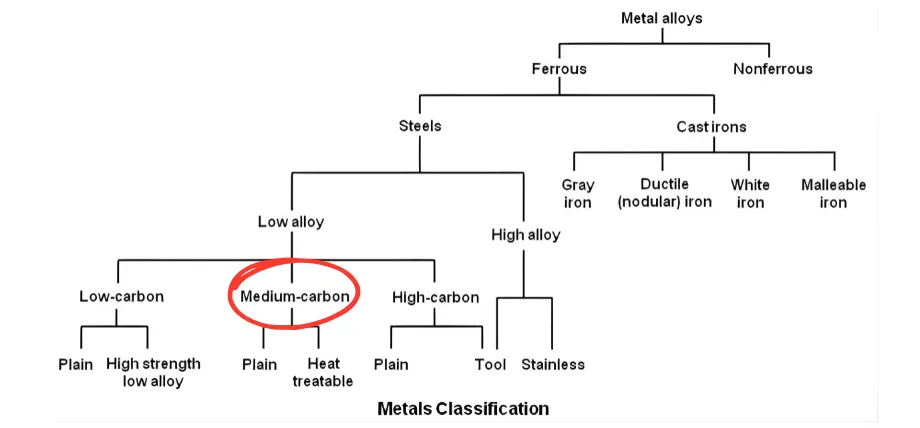 Classification of Steel
This is a common confusion that many people wonder about. Carbon steel is primarily composed of iron and carbon, with only small amounts of other elements serving as impurities. However, alloy steels contain intentionally added other metal elements, such as chromium and nickel.
Carbon steels are targeted for improving strength and hardness for structural applications, but alloy steels are optimized to achieve specific properties such as corrosion resistance and durability. Find a complete comparison of alloy steel vs carbon steel.
Carbon Content of Medium-Carbon Steel
Medium-carbon steel generally contains 0.30-0.60% of carbon and usually 0.60-1.65% of manganese. Additionally, small amounts of silicon, sulphur, phosphorus, etc. can be found as impurities. In the table below, you can clearly notice the positioning of medium-carbon steel within the carbon steel family, both quantitatively and qualitatively.
| Carbon Content (wt.%) | Steel Class | Properties |
|---|---|---|
| 0.05 – 0.30 | Low-Carbon Steel | High ductility and formability, low strength |
| 0.30 – 0.60 | Medium-Carbon Steel | Moderate ductility, formability, and strength |
| 0.6 – 2.0 | High-Carbon Steel | High strength, low ductility, and formability |
| > 2.0 | Cast Iron (Not a Steel) | High compressive strength and wear resistance, poor ductility |
Table 1: Comparison of Medium-Carbon Steel with Other Carbon Steels and Cast Iron
You can see that both low- and high-carbon steel are simply opposite extremes of each other. The theory is simple: increasing carbon percentage increases hardness and strength, but at the cost of ductility and increased brittleness. But medium-carbon steel properties stay in the middle, providing more strength than mild steel while still being machinable and heat treatable. You can also get a more detailed visualization of steels and cast iron by referring to iron-carbon phase diagrams.
Chemical Composition of Medium-Carbon Steel
Medium-carbon steels are not a single alloy; they are a family of different grades found in the alloy steel grades list with slightly varying compositions. In the table below, you can find the average weight percentages of the most common elements present within medium-carbon steel. Engineers usually vary these compositions to achieve customized properties.
| Element | Range | Purpose of Adding |
| Carbon | 0.30 – 0.60 | Increasing strength and hardness (but carbon reduces ductility) |
| Manganese | 0.60 – 1.65 | Improving hardenability and toughness |
| Silicon | 0.15 – 0.35 | To introduce deoxidizing properties and provide strength for ferrite |
| Sulphur | ≤0.05 | Available as an impurity |
| Phosphorus | ≤0.04 | Available as an impurity |
| Ni, Cr, Mo | 0 – 1 | Mainly found in alloy steel grades |
Table 2: Compositions of Common Alloying Elements of Medium-Carbon Steel
Heat Treatment Response of Medium-Carbon Steel
A very special property of medium-carbon steel is its excellent responsiveness to heat treatment, which allows us to alter its properties to meet custom requirements. Neither low- nor high-carbon steels have this ability because:
- Low-carbon steels do not have enough carbon for effective hardening.
- High-carbon steels have excessive carbon, so they become highly brittle and prone to cracking during treatment.
But medium-carbon steel contains a moderate carbon percentage, and the resulting microstructure is highly favorable for the phase transformation that occurs during heat treatment. If properly heat-treated, medium-carbon steels can achieve strength levels that even compete with high-carbon steels, but they provide better ultimate hardness and wear resistance. And most importantly, they can also maintain good toughness and have a very low risk of cracking. By controlling process parameters of heat treatment, you can also achieve customized performance requirements, making medium-carbon steel a highly useful material for custom metal machining.
Material Properties of Medium-Carbon Steel
The unique material properties of medium-carbon steel arise not only because of the amount of carbon but also because of the way that carbon is distributed within the iron matrix. It is not like a simple ordered pattern of carbon atoms inside the majority of iron atoms.
Microstructure of Medium-Carbon Steel
Medium-carbon steel does not consist of a single uniform phase at room temperature. Its microstructure consists of a mixture of two phases, namely ferrite and pearlite.
- Ferrite Phase: A soft and ductile phase. Ferrite is responsible for the ductility of the overall material.
- Pearlite Phase: A layered structure made up of ferrite and iron carbide (cementite). Iron carbide is the only place where carbons are present. Pearlite mainly contributes to the strength and hardness of the steel.
With the above explanation, it should be very clear why the strength increases when the carbon content increases. This also explains why medium-carbon steel naturally has higher strength than low-carbon steel, yet remains less brittle than high-carbon steel.
How Does Heat Treatment Change the Microstructure?
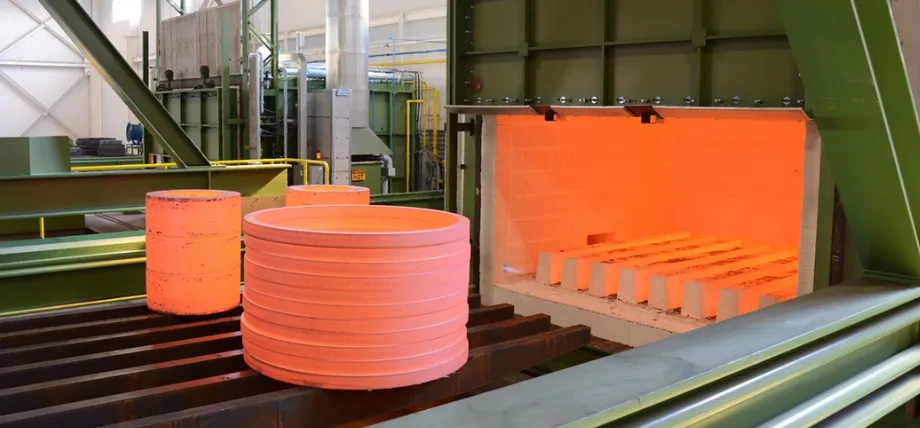 Heat Treatment Furnace
With heat treatment, the internal structure of medium-carbon steel can be further modified to obtain customized properties. In simple terms, what happens during the heat treatment of a medium-carbon steel is explained below.
- Heating converts the microstructure into a single, uniform phase. At this stage, carbon atoms get released from their trapped phases and can redistribute within the structure.
- Soaking the steel at the above temperature allows carbon to completely dissolve and spread uniformly. Soaking time is highly important because it is one of the main control parameters of the process.
- Quenching is the process of rapid cooling. Quenching suddenly traps carbon atoms without giving sufficient time to rearrange properly. This results in forming a different phase, which is martensite. Martensite has a significantly harder and stronger internal structure.
- Tempering is the final, low-temperature reheating step, which reduces excessive brittleness. This also restores a considerable amount of toughness while preserving much of the gained strength.
Some heat treatment techniques involve multiple stages of controlled heating and subsequent cooling, where we can vary process parameters such as temperature, time, and quenching medium to obtain specific properties.
Mechanical Properties of Medium-Carbon Steel
Medium-carbon steel is popular as a steel with highly balanced inherent mechanical properties due to its composition. However, if you need the strength and hardness to be further elevated, we can also achieve that with heat treatments while preserving acceptable values of ductility and toughness.
Strength and Hardness
Medium-carbon steel offers good strength and hardness that usually meets the requirements of moderate load-bearing and wear-resistant components. Average strength and hardness values of medium-carbon steels (in normalized or hot-rolled conditions) are given below. These values can slightly vary with the steel grade and processing techniques.
- Tensile Strength: 550 – 850 MPa
- Yield Strength: 350 – 600 MPa
- Brinell Hardness: 170 – 230 HB (can be elevated up to 280 – 300+ HB when heat treated)
AISI 1045 steel is the most popular grade of medium-carbon steel. It generally has a tensile strength of around 635 MPa but can be raised up to strength values around 900 MPa when heat-treated, making it suitable for medium-carbon steel bolts and automotive shafts.
Ductility
 Piano Hammer Assembly
Even though ductility decreases with the addition of carbon, medium-carbon steels can usually maintain usable flexibility with a 15-25% elongation at break value. This is generally considered a sufficient value to deform safely under unexpected loads instead of fracturing suddenly.
Toughness
Medium-carbon steels show good toughness in normalized form. However, excessive hardening or ignoring the tempering stage completely can drastically reduce impact resistance. And this is why controlled and proper heat-treatment cycles are important.
Physical Properties of Medium-Carbon Steel
Another huge advantage of medium-carbon steel is that it has ideal physical properties for manufacturing industrial components. It’s an excellent choice for applications that require strength and predictable temperature behavior.
| Property | Value |
| Density | 7.75 – 7.89 g/cm |
| Thermal Conductivity | 45 – 54 W/mK |
| Specific Heat Capacity | 0.49 J/g°C |
| Melting Range | 1425 – 1540 °C |
| Magnetic Properties | Ferromagnetic |
Table 3: Physical Properties of Medium-Carbon Steel
Try Prolean Now!
Grades and Standards of Medium-Carbon Steel
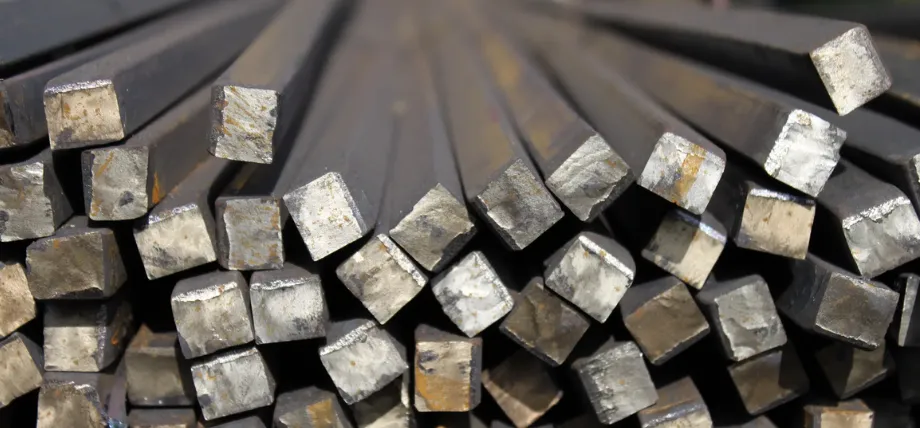 Medium carbon steel bars
Medium-carbon steel is available in a wide range of standardized grades, designed for specific requirements in terms of strength, toughness, and machinability. These grades share a similar carbon content but differ mainly in composition, processing, and heat treatment. Understanding these distinctions is essential for choosing the right grade for performance-critical and custom-manufactured components.
AISI 10xx Series (AISI 1045 Steel and Other Popular Grades)
The most popular medium carbon steels belong to the AISI 10xx series. Understanding this designation is simple; the first two digits represent the class of steel, and the last two digits indicate the carbon percentage. As an example, if we decode AISI 1045 steel:
- “10” stands for plain carbon steel
- “45” stands for 0.45% of carbon
Some of the popular grades of medium-carbon steels are listed in Table 4. Out of these, AISI 1045 steel is the most common type, which has numerous applications across a wide range of industries.
| Grade | Approx. Carbon (%) | Most Common Applications |
| AISI 1035 | 0.35 | General machine components (light-duty shafts, pins) |
| AISI 1040 | 0.40 | Medium-load mechanical components (forged parts, axles) |
| AISI 1045 | 0.45 | Structural machine parts (shafts, gears, bolts) |
| AISI 1050 | 0.50 | Wear-resistant and high-load mechanical components |
Table 4: Popular Grades of Medium-Carbon Steel and Their Applications
Is AISI 4140 a Medium-Carbon Steel?
AISI 4140 is technically a low-alloy steel, not a carbon steel. Sometimes it is mentioned under medium-carbon steel since it contains 0.38-0.43% of carbon, which places it numerically in the medium-carbon range.
But AISI 4140 contains chromium (0.8-1.1%) and molybdenum (0.15-0.25%) as intentional major alloying elements. Because of that, it is classified as an alloy steel, not a plain carbon steel. AISI 4140 offers excellent hardenability and fatigue resistance and is widely used for crankshafts, gears, and high-stress shafts.
International Equivalents of AISI Medium-Carbon Steel Grades
Medium carbon steels in the AISI 10xx series are globally recognized under different naming conventions. You might find different designation formats under different standards, but these grades are broadly equivalent in terms of carbon content and mechanical behavior.
| AISI / SAE (USA) | Carbon (%) | Europe (EN) | Germany (DIN / EN) | Japan (JIS) | China (GB) |
| AISI 1035 | 0.35 | C35 / C35E | 1.0501 (Ck35) | S35C | 35# |
| AISI 1040 | 0.40 | C40 / C40E | 1.0511 (Ck40) | S40C | 40# |
| AISI 1045 | 0.45 | C45 / C45E | 1.1191 (Ck45) | S45C | 45# |
| AISI 1050 | 0.50 | C50 / C50E | 1.1206 (Ck50) | S50C | 50# |
Table 5: Different Designations of Medium-Carbon Steel under Different Standards
Try Prolean Now!
How to Choose the Right Carbon-Steel Grade?
To select a suitable medium-carbon steel grade, you must have a clear understanding of engineering requirements. Choosing a material requires deep research on the component to establish clear requirements, boundaries, environmental conditions, and financial capability. The key factors you must consider when choosing a medium-carbon steel are:
- Mechanical load requirements
- Wear and surface performance requirements
- Section thickness and hardenability
- Manufacturing and processing constraints
- Environmental and service conditions
- Cost and material availability
And it is highly recommended to take advice and consultations from the relevant experts before making the final selection.
Applications of Medium-Carbon Steel
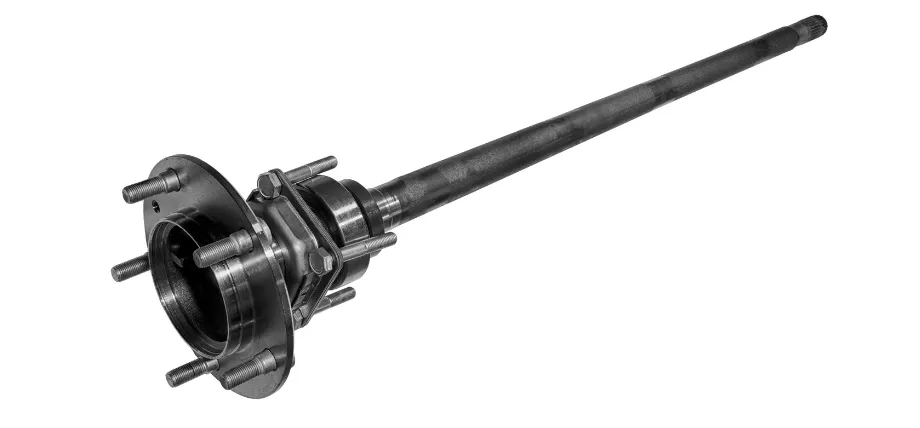 Automotive Axle Shaft
The excellent combination of medium-carbon steel properties is very popular among engineers in structural, mechanical, and automotive industries. That’s why they are widely used in components exposed to moderate to high stresses, cyclic loading, and wear.
Shafts & Axles
Highly used in automotive shafts, axle shafts, and power transmission shafts due to high tensile strength and fatigue resistance.
Gears & Couplings
Used as the material for gears, pinions, and mechanical couplings subjected to high contact stresses.
Forged Components
Commonly used in wrenches, rods, and hammer heads because of high strength, impact resistance, and durability.
Mechanical & Machinery Parts
Widely used in crankshafts, connecting rods, and rotating machinery components that experience combined torsional and bending loads under cyclic service conditions.
Construction & Heavy Equipment
Medium-carbon steel bolts, pins, lifting components, and structural connectors are very popular due to their high load-bearing capacity and resistance to mechanical wear.
Advantages of Medium-Carbon Steel
Balanced mechanical properties
Due to the excellent blend of medium-carbon steel properties, it can provide good strength and toughness at the same time. This makes it highly suitable for load-bearing components, which require good deformation resistance and tolerance to dynamic loads.
High responsiveness to heat treatment
This allows us to play with its properties during processing and heat treatment. A highly useful advantage of this property is that we can obtain hard, wear-resistant surfaces with tough cores inside. These are widely used in making gears, cams, and components subjected to fatigue loading.
Good machinability in the untreated condition
Medium-carbon steels are readily machinable before heat treatment. Therefore, we can easily machine them into various geometries before the final heat treatment. This significantly reduces tool wear and manufacturing cost for steel materials used in general machining.
Wide availability and standardization
Since most of the medium-carbon steels are globally standardized (e.g., AISI 1045 and C45 are the same grade under different standards) and easily sourced, the material selection, quality control, and replacement become very simple.
Cost-effectiveness
Medium-carbon steel provides strong mechanical performance without the addition of expensive alloying elements. So, it is widely used in high-volume components where alloy steels would introduce unnecessary costs and over-engineering.
Limitations of Medium-Carbon Steel
Lower ductility compared to low-carbon steel
Formability and cold forming are quite difficult in medium-carbon steels due to their higher carbon percentage.
Moderate weldability
If you need to perform welding, the material should be preheated, and proper post-weld heat treatment should be applied to avoid cracking.
Limited corrosion resistance
Medium-carbon steel is not the ideal choice if your main goal is corrosion resistance. If you need to use this steel in corrosive environments, coatings or appropriate surface protection strategies are a must. Otherwise, considering alternative steels like AISI 4140 is recommended.
Risk of brittleness due to incomplete heat treatment
Inadequate tempering or completely ignoring tempering might result in excessive hardness and loss of toughness, which could increase the risk of brittle failure.
Lower hardenability than alloy steel
For very thick sections, plain medium-carbon steels may not achieve uniform hardness evenly throughout the cross-section.
Custom Metal Machining
Proleantech provides high-quality metal machining for custom parts and precision components. We offer a range of materials and steel subclasses, including medium-carbon steel grades.
Why work with Proleantech
- Advanced CNC machining capabilities
- Large alloy variety and material selection
- Fast turnaround and prototype to high-volume manufacturing support
- Competitive pricing
Get a free quote online today!
Conclusion
Medium carbon steel is a great choice for projects that involve strength and toughness, and low ductility. For example, power transmission shafts and axles. There are many grades of medium carbon steel to choose from, and some can be readily heat-treated to improve toughness.
0 Comments