
Metals for 3D Printing
Metal 3D Printing has gone beyond the prototyping lab. It is used by industries from aerospace to medical device manufacturing to create high-performance components with geometries that conventional machining cannot produce. The range of metals that can be printed has grown significantly as the technology has matured. Choosing the right material is just as important as selecting the right machine.
Engineers and procurement teams are better equipped to make decisions when they know the mechanical properties of each material, its cost profile, and its ideal applications. A wrong selection can lead to poor performance of parts, increased costs, or expensive post-processing, which negates the advantages of additive manufacturing. Material selection can affect everything, whether you’re working on structural components, biomedical implants, or tooling.
ProLean Tech partners with manufacturers in a variety of industries to find the best metal 3D-printing process for the application. Our custom 3D printing resources and reasonable metal 3D printing costs are good places to start when evaluating your options.
What is Metal 3D Printing?
Metal additive manufacturing is also known as metal 3D printing. It builds parts from digital files using metal powders, wires, or bound forms. Additive processes, unlike subtractive manufacturing, which removes material from a block of material, deposit material only in the areas that are needed. This reduces waste and allows for complex internal geometries, which would otherwise be impossible to machine.
Powder Bed Fusion, Bound Powder Extrusion, and Directed Energy Deposition are the most commonly used process families. Each process has different characteristics in terms of material compatibility and resolution. You will be able to choose which metals you want based on the process you select.
Metal 3D Printing: How It Works
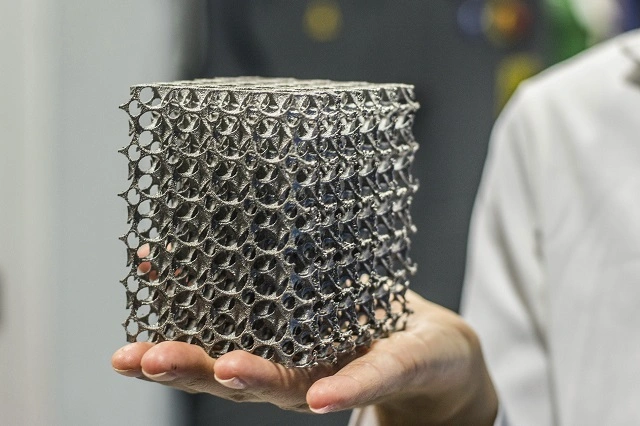
Metal 3D printed lattice cube structure
Powder Bed Fusion is a method of melting metal powder by selectively melting it layer by layer using a laser beam or an electron beam. The beam melts the next cross-section before each new layer of metal powder is applied to the build platform. Bound Powder Extrusion involves mixing metal powder with a binder polymer, extruding it into a shape similar to a thick paste, and then sintered in an oven to burn off the binder. Both methods produce dense, functional parts, but each has significant trade-offs with respect to surface finish, build time, dimensional accuracy, and material options.
Advantages of Conventional Manufacturing
Metal for 3D Printing excels in parts that require lattice structures or organic geometries, which machining can’t produce. This technology also allows for shorter lead times on low-volume components or unique items, and it enables the cost-effective manufacture of expensive alloys like Inconel and Titanium that would be prohibitively costly to machine. Additive manufacturing is not only an alternative to machining for many high-value applications. It is the only production method that can be used.
Metal 3D Printing Materials: The 05 Most Common Metals
Steel, superalloys, and titanium are among the most widely used 3D Printing Materials for metal additive manufacturing. Each material group offers a different balance of mechanical properties, cost, and application suitability, while individual grades are selected based on specific performance requirements.
Steel
Steel is one of the most commonly used metals in 3D printers. Steel is the most popular metal for 3D printing due to its excellent strength and stiffness. Steel 3D printing is also widely used in industry, has a wide range of industrial knowledge, and has relatively low costs. The majority of steel types are printable, but stainless steels and tool steels are the most popular. These grades are expensive to machine and are difficult. Additive manufacturing is therefore a cost-effective option for these grades.
Stainless Steels
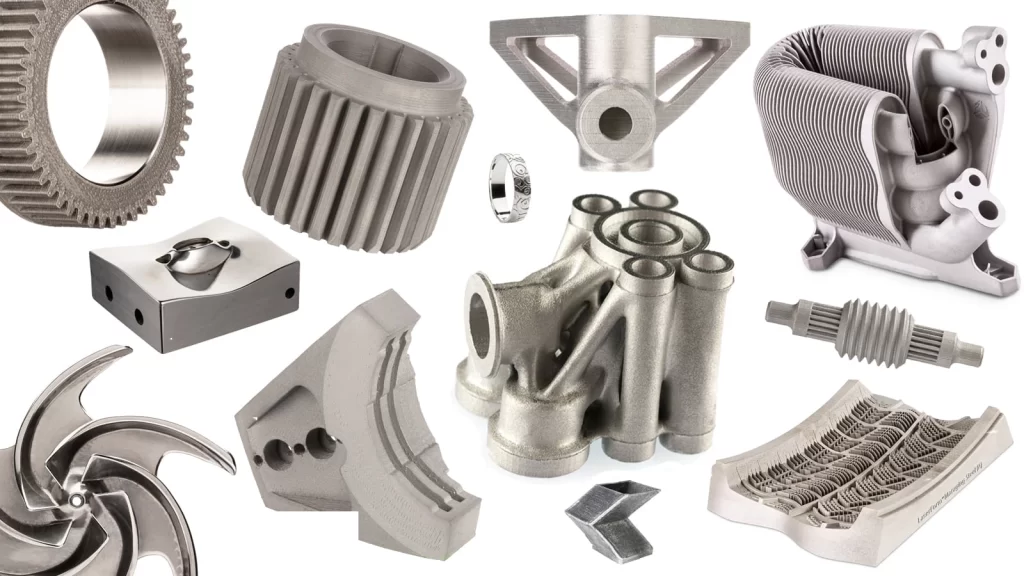
Different metal 3D printed parts
The corrosion resistance of stainless steels is due to the presence of at least 12 percent chromium. Two types dominate stainless steel 3D printing:
- Austenitic (316L): The stainless steel most commonly printed, with superior corrosion resistance. The stainless steel can be welded and machined, but not heat-treated. It is suitable for chemical processing, medical instruments, and marine hardware.
- 17-4 PH (Martensitic): A precipitation-hardening grade that can be heat-treated to achieve a wide range of mechanical properties across different hardness states. It is harder and stronger than 316L, but it is less resistant to corrosion. Widely used in industrial manufacturing and aerospace components.
Tool Steels
The tool steels are designed for specific operations such as cutting, grinding, and stamping. These steels contain carbide compounds, which provide extreme hardness and resistance to wear at ambient temperatures and high temperatures. The three most common grades printed are:
- A2: A versatile tool steel for cold work used in punches, dies, and general-purpose tooling. A good balance between toughness and wear resistance.
- D2 is optimized to provide maximum wear resistance for cold-work applications, including industrial blades and slitters.
- H13 A high-temperature tool steel that combines heat resistance with toughness and wear resistance. It is ideal for die-casting inserts and forging dies.
Superalloys – Inconel and Cobalt Chrome
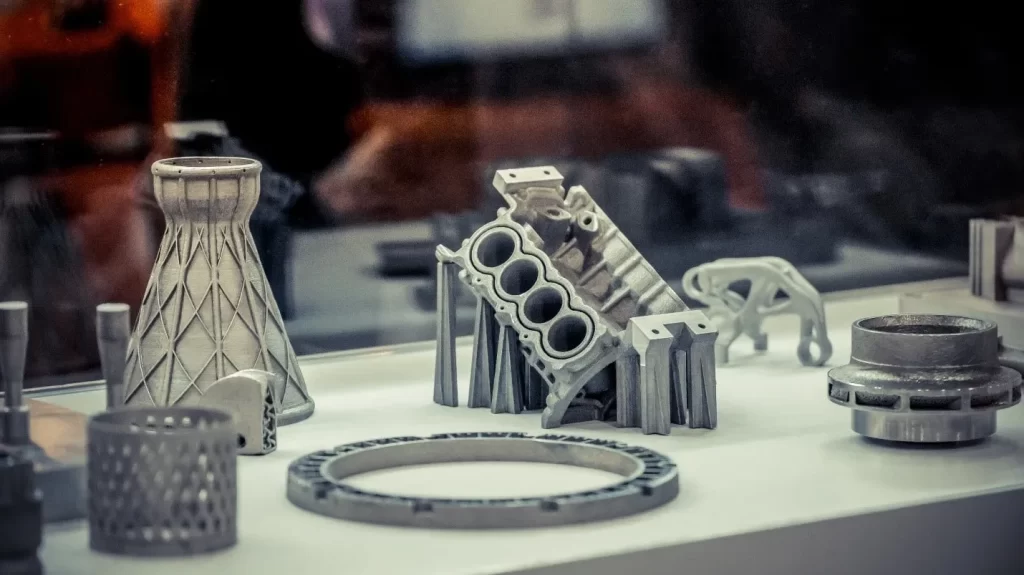
Metal 3D printed parts
Superalloys can perform in harsh environments, where heat, pressure, and corrosive chemical agents would otherwise destroy traditional alloys. Metal 3D printing is a cost-effective way to produce superalloys that are difficult and expensive for traditional methods.
Inconel
Inconel, a nickel-based family of superalloys, is known for its extreme strength, toughness, and corrosion resistance, even at temperatures where steel would lose structural integrity. Inconel 625 is more resistant to thermal fatigue and oxidation, and Inconel 718 has superior strength and toughness. Gas turbines, jet engine seals, exhaust parts, and rocket hardware all use both grades.
Cobalt Chrome
Cobalt Chrome is a combination of high strength-to-weight ratio, biocompatibility, and corrosion resistance. It is a denser, high-performance titanium alternative for applications that require both structural reliability and biological compatibility. Cobalt Chrome can be used for a variety of applications, including turbines, industrial environments, and medical instruments.
Titanium
Titanium is a material that offers exceptional strength-to-weight ratios, but also has high costs for raw materials and machining in conventional manufacturing. This makes it a compelling argument for additive manufacturing. Titanium 3D printing offers material savings, and the geometric freedom it provides often justifies the higher cost per machine for titanium components. It can be printed in two main forms:
- Ti-6Al-4V: The most common titanium alloy used in additive manufacturing. It is approximately 40% lighter than 17-4 PH, but has comparable or greater strength. It is resistant to corrosive environments and high temperatures. It is used in aerospace structures, automotive components, and industrial hardware, where mass reduction plays a major role.
- Commercially Pure Titanium: Less strong than Ti64, but more biocompatible regardless of the processing conditions. Used for medical devices such as orthopedic implants, bone screw, and other medical products where biointegration is important.
Titanium is a core material for any engineering team producing 3D-printed metal parts, where the weight-to-performance ratio drives the design brief.
Copper
Copper is a metal that has a special place in additive manufacturing. It’s chosen almost exclusively because of its thermal and electrical conductivity, rather than for its mechanical properties. Metal 3D printing allows engineers the ability to create geometrically optimized components of copper that would otherwise be very difficult to manufacture by machining or casting. Heat sinks, busbars, induction coils, and welding electrodes are some of the applications.
- Pure copper: It has the highest thermal conductivity and electrical conductivity among all copper variants. Its high laser reflectance, however, makes it incompatible with standard PBF laser systems. Only printable on Bound Powder Extrusion Machines.
- Alloyed copper (e.g., C18150): It contains 1-2% alloying components such as chromium or zinc, which reduce laser reflectance to the point that printing is possible on certain PBF platforms. The conductivity of alloyed copper is lower than that of pure copper, but it is still superior to that of the other metal groups.
Aluminum
Aluminum 3D printing is much less common than conventional manufacturing. This is primarily because the most commonly used wrought grades, 6061 and 7075, are not printable with standard PBF systems. Casting-grade alloys with up to 12 percent silicon are printable, but they have inferior mechanical properties to wrought alloys. The ROI for printing aluminum is lower than that of most other metals due to the relatively low cost of machining standard aluminum.
Continuous fiber composite printing is a great option for engineering teams that need parts with aluminum-equivalent strength. They can also improve stiffness, fatigue resistance, and impact resistance. Consider this alternative before you commit to aluminum additive manufacturing.
Try Prolean Now!
Metal 3D Printing Materials Comparison Table
|
Material |
Strengthening Your Body |
Weight |
Corrosion resistance |
Biocompatible |
Best Use Case |
|
Stainless Steel 316L |
High-quality |
The Medium |
Excellent |
No, |
Medical, marine, chemical |
|
17-4 PH Stainless steel |
Very High |
The Medium |
Good |
No, |
Hardware and industrial tooling |
|
H13 Tool Steel |
Extremely High |
The Medium |
Moderate |
No, |
Hot-work tooling, dies |
|
Inconel 718 |
Very High |
Medium-High |
Excellent |
No, |
Turbines for aerospace |
|
Cobalt Chrome |
Very High |
High-quality |
Excellent |
Yes, |
Aerospace implants |
|
Ti-6Al-4V |
High-quality |
Low-cost |
Excellent |
Conditional |
Aerospace, automotive |
|
CP Titanium |
Moderate |
Low-cost |
Excellent |
Yes, |
Medical implants |
|
Pure Copper |
Low-cost |
High-quality |
Good |
No, |
Heat sinks and conductors |
|
Aluminum (casting grade) |
Moderate |
Very Low |
Moderate |
No, |
Housings made of lightweight materials |
What are the Best Metal 3D Printing Materials?
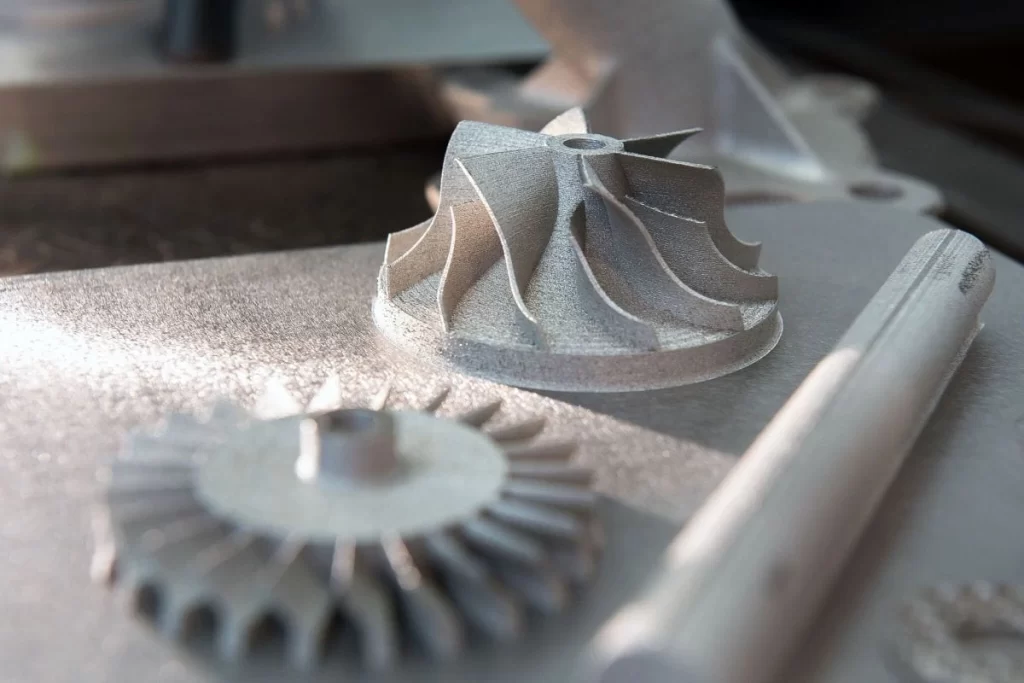
Freshly printed metal impeller
Understanding your project requirements in four dimensions – mechanical performance, environmental exposure requirements, biocompatibility requirements, and the total budget – will help you choose the best material. This is a costly mistake that teams often make when they move from prototype to production.
Matching Material with Application Environment
Superalloys should be considered if your part is exposed to high temperatures or chemically aggressive environments. Titanium is the strongest material for structural parts, where weight matters. Tool steel or stainless steel is the most cost-effective material for general industrial hardware and tooling. Copper is the only metal that can provide the thermal management components modern electronics and power systems demand.
Consider Post-Processing Requirements
Several materials need further processing to achieve their final mechanical characteristics. Other materials, such as H13 and 17-4 PH, require heat treatment. To close internal porosity, superalloys or titanium components are often closed using hot isostatic pressing. Surface finishing is often required for sealing surfaces and bearing interfaces. These steps can increase the time and cost of a project. When selecting materials, they should not be an afterthought.
For materials like Inconel or titanium, heat treatment or hot isostatic pressing may be necessary to close internal porosity and reach the required mechanical strength, which adds both time and cost to the project. Stainless steel parts, on the other hand, typically only need surface finishing such as polishing or bead blasting to meet sealing and bearing interface requirements. Understanding these post-processing needs for each material before the design is finalized helps avoid budget overruns and delays caused by unexpected additional steps late in the production process.
Balance Cost Vs Performance
Steel is less expensive than superalloys. However, titanium and superalloys cost more to manufacture and process. Metal 3D Printing cost analysis should be performed along with the material selection for budget-sensitive projects. The best value-performance ratio is found in stainless steel 316L, which can be used for a variety of applications. This material should be the default unless specific requirements require a higher-performance group.
Try Prolean Now!
Metal for 3D Printing for Automotive Parts
The automotive industry has adopted metal additive manufacturing at a much larger scale than other sectors. This is because of the demand for lightweight structural components and cooling channels with complex topologies. Brackets with optimized topologies are also in high demand. Materials that are suitable for structural components with a weight-sensitive nature include aluminum and titanium alloys. Tool steel is used for dies and fixtures.
The production of intake and exhaust manifolds can be done using 3D printing. Custom bracket assemblies, production tools, and suspension hardware are also possible. The result is reduced part count, shorter assembly sequences, and measurable improvements in performance-to-weight ratios across vehicle programs.
Common Mistakes When Selecting Metal 3D Printing Materials
By avoiding common selection mistakes, you can avoid production delays and save money.
- If all alloys are printed equally, not all grades in a family of materials can be printable. The most commonly used wrought grades of aluminum, 6061 and 7705, are not available as standard PBF systems.
- Not including post-processing costs in cost estimates. Many materials, such as Inconel or titanium, require heat treatment and finishing machining after printing. These costs are often overlooked in the budget, leading to major overruns during the production phase.
- Overspecifying the material grade: The use of Inconel when 316L will perform as well adds material and processing costs. Material should be chosen according to the environment and not the highest available specification.
- Skipping design optimization for additive: 3D-printed metal parts enable geometries impossible in machining. Replacing a machined part without redesigning it for additive manufacturing will not be cost-competitive and will miss out on the core value of this technology.
Conclusion
Metal 3D-printing materials are available in a variety of properties, prices, and applications. Copper enables thermally and electrically optimized designs. Aluminum is used for weight-critical applications, where printability restrictions are acceptable. To match the right material with the right application, it is important to evaluate mechanical properties, process compatibility, post-processing needs, and the total cost.
ProLean Tech helps engineering and procurement teams choose the right material, process, and manufacturing approach for their projects. Whether you’re producing your first metal additive part or expanding an existing workflow, our 3D Printing Service covers material selection, design support, and production. Visit our custom 3D printing page or contact our team to discuss your project.
FAQ’s
Which metals are most commonly used for 3D printing and why?
Metals such as steel (especially 316L stainless and 17-4 PH), titanium (Ti-6Al-4V), Cobalt Chrome (chrome), copper, and casting grade aluminum alloys are currently the most commonly used in additive manufacturing. Steel is the most popular metal due to its cost-effectiveness and versatility across industries.
What is the strongest metal 3D printed?
The hardest steels are tool steels. In particular, H13 and D2 are heat-treated. Inconel 718 is a structural alloy that offers exceptional tensile strength at high temperatures. Titanium alloys such as Ti-6Al-4V are the strongest in terms of strength-to-weight. The best choice will depend on whether you’re measuring yield strength or hardness, fatigue performance, or high-temperature performance.
How expensive is metal 3D printing?
Metal 3D-printing costs more per part than conventional machining when used in large volumes for simple geometries. Additive manufacturing is often cheaper for complex geometries or alloys that are difficult to machine, such as Inconel or titanium. The final cost is heavily influenced by the material selection, processing choice, and post-processing. This is why it’s important to model costs upfront.
Is metal stronger than plastic?
Yes, in almost all structural applications. Metal 3D-printed parts have mechanical properties that are equal to or better than those of their machined counterparts made of the same alloy. While continuous fiber composite printing is capable of achieving aluminum-level strength, it cannot match the high-performance alloys under high-temperature or high-load conditions. Metal is the only material that can be used for applications that are load-bearing, wear-intensive, or thermally demanding.
0 Comments