
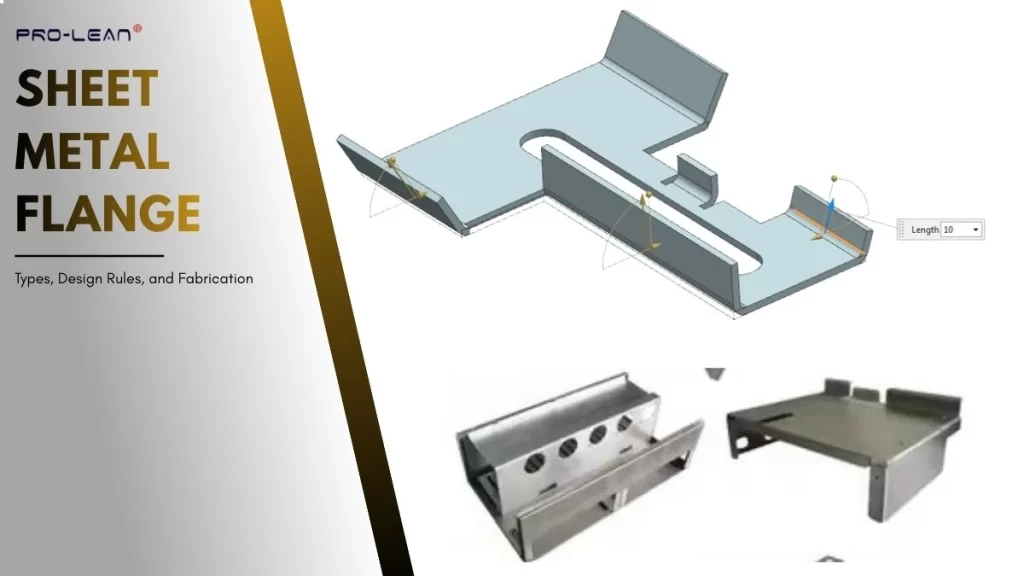
Sheet metal flanges
A sheet metal flange refers to a straight or angled surface extended from a bent line(or formed position) to the edges of the sheet. You might think the flanges are simple features in metal fabrication, but they provide structural reinforcement, attachment surfaces for secondary components, and easier assembly.
Several considerations related to design, material type, assembly compatibility, and bending operations are required when fabricating sheet metal parts with flanges.
The upcoming sections will discuss types of flanges, design rules, the impact of material selection, fabrication steps, and common issues.
What Are the Sheet Metal Flanges?
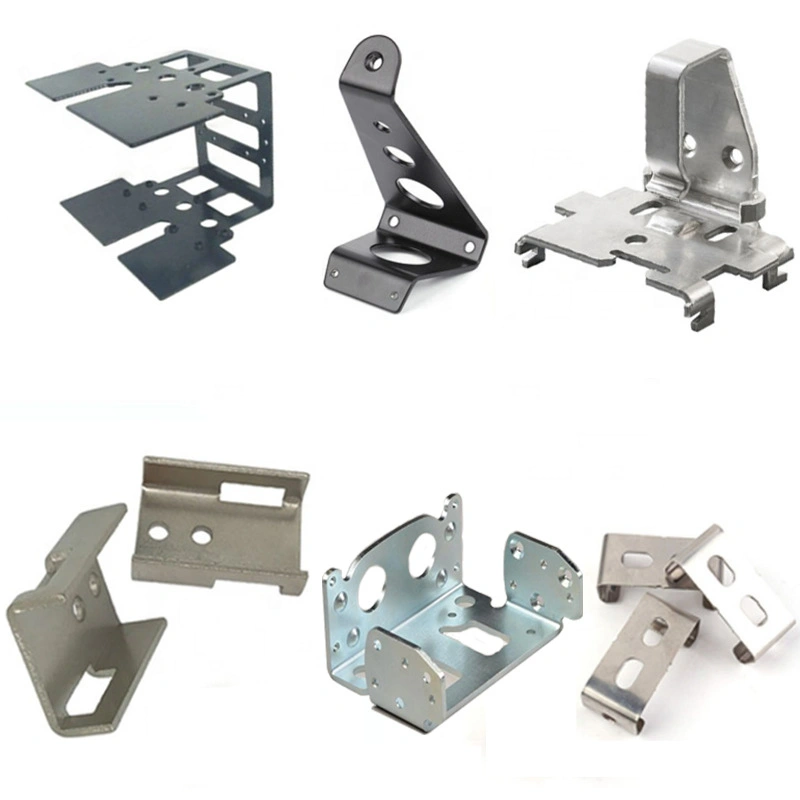
Metal parts with flanges
Flanges are the flat sheet metal surfaces defined by the bending line and the existing edge of the sheet. A simple example is the two legs of a U-shaped metal channel formed by bending a sheet metal strip. Similarly, a wide variety of components and products include flanges.
Different variables are used to define the shape, size, and characteristics of metal flanges in sheet metal fabrication, including flange face, length, height, thickness, bolt holes, and gasket surface. Designers and fabricators carefully choose these parameters at the time of designing and manufacturing.
Types of Sheet Metal Flanges
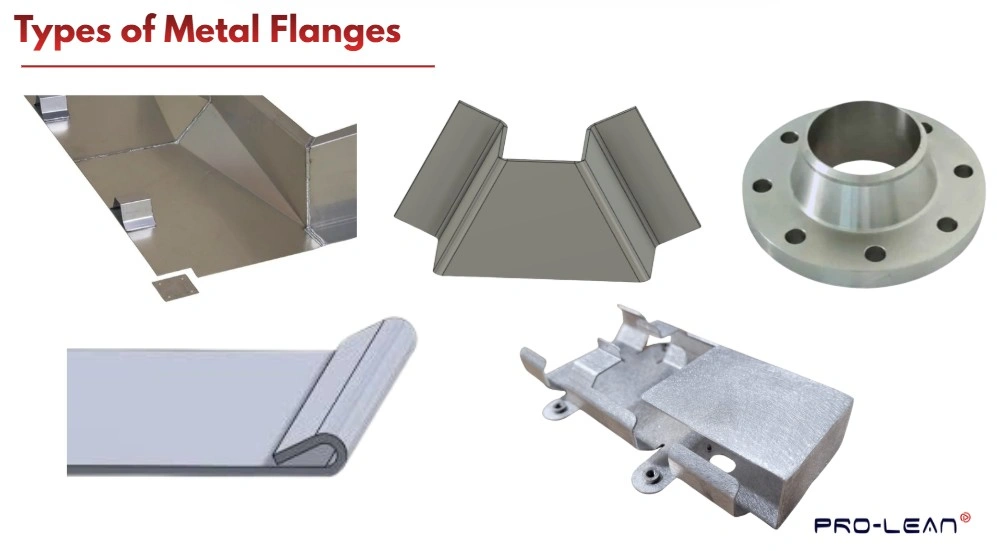
Types of metal flanges
Based on the component you are making and the requirements for the application, you can choose flat, angled pipes, hem, tab, or other types of flanges.
Let’s look at each type of sheet metal flange:
- Flat Flange: A flat & smooth surface used to mount the parts, which are made by bending at 90° without any offset or curvature.
- Angled Flange: The flange formed by bending the sheet at other than 90° or any specified curvature along the free end.
- Pipe Flange: As the name suggests, pipe flanges facilitate the joining of piping sections. It contains threaded holes for bolting, and you can also weld to form permanent joints.
- Hem flange: It is a flange with bent edges towards the sheet surface; it could be rolled hem flanges or angled bent flanges. Sheet metal hem reinforces sharp edges and enhances the aesthetic.
- Tab Flange: Tabs are not exactly flanges, but short extensions formed by bending to join, lock, and locate the parts in assembly.
- Ear/Lug Flange: As the name suggests, an ear flange is a short tab with a hole for a fastener to connect with other metal parts or mounting.
- Hole Flange: It is a circular ring around a hole in a sheet metal part made via forming or embossing, mainly for reinforcing and fastening purposes.
- Grooved Flange: It is a flange at the edge of the sheet metal that incorporates a small groove or channel, typically used for sealing or connecting purposes.
- Lofted Flanges: A transition formed to separate non-parallel or offset edges, used when you need to join different contours to make a seamless product/component.
Design Rules for Sheet Metal Flanges
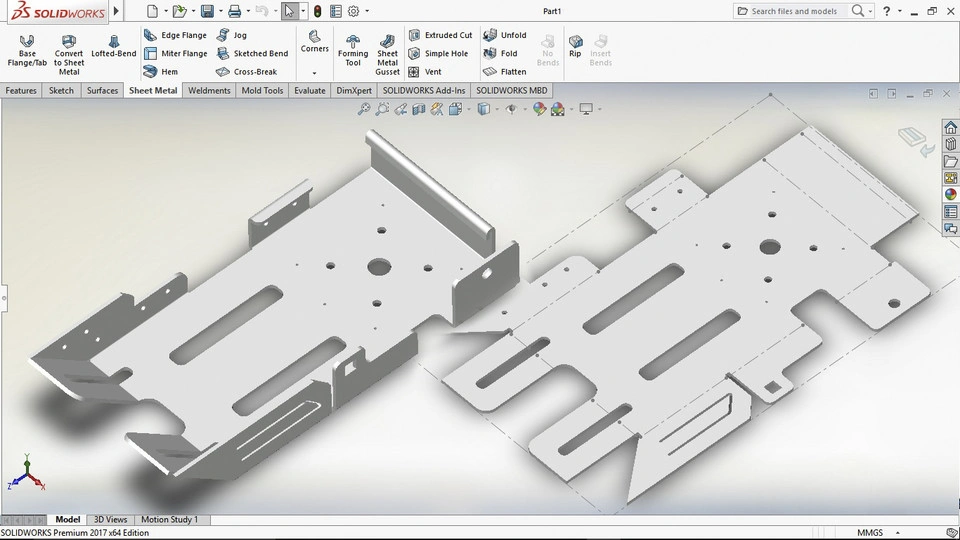
Sheet metal flange design
There are several design rules related to sheet metal flanges, such as maintaining minimum flange height & length, tab and hem sizing, and assembly considerations. Next, let’s elaborate on five key design rules of flanges and related sheet metal features.
Minimum Flange Height and Length
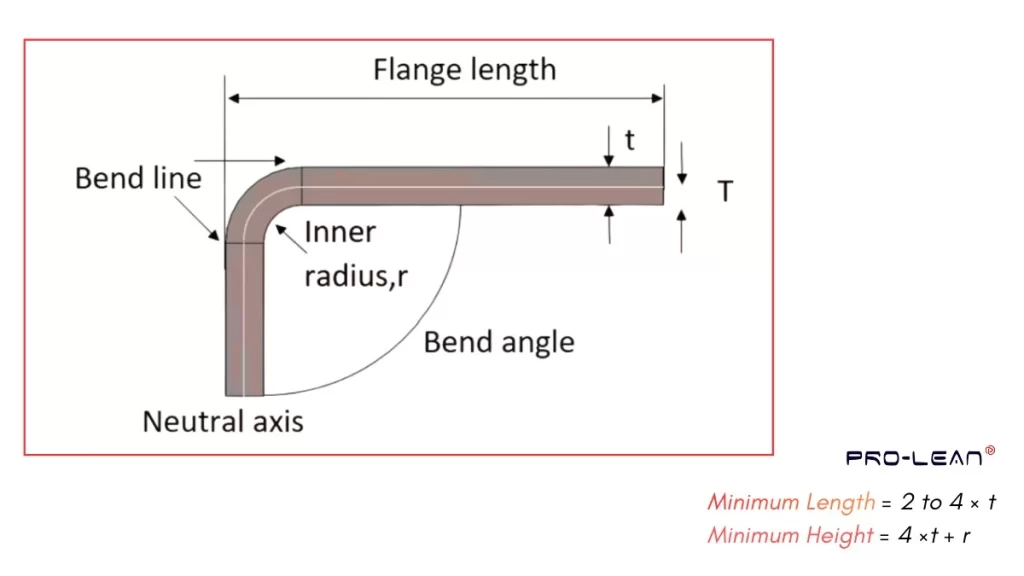
Flange height and length
Maintaining the minimum flange length in sheet metal parts is not only crucial to maintain structural strength, but also essential to avoid any kind of misalignment (or slip from the die) during the press bending.
Minimum Length = 2 to 4 × thickness (t), depending on material type
Minimum Height= 4 × thickness + bend radius (r)
If you need a shorter flange height, first bend the sheet metal to the minimum values, and then laser or mill cut the section to meet the desired height. For detailed sizing, refer to the standard flange chart.
Tab and Hem Specifications
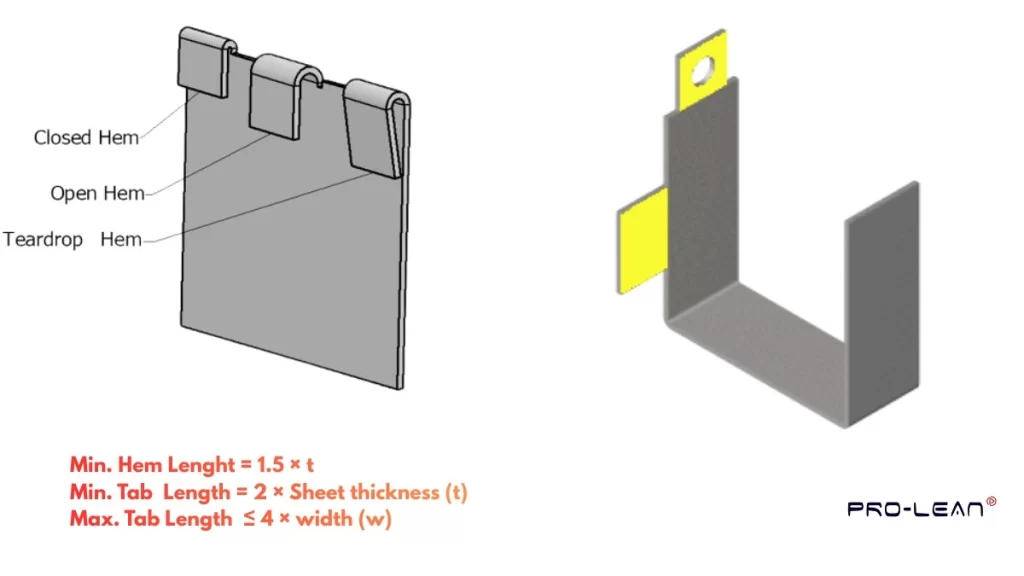
Hem and tab sheet metal
These small protrusions must be sized and designed for manufacturability to avoid any damage during bending. Additionally, the right tab and hem lengths are also essential for their functionality without excessive material bulk.
Recommended Hem Length= 1.5 × Sheet thickness(t), for most of the metals
Min. Length of Tab = 2 × Sheet thickness (t)
Maximum Length of Tab ≤ 4 × width (w)
Holes and Slots
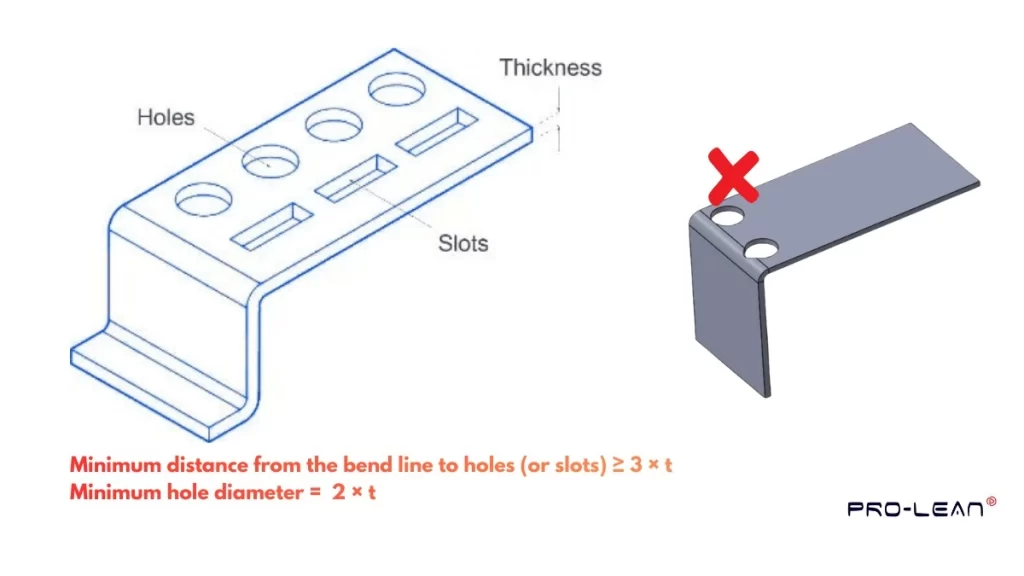
Sheet metal holes and slots
If you design any holes or slots on flanges, the spacing from the bending line to them should be at least three times the sheet thickness. This spacing is crucial to avoid strength weakening or material failure. Consequently, calculating and considering the minimum hole diameter is equally important.
Minimum distance from the bend line to holes (or slots) ≥ 3 × Sheet thickness (t)
Minimum hole diameter= sheet thickness(t) to 2 × Sheet thickness (t) , based on material type
Inside Bend Radius
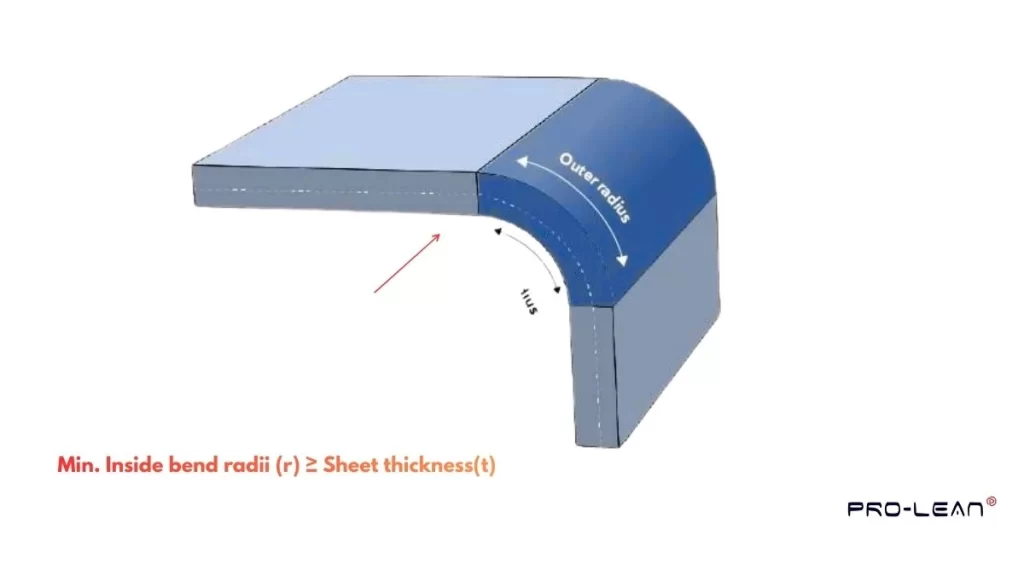
Inside bend radius
Too-tight bend radii can cause the material to crack during the metal forming process. Therefore, choose a bend radius larger than the sheet metal thickness.
Min. Inside bend radii (r) ≥ Sheet thickness(t)
Assembly Considerations
Consider the assembly factors like clearance between mating flanges, avoiding joining interference, locations of fastener holes, and proper bend allowance.
For complete consultation on design optimization for manufacturability and cost reduction, contact our experts. They will guide you through each minor detail with practice-proven strategies.
Try Prolean Now!
Impacts of Material Selection
Material selection for flanges mainly impacts the functional requirements and ease of sheet metal forming. Therefore, you must identify the required properties and analyze which metal fits them while offering good formability and cost benefit.
The common sheet metal flange materials are stainless steel, aluminum, mild steel, and copper. Each of them has distinct physical and mechanical properties with varying levels of formability.
- Stainless Steel: It has excellent corrosion resistance, strength, fatigue life, and good formability. But, it is expensive than mild steel and other alloys.
- Aluminum: High formability, corrosion-resistant, and suitable for lightweight applications. However, the minimum bend radii for aluminum are higher than those for stainless steel and steel alloys.
- Steel: Cost-effective than stainless steel & aluminum, high toughness, and used in heavy machinery and structural applications.
- Copper: Excellent formability, heat & electrical conductivity, and aesthetic appeal.
- Brass: Balance of strength and conductivity, corrosion-resistant, and used for fittings, plumbing, etc.
Step-by-Step Sheet Metal Flanging Process
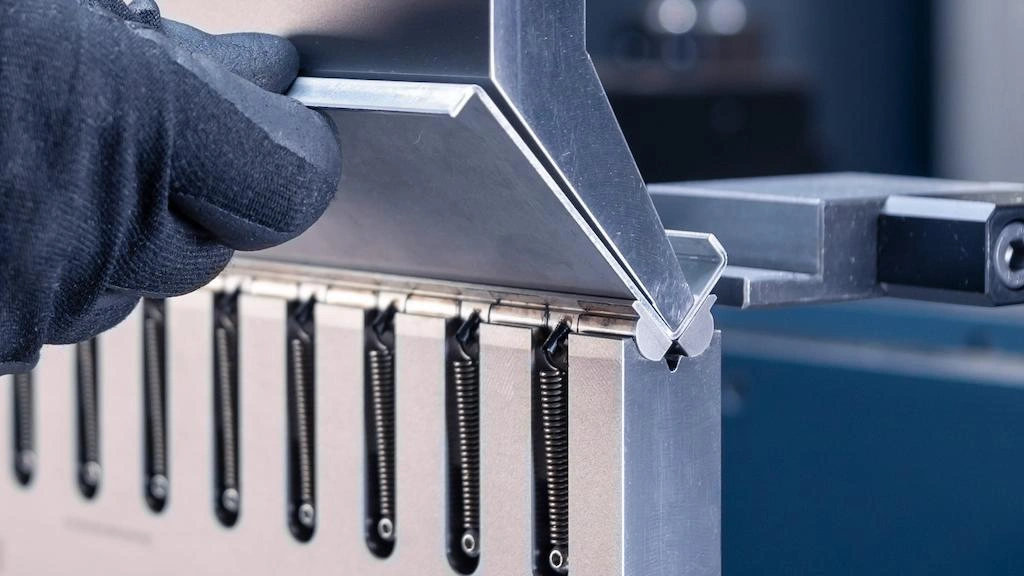
V bending of flanges
The metal flanging process involves multiple steps, including design, sheet cutting, operation setup, sheet bending, and surface treatment. In some cases, specialized metal fabrication techniques like stamping and roll forming are used to make flanges.
The list below illustrates the step-wise process of sheet metal flanging:
- Design: Starts with creating a sheet metal design in CAD software. Consider size, tolerances, and all flange-related features while designing.
- Material Selection: Choose a suitable sheet metal and thickness. Then, mark the surface for the flange based on the design.
- Sheet Cutting: Cut the large sheet metal blank into smaller pieces; the flat size you need to shape the designed part.
- Operation Setup: Set die and press brake, then create and upload G and M code file, if you are using a CNC machine.
- Bending Operation: Feed the sheet metal, and the press brake will force it to die and form the bend.
- Inspection and Finishing: After bending, inspect for defects and check the dimensional accuracy and consistency using measuring instruments. Then, deburr, polish, or coat them if finishing is required.
Common Sheet Metal Flanging Issues and How to Avoid Them?
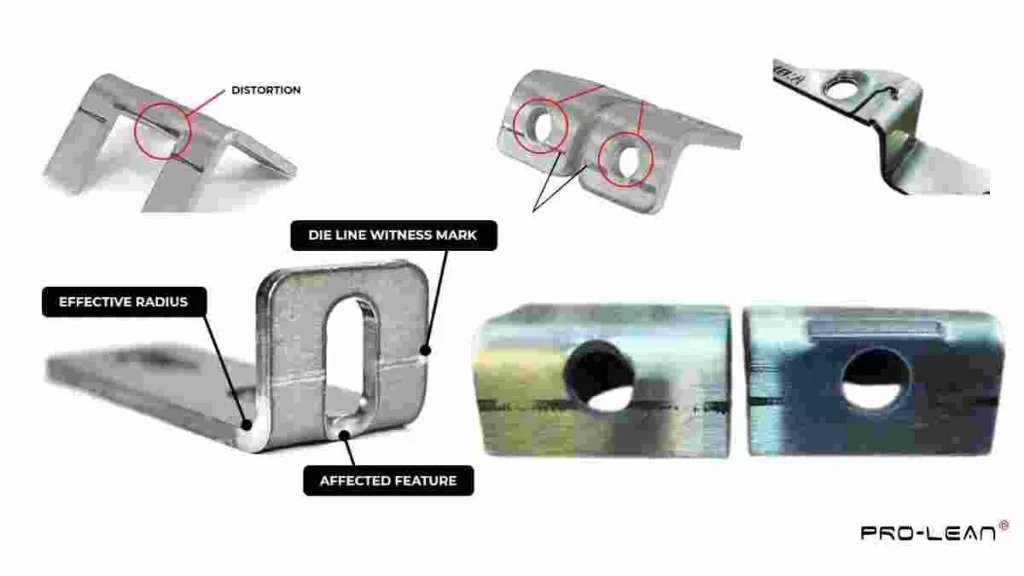
Flanging defects
Considering the potential issues and prevention strategies during flanging is crucial during precision metal fabrication of flanges, especially when precision, accuracy, and overall quality influence the application performance.
Cracking across the outer surface of the end line is most common, which is typically caused by tighter bend radii. The marks of the punch press strikes and the die impression could be visible on the surface.
If you did not compensate for springback, set improper die clearance, or any misalignment occurs, it directly affects the accuracy of the bent angle. Furthermore, there is a risk of a feature distortion and flange waviness as well.
You can consider the following prevention strategies to avoid the flanging issues.
- Consider Design for Manufacturability(DFM), regardless of what fabrication technique you are using for sheet metal flanging.
- Choose appropriate thickness, bend radii, flange height, length, and other dimensional parameters.
- Ensure proper spacing between the bent line and features on flanges, such as holes and slots.
- Try to standardize the size, shape, features, and tolerance.
Do you need defect-free sheet metal parts at a competitive rate? Upload your design and request a custom fabrication quote today. We have more than a decade of experience working as an OEM partner for companies across multiple industries.
Try Prolean Now!
Applications of Sheet Metal Flanges
Flanges are not the individual components; they are featured in countless sheet metal parts & products, from simple brackets to complex enclosures and assemblies.
Let’s look at the applications of flanges.
- Structural Stiffening: Flanges are used to improve the rigidity of structures without adding thickness. E.g., electronics chassis, mounting brackets,
- Mounting: Flanges provide a flat surface for mounting and joining ( welding, riveting, bolting, etc). E.g., car ECU brackets, enclosures & housing parts, frames, and fixture brackets.
- Safety and Edge Finishing: Flanges also integrate the hems for finishing, which allows safe handling of parts.
- Positioning: Flanges are also used in metal parts to locate and align the mating components, from electrical enclosures to refrigerator panels.
- Joining Surface: Flanges are used as a joining surface in sheet metal tanks, roofing elements, industrial ducting, etc.
If we look at the industry-wise, automotive, construction, aerospace, HVAC, architecture, electronics, and many other industries use sheet metal parts with flanges.
Conclusion
Flanges are critical sections/features in sheet metal parts; they provide reinforcement, a surface for mating in assembly, and also serve specific functional purposes. However, you need to consider different factors at the time of designing, material selection, and the forming process.
Are you looking for custom sheet metal parts? Partner with ProleanTech for high-quality yet competitive pricing. We provide comprehensive sheet metal fabrication services, from design consultation to production and surface finishing. So, upload the design and order your parts today.
FAQs
What is a flange in sheet metal?
A flange is an extended section from the bend line to the existing sheet edge. Moreover, it is a feature of a sheet metal part, not a unique part or product.
What is a metal flange used for?
The metal flange provides structural strength, a surface for mounting, supports assembly work, and helps to locate the mating parts.
What is the minimum flange distance?
The recommended minimum flange distance (from bent line to edge) is four times the sheet thickness, but it can vary based on metal type and used tooling.
0 Comments