
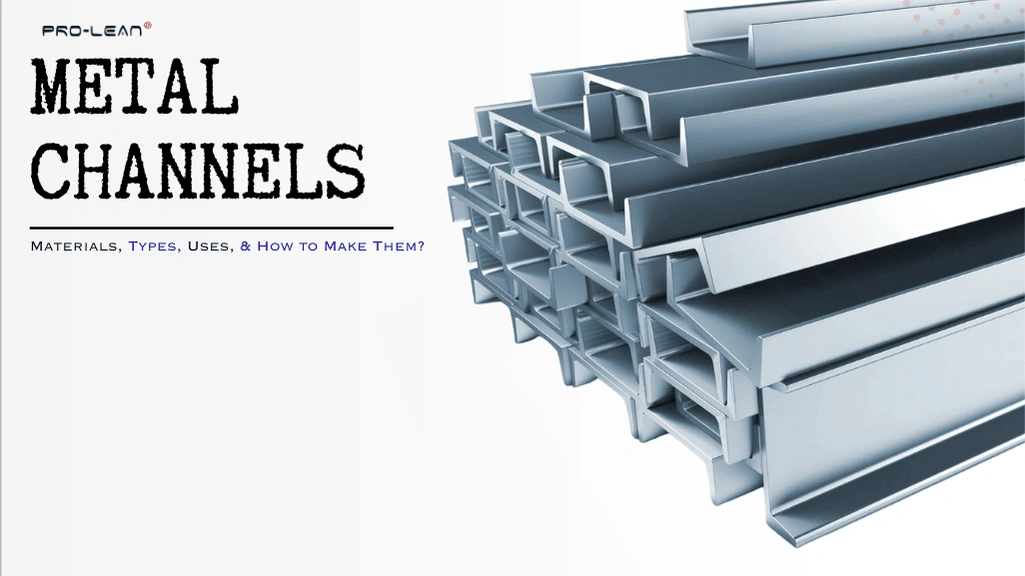
metal channels
Channels are metal strip profiles designed in specific shapes, such as U, C, J, and Z, with the desired size and thickness. Various methods are used to produce metal channels, including machining, casting, extrusion, and fabrication. Among these, metal fabrication stands out for design flexibility, quick turnaround, and efficient assembly of complex channel profiles.
The use of metal channels ranges from construction elements and industrial machinery to support structures in aircraft. Meanwhile, a vast range of metals & alloys can be fabricated to form channels.
The upcoming sections will cover the channel fabrication process, types of metal channels, compatible materials, and application areas.
Let’s get started!
What is a Metal Channel?
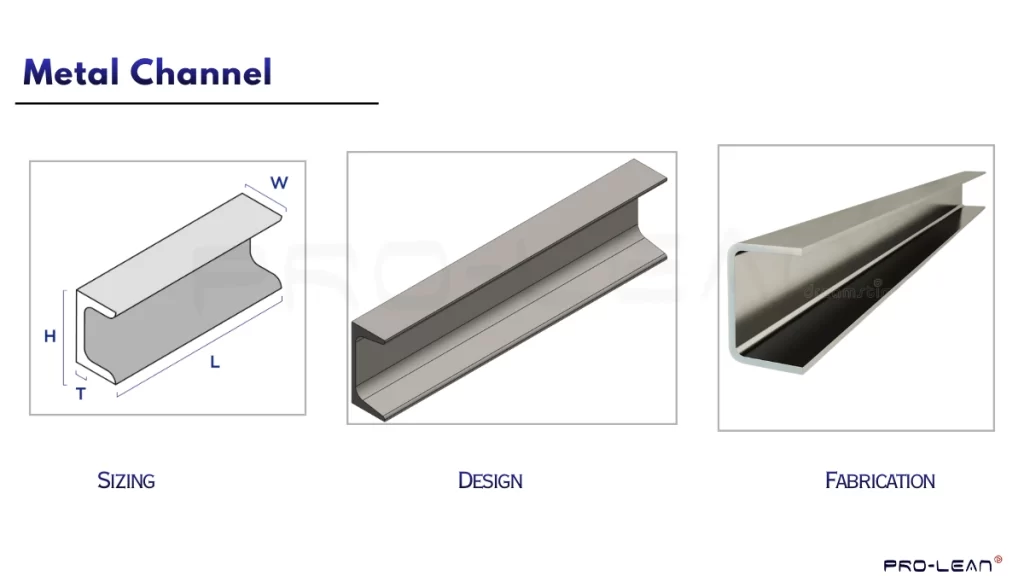
Channel shape illustration
A metal channel is a mechanical component that consists of a base section, or “web,” and flanges, forming a specific profile such as U, C, J, Z, T, or any custom shape. It serves structural, reinforcement, and assembly alignment purposes.
You can find various types of channel profiles in standard sizes on the market, made from materials such as steel, aluminum, stainless steel, titanium, or others. In some cases, channels with standard depth, flange width, and thickness might not be fit for your needs. That’s where the role of custom channel fabrication stands out.
You can partner with a reliable OEM to outsource your metal channel profiles/components. It provides you with control over profile configuration, dimensional customization, and overall production quality. At ProleanTech, we offer a wide range of sheet metal fabrication services for channel manufacturing, including bending, stamping, hot-rolling, and extrusion.
Common Metals for Channel Fabrication
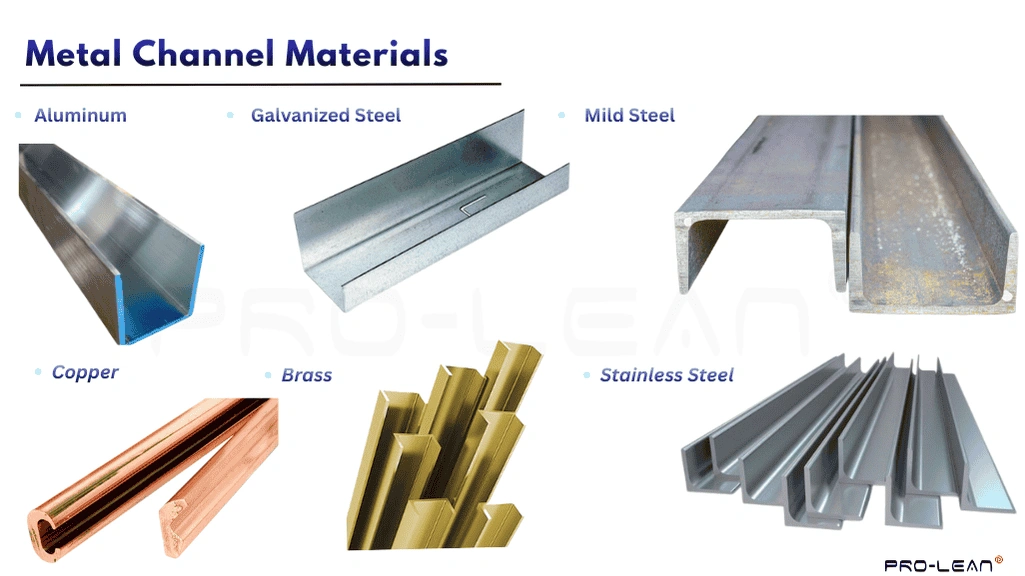
Materials for metal channels
Whether you are creating custom channels or purchasing them directly from the market, several metal options are available, including steel, stainless steel, galvanized steel, and aluminum. You can choose a suitable metal option based on your application & performance needs.
Let’s review the list of metals suitable for channel fabrication below.
Steel Channels
The high strength, corrosion resistance, and toughness make steel a suitable material for channels. You can find C, U, Z, and other types of steel channels in different sizes. They provide cost-effective solutions for construction, machinery, heavy framing, and general-purpose hardware.
You can use steel fabrication grades like ASTM A36, A572, and A992 to fabricate steel frame channels. These grades provide high toughness, tensile strength, and formability.
Aluminum Channels
Aluminum is a suitable metal for lightweight channels while maintaining good strength. Typically, manufacturers prefer the aluminum fabrication technique, such as bending & extrusion, to fabricate channel profiles from aluminum billets.
Aluminum channels can be used for frame structures, lighting fixtures, architectural fittings, and electrical & thermal systems.
Stainless Steel Channels
Primarily, two stainless steel grades are used for channel fabrication: 304 & 316. They offer excellent corrosion resistance, strength, and performance under high stress and high temperatures. The applications of stainless steel channels range from construction and shipbuilding to manufacturing & processing equipment.
Copper and Brass Channels
Copper and brass channels are not valued for their strength; instead, they are preferred choices for architectural items, decorative products, and electrical & thermal systems. Both of these metals are highly formable and can be roll-formed or bent to produce the channels.
What Are the Different Types of Metal Channels?
Metal channels are categorized into different types based on their profile shapes, including C channels, U channels, J channels, and Z channels. As the name suggests, they resembled the geometries of the letters.
Let’s discuss each type in brief.
U Metal Channel
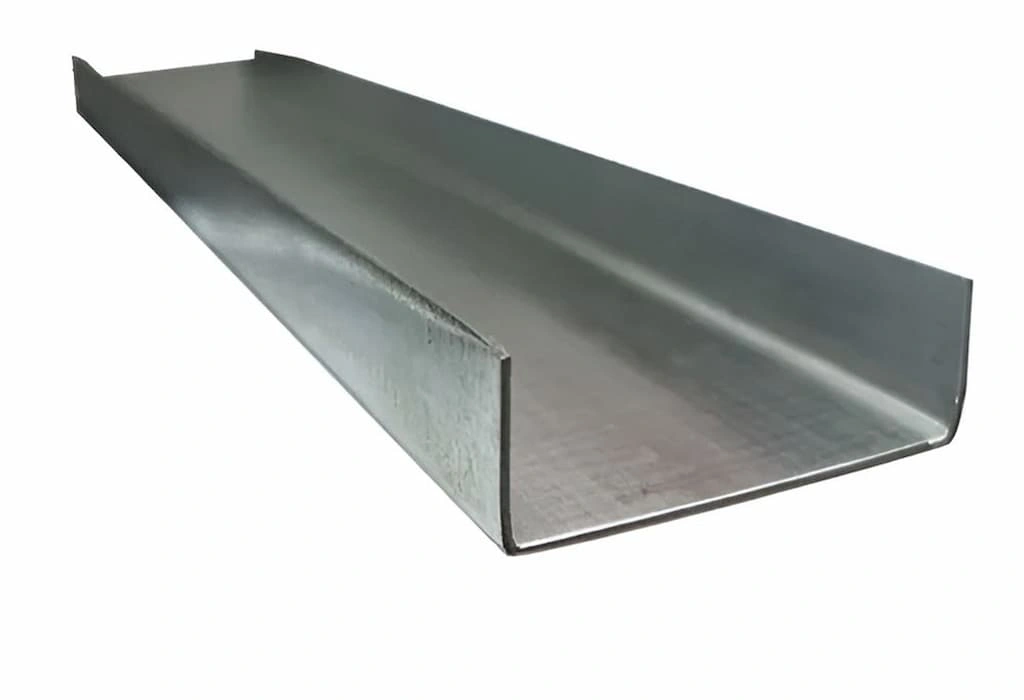
U metal channel
A U-channel component resembles the shape of the letter “U” with a flat base and two parallel legs (flanges) from both sides at an angle of 90°. This minimalistic design allows for fabrication using simple metal fabrication techniques or roll forming.
Based on the requirements, you can manufacture U metal channels with custom web widths, flange heights, and thicknesses.
U steel channels and aluminum channels can provide strong framing solutions for flat plate & components. Furthermore, they are also used for frame rails, trays & guides, support tracks, and structural supports.
C-Metal Channel
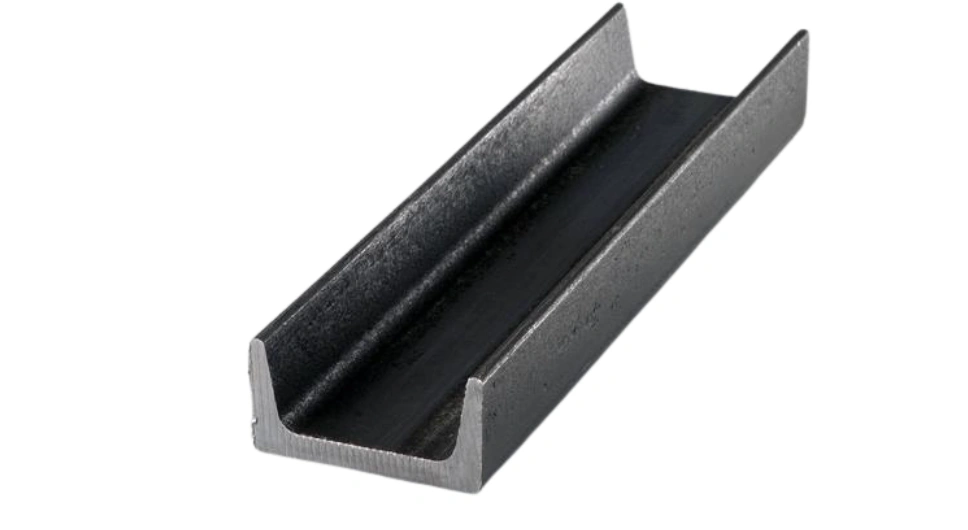
C metal channel
A C channel metal component is defined by its cross-section, which resembles the geometry of the letter “C”. What makes it different from U-channel is that the flanges are tapered or include inward lips. This geometry offers higher structural strength and improved buckling resistance.
These types of channels are mainly used in construction & mechanical structures. Moreover, you can choose from several variations, including steel C channel, galvanized steel C channel, and aluminum C channel.
Steel C channels are popular and preferred for rigid structures (beams, studs, and machinery frames, etc), whereas aluminum alloy channels are more suitable for lightweight applications.
J-Metal Channel
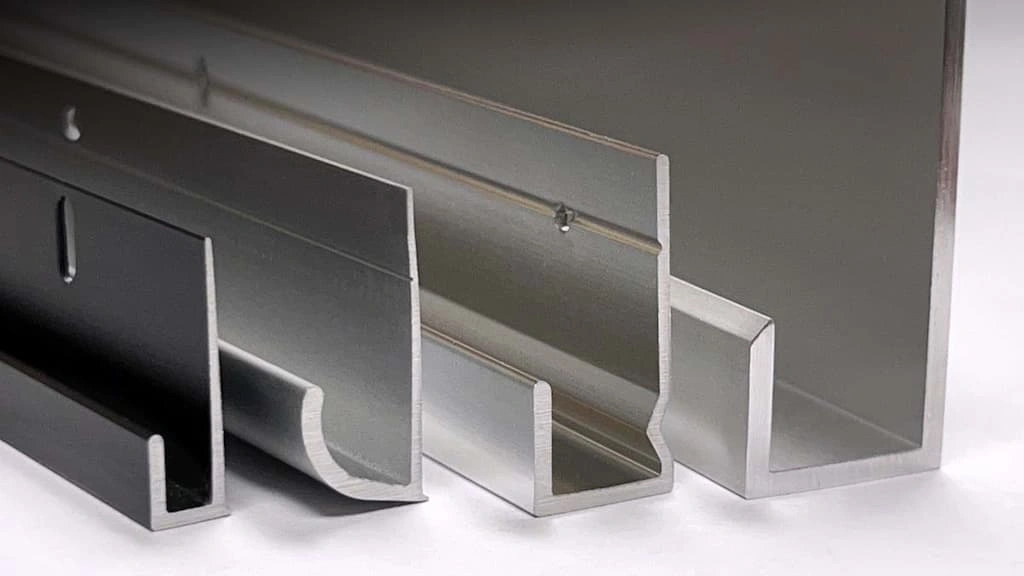
Metal J channels
This type of metal channel involves two parallel legs perpendicular to a flat base (like a U channel), but one side of the leg is shorter than the other, forming the shape of the letter “J”. How much shorter depends on the requirements. This design allows easy bending and snapping over the flat panels. Moreover, J channels with a smooth finish are favourable in industrial uses.
The common applications of J metal channel include panel edge covers, sliding mechanisms, soft trims, building cladding, facias, and drywall construction.
Z Metal Channel
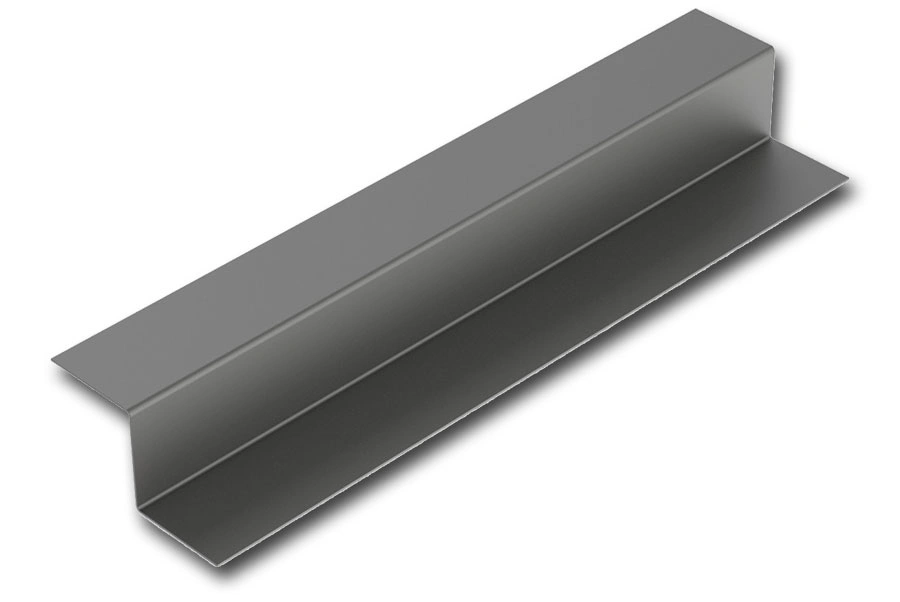
Metal Z channel
A Z metal channel features a flat base with two offset flanges in opposite directions, resembling the shape of the letter “Z”. Besides structural needs, it supports continuous spanning & nesting, providing good bending strength.
The applications of Z-type metal channels include roofing & cladding, framing reinforcement, metal building construction, agriculture & farmwork, shelves, racks, and custom DIY projects.
Try Prolean Now!
Metal Channel Fabrication Methods
Let’s discuss four types of metal channel fabrication methods: hot roll forming, bending, extrusion, and stamping.
Hot Roll Forming
It is one of the common methods of producing metal channels, which involves using rollers to shape heated metal strips. The hot metal strips are fed into the rollers, where the rollers press hot channel metal and progressively form the desired shape.
Since the process involves heating metal above its recrystallization temperature, hot roll formed channels provide excellent metallurgical properties.
Metal Bending
Bending involves deforming the flat sheet into a channel shape using a die and a press. First, large blank sheets are cut into the desired size using metal cutting methods like shear cutting and laser cutting. Then, the metal sheet is fed between the die and the press. Next, the press moves downward, forcing the sheet inside the die.
You can use this sheet metal processing technique to produce channels with a thickness of up to 6mm (or higher, based on material type). Consequently, it is cost-effective for high volumes and offers design flexibility.
Stamping
Metal channel stamping utilizes dies and punches to achieve the desired shapes, offering excellent repeatability. It is a precision metal fabrication method suitable for ductile metal sheets with low to medium thickness, including low-carbon steel, aluminum, and copper.
Extrusion
Extrusion involves pushing a hot metal billet through a die, where the metal flows through the die and forms a continuous profile defined by the geometry of the open cavity. This method is typically used for aluminum profiling and can produce sheet metal channels with smooth finishes.
Moreover, which fabrication method is ideal for your needs depends on multiple factors, such as material type, shape & size of channel, production volume, and desired tolerance level. If you need any consultation on method selection, contact us to get an experts guide.
How Metal Channels are Roll Formed?
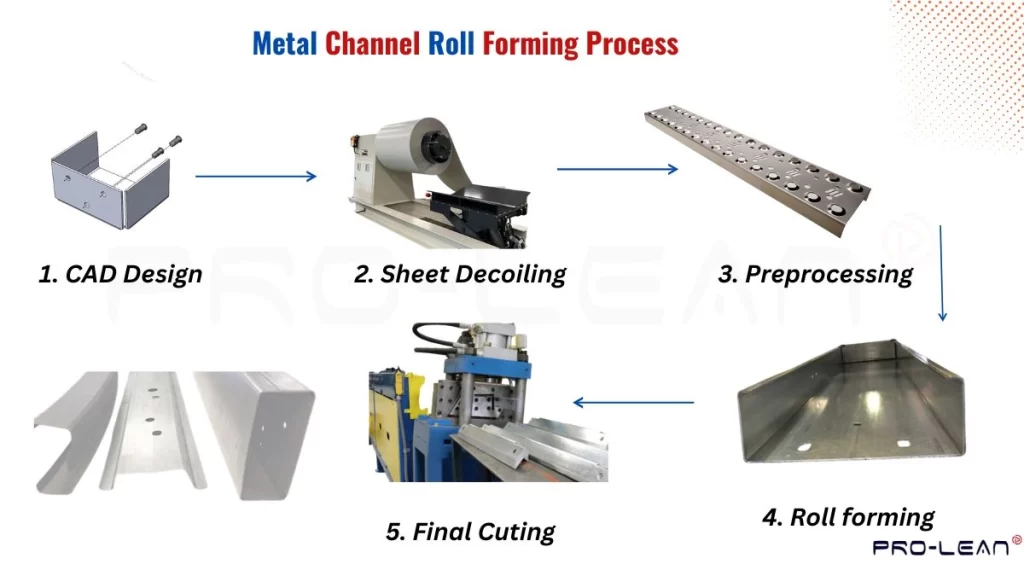
Roll forming of metal channel
Roll forming is the key method for producing metal channels. Typically, manufacturers use CNC roll forming machines for this process, which involves a series of steps that include CAD design, sheet metal preparation, tooling, and forming.
Let’s discuss the step-wise process in brief:
Channel Design
The first step of the channel roll forming is creating a detailed engineering design of the desired channel profile. The design defines geometry, features, dimensions, tolerances, and material grade. Meanwhile, you can use CAD software for design creation.
Sheet Decoiling
It is the process of preparing metal coils for feeding. The large coil of metal strip is placed on a decoiler shaft (at the centre), which rotates and allows automatic feeding into forming stations. This continuous feeding from the decoiler is important for faster production of metal channels.
Preprocessing Operations
As mentioned previously, channels may include features such as holes, slots, and notches. In the roll forming of channels, these features are formed before shaping the channel geometry. The metal strip from the decoiler first passes through a series of die presses to achieve these features.
Roll Forming Stage
The strips go into the roll forming stations after pre-processing operations. The roll forming dies and presses successively form the channel shape into multiple steps, based on the type and complexity of the desired channel.
Channel Cutting
Next, the formed metal channel is cut into the desired length and inspected for potential defects. Here, the process is continuous, and the formed strip channels are cut with precise machines as they pass from the roll-forming stations.
Benefits of Roll Forming Metal Channels
The list below outlines the key advantages of roll forming metal channels, including speed, customization flexibility,
- Faster Speed: The integration of the decoiler and recoiler streamlines the channel fabrication process, automating the process for high-speed production.
- Customization: The roll-formed channel profiles can be cut into any length. Additionally, the channel profile can be customized using specialized dies.
- Cost-effective: Roll forming is a cost-effective method for producing large volumes of metal channels.
- Versatility: You can roll form mild steel, carbon steel, aluminum, stainless steel, copper and many other metals into the desired channel profile.
Try Prolean Now!
Industries Using Metal Channels
Construction, transportation, agriculture, architecture, aerospace, industrial manufacturing, and other various industries use metal channels as structural components, frames, supports, alignment fixtures, and even decorative items.
The table below outlines common application examples of metal channel across industries.
Construction
- Benefits: High strength, easy to bolt & weld, economical, and durable.
- Application Examples: Roof purlins, wall studs, rail support, local reinforcements, etc.
Architecture
- Benefits: Ease of fabrication, aesthetic appeal, and a wide variety of finishing options.
- Application Examples: Aesthetic trims, façade rails, window frame channels, sign & display frames.
Agriculture
- Benefits: Long life spans, modular flexibility, easy welding and repair, and low cost.
- Application Examples: Trailer chassis, conveyor supports, equipment guards, and mounting brackets.
Transportation
- Benefits: Structural strength, good fatigue life, modular assembly, and material variety.
- Application Examples: Underframe members, structural rails, crossmembers, and brackets.
Aerospace
- Benefits: lightweight, corrosion resistance with coatings, flexibility of integrated features
- Application Examples: Floor stringers, interior fittings, seat rails, cable trays
Industrial machinery
- Benefits: High stiffness, durability, easy to integrate with secondary components, size flexibility
- Application Examples: Machine frames, gantry rails, mounting channels, safety-enclosure frames
How to Choose a Roll-Formed Channel Supplier
Choosing a roll-formed channel supplier requires consideration of several factors, including production capabilities, available material options, lead times, and costs. However, you should not trade the quality for a price reduction.
Analyze the offerings of multiple suppliers and choose one that provides the quality you need at competitive rates. Additionally, consider the lead time to ensure it aligns with your project timeline and avoid any potential delays.
You can request detailed quotes and ask suppliers about their previous projects related to channel fabrication. It can help you find a supplier that has expertise and experience to deliver the required result.
Summing Up
Overall, metal channels provide strong & lightweight structural support across many industries. It is also used for decoration, assembly alignment, and general purposes. C and Z channels are known for structural purposes, whereas U and J are preferred for trims and supports. Meanwhile, they can be produced using roll forming, press-brake bending, stamping, or extrusion.
Whether you need metal channels for custom projects or you are a supplier selling metal channels in the local market, we can provide extensive sheet metal fabrication services tailored to your specifications.
FAQs
What is a metal channel?
A metal channel refers to an open profile with a flat web and flanges, resembling the shapes of U, C, J, Z, T, and others.
Is a C channel stronger than angle iron?
Yes, but the exact strength varies with thickness. The larger cross-section makes the C channel stronger than angle iron, as it can distribute the load/stress uniformly.
What are the common metal channel sizes?
The sizes of metal channels vary widely; the common sizes are C50×25×5, C75×40×5, and C100×50×5.
0 Comments