
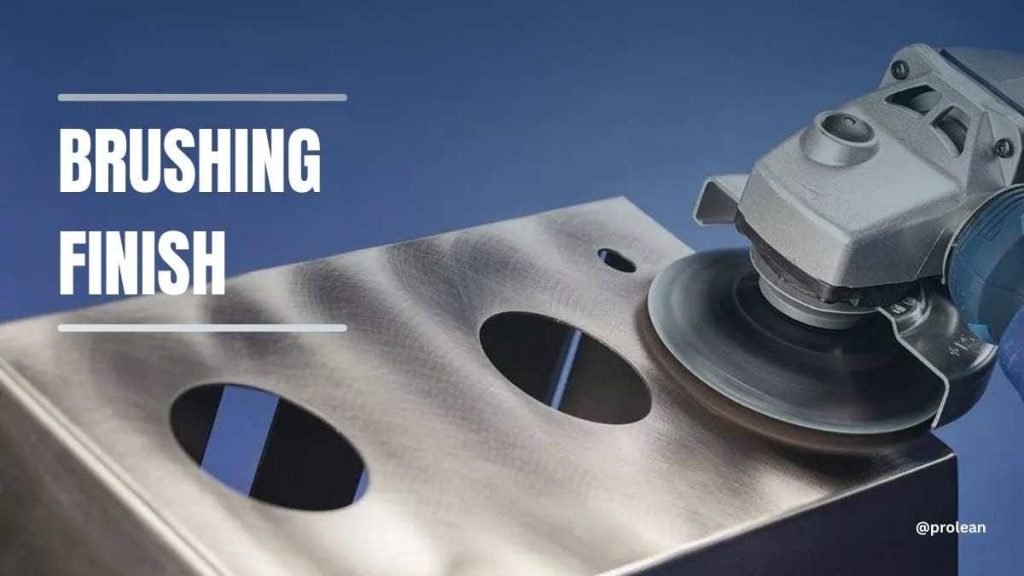
Brushing finish on metal parts
A brushed metal finish is produced by using abrasive brushes on a metal surface to create fine lines in one direction. The brushing action removes surface irregularities and produces a uniform grinding pattern.
When it comes to applications, engineers commonly employ it for metal parts such as panels, enclosures, brackets, appliances, and automotive components. Often, these parts need a clean appearance along with a suitable surface texture. It also helps hide small scratches and other minor surface marks.
Brushing is useful for several finishing operations. These include deburring, cleaning, edge rounding, edge blending, and surface preparation.
In this article, you will learn about the main steps for achieving a quality brushed metal surface, its different types, common applications, and benefits, and the factors that affect the final finish.
A Brief Overview of Brushing Finish
Brushing technique entails the utilization of a variety of brushing abrasives to improve the surface finish and/or attain a particular surface aesthetic. Unlike coated or bonded abrasives, these brushes are filament-based and reduce the chances of damaging the substrate. They offer better control as compared to hand tools since they apply minimal cutting pressure to level out irregularities.
Brushing tools are quite effective in operations such as deburring, cleaning, and edge rounding. In deburring, the brushes apply extremely high cutting pressure at the first contact point because of the small contact area. As the burrs are separated and the contact area is enlarged, the force is reduced. It assists in completing the operation and attaining a uniform surface without changing the part size.
Also, it’s possible to make accurate radii and blend the corners with the help of abrasive brushes, which are essential for shaped parts.
Steps to Achieve a Quality Brushed Metal Surface
Roughing a metal surface is a very delicate process, generally done in designated centers with the right tools and skills. The process can be divided into three key phases:
Initial Preparation
The first step is to prepare the metal for brushing. It starts with washing to get rid of any unwanted materials on the surface of the material to be bonded. After cleaning, fine-grit sandpaper is used to sand the surface. The process removes any scratches on the surface and prepares it for brushing.
Brushing Process
After that, the brushing phase is started for the metal in question to prepare for the next step. For any imperfections on the metal surface, an abrasive brush is used in a circular motion. This action produces a set of unidirectional lines that provide a brushed metal look to the material. This phase, also referred to as mechanical polishing, may differ in the extent of brushing. Others advise changing the direction of brush strokes now and then to take advantage of the brush’s ability to sharpen itself and to get a smoother brushing finish.
Finalizing the Finish
In the last stage, the surface is cleaned to avoid the presence of any particles and metal debris. This is normally done by washing the metal in water tanks, which at times contain things such as alkalis, acids, surfactants, and solvents. Modern techniques may include the use of cleaners and polishes. Moreover, electrochemical methods are employed for cleaning.
While brushing offers a smooth surface, it’s not the last phase. If the final appearance needs to be refined further, then some post-processing techniques like polishing, plating, and painting are added to the process to meet the desired product finish requirements.
Different Types of Brushing Finishes for Metal Surfaces
Brushing finishes come in various styles that not only improve the texture but also the look of the metal surface. The following are the basic types of brushed finishes that are widely utilized in various industries.
Straight-Line Brushed Finish
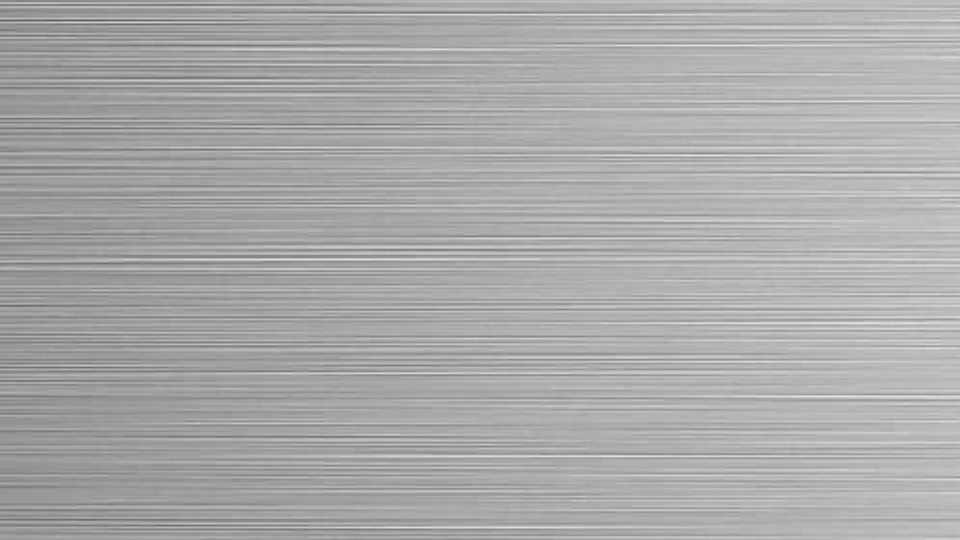
Straight line brushing pattern
This finish is carried out by drawing a brush over the metal surface in one consistent manner to give parallel lines. It is best for a neat and sleek appearance, which is common with kitchen appliances and industrial products.
Circular Brushed Finish
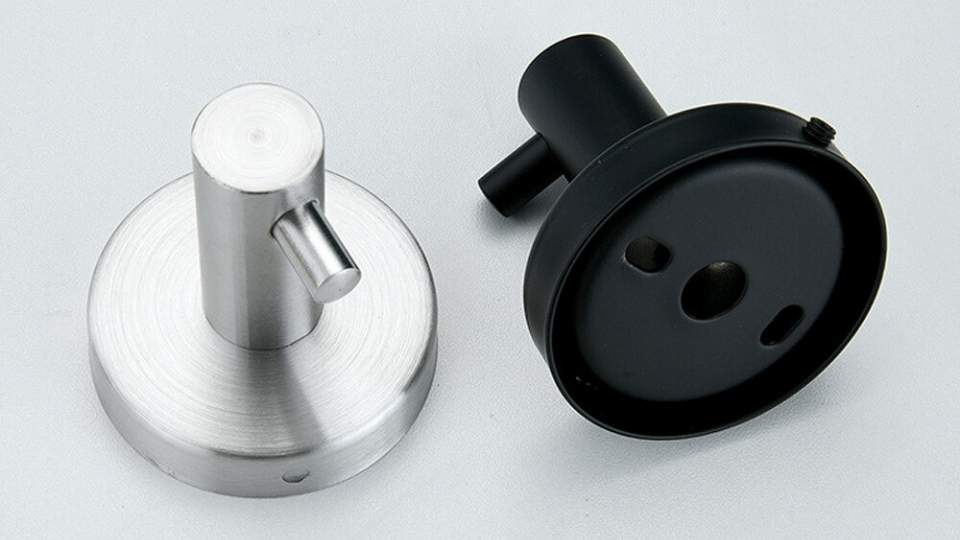
Circular brushing finish
In this finish, an abrasive brush is rotated in a circular motion on the metal surface, and as a result, there is the formation of rings that are in a circular overlapping fashion. This design is applied in most advanced wristwatches and adds elegance and a style of its own.
Cross-Hatch Brushed Finish
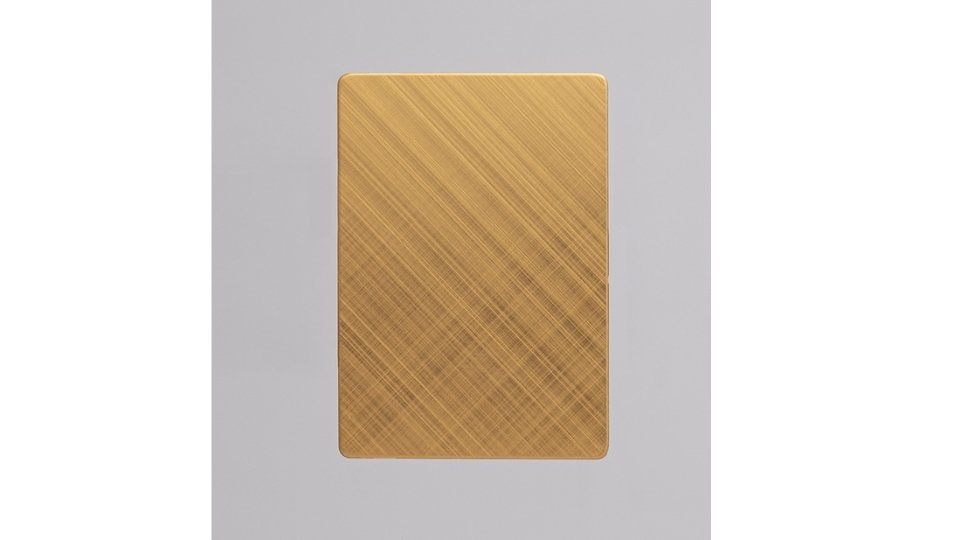
The cross-hatch finish is done by brushing in two directions, resulting in the formation of a ‘plus’ sign on the material. This style lends depth and texture to designs and is therefore ideal for designs that require a high surface texture.
Try Prolean Now!
Key Factors Influencing Brushed Metal Finish Quality
There are important parameters that decide whether it is possible to obtain a high-quality brushed metal finish and how durable it is going to be. These factors include the base material nature, the brush, the technique of applying the coating, the conditions in which the coating is applied, and the drying and curing process. Let’s talk about each process;
Quality of Base Material
The type of material used has a large influence on the final brushed finish. Stainless steel and aluminum are primarily used as they are strong, do not rust easily, and are stylish.
Selecting the Appropriate Brush
There are various types of brushes, including steel wire brushes, brass brushes, and power brushes, and each of them is useful in some specific areas.
- Steel Wire Brushes: Durable and round, most suitable for surface preparation and the removal of rust or paint. However, they are known to wear out softer fabrics if they are not handled with care.
- Brass Brushes: Less hard and not as effective as steel brushes, but suitable for softer materials such as aluminum brush finish. They provide a clean hit with little damage being done to the opponent.
- Power Brushes: These are tools that help in the brushing task and, most importantly, provide uniformity in brushing, especially when working on large areas.
Mastering Application Techniques
Overall, it’s significant to ensure the method of applying the paint is professional enough, and the finishing is done in the right manner. Because irregularities cannot be avoided, and high pressure and directionality are needed to counter such issues. Sometimes the brush is drawn at very high speed, or pressure is applied on the brush, which results in an uneven surface and requires a lot of effort to smooth it.
Impact of Environmental Conditions
Dust, moisture, and dirt can affect the brushed finish during the process. These particles can stick to the metal and change the brushing pattern. The metal surface should be clean and dry before brushing to get an even finish.
Curing and Drying Considerations
Application of finish and sealing is also important to prevent the brushed finish from being damaged during curing and drying. A sealant or a coating applied to the material shields it from rusting or oxidation. The sealant type used, method of application, and curing conditions play a significant role in the longevity and appearance of the brushed finish metal.
Avoiding Common Mistakes
- Neglecting Surface Preparation: If proper cleaning and preparation are not done, it can result in a poor finish and potential damage to the material.
- Choosing the Wrong Brush: Sometimes, one can use the wrong brush for the material, and this can lead to undesired outcomes. So, the right brush must be selected for optimal results.
- Inconsistent Brushing: If there is irregular pressure when brushing or irregular direction, then a chance of mismatching of grain/match patterns may occur.
- Forgetting Surface Protection: However, the most critical aspect is that the finished surface has to be protected adequately so that the brushed finish does not get damaged or contaminated.
Types of Brushes Influencing Brushed Metal Finish
When getting to the brushed metal finish, the brush you select has to be carefully chosen. Because it is useful to achieve a specific outcome. Among the many types of surface finishes, the brush finishing technique uses steel wire brushes.
Steel Wire Brushes
Steel wire brushes are mainly used because they are effective and versatile in use. These brushes are designed to work on metal surface parts to make them clean and polished without affecting the part’s dimensions.
Steel wire brushes operate similarly to sandblasting, but instead of particles, they use wires. The hardened steel tips of the brush, when used in conjunction with high-speed motion, enable the removal of the surface contaminants without affecting the base material.
The steel wire brushes are available in a wide range of types, and each type of brush is designed to meet specific requirements:
- Long-Filament Brushes: These are relatively mobile and can, on most occasions, easily adapt to different forms, particularly curved surfaces, hence appropriate for intricate forms.
- Short-Trim Brushes: These are the brushes for more aggressive actions and allow you to have a very fast and effective brushing for tougher jobs.
Another parameter that defines the performance of the brushes is the density of the wire fill-in brushes. High-density brushes give more brushing actions in a short time and have a longer working life than low-density brushes, which are suitable for uneven surfaces. Moreover, steel wire brushes do not get blocked, and they can work on any surface, including coated or painted ones.
Power Brushes
Power brushes are universal tools that can be used in operations including polishing, edge blending, and other operations for cleaning. These are made from carbon steel, various types of metals, and natural as well as synthetic fibers.
The power brush depends on power when in use. The outcome you get will be in proportion to the force and the strength of the tool. Several types of power brushes are different in shape and size and are used for different purposes:
- Longer Filaments: They are employed for moderate wear, and the final product is a smooth finish.
- Shorter Filaments: These are used for tough operations and provide a deeper brushing action than the normal brushes.
Carbon Steel Brushes
These brushes are made from high-carbon steel to cater to industrial uses such as sheet metalworking and welding. They are rigid and highly effective at dislodging rust and paints, and removing dust from the workpiece surface. Carbon steel brushes are considered to be rather sturdy and capable of working in a dusty environment.
Variable Grain Abrasive Brushes
Variable-grain abrasive brushes can be made of synthetic filaments. Generally, they have abrasive particles such as silicon carbide or aluminum oxide. Unlike conventional brushes, these brushes entail levels of coarseness of abrasive bristles, which afford better control. These are perfect for jobs like surface conditioning and cleaning because of their all-around and efficient scrubbing characteristics.
Crimped Wire Brushes
Crimped wire brushes are characterized by wire flexibility and hence are optimal for working on curved or hard-to-reach areas. This flexibility is valuable for removing rust, paint, and corrosion from complicated structures.
Bristle Brushes
Another type of brush is the Bristle Brushes, which are available either natural, like animal hair, or synthetic, like nylon. They are used in applying coatings such as paint and varnish. Their soft bristles make them easy to use and give a uniform coating when applying paint or varnish. So, these are notable for use in finishing in woodworking, automobile, and furniture manufacturing industries. Moreover, these brushes give a smooth and even texture to different materials. Overall, the brushes with a larger diameter are seen to give the best performance, especially when dealing with large surfaces.
Try Prolean Now!
Common Uses for Brushed Metal Finishing Techniques
The finishing techniques using brushed metal are mainly incorporated in different industries to improve surface characteristics and product life. All these methods offer substantial advantages in terms of processing and manufacturing of metal parts with improved surface appearance and performance.
Deburring
In metalworking, brushes are used for CNC deburring. The brushing process is more effective than traditional grinding methods because it solely focuses on the burrs with minimal interference on the other part of the material. Such precision guarantees that the base material is not compromised in any way, shape, or form by the creation of new sharp edges and by eradicating other adjacent areas.
Edge Blending
Power brushes are superior in edge blending since they produce smooth curves at the interface between two different surfaces. This process helps in the elimination of sharp corners, which decreases stress concentration and thus part fatigue. The tolerance of the part is retained with the use of power brushes in edge blending. So, the durability and efficiency of the component is boosted.
Cleaning
Peeling tools include brushes for the removal of contaminants as well as dirt, film, rust, weld slag, paint, and heat treat scales. Stainless steel brushed finishes are particularly adapted for cleaning operations, which involve washing, which makes cleaning residues particularly efficient.
Roughening
Brushing finishing is also applied to give the material a surface roughness on nonferrous metals, rubber, and leather plastics, among others. This roughening process improves the paint coating that may be applied on the surface due to the enhanced bonding. So, increases the part’s durability and makes it reliable for longer use. In addition, the power or steel wire brushes are used for preparing the surface, which gives the best result for paint application or surface treatment by the manufacturers.
Brushing Finish Compatibility With Different Materials
Brushing can be used on different materials, but the brush and brushing method should match the material. The table below lists the most suitable metals, usually with a brushed finish, and their considerations.
|
Material |
Brushed Finish Application |
Main Consideration |
|
Stainless Steel |
Used for panels, enclosures, appliances, and other visible parts |
Provides a clear and uniform grain pattern |
|
Aluminum |
Used for panels, housings, trim, and decorative parts |
Requires a suitable brush to avoid deep marks |
|
Brass |
Used for decorative parts, fittings, and hardware |
Softer than steel, so lower pressure may be needed |
|
Plastics |
Used for selected decorative and surface-textured parts |
Requires a suitable abrasive to avoid damaging the surface |
Comparing Brushed Finish with Other Finishes
In choosing a metal surface finishing, it’s helpful to understand how a brushed finish stands against other common finishes. All of the finishes have unique properties and uses that fit various applications.
Brushed vs. Mirrored Finish
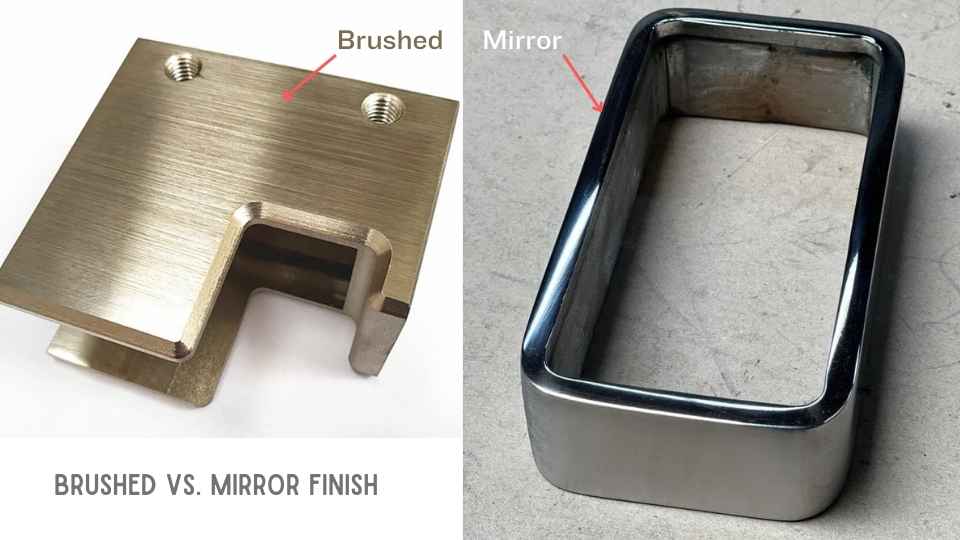
Brushed vs. mirror finished parts
Mirror finish has the highest reflectivity and looks like the surface of a mirror, as the name suggests. This finish is done by polishing the surface of the steel until it has a mirror-like sheen. On the other hand, brushed finishes have directional lines that run parallel to each other. While the mirrored finishes are non-directional and give a smooth and shiny surface. Semi-glossy finishes are reflective and employed in construction elements and home accessories that require a lustrous surface.
Brushed vs. Bead Blasted Finish
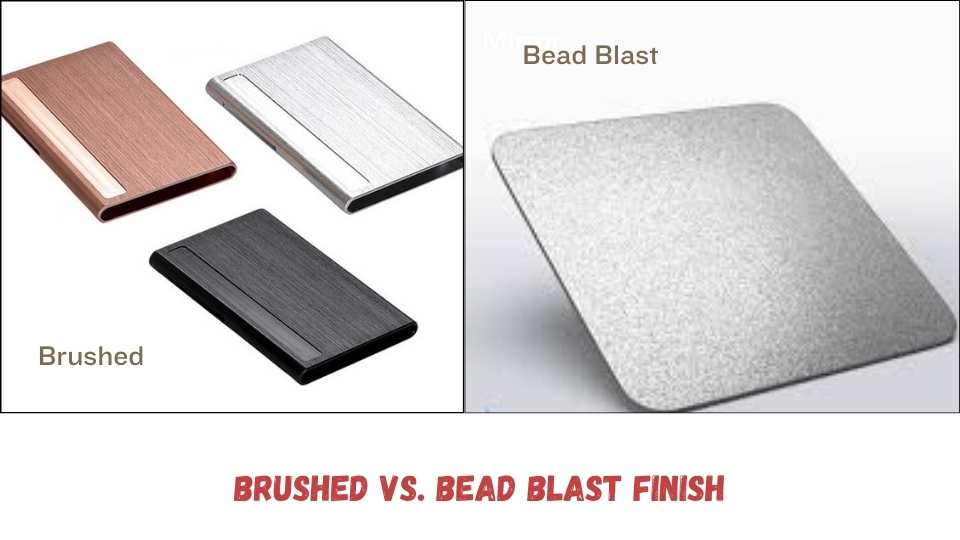
Brushed vs. bead blasted finish
Bead blasting makes use of glass, ceramic, or corundum beads fired at the metal surface to produce a uniform and dull finish. This leads to obtaining a non-directional, smooth surface without any kind of reflection pattern. Unlike brushing, which has lines and directional marks on the surface. Bead blasting gives a uniform surface, mostly employed in the architecture sector.
Brushed vs. Satin Finish
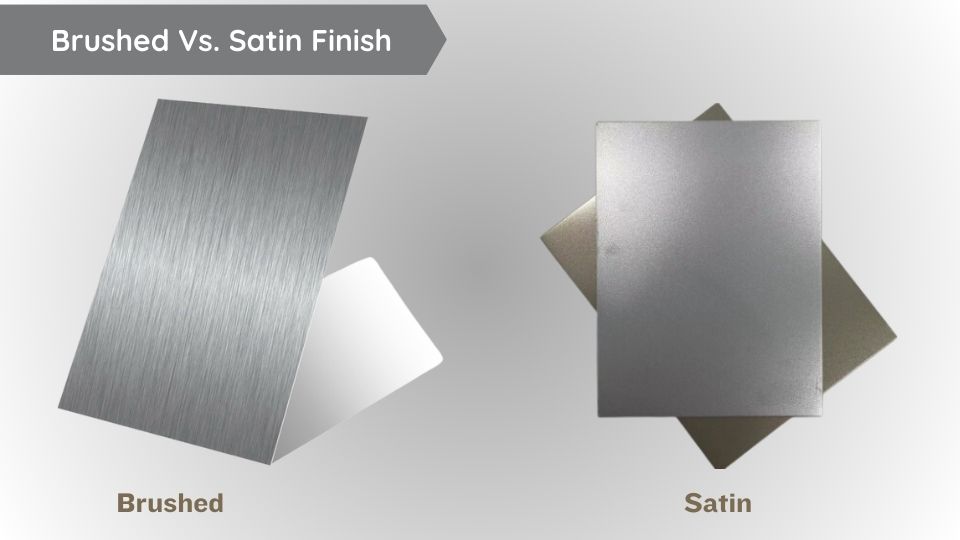
Brushed vs. satin finish
As detailed above, brushed and satin finishes may look alike but have distinctions. The satin finish is characterized by a low sheen and a velvet-like touch, which is produced by abrasive papers or other abrasive media. Unlike brushed finishes, satin finishes do not possess directional lines, and hence, the luster is distributed evenly on the surface. Further, the satin finish is slightly more resistant to rust and corrosion than the other types. Therefore, its use is common in kitchen sinks.
Pros & Cons of Brushing Finish
There are numerous benefits associated with a brushed surface finish; the surface appears to be more classy and modern. Additionally, it’s cheaper to use and has a low initial investment because it does not need many materials and little preparation. Besides, it hides small defects such as scratches and dents, and also provides durability in various settings.
However, there are some drawbacks to using it. The brushed finish can be disadvantageous in that it may make the texture of the surface rusty and hence easily corrode. This process can also be time-consuming and may need a lot of time, especially when working on a large, complicated surface. Last but not least, the creation of parallel lines might reduce the choices of design, hence reducing the aesthetic options.
Try Prolean Now!
Get Brushing Finish Services for Metal Parts From Prolean Tech
Brushing is a widespread method used for leveling metals and non-metals where the required surface has to be flat.
This technique has a uni-directional finish employing abrasive brushes to leave the surface of the floor with a uniform surface finish. These finishes are preferred because they have a good appearance and are convenient to use.
Due to the increased demand for a brushed surface, one should consult the brush makers. Prolean Tech has the brushing finish services for your components, and we guarantee the best finish for your parts.
Our engineers can help you achieve a brushed surface finish with a typical roughness range of Ra 0.8 to 3.2 µm, depending on the material, brush type, and finishing requirements. Contact us to discuss your required surface finish for your components.
FAQ’s
Q1. What is a Brushed finish metal?
The brushing finish metal process produces a matte finish on the metal surface with the use of abrasive tools running in a parallel manner on the surface of the metal. This gives the metal a unique, simple, and elegant appearance.
Q2. What is the difference between a brushed and polished surface?
Brushed has a dull appearance with lines on the surface, while a polished one has a smooth and shiny appearance. Brushing leaves a faint texture on the surface, while polishing gives a shiny/lustrous surface to the material.
Q3. What is the difference between a brushed finish and a mirrored finish?
Brushed finishes are characterized by their matte surface and linear directions, while mirrored finishes are shiny and free from any directionality. Brushing creates texture while mirroring provides the surface with a mirror-like/reflective finish.
Q4. What is a brushing surface finish, and why should it be used?
Brushing surface finish uses abrasive tools to put a pattern on the surface of the material. It brings aesthetics, hides imperfections, and can increase the protection against corrosion, making it useful in various applications.
Q5. In what manner is brushing different from other surface finishing techniques?
Brushing gives a texture that will mask some sort of defect and is different from polishing, which gives a shiny surface. Although brushing can be time-consuming, it is useful for obtaining the desired and precise result.
Q6. Which materials can be used in brushing surface finish?
Brushing is applicable to metals, including stainless steel, aluminum, brass, bronze, and other materials such as wood and polymers. Every material needs a certain treatment to give it the required surface finish.
Q7. Can brushing be applied on a large-scale production?
Yes, brushing is good for large-scale manufacturing, but the technique of brushing needs to be properly employed to achieve evenness in large areas. It can be time-consuming and, as such, efficiency and consistency of the process become an issue of concern.
0 Comments