
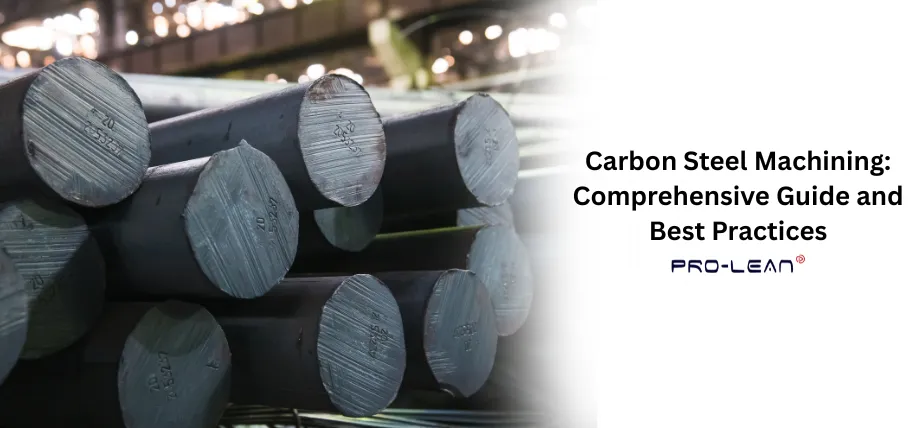
Carbon Steel Bars
Carbon steel machining requires an understanding of carbon steel alloy and its suitability for custom steel machining. It is an iron-carbon alloy that contains around 0.05% to 2.1% carbon of its total weight. Its mechanical behavior and carbon steel material properties depend on the amount of carbon present in the alloy, which directly impacts machinability in carbon steel machining.
Carbon steel with lower content is softer and generally easier to machine, though high-carbon carbon steels are harder to machine and require specialised tools, but they have higher durability and wear resistance. The choice of carbon content and alloy steel machining can affect the tool life, and in turn, the accuracy of precision CNC machined carbon steel parts.Read more:Alloy Steel vs Carbon Steel
What is Carbon Steel?
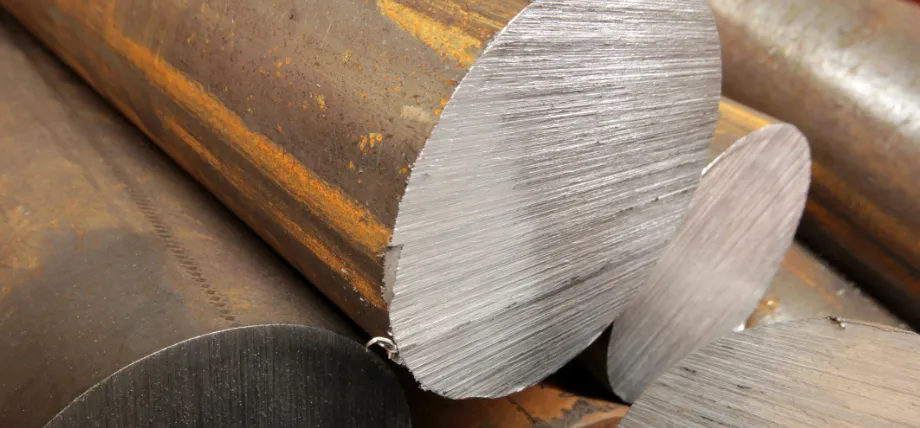
Cut Steel Bars
Carbon steel is made up of iron and carbon and is classified into three main categories depending on the carbon content. Low carbon steel is classified as 0.3% and lower, medium ranges from 0.3 to 0.6% and high carbon steel is higher than 0.6%.
It does not contain intentional alloying elements such as chromium, which separates it from alloying alloys. Minor elements such as manganese, sulfur, phosphorus, and silicon are present. The carbon content present in the steel directly impacts the physical and mechanical characteristics, such as strength, hardness, and ductility, of the material.
Carbon steel transforms from austenite to martensite during heat treatment. This allows you to tailor its properties. Low-carbon steels, such as AISI 1018, have good weldability and formability. High-carbon steels such as AISI 1095 provide superior wear resistance and durability. Carbon steel is produced by melting iron ore along with carbon in blast furnaces. The molten steel is then cast and rolled to make sheets or blocks of carbon steel.
Low-grade carbon steel has a ferrite and pearlite microstructure, while higher-grade carbon steels have a pearlite & cementite structure. The difference in microstructure directly affects the properties of the steel, such as elongation and strength.
Machining Properties of Carbon Steel
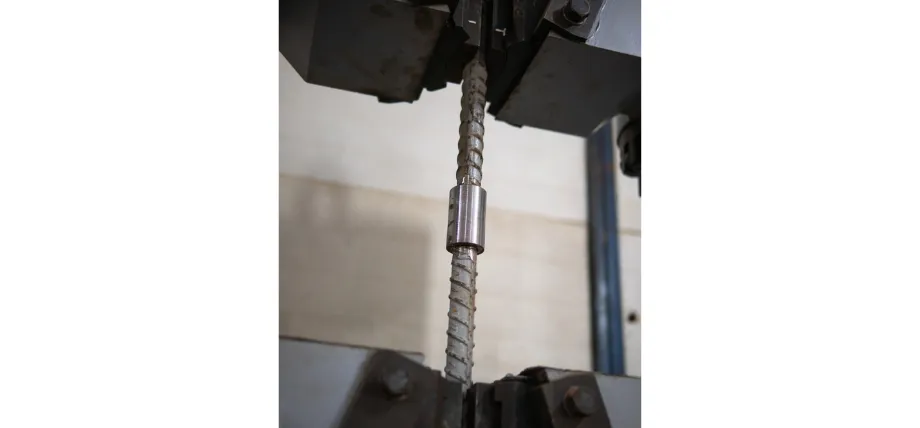
Tensile Testing Specimen
Carbon steel is used for machining due to its mechanical and thermal properties, making carbon steel machining suitable for a wide range of industrial components. Machined carbon steel has excellent surface finishes and durability. Some carbon steel material properties that make it the perfect choice for machining parts are listed below:
Hardness
Carbon steels have a hardness range from 125 HB to over 300HB. Harder materials tend to deform less when they are being machined. Softer steel, such as AISI 1010, is processed at higher cutting speeds, but it produces built-up edges, while harder grades require specialised tools to machine.
Tensile Strength
The tensile strength of low-carbon steel can range from 370 MPa to 1500 MPa in high-carbon steels. Higher tensile strength means better part durability, but it also increases the machining difficulty.
Yield Strength
Yield strength is the limit at which plastic deformation occurs. Carbon steels have a yield strength from 250 to 800 MPa. Work hardening can occur during machining if the machining forces exceed the limit. In such cases, the machining requires adjusted feed rates.
Elongation and Ductility
Low-carbon steel has a 20% to 40% elongation at break, and the elongation at break of high-carbon steels is even lowerthan 10%. The higher elongation of low carbon steel results in longer continuous chips, while the more brittle high carbon steel makes segmented chips.
Thermal Conductivity
The thermal conductivity of carbon steels is around 50 W/m·K. Its heat dissipation is moderate while machining, and needs to be regulated. Poor heat management can cause thermal expansion in materials and affect tolerances as well as dimensional stability.
Density and Modulus
The density of carbon steel is around 7.85 g/cm³, and the Young’s modulus is 200 GPa, which provides sufficient stiffness, enough to allow for deflection in large parts. The following table summarises typical properties for common carbon steel grades:
| Grade | Carbon Content (%) | Hardness (HB) | Tensile Strength (MPa) | Yield Strength (MPa) | Elongation (%) | Thermal Conductivity (W/m·K) |
| AISI 1018 | 0.14-0.20 | 126-197 | 440 | 370 | 15 | 51.9 |
| AISI 1045 | 0.43-0.50 | 163-229 | 585 | 505 | 12 | 50.7 |
| AISI 1095 | 0.90-1.03 | 248-352 | 965 | 745 | 9 | 48.0 |
| AISI 1144 | 0.40-0.48 | 217-255 | 745 | 620 | 10 | 49.5 |
| AISI 1215 | 0.09 max | 167-229 | 540 | 415 | 10 | 51.0 |
Types of Tools That Can Cut Carbon Steel
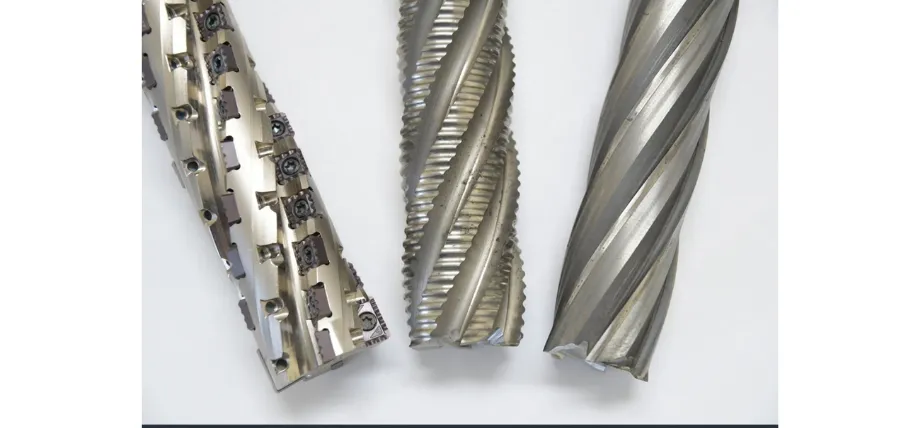
Machining End Mills
Tool selection is important for carbon steel machining. Selecting the right tool allows for greater precision and efficiency as well as optimising parameters such as heat generation and work hardening. Some common tools are listed below:
- High-Speed Steel (HSS) Tools: HSS tools are made of tungsten, molybdenum, and vanadium, which improves toughness for cleaner cuts. They are usually used to process low to medium-carbon steels with speeds of up to 30m/min. They aren’t suitable for high-carbon processes since they wear extremely fast due to heat generation.
- Carbide Tools: These tools are tungsten carbide-based and feature a TiN or TiAlN coating to improve their wear resistance, which is essential for high-speed machining (100-200 m/min) for all carbon steels. It produces an improved surface finish and reduces deflection.
- Ceramic Tools: Ceramic tools have really high hardness, around 2000 HV, and speeds of up to 300m/min. Ceramic tools are typically made of Alumina and nitride composites, which are highly effective at machining high-carbon steels (for dry cutting) since they are able to manage heat generation.
- Coated Carbide Inserts: These inserts have a CVD or a PVD coating similar to TiCN, which improves their life by 2-3 times in abrasive conditions. They are commonly used in turning and milling medium carbon steels.
- Cubic Boron Nitride (CBN) Tools: CBN is the Second hardest material after diamond, which is great in hard turning of heat-treated carbon steels (45-65 HRC). It requires minimal coolant and can machine at a rate up to 200 m/min.
- Solid Carbide End Mills: Carbide end mills are used for deep cutting and have a different helix design that minimizes vibrations.
- Indexable Milling Cutters: They are equipped with carbide inserts that allow for quick replacement and versatility in face milling carbon steel plates.
- Drills with Carbide Tips: Designed for hole-making, incorporating coolant holes to evacuate chips and cool the cutting zone in carbon steel.
- Taps and Dies: Taps and Dies are typically made of HSS and carbides for threading. They feature coatings to prevent galling in ductile low-carbon steels.
CNC Machining of Carbon Steel
Carbon steel machining uses CNC systems that subtract material from a solid block of metal to form a workpiece. The CNC program optimises tool paths, ensuring precision and consistency. CNC operations utilise carbide tools to remove material and employ coolant to regulate temperature and evacuate chips during machining. The CNC process is different depending on the type of carbon steel, and different cutting parameters are used by machinists for effective carbon steel machining.
- Typical parameters (carbide tools, medium-carbon steel like AISI 1045): Cutting speeds are from 100-200 m/min (328-656 SFM) with a feed rate of 0.1-0.3 mm/tooth and a depth of cut of 1-5 mm. Flood coolant is used to regulate temperature during the machining process.
CNC Milling Carbon Steel
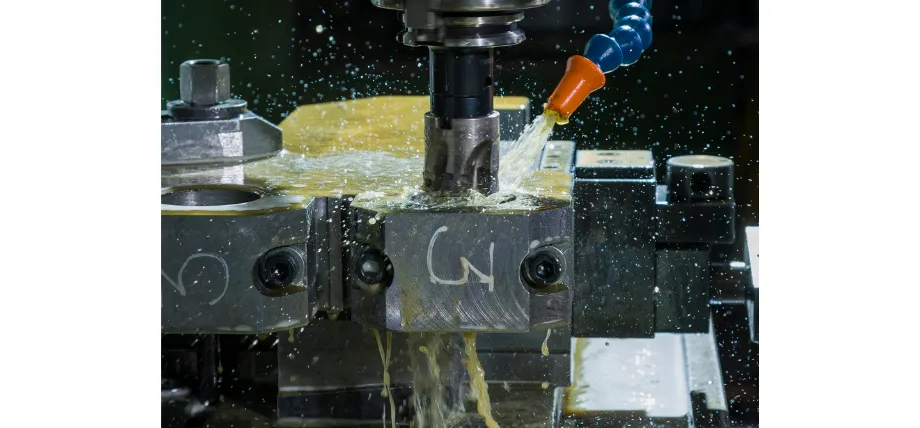
CNC milling carbon steel part
CNC Millining is a computer-programmed subtractive process that works by using cutters with multiple points to make different features such as contours and slots. The process also allows for roughing to remove the bulk of the material and give shape to the workpiece with finishing passes to refine it for dimensional accuracy. Climb milling is more preferred because it can produce better results compared to conventional milling.
CNC Turning Carbon Steel
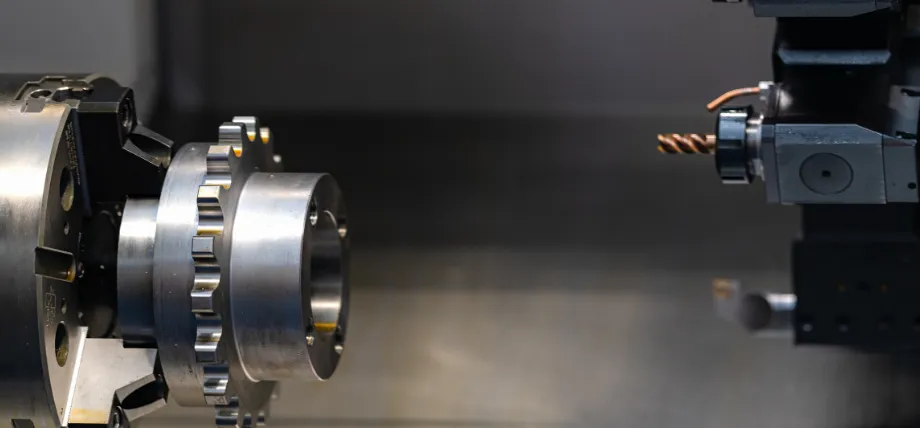
CNC Lathe Machining
The process of CNC turning involves rotating a workpiece in relation to a cutting tool, which is stationary, to produce a cylindrical shape. This process is used to make various features such as bores and threads.
The use of a positive rake angle in cutting tools allows for effective chip control, which is critical for finishing operations. The process of cutting starts with rough machining, which is then followed by a second operation of finish machining to ensure the parts meet specifications
4 Axis CNC Machining
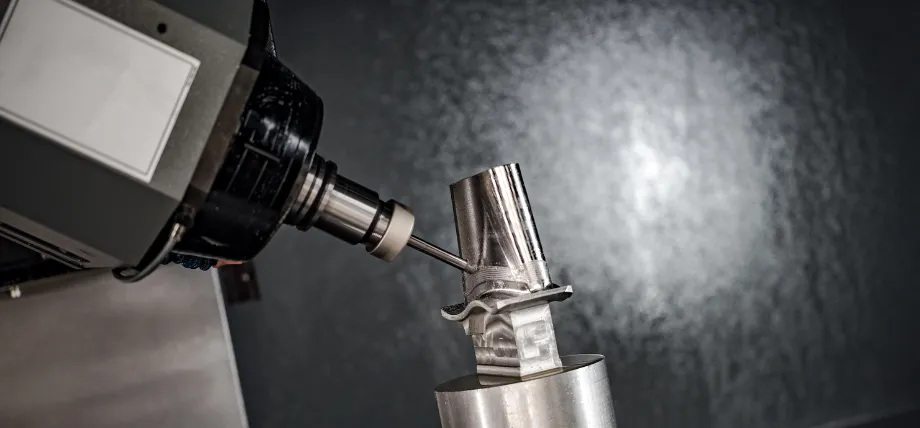
CNC machining in 4 axes
4-axis CNC machining combines rotational axis (typically A-axis) along with the standard X, Y, and Z linear axes. This enables you to rotate the workpiece for access to multiple sides without repositioning. This machine is specially designed to produce components of carbon steel featuring complex shapes such as lobed cam, helical grooved, and items with a wrapped-around profile.
Multi-Axis CNC Machining
Multi-axis CNC machining (5-axis or more) is a modern machining process that allows you to move the workpieces simultaneously along the 3 linear axes and two rotational axes. This feature reduces multiple setups and allows you to make complex geometries from a single setup. Multi-axis CNC machining allows you to make undercuts and compound angles along with a curved surface, with high precision.
Large Part Manufacturing
A large part of manufacturing using CNC machines involves making parts that are bigger than 1-2 meters in dimension. Large parts are processed using gantry systems and extended travel machines. The parts are held using robust fixtures, and any stress distortion is accommodated by stress relief applications to counteract distortions or uneven material removal.
Try Prolean Now!
Challenges in Carbon Steel Machining
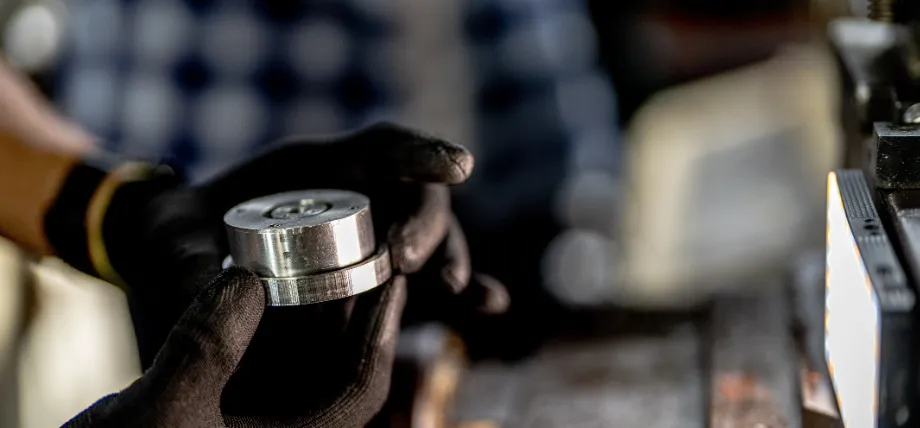
Finished Steel Part
Carbon steel machining, like any other material, presents its own unique challenges and difficulties that must be addressed. The hurdles are overcome through parameter optimization. Some common hurdles are listed below:
Tool Wear
Tool wear is a common problem that occurs during machining. It is commonly caused by abrasive carbon particles that accelerate flank and crater wear, especially in high carbon grades, which are harder to machine. To address this issue, carbides are coated to improve their durability, but they require monitoring to prevent failure and ensure successful machining.
Heat Generation
The heat generated during the machining process can reach up to 800 °C, which can cause thermal expansion and distort the workpiece. The temperature is regulated by using coolants and lower speeds.
Work Hardening
Work hardening occurs when the material exceeds its elastic limit. The deformation causes the surface to harden, causing you to use more cutting force. A lower feed rate and a sharper cutting tool can reduce work hardening, keeping the surfaces soft and producing precise results.
Chip Control
Lower carbon steels, which have higher ductility, make longer chips that can cause entanglement. Chip breakers and high-pressure coolant help in chip evacuations, keeping the process hazard-free.
Surface Finish Issues
Vibrations and uneven forces cause poor surface finishes and high Ra values. Rigid tools, properly mounted, along with a balanced setup and proper fixing, depending on the shape and geometry of the workpiece, reduce this problem.
Dimensional Stability
Raising the material temperature and cooling it repeatedly induces stresses and distortions in the material. Annealing is great to reduce stress and stabilize the material prior to machining.
Common Precision CNC Machined Carbon Steel Parts
- Bolts and Fasteners: Threaded components from AISI 1045, offering high tensile strength for structural assemblies.
- Shafts: Turned from AISI 1018, providing torsional resistance in drivetrains.
- Gears: Milled from medium-carbon steels, heat-treated for wear resistance in transmissions
- Pins and Dowels: Precision-ground for alignment in machinery.
- Brackets: Formed for mounting, utilizing ductility for bending post-machining.
- Valves: Machined for fluid control, with tight tolerances for sealing.
- Flanges: Turned for piping connections, ensuring flatness.
- Bushings: Bored for bearing applications, reducing friction.
- Springs: Coiled from high-carbon wire, offering elasticity.
- Knives and Blades: Sharpened from AISI 1095 for cutting tools.
Try Prolean Now!
Applications of Carbon Steel
Automotive Industry
The automotive industry is using carbon steel to make a variety of different parts, ranging from chassis, engine blocks, to suspension components. This is mainly because carbon steel has excellent durability and mechanical properties.
Construction Sector
Carbon steel is used to make rebar for construction beams, providing high structural integrity in buildings and bridges. Heavy-duty pipes are being made using carbon steel because it is able to withstand extremely high pressures.
Machinery and Equipment
Machinery gears, shafts, and frames used in major industries are made using carbon steels. The ability to be machined enables the making of custom parts for jigs and custom fabrications.
Oil and Gas
Pipes and valves used in the oil and gas sector need to withstand high pressures and a harsh environment. Carbon steel performs extremely well in such conditions and is widely used for this reason in the industry.
Aerospace
The aerospace industry only uses it for fasteners and non-critical structures or secondary parts that require carbon steel’s specific properties for functionality.
Consumer Goods
Carnon steel is used in a wide range of appliances and tools, such as mixers and kitchen knives, as it offers high durability at a low cost.
Custom Metal Machining
Proleantech provides steel service for carbon steel, alloy steel, and stainless steel alloys. We maintain a stock of metal alloys with material certificates and process transparency. Standard CNC machining tolerances for carbon steel parts are typically ±0.025 mm, depending on geometric complexity. Our engineering team also offers expert consultation and material selection support.
Request a free quote today!
Conclusion
Carbon steel machining is one of the most widely used manufacturing techniques that is used across various industries, ranging from automotive to the marine industry. Comparing alternatives, it outperforms some metals in cost and availability when compared to titanium vs steel. It is reliable and efficient, which makes it a preferred choice for manufacturers. It is able to combine material properties with advanced processes and produce reliable components that set the standard for the industry.
FAQ
Is carbon steel machinable?
Yes, carbon steel is machinable. There is a wide range of machining techniques that are being used to make parts and components.
Is carbon steel easy to manufacture?
Yes, it is easy to manufacture, and carbon steel is considered the best steel for machining. Modern manufacturing processes have made it relatively easy, and it is mainly made through casting or forging, depending on the steel’s grade.
Can you CNC carbon steel?
Yes, you can CNC machine carbon steel, and precision CNC-machined carbon steel parts are popular for automotive uses.
Is carbon steel good for cutting?
Carbon steel is readily used to make cutting tools, especially high-carbon grades that are able to retain their edge due to improved hardness. Though alloy steel grades can also be selected for heat and wear resistance applications.
0 Comments