
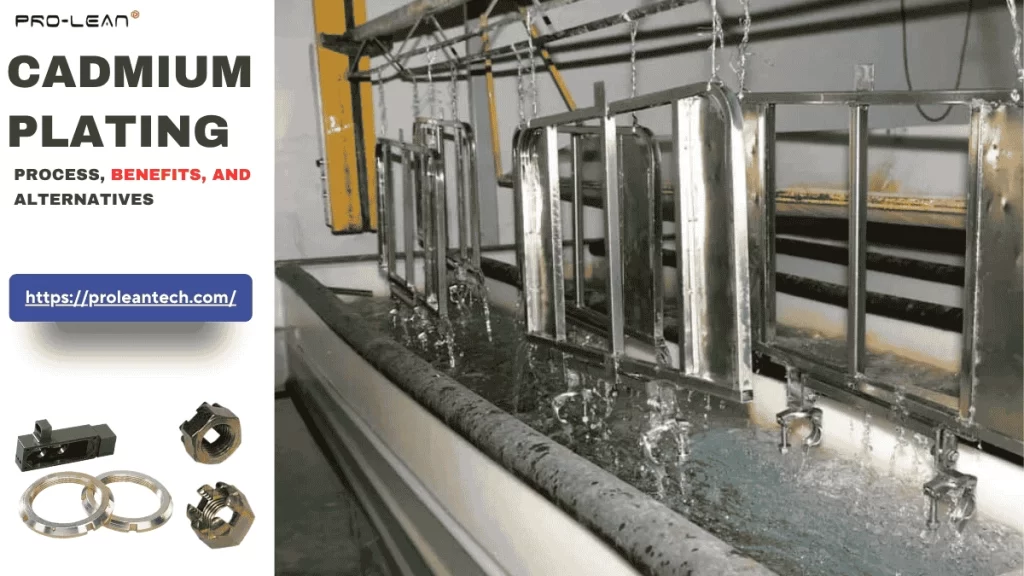
Cadmium plating
Cadmium plating deposits a thin coating layer on components requiring high lubricity, electrical conductivity, and corrosion resistance in harsh environments. It significantly enhances the performance & durability of aerospace, defense, naval, and electronic parts.
Cadmium is harmful to human health & enviroments and needs strict process control. For manufactureres, alumiplate, Zn-Ni, Tin-Zinc, and electroless nickel are the best alternatives.
Compared to other coating methods, cadmium plating is particularly useful for protecting underlying materials, such as steel, aluminum, cast iron, stainless steel, and copper.
It can maintain functionality and durability in high-moisture and humidity environments, alkaline conditions, saltwater, and elevated temperatures. Agencies like EPA and OSHA have strict rules regarding their handling and exposure limitations. At ProleanTech, we have multiple electroplating services as its alternatives.
Cadmium plating demands strict process control and precaution to avoid potential hazards. This article will guide you through the cadmium plating process, advantages, application examples, and What is cadmium plating used for.
What is Cadmium Plating?
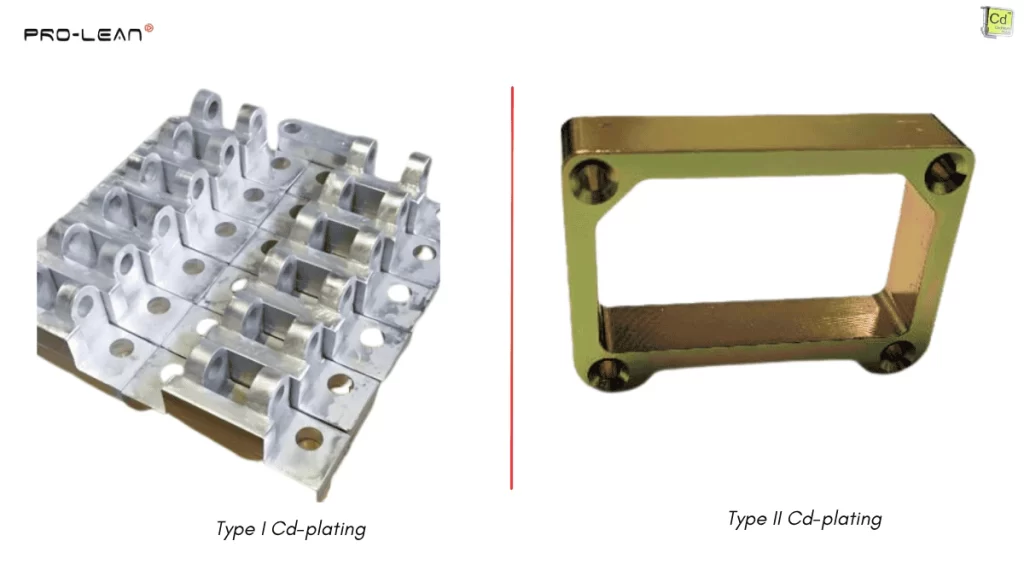
Type I and II Cd-coating
Cadmium plating is an electrochemical finish for manufactured components, where a sacrificial layer protects the underlying parts. Its white-silver finish with a slight blue tint looks similar to zinc plating, but is brighter and lustrous. Meanwhile, Cadmium with chromate conversion provides colors such as yellow and olive drab.
The thickness varies with the class type of cadmium plating:~ 12-25 µm for Class 1, ~ 5-12 µm for Class 2, and 2-5 µm for Class 3.
Cadmium-plated components exhibit superior corrosion resistance, ductility, electrical conductivity, and a low coefficient of friction. For instance, cadmium plating on steel outperforms other common alternative coatings, such as nickel and zinc.
Due to its impacts on human health and the environment, applications are limited to aircraft manufacturing and the defense industry.
- Type I Cadmium Plating: Pure cadmium plating without any other supplement, suitable where electrical conductivity matters.
- Type II Cadmium Plating: Cadmium plating with supplementary chromate film. It gives cadmium plating colors, such as clear, yellow, and olive drab.
Try Prolean Now!
What is Cadmium Plating Used For? The Applications
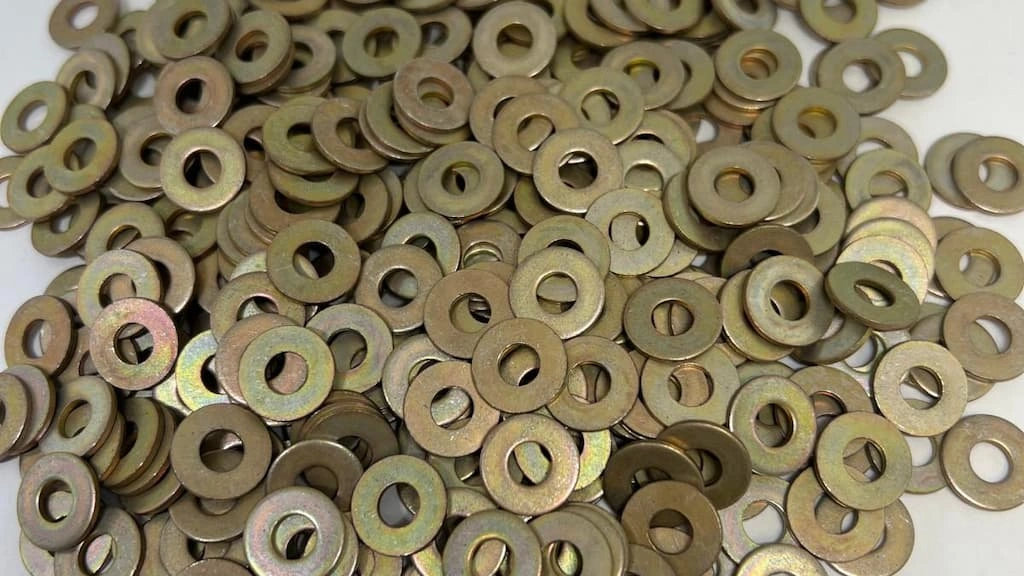
Cadmium-coated hardware
Cadmium plating is used for high corrosion resistance, lubricity, and conductivity in diverse aerospace and military components. Subsequently, it is the preferred choice for plating components exposed to cold and air-breathing conditions.
Since interaction with Cadmium coating harms human health, it is not used in consumer items or common industrial components. Instead, zinc, chrome, nickel, or other alternatives are coated on their surface.
Application Examples of Cadmium Plating
Aerospace Industry
Landing gear components, structural parts, fasteners, hydraulic system components, valves, and electrical-contact surfaces.
Military and Defense
Due to the high-performance benefits of cadmium plating, it is applied to rotor components for military helicopters, connector shells for electrical systems, custom hardware for missile systems, radar arrays, and military parachute buckles.
Marine
Only some naval applications use this finish due to strict regulations, not general shipbuilding & offshore systems. For instance, cadmium plating on steel fasteners, hull fittings, and propeller components.
Nuclear Energy
Reactor control rods (along with indium and silver) and carbon steel fasteners.
What Are the Benefits of Cadmium Plating?
Excellent corrosion resistance, natural lubricity, coating uniformity, electrical conductivity, solderability, substrate diversity, and abrasion resistance are the main benefits of cadmium plating.
Let’s shortly break down these benefits.
- Excellent Corrosion-Resistance: When you plate cadmium on steel, aluminum, and other compatible metals, it resists corrosion in saltwater, alkaline, cold, humid, and other harsh conditions.
- Natural Lubricity: Cadmium-plated surface provides natural lubricity and withstands high friction.
- Uniform Coating: The cadmium plating maintains uniform coating thickness and can be applied to parts with complex geometries.
- Adhesion: The cadmium surface is highly adhesive for painting/applying subsequent cadmium plating colors.
- Conductivity & solderability: The cadmium-plated surfaces enhance the electrical conductivity. Additionally, they are highly solderable.
- Substrate Compatibility: Cadmium can be plated on a wide range of metals and alloys, including steel alloys, stainless steels, aluminum alloys, and brass.
- Abrasion Resistance: Due to the sacrificial nature of the coating, the underlying parts remain untouched in case of abrasion & scratches.
- Galvanic Compatibility: Cadmium provides galvanic compatibility to steel and aluminum.
Cadmium Coating Process: Step-wise Workflow
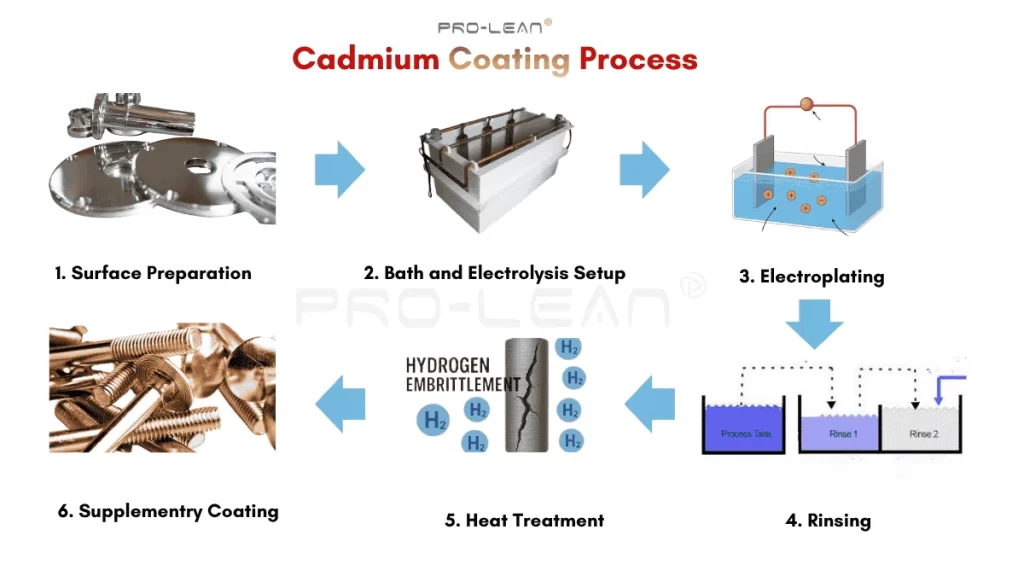
Cadmium plating steps
The cadmium plating process complies with the AMS-QQ-P-416 standard [1] and involves multiple steps, including surface preparation, process setup, electroplating, rinsing, embrittlement relief treatment, and supplementary coating.
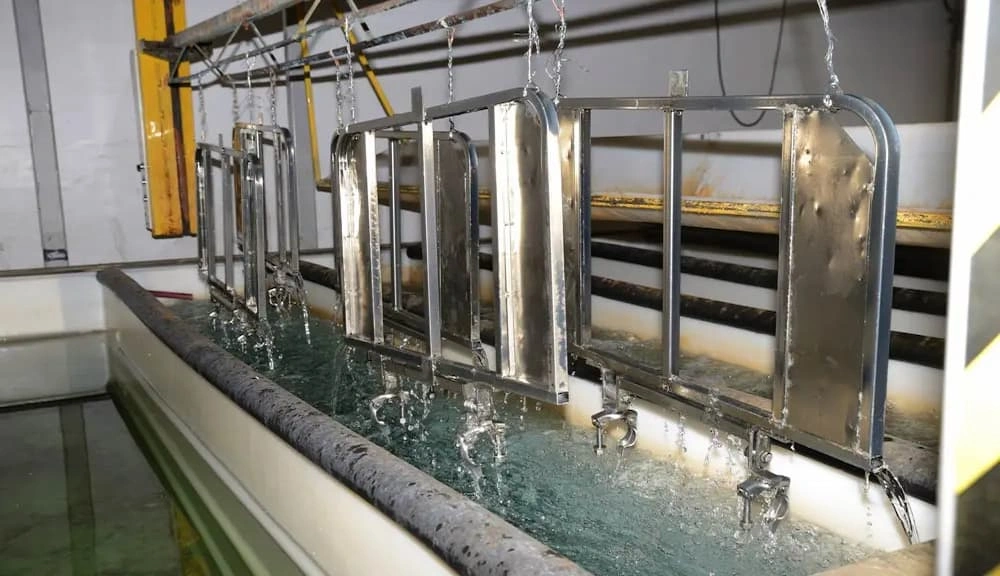
Cadmium plating process
Let’s further elaborate on the step-wise cadmium plating process.
- Surface Preparation: The process starts with stress-relief treatment (if the substrate is hardened). Then, the parts are thoroughly cleaned to remove dirt, oil, and other contaminants.
- Bath and Electrolysis Setup: Prepare the bath with the desired concentration of cadmium ions, process stabilizers, and additives. Then, immerse the cathode & anode in the bath container.
- Electroplating Process: Supply current through the circuit for a predetermined time period.
- Rinsing: Rinse the plated parts in warm water to remove process impurities from the surface.
- Embrittlement Relief: Especially, cadmium plating on steel parts is prone to hydrogen embrittlement, and the parts must undergo the relief process.
- Supplementary Coatings: For type II and III cadmium plating, perform chromate and phosphate treatment.
What Are the Cadmium Coating Alternatives?
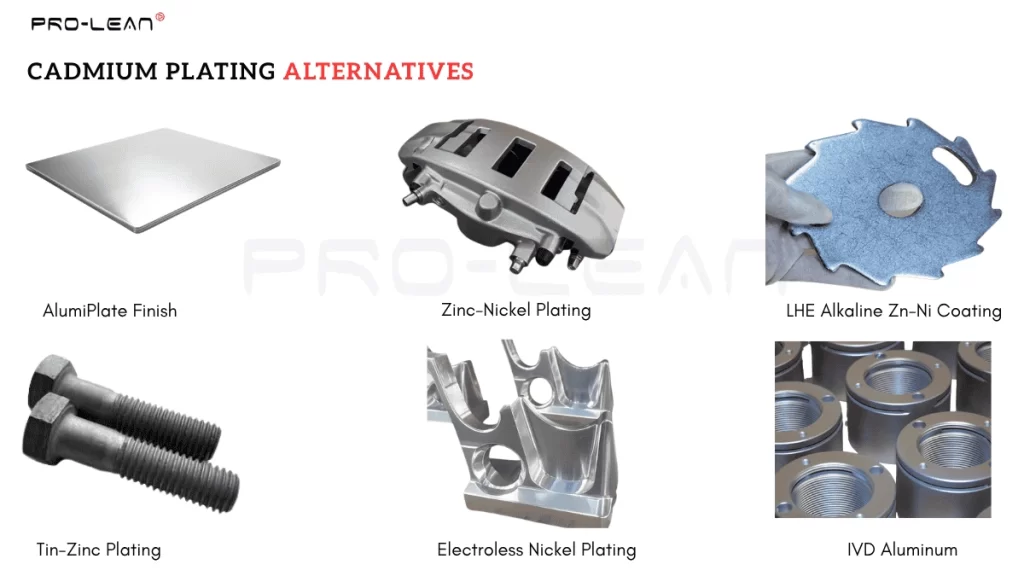
Cadmium plating alternatives
Due to strict regulatory requirements, AlumiPlate, Zinc-Nickel, LHE alkaline Zinc- Nickel, Tin-Zinc, Electroless Nickel, IVD aluminum, and other cadmium-plating alternatives are available in the industry.
However, these alternatives cannot provide properties identical to those of Cadmium. Let’s briefly discuss them.
1. AlumiPlate
AlumiPlate involves surface-coating parts with pure (~99.9%) aluminum. It is compatible with steels, stainless steels, aluminum alloys, and other metals. Subsequently, the alumiPlate finish follows MIL-DTL-83488B standards.
AlumiPlate is a good Cadmium alternative for coating aircraft landing gear parts, structural components, electrical connectors, etc.
2. Zinc-Nickel Plating
Zinc-Nickel is the closest alternative to cadmium coating in terms of functionality and performance. Comparing cadmium vs zinc plating, zinc alone is less effective, but plated parts resist corrosion in harsh conditions when the Zn-Ni combination is used in the coating layer.
The simultaneous co-deposition of Zn and Ni ions forms a thin protective layer (~10-15% Ni and ~85-90% Zn). Nickel provides a corrosion barrier, and zinc acts as a sacrificial protection. For aircraft fasteners and bushings, structural hardware, and many other components, it replaces Cadmium plating.
3. LHE Alkaline Zn-Ni Coating
Low Hydrogen Embrittlement(LHE)alkaline Zn-Ni coating is a specialized Zn-Ni coating that uses a modified alkaline solution for electroplating. So, corrosion resistance and ductility can be increased.
4. Tin-Zinc Plating
Tin-Zinc (Ti-Zn) plating provides higher corrosion protection than Cadmium, and good lubricity & conductivity. Meanwhile, the coating contains ~15-35% of zinc and ~65 to 85% of Tin.
This coating is used in automotive transmission components, fasteners, industrial machinery parts, and water supply systems.
5. Electroless Nickel Plating
Electroless nickel plating, as a cadmium alternative, is a good choice for parts requiring high corrosion protection and moderate to high lubricity. Subsequently, the lubricity can be enhanced by combining PTFE additives in electroless nickel coating.
It is used for the protective finishing of aircraft engine shafts, fastening hardware, and industrial mold tooling.
Chemical deposition of nickel ions is done by using reducing and complexing agents in a plating bath. Often, nickel is also combined with Teflon particles to enhance the coating performance, called electroless Ni-PTFE MIL-DTL-38999.
6. IVD Aluminum
IVD Al, or Iron Vapor Deposition Aluminum, is a suitable alternative for cadmium plating on steel components, especially in aerospace and defense. The process involves coating a thin aluminum layer on the substrate surface using a vacuum chamber.
Furthermore, IVD Al coating complies with MIL-DTL-83488 specifications.
Try Prolean Now!
What Are the Key Roles of Cadmium Plating in the Aerospace & Defense Industry?
The corrosion protection in extreme weather and harsh conditions makes cadmium plating an excellent surface coating choice in aerospace and military applications. Subsequently, it provides high electrical conductivity in such conditions.
The key roles of Cadmium plating in the aerospace and defense industry are:
- Corrosion resistance in harsh environments, including in elevated heights and seawater.
- Cadmium-plated parts withstand high and repetitive loads.
- Compared to the performance the plating provides, cadmium provides a lightweight benefit.
- The cadmium layer allows efficient current flow at elevated temperatures.
Is Cadmium Plating Still Desirable?
Cadmium plating is no longer desirable for general-purpose finishing. It is only allowed for use on certain critical aerospace and military-niche components. It is because most agencies worldwide have labeled it as a “hazardous metal”.
It is not useful for vacuum environments, produces harmful oxides & sulfides, requires a hazardous bath, and is not compatible with acids.
Is Cadmium Plating Banned in the US and Europe?
Cadmium plating is not fully banned in the US and Europe; it has exceptions for some aerospace and defense applications under strict regulations. Cadmium plating services were somewhat applicable in electronics & automotive until 2003, but later, REACH and RoHS heavily restricted their use in those industries.
Still, industries rely on cadmium plating services for finishing of high-performance aircraft and military applications. Some examples include landing gear parts, Naval hardware, mining equipment components, and military-grade fasteners.
At ProleanTech, we offer other types of metal plating as alternatives to Cadmium. Some of the options we have are electroless nickel, aluminum oxide, hard chromium, and zinc. The focus of our alternatives is to provide the protection your parts need to maintain the desired performance over time. You can contact us and talk to an industry engineer for further information.
Cadmium Plating Services for Aerospace and Defence
The role of cadmium plating services can be defined by the simple fact that the coating quality can directly cause the catastrophic failure of military systems and compromise aircraft safety. Therefore, companies and parts suppliers outsource the services from reliable and experienced OEMs.
Some parts examples include aircraft fasteners, landing gear hardware, electrical connectors for military systems, and armament & ordnance hardware.
Why Cadmium Plating Services are Choosen for Aerospace and Defence Parts?
- Cadmium plating gives superior corrosion resistance to aircraft & defence parts operated in high-friction, high altitude, and harsh environmental conditions.
- Coating on fastening hardware gives high rigidity and strength to assemblies.
- Outsourcing the services is cost-effective and hurdle-free, as you don’t need to worry about process hazards and regulatory compliance.
- Cadmium plating services offer flexibility for supplementary coatings such as chromate and phosphate films.
Cadmium vs Zinc Plating: Which Provides Superior Performance?
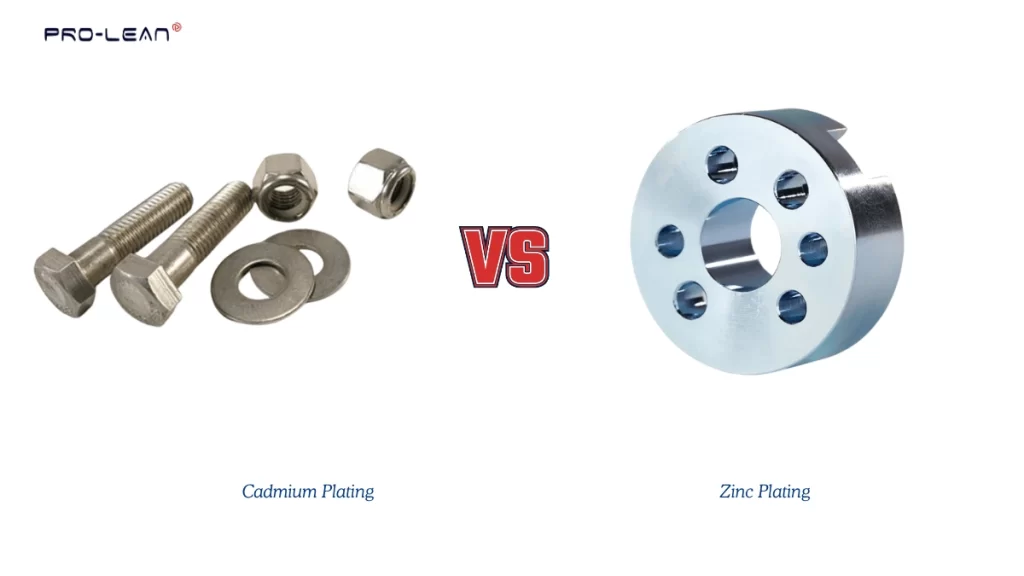
cadmium vs zinc plating
Cadmium outperforms Zinc plating in corrosion resistance, color retention, coating durability, and lubricity. Additionally, Cadmium has higher thermal stability and can withstand up to ~230 °C, whereas Zinc Coating can withstand only ~120 °C.
Let’s look at the comparison table of Cadmium vs Zinc Plating below.
| Aspect | Cadmium Plating | Zinc Plating |
| Cost | Higher due to strict process control and regulation compliance | Highly cost-effective, suitable for large volumes |
| Applications | Limited applications in aerospace, military, and Naval. | Diverse applications, including automotive, consumer electronics, construction, and aerospace. |
| Temperature Resistance | High, stable performance up to ~ 230°C. | Moderate resistance,~ 200°C. |
| Appearance | Silver white (type 1), yellow or olive drab (type 2, and retain the appearance for a longer time | loose color relatively faster than Cadium |
| Toxicity | Highly toxic and harmful to human health | Minimal toxicity and safer for industrial & consumer use. |
Try Prolean Now!
Summing Up
Cadmium plating provides superior corrosion resistance in extreme environmental conditions, such as high-friction, saltwater, moisture, and cold & windy conditions.
Although there are several benefits to finishing & post-treatment, cadmium plating services are limited to a few aerospace and military components due to adverse effects on human health & the environment. Therefore, alumiplate, Zn-Ni, LHE alkaline Zn-Ni, Tin-Zinc, and other coatings are used as alternatives in many cases.
If you are planning to outsource Cadmium or any other electroplating services, these are some critical factors to consider. Analyze the capability, equipment, safety protocol, compliance with industry standards, and related experience of the service provider.
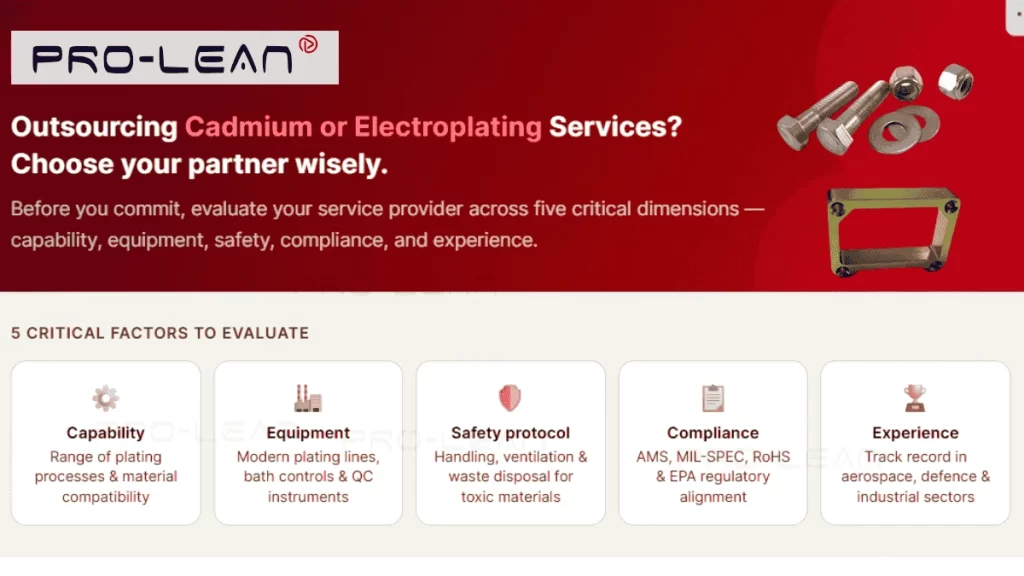
Cadmium plating services
Here are the quick points why ProleanTech can be a one-stop solution for your electroplating needs.
- Extensive Capabilities: 15+ plating solutions, including nickel, chrome, zinc, and aluminum oxide.
- Advanced Equipment: We have semi-automated and automated plating lines with accurate bath control systems.
- Safety Concerns: Process handling, waste disposal, and inventory management at our facility are in accordance with according to OSHA 29 CFR 1910 and other standards.
- Industry Compliance: Our manufacturing and finishing services are ISO 9001:2001 certified.
- Industry Experience: We have more than a decade of experience providing surface finishing services for automotive, aerospace, electronics, architecture, and other industries.
For any inquiry or an electroplating quote, upload your design file to our online platform today.
FAQs
Why is cadmium plating restricted?
Cadmium plating is restricted except for some specialized aerospace and defense applications beacause it is toxic to human health and the environment.
What are alternatives to cadmium plating?
AlumiPlate, Zinc-Nickel, LHE alkaline Zinc- Nickel, Tin-Zinc, Electroless Nickel, and IVD aluminum are the alternatives to cadmium-platin.
Is cadmium plating better than zinc?
Cadmium plating is better than zinc in terms of corrosion resistance, lubricity, galvanic compatibility with aluminum, and a few other aspects. But it is highly toxic and not safe for everyday use like zinc.
0 Comments