
Metal fabrication technology
Modern manufacturing and metal fabrication technology are intertwined. Fabrication techniques convert raw metal into functional items through processes such as cutting, forming, assembly, and finishing.
Advanced fabrication technology underlies many products across various industries, from cars to medical equipment. The merger of modern technology with conventional solutions produces an unbeatable metal fabrication strategy.
But what is fabricated metal? This is raw metal that has been subjected to fabrication methods to produce a functional part. The next sections unpack this technology, providing a briefing on the options, benefits, limitations, and applications, and other aspects.
What is the Meaning of Fabrication Technology?
Fabrication technology is the application of scientific knowledge and a range of equipment and machinery to produce parts and structures from raw metal materials. This technology uses a series of cutting, forming, joining, and finishing methods to achieve its goal.
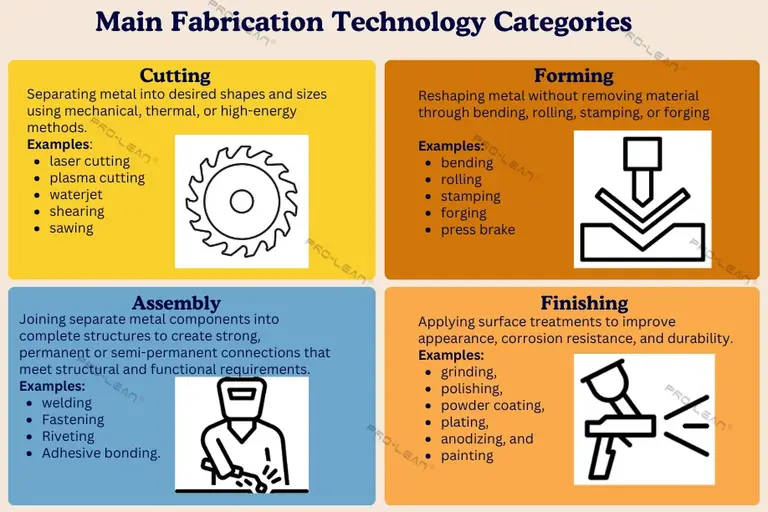
Metal fabrication technology categories
At the heart of it, fabrication techniques connect design ideas and real, physical products.
A Brief History of Metal Fabrication Technology
Metal fabrication technology has a rich history that dates back to the early days; archaeologists have unearthed metal tools dating back to the pre-9,000 BCE times. This time coincides with the discovery of copper, gold, and silver, which were widely used to make coins, jewelry, and tools.
Significant innovations occurred between the 15th and 18th centuries, culminating in the widespread application of hot rolling mills. From individual blacksmiths using copper, the technology has advanced significantly to the point where there are establishments worth billions.
What Does a Fabrication Tech Do? – Applications
Precision metal fabrication technology is highly valued for its ability to enhance customization, enabling rapid prototyping, consistent high-volume production, and repair of existing metal parts.
Part Customization
Metal fabrication technology effectively helps customize parts to the client’s requirements at different, unique levels. When standard parts are not a perfect fit for a project, this strategy helps achieve the project’s goals.
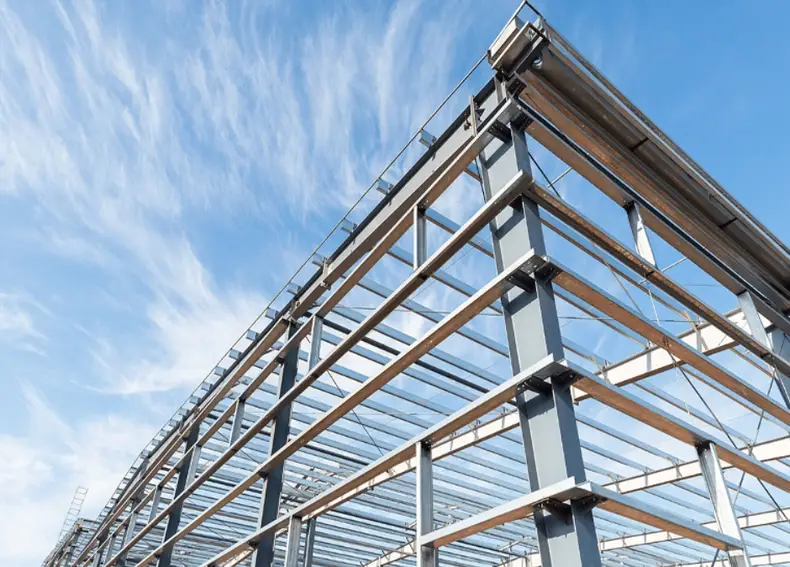
Custom metal-fabricated structure
In other words, advanced fabrication techniques are some of the best ways to differentiate products because of the difficulty of replicating them.
Creating Prototypes
Another critical function of advanced fabrication tech is to produce functional prototypes to test performance and manufacturability. With sheet metal drawing and other dependable fabrication techniques, the manufacturer avoids costly errors at the design stage.
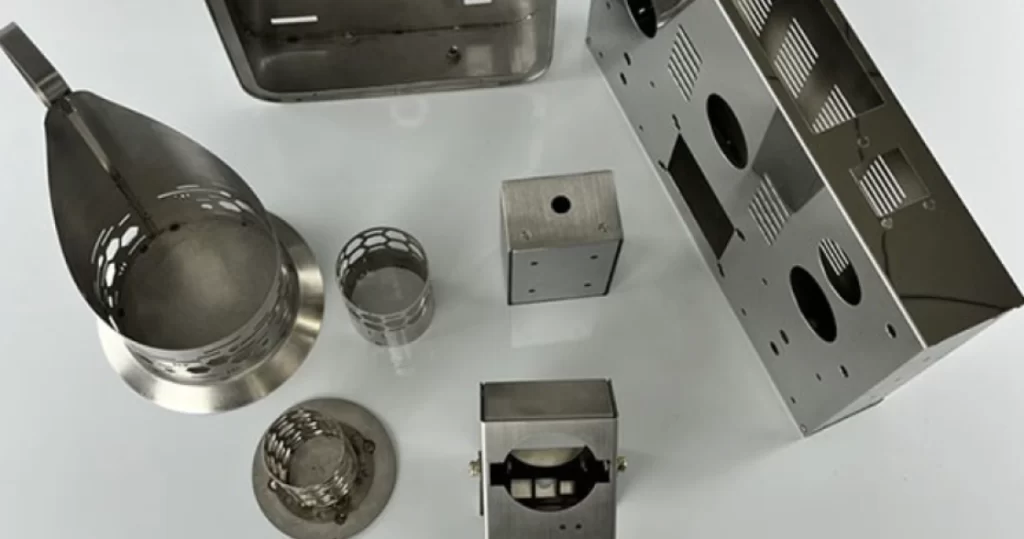
Sheet metal prototypes
The iteration is faster and the time-to-market shorter because the prototype is exposed to real-world environment testing.
Consistent High-volume Production
Provided a design has been validated, it is easy to produce thousands of them with metal fabrication technology, without loss of accuracy or consistency. The technology is crucial in meeting industry standards and regulatory requirements.
Repairing and Modifying Components
The role of sheet metal processing extends to repairs and modifications, a capability that can save costs by enhancing equipment life.
Benefits of Metal Fabrication Technology
The functions above lead us to the benefits of fabrication technology, which include precision, repeatability, scalability, and efficiency. By also allowing for fast design iteration, the technology enhances competitiveness and profitability.
Precision
With tolerances as tight as thousandths of an inch, advanced fabrication technology ensures that parts always fit and function as expected. The manufacturer doesn’t have to rework, and valuable lead time is not lost on the client’s side.
Repeatability
The metal fabrication method only requires a programmed design, and the work can be reproduced repeatedly with the same quality level. A manufacturer like ProleanTech finds this technology valuable because it enables the maintenance of high manufacturing standards.
Scalability
Whether you need prototypes or full-scale manufactured parts, fabrication technology can serve both levels with comparable quality. The manufacturer can help you test a product in small batches, then scale up production to serve the ready market.
Efficiency
Automated metal fabrication requires very minimal supervision, significantly reducing operational costs. For processes that incorporate nesting software, the savings from reduced material wastage are remarkable.
Limitations of Fabrication Technology
Fabrication technology has some limitations related to part geometry, lead times, material compatibility, and setup costs (for low production runs). Considering these limitations helps when choosing a specific metal fabrication method for projects.
Part Geometry Limitation
Some fabrication methods, for instance, laser cutting, can struggle with complex geometries. Fortunately, there’s often a technique more suitable for a task than another one.
Longer Lead Times
Custom fabrication projects require custom approaches for tooling and programming, which can sometimes delay rush orders. This is where clear communication between the provider and client is critical.
Material Compatibility
Each project must consider the relevance and suitability of the material. Some materials are too soft or hard for certain processes. The metal cutting methods and other processing methods can differ significantly from one material to another.
Setup Costs
The need for investment every time there is a change in tooling, equipment configuration, or CNC programming can be exhausting. For smaller production runs, such expenses can be uneconomical.
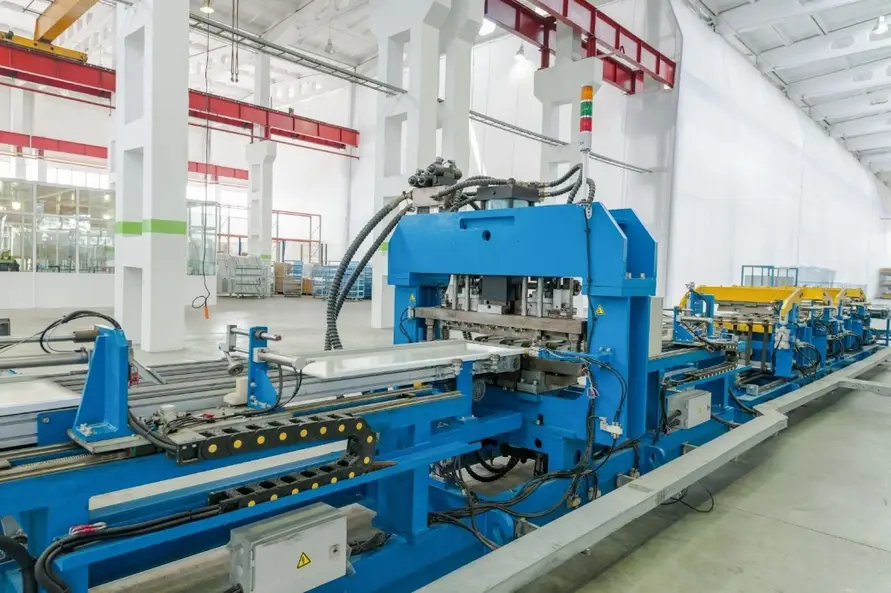
Metal fabrication setup
Try Prolean Now!
Different Options for Fabrication Technology
There are three fundamental categories of fabrication technology: Subtractive manufacturing, additive manufacturing, and cast metal technology. Subtractive manufacturing removes material through processes such as cutting, drilling, and milling. Additive manufacturing builds parts layer by layer. Cast metal technology transforms raw metal through melting and solidification to produce complex parts.
A detailed review of these categories follows below.
Subtractive Manufacturing
Subtractive manufacturing is characterized by the removal of material from an original block or piece to attain the final shape and form. The main subcategories of subtractive manufacturing are CNC machining and sheet metal fabrication.
Computer Numerical Control (CNC) Machining
The tools and machinery in CNC machining are computer-controlled, ensuring accurate and precise material removal from the workpiece.
This advanced fabrication technology follows the following basic steps:
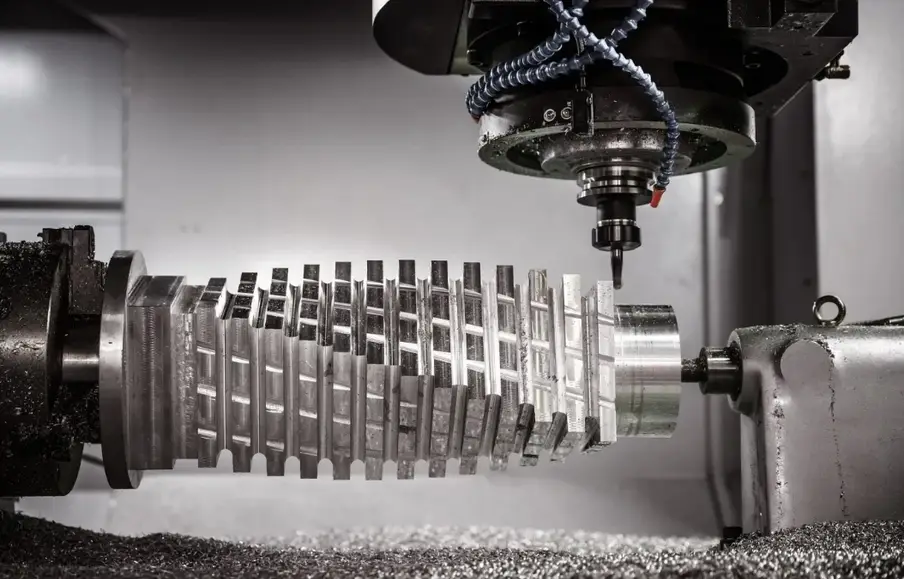
CNC milling
- Part Design and CNC Programming: The design engineer utilizes Computer-aided design (CAD) software to generate a 3-D model of the part. Using CAM software, the digital design is engaged with the CNC machine for the manufacturing process.
- Material Setup: The next step is to select the appropriate CNC machining material and set it on the CNC machine.
- Cutting Tool Setup: Similarly, the machinist selects the appropriate tool type depending on the workpiece material and sets it on the CNC machine. Tool calibration is particularly critical to ensure the suitable depth of cut and machining precision, devoid of defects.
- CNC Machining: The CNC turning machine, milling machine, drilling machine, or any other, follows the instructions from the CNC program to machine the workpiece.
- Post-Processing: The CNC-machined part will often require post-processing to remove burrs, attain the final dimensional accuracy, and enhance aesthetics. Options include powder coating and polishing.
Benefits of CNC Machining
- Accuracy and repeatability
- Ideal for producing complex parts
- High material versatility
- A wide range of surface finishes
Limitations of CNC Machining
- CNC machinery is expensive to set up and run
- The methods produce a relatively high amount of scrap
Sheet Metal Fabrication
Sheet metal fabrication services are effective in producing 3-dimensional parts of varying complexity from sheet metal. This fabrication technology entails the following steps:
- Part Design: The desired sheet metal fabricated part is designed, and the design is fed to the relevant machine. The designer specifies bends, cutouts, and dimensions.
- Material and Tooling Preparation: This involves choosing the metal type and thickness
- Sheet Metal Cutting: The sheet metal is cut into the designed shapes and sizes, ready for the next manufacturing steps.
- Folding/Bending: The designed shapes and angles for the part are achieved by bending or folding the sheet metal parts along the bend lines.
- Assembly and Joining: This step helps produce the final shape and form of the sheet metal fabrication part. Different parts are joined using techniques such as riveting, bolting, nuts, and welding.
- Finishing: Finally, the assembled components are given the final touches through painting, powder coating, and other methods.
Benefits of Sheet Metal Fabrication
- Produces parts with a high strength-to-weight ratio
- Cost-effective in volume manufacturing
- High material versatility
- Relatively quick process
Limitations of sheet metal fabrication
- Fabricated metal parts are limited to about 0.006″ to 0.25″ thickness
- Custom fabrication techniques require expensive tooling
- Inability to produce complex 3-D parts
Additive Manufacturing
Additive manufacturing is a layer-by-layer formation of metal parts according to a 3D design. It is typically available as 3D printing for metals.
The benefits of additive manufacturing are:
- Lightweight parts
- Minimal material waste
- Allows for rapid prototyping
- Enhanced design versatility
- Ideal for on-demand manufacturing
The limitations of additive manufacturing for metals are:
- Slow manufacturing speed
- Residual stresses, inconsistent microstructures, and related problems
- High initial investment for equipment
3D Printing for Metals
Metal 3D printing fuses layers of metal powder using technologies such as electron beam melting (EBM) and direct metal laser sintering (DMLS). The complexity and reliability of the resulting parts are valuable in aerospace and medical industries, among other areas.
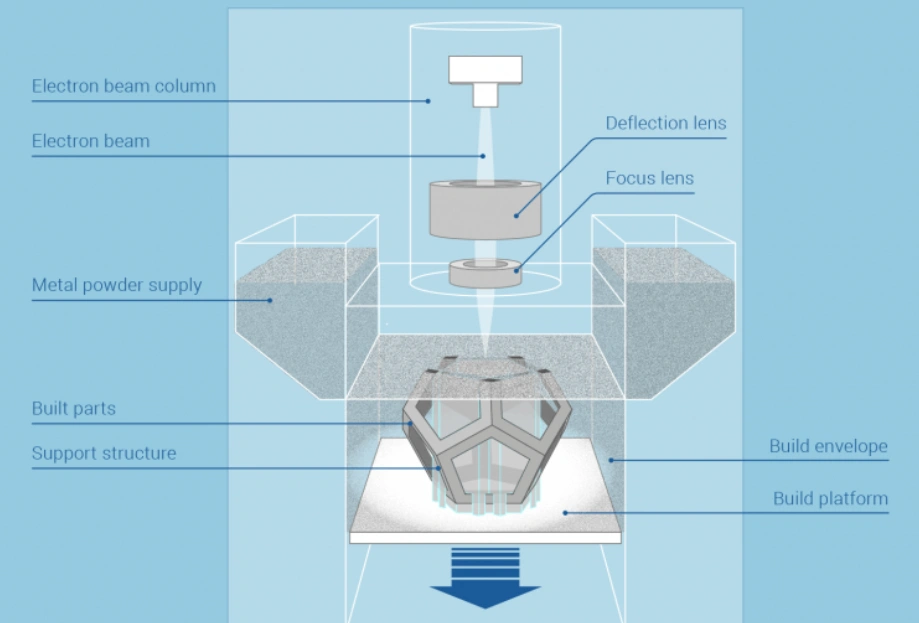
The EBM process diagram
Cast Metal Technology
Cast metal technology involves filling molds with molten metal to produce 3-D parts. The desired part’s geometry is placed in the mold and is transferred to the finished, solidified part.
Benefits of Cast Metal Technology
- Cost-effective
- Material versatility
- Good dimensional accuracy
- Relatively fast
Limitations of Cast Metal Technology
- Molds can be expensive
- Possibility of casting defects
- Challenging working environment
Try Prolean Now!
The Developments of Fabrication Technology
Fabrication technology is constantly changing, with AI-oriented optimization and hybrid setups looking to be where the future is headed. Most innovations aim to address the need for faster turnaround, increased design capabilities, and tighter tolerances.
Here are some of these growing trends.
Advanced CNC Machining
CNC machining technology is continually advancing, making a lasting impact on the entire fabrication technology industry. Request a quote and discover how 5-axis CNC machines and other systems can achieve remarkable precision levels, which are required in sectors such as medical and aerospace.
The emergence of hybrid CNC machines is noteworthy. This technological milestone enables the manufacture of components in a single setup by combining additive manufacturing and conventional machining.
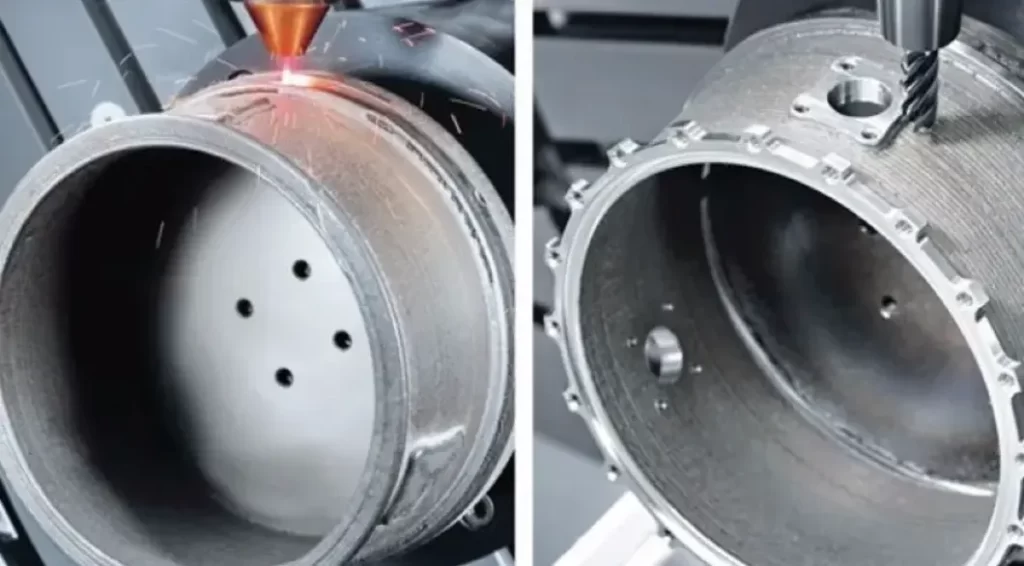
Hybrid manufacturing
The speeds in CNC machining have also increased significantly. These machines are now capable of processing materials at a substantially faster rate than a few decades ago.
Further review of these developments in this space reveals that the CNC machines are also more versatile today compared to those of yesteryears. With powerful computer control, these machines can handle complex designs faster and more reliably.
Better Welding Methods
Welding technology has also advanced with notable advancements, including laser welding and friction stir welding. Manufacturers are fond of laser welding for its accuracy and repeatability.
Friction stir welding uses friction-based heat and pressure to produce robust welds without melting the base metal. Unlike conventional fusion welding, this technique minimizes residual stresses and weld defects.
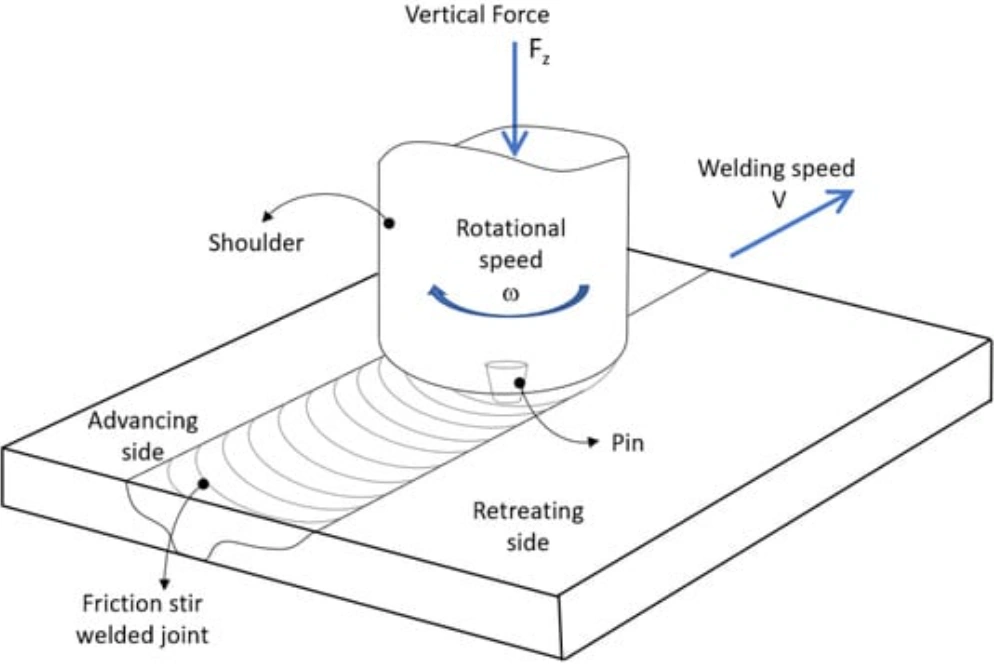
Friction stir welding
Specialized Materials
The developments of specialized materials have further expanded the capabilities of metal fabrication techniques. To meet the demand for high-performance materials in various industries, manufacturers are now utilizing a range of specialized composites and alloys. The most common materials are highly reliable and durable carbon-fiber-reinforced composites, titanium alloys, and Inconel (nickel-based superalloy).
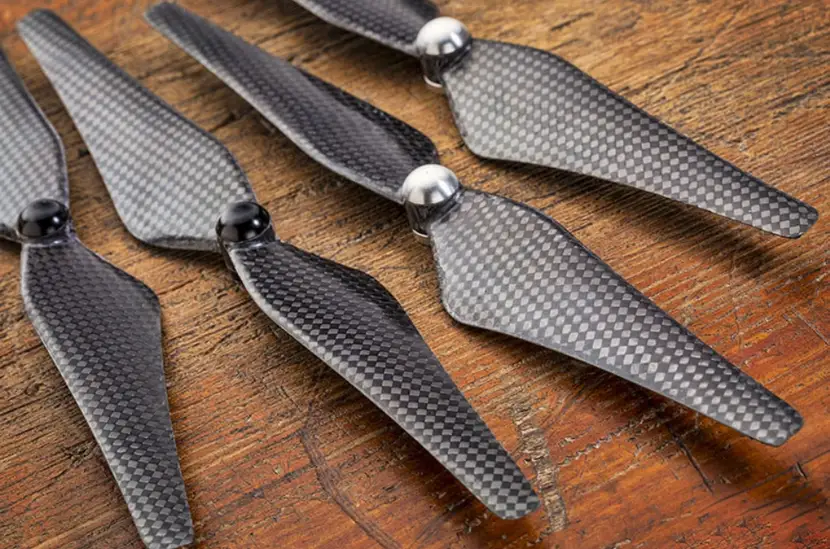
Carbon-fiber-reinforced composite parts
Improved alloys provide enhanced mechanical properties, including higher heat resistance and tensile strength. The availability of alloys with a higher strength-to-weight ratio has been particularly instrumental in the success of metal fabrication. For composite materials, advancement is mainly towards finding a perfect balance of different properties, including conductivity, weight, and strength.
These are just some of the trends shaping the metal fabrication space. Innovators and researchers are continually looking for even greater improvements, the goal being to find lasting solutions to persistent challenges in the industry. With these approaches, the technology is even more appealing.
In Conclusion
Sheet metal fabrication techniques bridge innovation with practical solutions, resulting in products for various industries. From conventional sheet clipping to AI-driven machinery, the space is very versatile.
For a business seeking precise and reliable sheet metal fabrication solutions, ProleanTech is on hand to convert your ideas into tangible components and systems. Check out our sheet metal fabrication capabilities and talk to our experts today.
0 Comments