

“Imagine a process where metal flows like a river into forms that strength and design dictate; that’s aluminum extrusion. It is a combination of force and finesse, creating diverse structures that support our daily lives.”
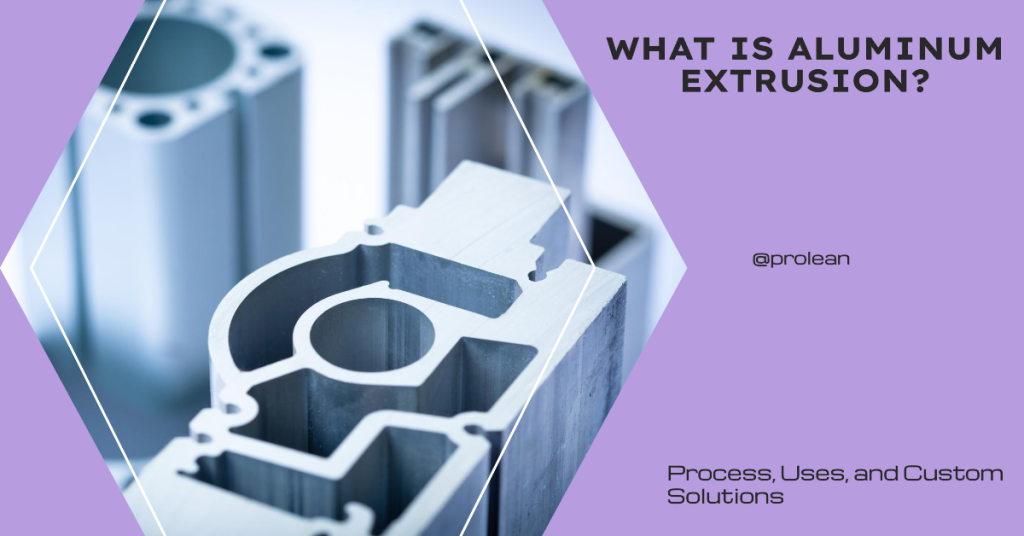
Do you have ever noticed the intricate shapes of heat sinks and how they are made? The answer is the aluminum extrusion process. It creates heatsinks, automotive parts, aircraft components, and other various applications. But, what is aluminum extrusion? It is a manufacturing process used to create objects with a specific cross-sectional profile by pushing a heated aluminum billet through an opening die.
Here, this technique leverages the malleable properties of aluminum into complex and intricate shapes. Once the aluminum passes through the die, it emerges on the other side as an elongated piece with the cross-sectional shape of the die opening.
This article will cover various aspects of aluminum extrusion, including detailed processes, advantages, applications, and extrusion die.
What is Aluminum Extrusion?
Aluminum extrusion is a manufacturing technique used to shape aluminum into profiles with specific cross-sectional designs. This process involves heating aluminum billets until they are malleable. Then, manufacturers force the soft metal through a die shaped in the profile’s desired cross-section. As a result, aluminum extrusions emerge in various complex shapes.
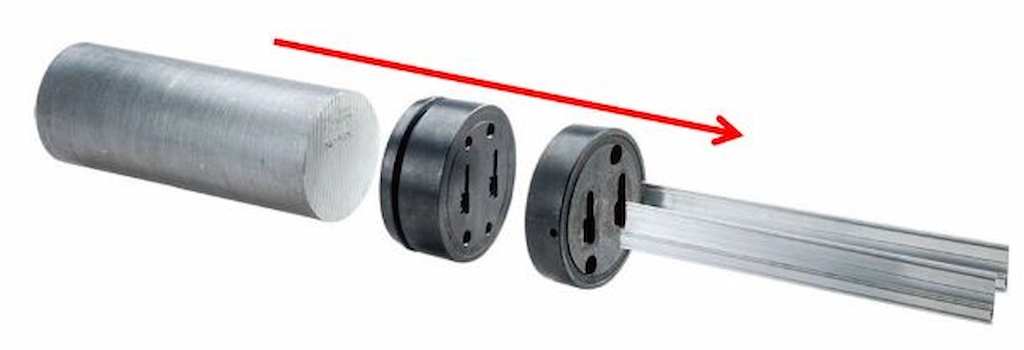
Aluminum extrusion mechanism
Furthermore, this method capitalizes on aluminum’s excellent malleability and strength-to-weight ratio. So, it allows for the production of intricate and tailored designs with high precision and minimal waste. Additionally, the applications of aluminum extrusion span numerous industries, showcasing its versatility. It ranges from automotive and aerospace to consumer goods.
Moreover, it provides an eco-friendly manufacturing solution, as aluminum is both abundant and recyclable. The process allows for high-volume production with consistent quality, which is essential in industries where precision and reliability are paramount. Meanwhile, the ability to customize shapes also enables innovation.
Related: Aluminium Extrusion Explained: Tooling, Process, and Applications
Try Prolean Now!
How Aluminum Extrusion Process Work?
Aluminum extrusion starts by heating aluminum until it becomes malleable, then pressing it through a die that shapes it into the desired profile. The strength, flexibility, and lightweight nature of aluminum make it ideal for this process. So, it enables the production of complex shapes that are both strong and lightweight.
This method is highly efficient, producing minimal waste while allowing for a wide range of shapes and sizes, making it perfect for creating custom profiles tailored to specific applications.
Preparing the Aluminum
This initial step involves heating the aluminum billet to the pre-determined temperature that makes it pliable and ready for molding. The temperature is typically 400°C to 500°C.
This precise heating ensures that the aluminum does not melt but becomes soft enough to be shaped through extrusion. It’s a delicate balance that prepares the metal for its transformation, ensuring it can flow smoothly through the die without resistance.
Loading into Billet
After heating, the billet’s placement into the extrusion press begins its transformation. This step is more than just positioning; it’s about readying the aluminum for a significant change. Now, the billet is heated & malleable and sits poised at the press’s entrance, on the brink of becoming something new.
The Extrusion Press
At this stage, the extrusion press exerts a formidable force on the billet, driving it through the die. This pressure is immense, reshaping the aluminum as it moves through the die’s intricately designed opening. The process involves pushing the billet through a mold or die.
Exiting the Die
As the aluminum exits the die, it encounters a critical cooling phase. This step is vital for “setting” the profile into its intended shape. Here, the coupled cooling control affects the mechanical properties, surface finish, and overall integrity.
Quenching
Quenching refers to the rapid cooling process applied to the aluminum immediately after extrusion. This step hardens the aluminum by immediately cooling it with air or water. Consequently, the quenching process locks in the profile’s shape and prepares it for the subsequent stages of production. It’s critical because it influences the aluminum’s structural integrity and mechanical properties of extruded parts.
Stretching
Post-quenching, the profiles may exhibit slight bends or internal stresses. Stretching is the corrective measure, pulling the profiles until they are perfectly straight and aligned. This process also enhances the material’s strength by aligning its internal crystal structure. Stretching ensures that the extruded profiles are not only aesthetically pleasing but also meet the rigorous standards required for their intended applications.
Cutting
This step is about tailoring the extrusions to fit specific needs. It’s a crucial phase where the profiles are cut with precision. So, they can perfectly match the project requirements.
Surface finishing
The final step in the process involves applying various finishes to the extruded profiles. Techniques like anodizing, painting, or powder coating protect the parts and enhance their aesthetic appeal. These finishes add a layer of corrosion resistance and increase surface hardness. Moreover, finishing is the touch that makes the profiles ready for a multitude of applications.
What is Custom Aluminum Extrusion?
Unlike standard extrusion processes that produce generic shapes and sizes, custom extrusion allows for unique profiles designed to fit precise specifications. This process begins with the design of a custom die. The die shapes the aluminum as it is pushed through under high pressure.
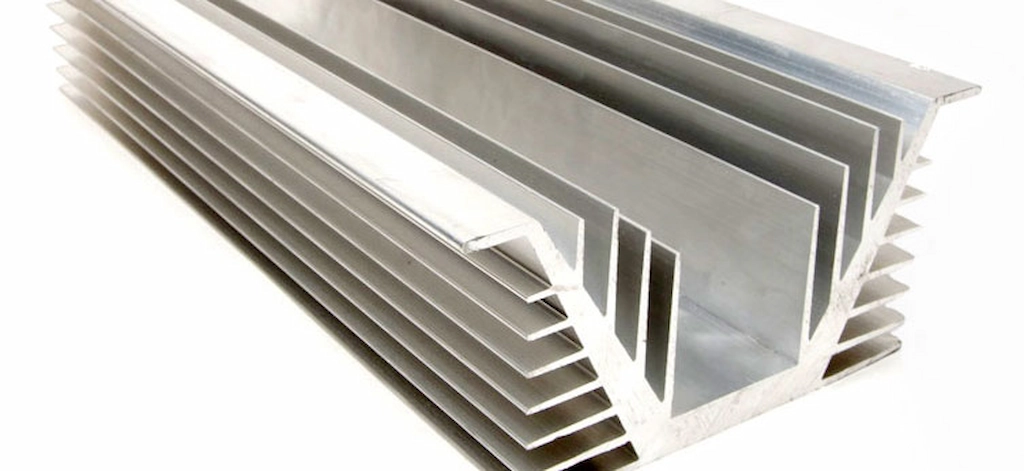
Custom aluminum extrusion part
In this context, custom aluminum extrusion manufacturers in China provide flexibility to create endless shapes and features with design optimization. This custom approach to manufacturing is particularly valuable in sectors where standard profiles cannot meet the unique demands of complex projects. Furthermore, the process caters to the exacting needs of industries such as aerospace, automotive, construction, and electronics.
Benefits of Custom Aluminum Extrusion:
- Tailored Designs: Create profiles that match specific design requirements, avoiding the limitations of standard shapes.
- Efficient Production: Minimize material waste and reduce production time by manufacturing parts that fit precise needs.
- Enhanced Performance: Achieve superior mechanical properties tailored to specific applications, enhancing product durability and functionality.
- Cost Savings: Reduce machining and fabrication costs by producing near-net shapes that require minimal finishing.
- Innovative Solutions: Enable the development of innovative products and components by overcoming design constraints of standard extrusions.
What are the Advantages of Aluminum Extrusion?
It is a highly efficient manufacturing process that transforms aluminum alloy into diverse shapes and profiles. This method leverages the unique properties of aluminum, including its malleability, strength, and lightweight to functional shapes.
Advantages of Aluminum Extrusion:
- Versatility in Design: Extrusion allows for intricate shapes and profiles, meeting diverse design requirements.
- High Strength-to-Weight Ratio: Produces lightweight components without compromising strength, suitable for various applications.
- Cost-Effectiveness: Reduces material waste and lowers production costs, offering an economical solution for manufacturing.
- Durability: Ensures products are corrosion-resistant, extending their lifespan in challenging environments.
- Efficiency: Aluminum extrusion streamlines production processes and enables quick turnaround times.
- Eco-Friendly: Utilizes recyclable materials, contributing to sustainable manufacturing practices.
- Precision: Achieves high dimensional accuracy, minimizing the need for further machining.
Try Prolean Now!
Applications of Aluminum Extrusion
The aluminum extrusion is renowned for its versatility and efficiency across many industries. The reason is its capacity to meet specific engineering and design requirements. Moreover, it contributes to both the aesthetic appeal and functional integrity of final products.
Table: Applications of Aluminum Extrusion Across Industries
| Industry | Applications |
| Construction | Window frames, door frames, curtain walls, roofing |
| Automotive | Chassis components, roof racks, body panels |
| Electronics | Heat sinks, enclosures, frames for solar panels |
| Aerospace | Structural components, fuselage frames, seat tracks |
| Consumer Goods | Furniture frames, appliances, sports equipment |
| Infrastructure | Bridge railings, sign supports, lighting poles |
Related: CNC Machining Heat Sink VS Aluminum Extrusion
What is an Aluminum Extrusion Die?
An aluminum extrusion die is a tool that shapes molten aluminum into profiles with specific cross-sectional designs. This die is crucial for the precision and efficiency of extrusion. Hence, heated aluminum adopts the die’s shape when aluminum is pressed through this die at high temperatures. This process relies on the die’s precision to produce profiles that meet specific tolerances and dimensions, making the die’s design and fabrication critical to the success of the extrusion process.
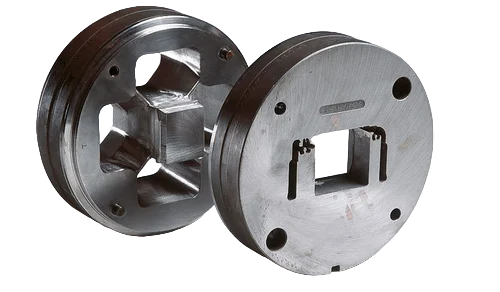
Semi-hollow aluminum extrusion dies
The common materials for aluminum extrusion dies are hot-work tool steel, high-speed steel, and tungsten carbide. Additionally, you can click here if you want to learn more about different aluminum extrusion die types.
The Components of an Aluminum Extrusion Die
The main components of an aluminum extrusion die include the die proper (or die insert), the backer, and the bolster. The following table describes these components in brief;
Table: Aluminum Extrusion Die Components
| Component | Location | Description | Function |
| Die Proper (or Die Insert) | Inside the die assembly | The part of the die that contains the exact profile shape to be extruded. | It directly shapes the extruded aluminum. |
| Backer | Behind the die proper | A supportive plate that backs the die properly. | Absorbs the pressures and stresses of extrusion to protect the die. |
| Bolster | Behind the backer | A thick plate that supports the backer and dies properly. | It provides additional support and stability to the die assembly and ensures proper alignment within the extrusion press. |
The Die-Making Process
The die-making process for aluminum extrusion begins with the design phase. Here, engineers create a detailed blueprint of the desired profile. Computer-aided design (CAD) software can plan the die’s shape, accounting for factors like aluminum flow and cooling rates. The next step involves selecting the appropriate tool steel, which is then cut and machined into the rough shape of the die.
Machining involves detailed work to shape the die’s cavity to precise dimensions. Advanced techniques like wire electrical discharge machining (EDM) and computer numerical control CNC machining is common. Meanwhile, these methods create complex and intricate shapes with high precision.
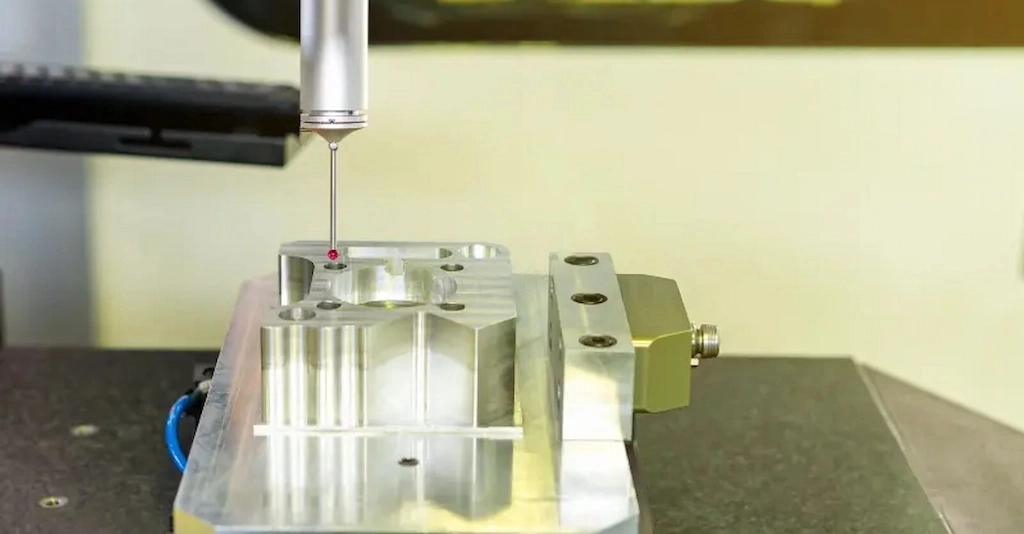
Aluminum extrusion die machining with EDM
After machining, the die undergoes heat treatment to enhance its durability and resistance to wear during extrusion. Next, aluminum extrusion die polishing ensures a smooth surface, minimizing friction and assisting in the easy flow of aluminum through the die during the extrusion process.
Aluminum Extrusion Die Design Tips
The die design directly influences the quality, efficiency, and cost-effectiveness of the production process. A well-designed die ensures the production of aluminum profiles that meet precise specifications and minimize material wastage. You can achieve consistent quality across batches and reduce production times by optimizing the die design.
Here are the tips to optimize your aluminum extrusion die design;
1. Simplify the Profile Design
A simple profile design can significantly enhance the manufacturability and strength of the extruded part. When die design becomes simpler, it reduces the risk of defects like warping or twisting. Additionally, it improves the structural integrity of extruded parts and speeds up the process.
2. Ensure Uniform Wall Thickness
Uniform wall thickness promotes consistent cooling and solidification of the extruded profile. It reduces issues like internal stresses and distortions.
3. Incorporate Radii and Fillets
Adding radii and fillets to corners can reduce stress concentrations and enhance the flow of aluminum through the die. For example, automotive bumper profiles that incorporate smooth radii and fillets. So, it exhibits better aesthetic qualities and adds resistance to impact due to the even distribution of stress across the profile.
4. Optimize Die Opening
The design of the die opening should facilitate optimal aluminum flow, ensuring quality and reducing the likelihood of defects. Account for Material Shrinkage
Die design must consider the shrinkage of aluminum as it cools, to ensure the final product meets dimensional tolerances. For instance, the vacuum casting of precision components like aerospace fasteners accounts for material shrinkage in the die design.
5. Facilitate Easy Ejection and Handling
Design the die so it facilitates the easy ejection & handling of the extruded profile. It can significantly reduce cycle times and improve efficiency. For example, conveyor belt frames require a design with quick and easy ejection from the die. So, it can minimize downtime and maximize production throughput.
Aluminum Extrusion Services at ProleanTech
ProleanTech specializes in transforming your ideas into reality, offering custom aluminum extrusion services that cater to diverse industries. We ensure precision and quality whether you require intricate profiles for electronics or robust components for automotive.
Our process is designed to meet your specific needs, from design consultation to the final extruded product. We invite you to take the first step towards innovative manufacturing solutions by uploading your design to ProleanTech.
Read more:
Try Prolean Now!
Summing Up
Overall, aluminum extrusion offers unparalleled versatility, efficiency, and sustainability. Its applications span across various industries, providing solutions that are both innovative and practical. Furthermore, you can leverage the potential or choose the best service provider by understanding what is aluminum extrusion. If you still need further information, do not hesitate to contact us.
FAQs
What is aluminum extrusion used for?
Aluminum extrusion is used in various industries, including automotive, construction, aerospace, and electronics, for applications ranging from structural components to intricate design features.
How does the aluminum extrusion process work?
The process involves heating aluminum billets and forcing them through a die to create profiles with specific cross-sectional shapes, followed by cooling, cutting, and finishing.
What are the benefits of using aluminum extrusions?
Benefits include a high strength-to-weight ratio, corrosion resistance, design flexibility, and environmental sustainability due to recyclability.
Can aluminum extrusions be customized?
Yes! Custom aluminum extrusions can be designed and manufactured to meet specific requirements, offering unique solutions beyond standard profiles.
How are aluminum extrusions finished?
Finishing options include anodizing, painting, and powder coating, each providing additional protection and aesthetic appeal.
What factors should be considered when designing for aluminum extrusion?
Design considerations include the choice of alloy, profile design, tolerances, and the intended finishing process.
Resource
Saha, P. (2000). Aluminum Extrusion Technology. ASM International. Retrieved from https://doi.org/10.31399/asm.tb.aet.9781627083362
0 Comments