
When you are going to choose between CNC routing and CNC milling, the core difference lies in their work precision and material capability. Routers are suitable for large-format works on soft metals like aluminium, brass and high-efficiency cutting of woods and plastics, while mills are best adapted to hard, rigid materials like steel and titanium. The decision to choose the best option for your project depends on the number of aspects, like which material is to be used, the final design and shape, overall budget, and the industry type.
Before discussing the differentiating aspects in CNC routers vs mill, a major similarity is that they operate by using a computer numeric control (CNC) system in which machines are controlled by digital instructions given by engineers in the form of G-code. A CNC mill is used for CNC custom milling projects and is commonly used for precision metal parts, while CNC routers are widely used in large panel work. Both are used to create prototypes.
In this comparison guide, we will discuss differences in detail so you may know which one is your right go-to option.
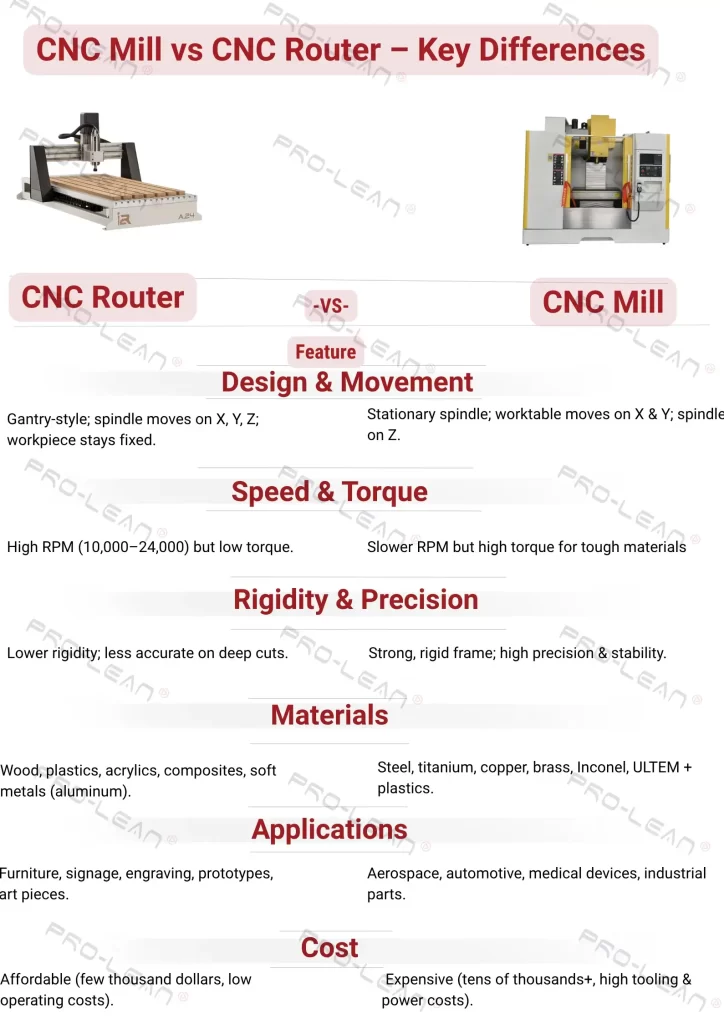
CNC Mill Vs CNC Router
What is a CNC Router Machine?
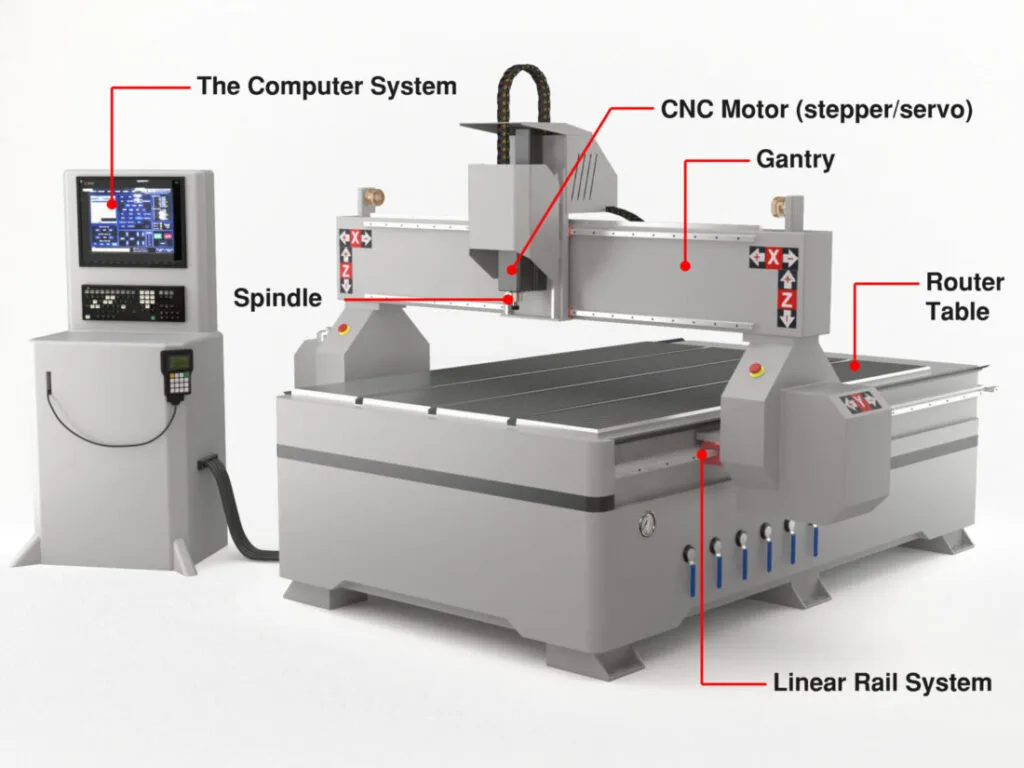
CNC Router Machine
A CNC router is a computer-controlled machine. It is used to automatically cut, give shapes, and engrave materials such as wood, plastic, and soft metals, using the subtractive manufacturing method.
It uses CAD (computer-aided design) and CAM (computer-aided manufacturing) software to pick the digital instructions and create precise designs with minimal human involvement. CNC routing creates wide industrial products like plastic prototypes, trademark signs, and art pieces.
What is a CNC Mill?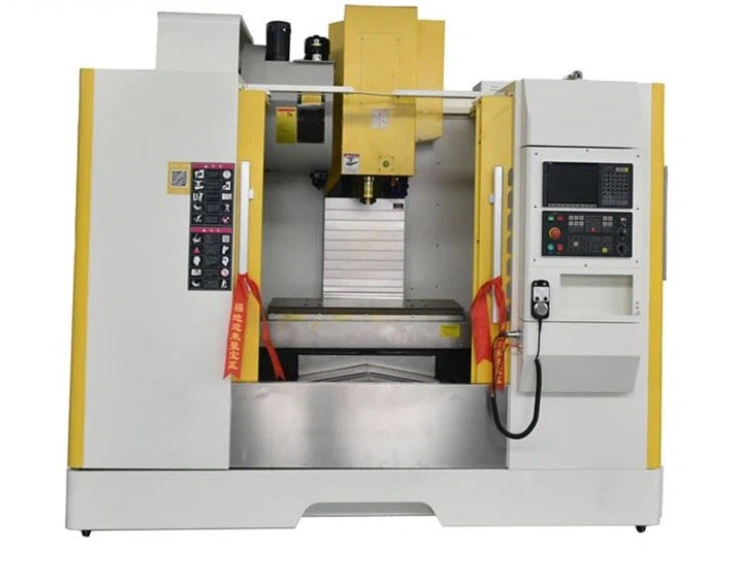
CNC Milling Machine
A CNC mill is a subtractive manufacturing method in which products are designed by removing excess material in order to achieve the desired shape. It is used to precisely cut, shape, and drill the solid parts.
Milling operates by using computer-numeric control, which means intricate parts are designed with the help of AutoCAD and computer-aided manufacturing. It also involves minimal human interaction. The versatility of CNC milling results in the formation of countless products, from smartphones to parts of supersonic jets.
What are the Similarities between a CNC router and a CNC Mill?
CNC mills and routers are both included in the types of CNC machines; hence, they share some similarities, but both are built for different working purposes. Some of them are as follows:
- Both use computer numeric control CNC for direct movement.
- Operate with the help of CAD and CAM software.
- Both work on material removal manufacturing processes instead of adding material, like 3D printing.
- Both use X (left–right), Y (front–back), and Z (up–down) axes, driven by G-code.
Try Prolean Now!
Working Principle of CNC Router and Mill
Whether working with a mill or a router, custom CNC machining starts with the same common steps. An engineer creates a 3D design using computer-aided design (CAD) software. CAM transforms this design into machine-readable information by producing G-code. This code directs the machine’s automatic movements.
The workpiece is securely placed on the work bed once the G-code is complete and cutting routers or spindles are set in accordance with project requirements. Then the machine loads the code and begins the cutting process for precision parts machining.
Moreover, the main differences lie in the cutting process, and he fundamentals remain the same. You will find out the difference between their operating methods below.
What are the Differences between a CNC Router and a CNC Mill?
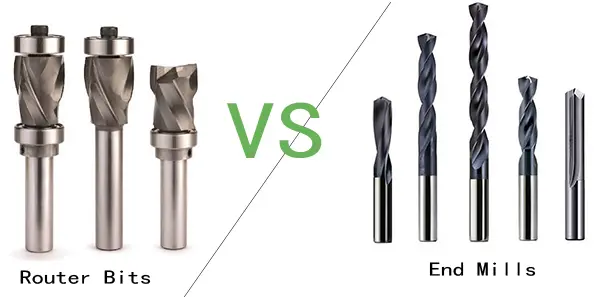
Router Bits vs End Mills
CNC routers and mills have a variety of differences, from their operating method to their applications and costs. Knowing these differences is crucial to choosing the one that is best suited for your project. If you are confused about it, Prolean Tech has 40+ experienced engineers to help you select the right option.
Let’s read the differences in detail between these two CNC machining methods.
How Do CNC Routers and CNC Mills Work?
Although few initial steps are similar in both routers and mills, they are distinguished from each other on the basis of their axial movements. Let’s have a quick overview:
CNC Router:
The design of a CNC router is gantry-style. The spindle travels along the X, Y, and Z axes while the workpiece stays motionless on the bed.
- The gantry moves on the Y-axis from front to back and on the X-axis from side to side.
- On the Z-axis, the spindle moves up and down.
To cut through softer materials like wood, plastics, and non-ferrous metals, high-speed router bits rotate at extremely high RPMs.
Despite having limited Z-axis clearance, this configuration enables routers to process large sheets of material efficiently.
CNC Mill
A CNC milling machine consists of a moving table and a stationary table. In this configuration, the spindle moves vertically along the Z-axis to regulate cutting depth, while the workpiece is fixed to the table, which moves along the X and Y axes. This configuration increases the machine’s rigidity and enables accurate tool positioning control.
CNC mills use slower but more powerful spindles along with a heavy, rigid frame, in contrast to CNC routers that use high-speed spindles for softer materials. Because of this, they can accurately cut and shape hard materials like titanium, steel, and iron. In order to maintain stability, achieve finer tolerances, and produce complex components for industries like aerospace, the solid structure also reduces vibration.
Material Capability of CNC Router vs Mill
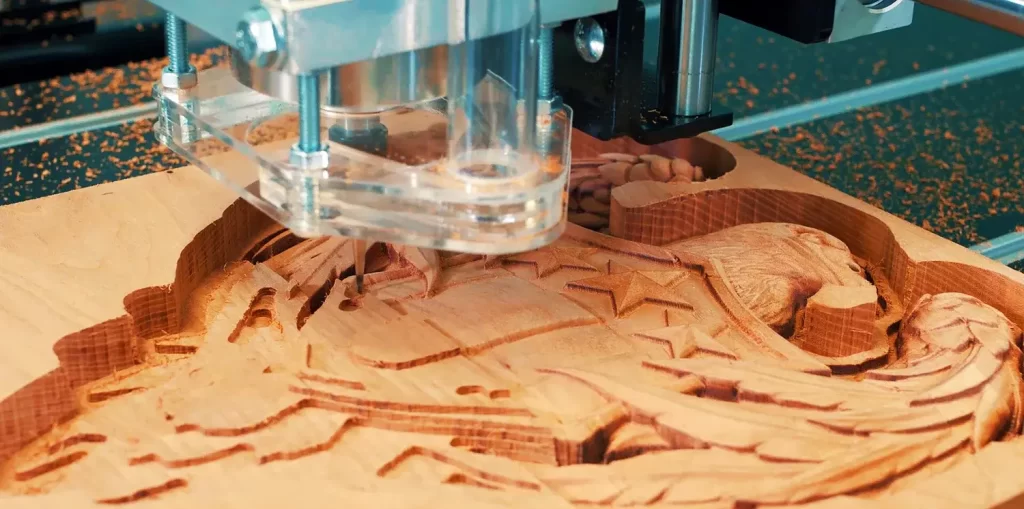
Artwork Creation by CNC Router
Material capability is the major differentiating factor in CNC router vs mill. CNC routing works best on soft materials like wood, ceramics, and soft metals; however, CNC milling is capable of precise working on hard and rigid metals, including titanium. It is more focused on the tight tolerances.
Which materials are used in the CNC router machine
Softer materials and tasks requiring speed and adaptability over extreme strength are best suited for CNC routers. Woods like plywood and hardwood, which are easy to machine because of their low hardness and ductility, are examples of common materials.
Compression end mills, which minimize cracks, are also beneficial for composites. Although low cutting speeds are necessary to prevent melting or overheating, plastics such as acrylic, nylon, LDPE, and polystyrene can be routed.
If abrasive tools are used, CNC routers can also work with low-toughness ceramics like granite or tiles and soft metals and alloys, primarily aluminum.
Which material is used in a CNC Mills
CNC mills are designed to precisely handle more resilient and harder materials. The most prevalent category is metals, which includes brass, copper, titanium, mild steel, stainless steel, aluminum, and tool steel.
In sectors where strength and precision are essential, such as aerospace, automotive, and medical manufacturing, these materials are frequently needed. Engineering plastics like ABS, nylon, and polycarbonate, which are frequently used for functional prototypes, also work well with CNC milling.
Furthermore, CNC mills employ end mills, drills, and other specialized tools for precise metal cutting, drilling, and milling operations. Although there are some notable differences in CNC milling vs Drilling, mills are perfect for complex and heavy-duty parts because they can machine composites, phenolics, ceramics, and high-performance materials like Inconel or ULTEM.
Speed, Power, and Rigidity
Machining process of routers and CNC mills is different, as they have distinct speed, machine power, and rigidity. CNC routers are quick on workpiece as compared to milling machine.
CNC Router
The speed, power, and rigidity of CNC routers vs milling machine vary greatly, which has an immediate effect on their intended uses. Routers are made to be quick. They can swiftly cut through wood, plastics, and soft metals because their spindles run at extremely high RPMs, which are typically between 10,000 and 24,000. They are less efficient on hard materials, though, because this speed comes with less torque.
Speed mostly depends upon the material being used. Higher RPM brings efficiency, but they also causes friction and risk of wear and tear.
CNC Mill
In contrast, CNC mills place a higher value on rigidity and power. Their spindles produce significantly more torque despite rotating more slowly. When we compare routing vs milling, mills can precisely cut through hard materials like copper, titanium, and steel thanks to their heavy construction and rigid frame. For the production of complex parts, the rigidity reduces vibration and increases accuracy.
Try Prolean Now!
What are the Advantages of CNC Routers?
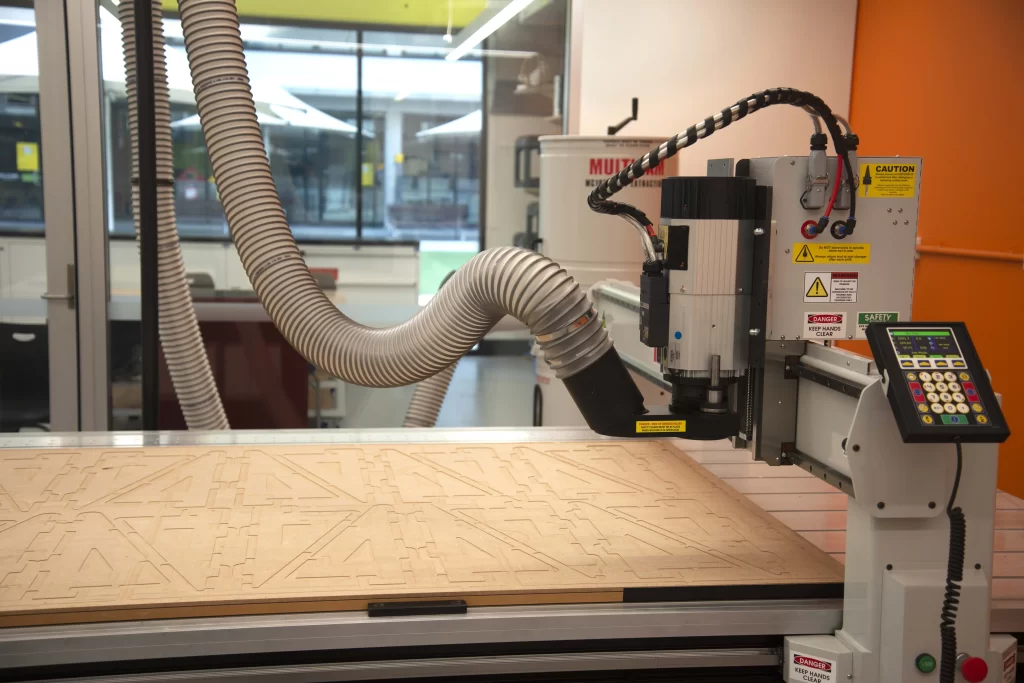
CNC Routers Application
CNC routing has many advantages, like rapid cutting and the ability to work on large panel. They are easy to operate and maintain.
Rapid Cutting
CNC routers can swiftly cut through materials and increase production efficiency because of their extremely high spindle speeds.
Huge Workspace
They are perfect for large-scale projects because they can work with large sheets of wood, acrylic, and soft metals.
Versatility of Materials
Routers offer versatility in a variety of applications by being compatible with plastics, composites, and soft alloys.
Simple Maintenance and Setup
Compared to larger machines, CNC routers are easier to set up, run, and maintain because of their straightforward gantry design.
Lightweight and Decorative Projects
They are frequently utilized for cabinetry, signage, decorative work, and other lightweight components that don’t need to be extremely precise.
What are the Advantages of CNC milling?
CNC milling can cut the hard materials with high precision. They are used in various industrial application.
Cutting Hard Materials
CNC milling machines are ideal for industries that require robust and long-lasting parts because they can easily cut hard materials like copper, titanium, and steel.
High Rigidity
Even during intricate and protracted machining operations, high accuracy and repeatability are guaranteed by the sturdy construction and rigid structure.
High Precision
They are ideal for producing complex and finely detailed parts that need precise finishes and close tolerances.
Intensive Machining
Milling machines can handle heavy-duty machining without sacrificing performance thanks to their high torque and stability.
Industry Applications
They are extensively utilized in the automotive, aerospace, and medical sectors where precision and strength are essential.
What are the Disadvantages of CNC Routers?
CNC routers have some cons, like they can work on a limited range of materials, have less precision, and can’t perform the heavy machining tasks.
Limited Materials
CNC routers are not appropriate for tough metals because they can only work with softer materials like wood, plastics, acrylic, and aluminum.
Lower Precision
CNC routers have trouble maintaining accuracy during long or deep cuts because of their reduced rigidity.
Low Torque
They are unable to efficiently complete heavy machining tasks due to their low torque capacity.
Limitations in Design
The thickness of the material that can be machined is limited by the gantry design’s Z-axis clearance.
Less Metal Precision
High-precision metal parts cannot be produced with routers.
What are the Disadvantages of CNC milling?
CNC milling takes more time to produce a finished product. It works on a small area, and the overall expense is high. It requires maintenance and is not easy to operate.
Slow Speed
The overall production time is impacted by CNC milling machines’ slower cutting speeds when compared to routers.
Small Workspace
They are not appropriate for handling large sheets of material and have smaller work areas.
Increased Prices
Compared to routers, the machines are more complicated to set up and are more costly to buy.
Maintenance Demand
The machine needs regular maintenance to stay in good working order, particularly when performing heavy-duty tasks.
Less Adaptable
When it comes to non-metal materials or decorative projects, routers work better than CNC milling.
What are the Applications of CNC Routing?
CNC routers are used to create signs, engraved art pieces, woordworks and furniture designs. They are also used to create models and prototypes.
Furniture and Woodworking
CNC routers are frequently used in woodworking for furniture, cabinetry, and interior design components that require intricate patterns and sizable panels.
Signs and Engraving
Because they can quickly cut wood, plastics, and composites, they are frequently used in sign-making, decorative carving, and engraving.
Composites
Routers work well for cutting and shaping composite materials, acrylic sheets, and plastics that are used in packaging, advertising, and light-duty industrial components.
Models and Prototyping
Additionally, they are employed in small-scale manufacturing, architectural models, and rapid prototyping and applications where speed and adaptability are more crucial than robust cutting.
What are the Applications of CNC Milling?
CNC Milling Machine Capabilities
CNC milling is used in metal parts production in different industries like aerospace, automotive parts, and medical equipment.
Metals Manufacturing
Strong and accurate parts made of titanium, steel, aluminum, and other metals are frequently produced using CNC milling.
Automotive and Aerospace
These devices produce intricate structures, frames, and engine parts for the automotive and aerospace industries, where precision and longevity are essential.
Medical Devices
In order to create surgical instruments, implants, and prosthetics that demand the utmost accuracy and superior finishes, milling is utilized.
Industrial Equipment
For a variety of industries that require robust and long-lasting parts, CNC milling creates gears, housings, and machine components.
Cost Comparison of CNC Router vs Mill
An entry-level CNC router machine is about $3k–$8k, while an industrial-grade mill typically ranges from $40k–$150k+. This affects their machining prices as well.
In terms of both initial investment and recurring costs, CNC routers are more affordable than CNC mills. Small businesses, hobbyists, and industries dealing with wood, plastics, and softer metals can all benefit from a router, which can be bought for a few thousand dollars.
Additionally, they require less maintenance, use simpler tooling, and use less power, all of which reduce operating costs. However, because of their robust frames, strong spindles, and sophisticated precision systems, CNC mills require a significantly larger investment, frequently in the tens of thousands to six figures.
They also entail more frequent maintenance, costly tooling, and higher operating costs due to increased power consumption.
CNC Router vs CNC Mill: A Comparison Table
| Feature | CNC Router | CNC Mill |
| Design & Movement | Gantry-style design; spindle moves on X, Y, Z axes while workpiece stays fixed | Moving worktable on X and Y, spindle moves on Z |
| Speed & Torque | High spindle speed (10,000–24,000 RPM) with low torque | Slower spindle speed but high torque for heavy-duty machining |
| Rigidity | Lower rigidity, less precise on deep cuts | Strong, rigid frame, high stability, and accuracy |
| Material Capability | Works best on soft materials: wood, plastics, composites, acrylics, soft metals like aluminum | Handles hard materials: steel, titanium, copper, brass, Inconel, ULTEM, plus plastics and composites |
| Precision | Good for lightweight, decorative, and large-sheet work; limited in fine tolerance | High precision for complex, intricate, and heavy-duty parts |
| Work Area | Large cutting area, ideal for big sheets | Smaller work area, better for compact, detailed parts |
| Applications | Furniture, sign-making, engraving, prototypes, art pieces, soft materials | Aerospace, automotive, medical devices, industrial components, and metal manufacturing |
| Setup & Maintenance | Easier setup and maintenance due to simpler design | A more complex setup requires frequent maintenance for heavy-duty work |
| Cost | Affordable: a few thousand dollars, low operating costs | Expensive: tens of thousands to six figures, higher tooling and power costs |
Final Thoughts
Both CNC mills and routers are essential to contemporary manufacturing, meeting distinct requirements according to cost, accuracy, and material type. While mills are excellent at machining hard metals and creating complex, high-precision components, routers are best suited for soft materials, large sheets, and decorative projects. Your project’s needs, financial constraints, and industry norms will determine which option is best for you.
Submit your drawings to receive a quote and manufacturability (DFM) report within 24–48 hours. We provide one-stop delivery, including material sourcing, tooling & fixtures, surface finishing, and assembly. Get a quote from Prolean now, and we’ll work with you to bring your idea to life with unparalleled accuracy.



0 Comments