
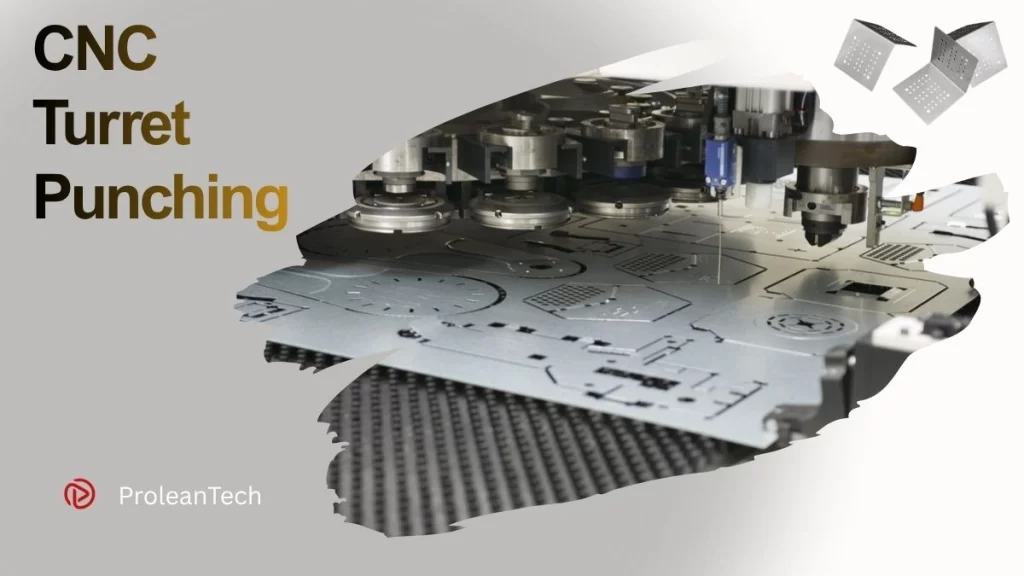
CNC turret punching
Sheet metal punching is a key method used in metal fabrication to create holes of various shapes and sizes. The fundamental concept is striking the punch having an identical profile to the desired hole geometry on the metal sheet against the matching dies.
There are different equipment and techniques of punching, turret punching is one of them. Unlike manual or conventional CNC Die punching, it accommodates multiple tooling stations in a single setup for high-speed production, complex part geometries, and efficient nesting on large sheets.
This article will cover how a CNC turret punching works, its benefits & industrial applications, and much more.
What is Turret Punching?
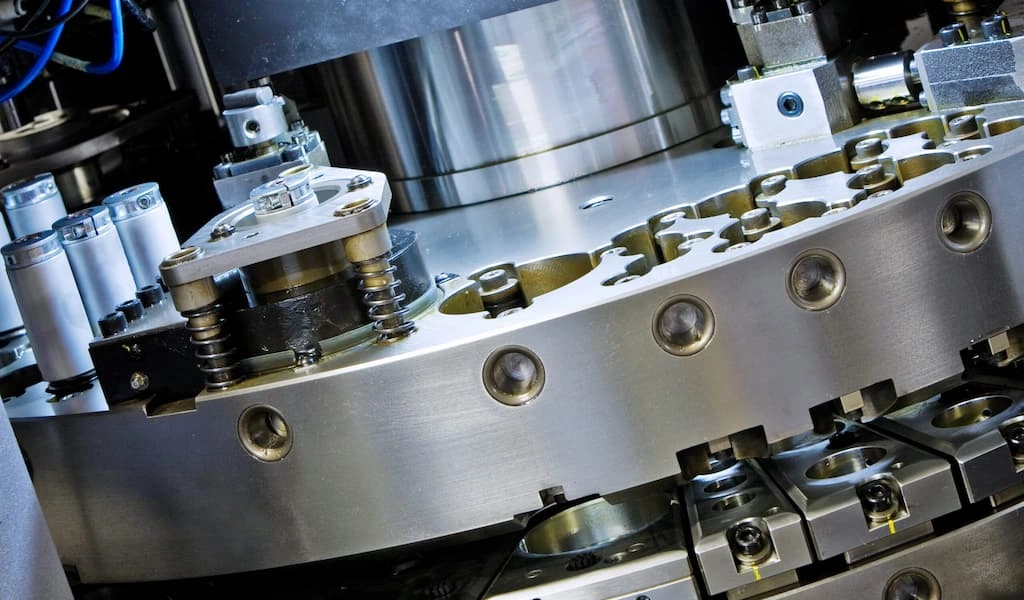
Turret punching process
It is a sheet metal fabrication process that uses a CNC-controlled turret press to punch precise holes, slots, and nesting patterns. This process is fast, economical, and has extensive applications across the industries.
A turret punching press features two rotating indexing tables, known as turrets. The upper section holds multiple punches (up to 60 different punching tools), while the lower turret contains the counterpart dies.
The turret rotates and positions the worksheet between the desired punch tooling and die. Then, the punch strikes the sheet, quickly moves upward, and repeats the process, while the sheet moves to the next position for subsequent sheet metal hole punching operations.
You can make circular, square, rectangular, hexagonal, and any other custom-shaped holes with turret punching. Consequently, CNC turret machines automate the process, allowing the creation of various hole shapes and sizes on a sheet of metal without requiring tooling changes.
Structure and Components of CNC Turret Punch Press
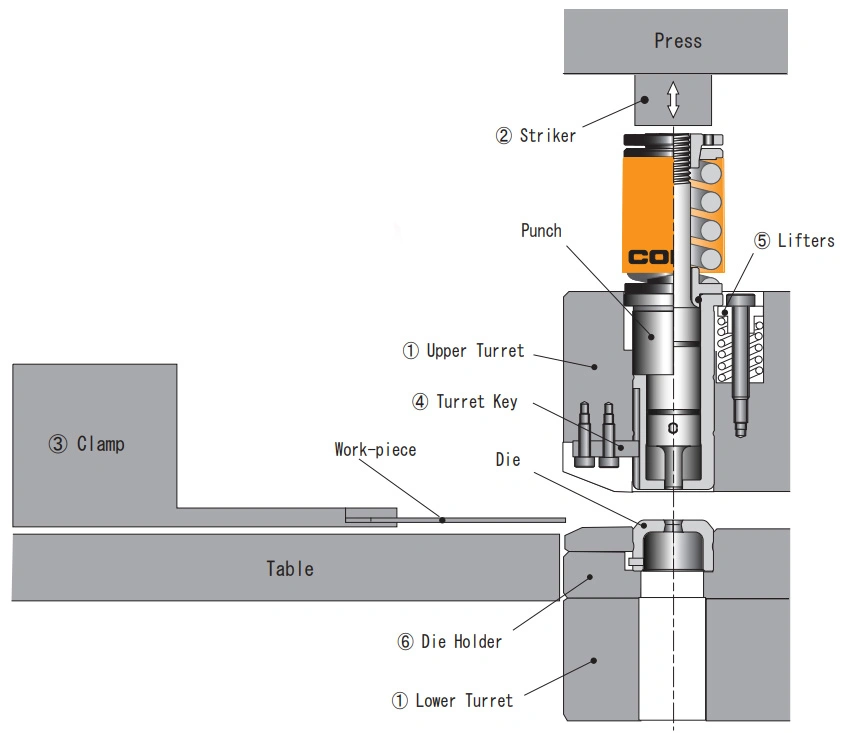
Turret punch press components
CNC turret punch presses are known for their compact designs and rigid structures. Different systems and components work together to punch accurate and repeatable holes in metal sheets.
Let’s further elaborate on the structure through the different components of the CNC turret punch press.
Turret Tooling System
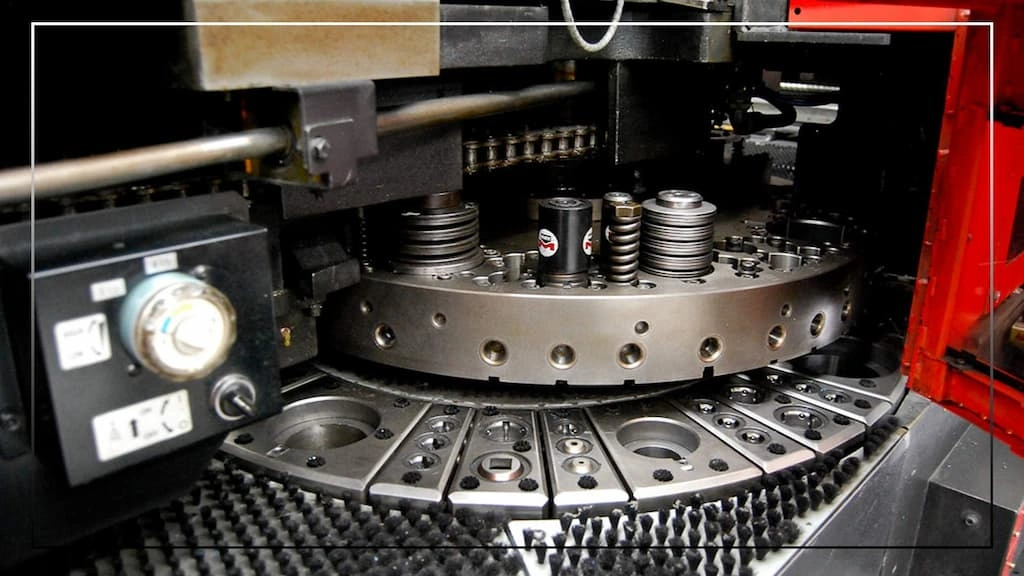
Turret tooling
Turret punching presses are named after their unique tooling system, called turret tooling. It contains upper and lower sections, equipped with various punches and corresponding dies. You can find them above the working bed of the punching press.
The upper turret section can move along the rotational direction to switch the punching tool, whereas the metal sheet moves along the X and Y axes between the upper and lower turrets. These motions are controlled by CNC instructions.
Sheet Clamp
This component holds the metal sheet and keeps it in its determined place. It is essential to precisely position and align the sheet with the tooling while striking.
Punch Striker
Striker is positioned above the punch and moves down, facilitating the striking of the punch to the metal sheet. So, the sheet metal turret punch can shear-cut the material. Hydraulic, mechanical, or servo motors are used to power the striker.
Turret Key
Turret keys are responsible for holding the angular tools in the rotational direction, ensuring correct alignment for punching. As the turret rotates, they maintain the angular position of the tools.
Lifters
Lifters are used for holding the punch (upper turret) to facilitate the position shifting of the worksheet after each strike.
Punching Dies
Dies are the precision engineering tools that help counterpart punches to shear the material against their cutting edges. These are typically made with tool steel, carbide, or other tough materials. In turret punching presses, they are mounted on the lower part of the turret tooling system.
Working Bed/Table
It is a flat bed that provides space to feed the sheet and carry out the punching operations. A work bed/table is typically made with hardened steel and helps to support and position the sheet for operations.
Working of CNC Turret Punching Machine
The working of CNC turret punching is similar to the standard sheet metal punching process, except for the die-punch tooling setup. Different punch profiles and matching are mounted on the upper and lower parts of turret systems. The turret can rotate and apply specific punches to create desired holes in various locations of a metal sheet.
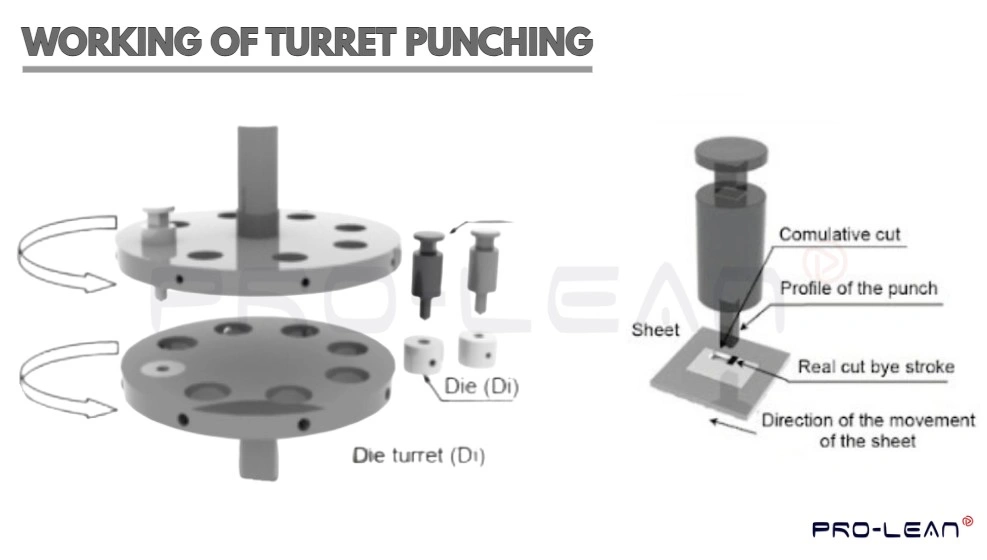
Working of the turret punch press
Here is the working mechanism of CNC turret punching:
- The CNC system interprets the instructions from G & M codes about punching sequence, movement path, and punch selection.
- The servo system moves the worksheet along the X & Y axes for its precise position between the punch and die.
- The upper turret rotates to choose the defined punches according to the CNC program, whereas the lower turret can rotate the mounted dies at any angle.
- The pressing mechanism (servo, hydraulic, etc.) drives the ram and strikes the punch to the sheet metal against the die.
- The sheet moves continuously and performs single punching, nibbling, or continuous punching until all designed features are complete.
What Are the Different Types of CNC Punching Machines?
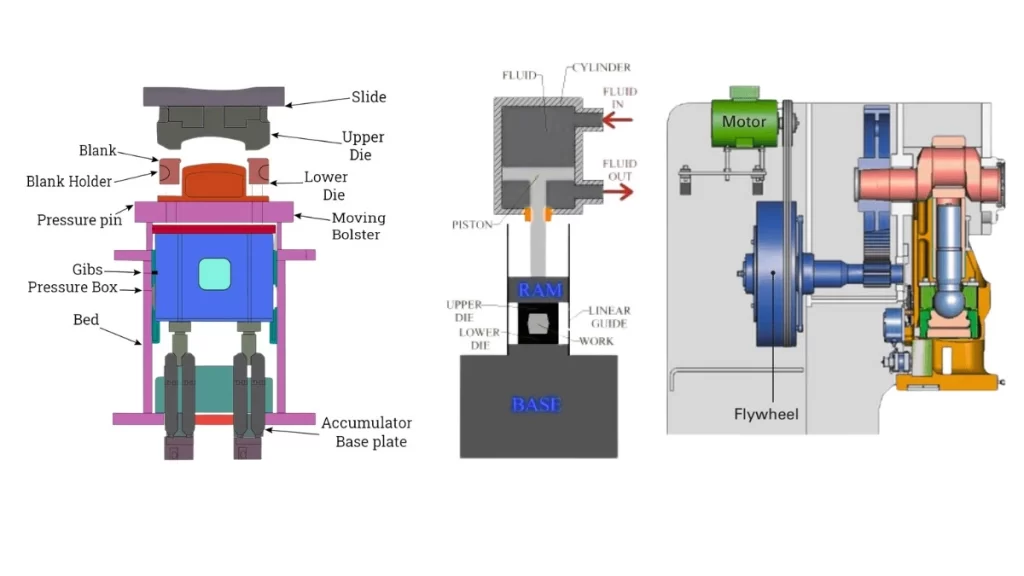 Types of punch presses
Based on the driving mechanism used in metal punching methods, punching machines can be classified into three different types: mechanical, hydraulic, and servo press machines.
CNC Mechanical Press
A mechanical CNC punch press relies on a flywheel & cranks, which store and convert the rotational forces into vertical forces for pressing and punching the sheet. You can choose a mechanical press for simple and repetitive work that requires continuous high-speed operation.
CNC Hydraulic Press
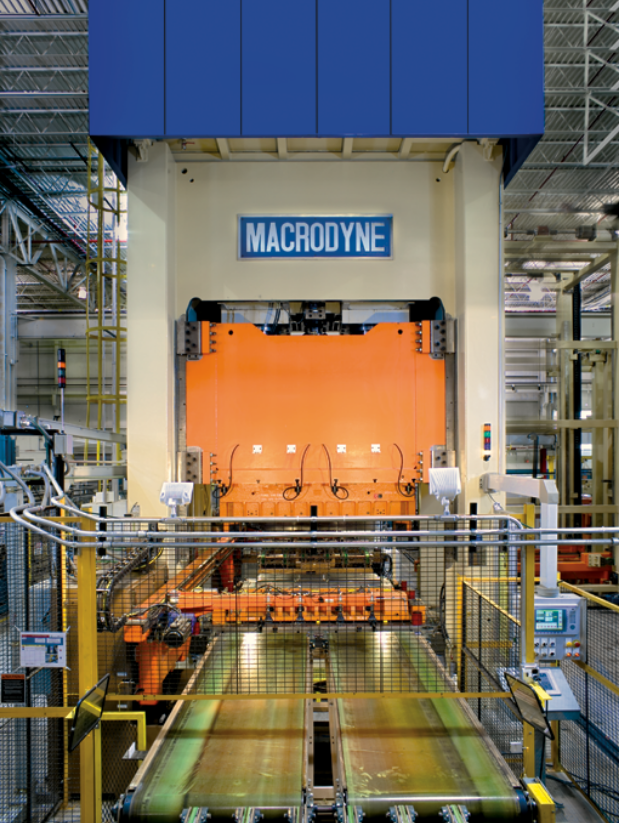
Hydraulic Presses
In hydraulic presses, fluid motion drives the piston in a vertical direction to deliver the punching force. As they require frequent changes of hydraulic oil and other maintenance, they might be less suitable for use in large sheets and high-temperature conditions.
CNC Electrical-Servo Press
Although mechanical and hydraulic presses can be equipped with servo motors for improved coordination between systems, electrical servo presses rely entirely on servo motors to generate the force. Meanwhile, a crank mechanism transfers the force into vertical ounces. Moreover, servo-electrical presses are flexible and support complex forming sequences with quick changeovers.
Try Prolean Now!
Advantages of CNC Turret Punching
Using a sheet metal turret punch for custom holes and sheet metal punching offers benefits such as high fabrication speed, accuracy, repeatability, and tooling flexibility.
Let’s look at the list of advantages offered by Sheet metal punching & stamping services.
- High Fabrication Speed: With automatic tool changeovers and minimal machine downtime, turret punching enables a high fabrication speed.
- Tight Tolerances: It allows for the production of metal parts with sheet metal punching precision of ±0.003 inches or lower.
- Complex Shapes: The interchangeable tooling allows for the creation of versatile shapes, including holes and other features, in a single setup.
- Repeatability: The CNC automation and turret tooling result in high repeatability of sheet metal parts.
- Cost-Effective: The high production speed, reduced labor cost, and lower material wastage make turret punching a cost-effective fabrication process.
Is Turret Punching Expensive?
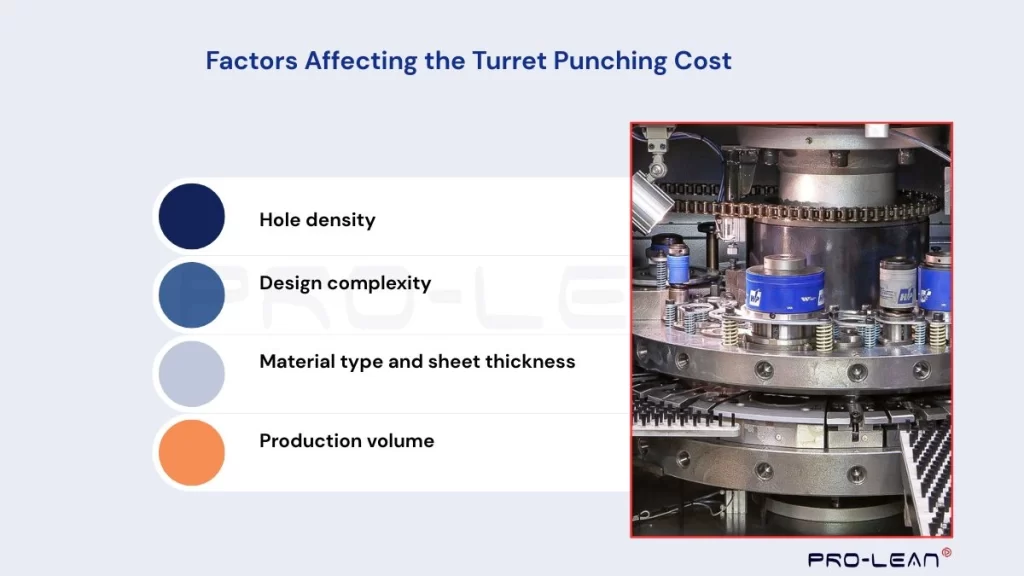
Turret punching cost
No, turret punching is one of the cost-effective manufacturing processes, particularly for high volumes. It might require a heavy upfront cost for dies and punches, but they can be used for hundreds of thousands of production cycles. As a result, per-part cost decreases significantly.
The exact cost of turret punching depends on factors such as hole density, design complexity, material type, sheet thickness, production volume, and post-processing requirements.
To determine the cost of your punching project, simply upload your design and get a quote from us.
Try Prolean Now!
Industrial Applications of Turret Punching
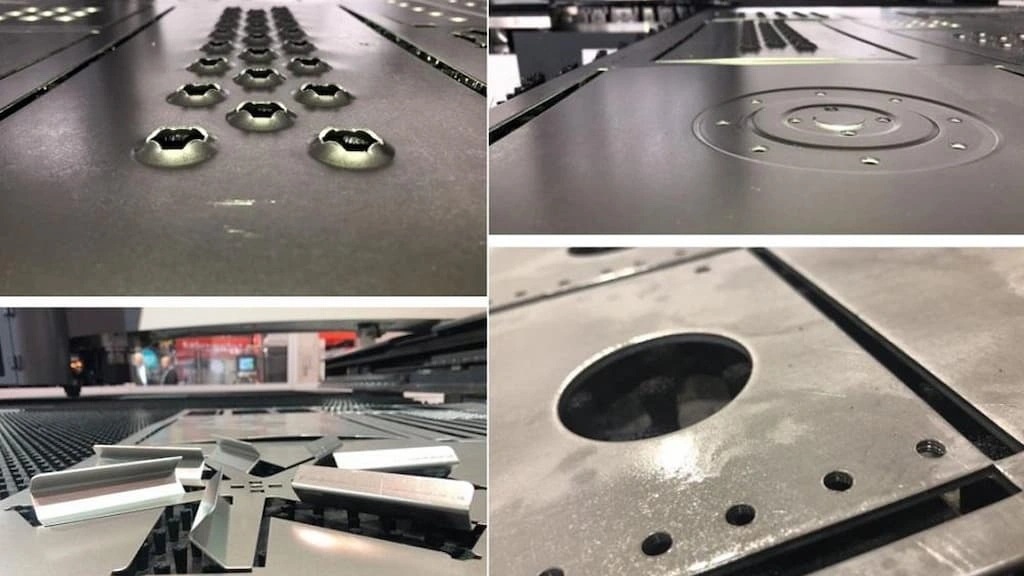
Turret Punching Applications
The turret punching applications are widespread across the industries, including general hardware & furniture, electronic & electrical, household appliances, automotive, medical equipment, and HVAC.
The table below outlines common applications with examples of punch press products.
|
Industry |
Why Turret Punching |
Examples |
|
General Hardware |
Fast repeatable holes, low cost for high runs, and material versatility. |
Perforated plates, hinges, drawer slides, shelf brackets, panels, handles. |
|
Electronic & Electrical |
Precise enclosures & mounting patterns, automation, and accuracy |
Instrument enclosures, chassis panels, EMI vents, mounting plates, brackets |
|
Household Appliances |
Efficient and consistent production faces and vents |
Control and face panels, oven fronts, vent panels, latch plates, trim rings. |
|
Automotive |
High-volume bracket and panels with tight tolerances |
Sensor housing, heat-shield tabs, clips, mounting plates, cable guides. |
|
Medical |
Fabrication of miniature items with high accuracy and repeatability |
Instrument & sterilization trays, device housings, panel overlays, and clamps. |
|
HVAC |
Precision and economical for high volumes. |
louvers, grills, duct flanges, filter frames, and perforated panels. |
Read More:
Do you Need Metal Punching and Stamping Parts? Contact ProleanTech
Are you looking for a manufacturing partner to outsource sheet metal parts tailored to your specific design requirements? Contact no further than ProleanTech, an on-demand manufacturing company with precise metal punching and stamping services.
We utilize advanced CNC progressive-die stamping, turret punching, and multi-process stamping technologies to create punch press products with complex features. Additionally, our expert team and a decade of industry experience can be beneficial for your custom projects.
Summing Up
As we have discussed, turret punching is an efficient, cost-effective, and precise method for creating holes in sheet metal parts. You can use this method combined with bending, stamping, or other forming processes to achieve higher complexity. However, it is essential to utilize the appropriate type of punching presses and tooling to leverage the full capabilities.
If you are still confused about turret punching and stamping strategies, contact us. Our engineers will provide the detailed consultation you need before starting the project.
FAQs
What is a punch press?
It is a sheet metal forming mechanism that cuts or shapes the sheet metal using the die and punches in pairs. Punches strike the sheet with a high force and its edges into a matching die.
What is the difference between a turret punch machine and a laser cutting machine?
The primary difference lies in their working mechanisms: a turret punch machine utilizes high-force punches and dies to cut or form sheet metal, whereas a laser cutter uses a concentrated laser beam that melts and vaporizes the material to create cuts and shapes.
What is a turret punch?
A turret punch is defined by a rotating turret system that mounts multiple punch press tools on the upper section and corresponding dies below them to punch holes, notches, cutouts, and other features. Unlike conventional punching, it does not require tool changes.
0 Comments