
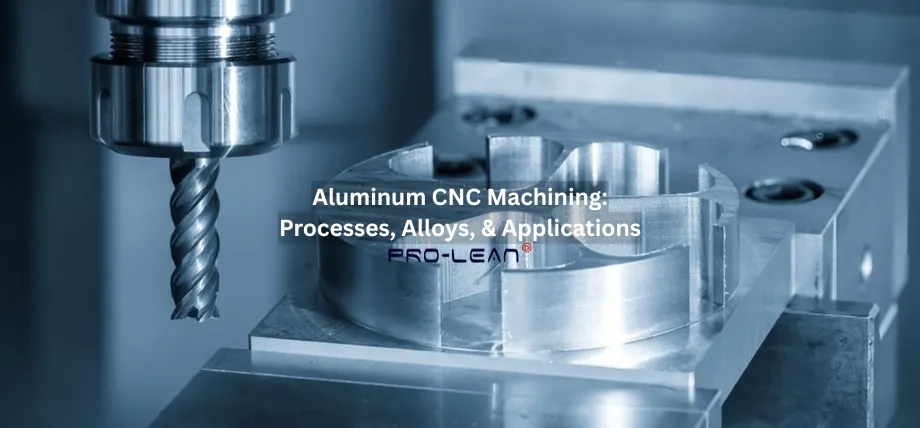
Aluminum CNC machining
Aluminum CNC machining is one of the most reliable and practical ways to produce strong, lightweight components with high dimensional accuracy. Therefore, you can find many applications of aluminum CNC machining in the automotive industry, consumer electronics, automated systems, and construction and aerospace industries.
This article will bring you a complete overview of aluminum CNC machining, including the techniques used, materials, and applications. Proleantech has ISO certifications and material machining for aluminum parts and prototypes.
Introduction to Aluminum CNC Machining
What Is CNC Machining?
CNC machining is the abbreviation used for Computer Numerical Control machining. It is a modern custom machining technique where you remove material (either by cutting, shaping, or drilling) from a solid stock using computer-controlled toolpaths. CNC machining provides components with high precision (up to micron-level accuracy) and excellent repeatability.
How Does CNC Machining Work?
In CNC machining, you convert a digital design into a precise physical part. This is a multi-stage process that is mainly computer-controlled and automated. Even though this is an advanced process, the workflow can be simply outlined as follows.
- Designing – Creating the 2D or 3D model of the component using CAD software
- Programming – Converting the design into machine-readable instructions (this is known as G-code)
- Machining – Forming the components automatically using the CNC machine, following the given instructions
- Inspection and finishing – Final quality checking and the surface finishing processes
When Should You Choose Aluminum CNC Machining?
Not only metals, but also many types of plastics, composites, and wood are also used for CNC machining. Among metals, steel, aluminum, brass, and copper are the most widely used. Aluminum is a popular metal used for CNC machining since it is very easy to cut. It needs less cutting force compared to other metals. Therefore, aluminum CNC machining is your go-to choice when you need components with:
- High strength-to-weight ratio (aluminum is one of the lightest metals, with the highest strength)
- Faster production (aluminum machining is faster than most other metals)
- High corrosion resistance
- Clean surface finishes
- Good thermal and electrical conductivity
One of the main reasons aluminum CNC machining is popular is that it is widely available in the market. You can find aluminum alloys in many different grades, so you can easily match the performance and cost requirements.
Popular Aluminum Alloys for CNC Machining
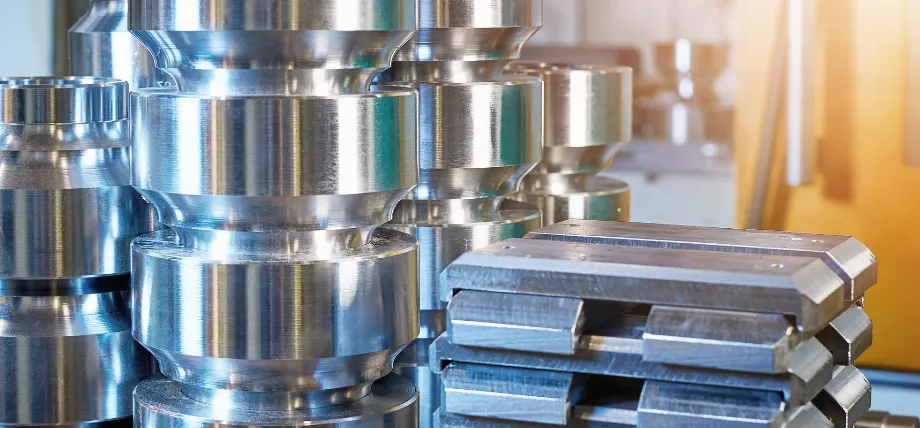
Machined aluminum components
The choice of the aluminum alloy directly affects both the product and the tools. It decides the performance, strength, quality of the finishing, and also the level of tool wear. The most common alloys used for aluminum precision machining in the modern industry are:
Aluminum 6061 (General Purpose)
Aluminum 6061 is an all-rounder type used for making many custom aluminum parts. It has a good balance of properties such as machinability, weldability, and strength. Aluminum 6061 is highly available and also cost-effective. It is mainly used to produce custom aluminum parts like brackets, housings, frames, etc.
Aluminum 7075
If your priority is strength or fatigue resistance, aluminum 7075 is your go-to choice. It is slightly harder to machine than 6061, but its performance is excellent for high-stress aluminum CNC machining parts. This is your best option for high-load components and competitive applications.
Aluminum 2024
For good fatigue resistance and machinability, aluminum 2024 is your best candidate if corrosion resistance is not a critical requirement. If you are planning to use this grade in harsher environments, you will need to support the alloy with surface treatments. Aluminum 2024 is mainly used for aircraft fittings and components that operate under cyclic loading.
Aluminum 5052
Aluminum 5052 is popular for its excellent corrosion resistance. It is mainly used for making fuel tanks and parts that operate in corrosion-prone environments. This grade of aluminum is not heat-treatable.
Aluminum 6063
If you need good formability and a nice finish with low-to-moderate strength, aluminum 6063 is the ideal option. That’s why this grade is widely used in extrusions and architectural profiles.
MIC-6 – Cast Plate
MIC-6 is the trade name used for a cast aluminum tooling plate, which is well known for its flatness, machinability, and dimensional stability. When you want to minimize distortion during machining, parts made using MIC-6, such as jig plates and fixtures, are highly useful.
Billet, Cast & Forged Aluminum – Choosing the Best Stock Form
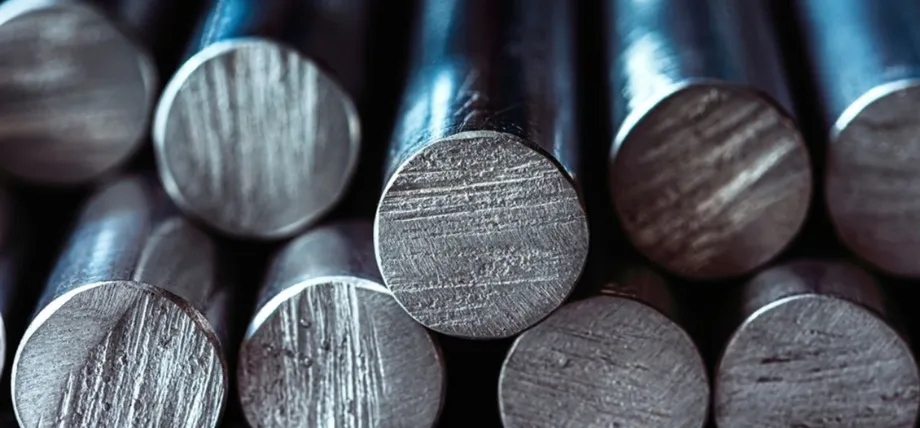
Aluminum alloy bars
Even if you use the same alloy family, choosing the right stock form highly impacts performance and cost. Billet, cast, and forged are the three main types of aluminum stocks you can find in the market. A comparison of these three forms is given in the table below.
Table 1: Types of Stock Forms of aluminum (Billet vs Cast vs Forged Aluminum)
| Stock Form | How It’s Made | Strength | Cost | Best For |
| Billet Aluminum | Machined from a solid bar or plate | High (consistent) | Medium-High | CNC aluminum prototypes, precision-machined parts |
| Cast Aluminum | Made by pouring molten aluminum into molds | Lower than billet forms | Low | Complex geometries, cost-effective production |
| Forged Aluminum | Compressed into shape under high pressure | Very high | High | High-load, fatigue-resistant components |
Billet is the safest option if you need predictable aluminum precision machining parts. For high-load applications or if the fatigue resistance is critical, forged will be the best choice.
Try Prolean Now!
Types of CNC Machining for aluminum
You have multiple methods to produce aluminum CNC machining parts. With the required geometry, tolerance requirements, surface finish, and production volume, you’ll have to choose the right method accordingly.
CNC Milling Aluminum
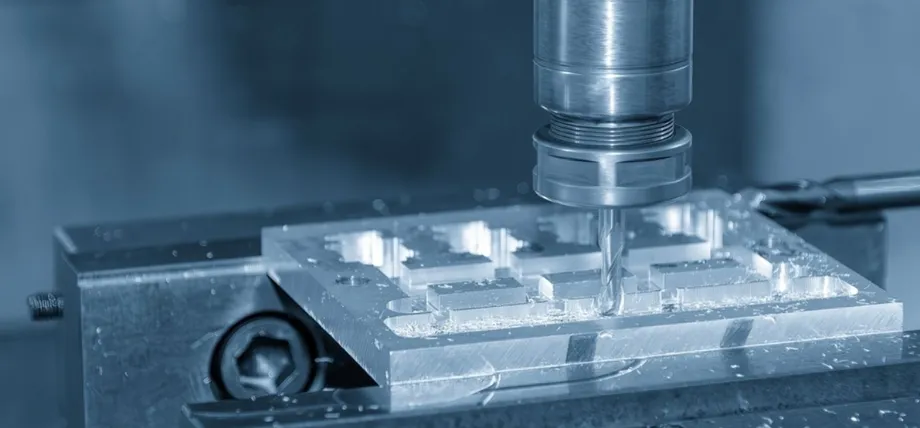
Precision aluminum machining
This can be called the backbone of aluminum CNC machining. In CNC milling aluminum, the aluminum workpiece is kept fixed, and the cutting tools are rotated to remove material. It is the most flexible option for making pockets, slots, faces, and complex 3D contours (like molds, housings, and brackets). You can use multi-axis milling to reduce the number of steps and simplify the process, since it can reach more sides in one run. There are two widely used multi-axis milling techniques:
- 3-axis milling – This is ideal for making prismatic parts like plates, brackets, and housings
- 5-axis milling – This is useful for more complex cases where you have compound angles or deep pockets with tool access issues
If you need custom aluminum parts with more complex geometry, 5-axis is the best option since it reduces repositioning and improves consistency. End mills are the main tools used for CNC milling aluminum. There are many types, such as 2-flute end mills, 3-flute end mills, and high-helix cutters. These are mainly made of tungsten carbides because they stay sharp longer, resist heat better, and can handle higher spindle speeds. Tool selection heavily influences the finish of the product, so you need to be very careful in decision-making regarding tools.
CNC Turning Aluminum
Here, the aluminum workpieces (usually bars) are spun while the cutting tool shapes the outer diameter, inner bores, tapers, grooves, and threads. This is the best way to machine parts that have rotational symmetry (such as shafts, couplers, bushings, etc.).
You can also embed drilling or tapping methods into the same setup if you need faster production. If your product has aluminum turning parts, you will get better surface uniformity and concentricity from turning than from milling.
Electric Discharge Machining (EDM) Aluminum
This method removes material using controlled electrical sparks. If you need to achieve very fine details and delicate features that are hard to cut with other methods, this is the best way. EDM is commonly used for hard metals. This is not usually the first choice to make aluminum CNC machining parts because milling and turning are faster and cheaper. But this can be used for aluminum machining with special requirements.
CNC Drilling Aluminum
CNC drilling is used to create precise holes. Drilling operation is usually followed by reaming (to control diameter accurately) or tapping (to cut internal threads). Drilling is usually paired with milling or turning cycles for faster assembly in custom aluminum machining products.
CNC Grinding Aluminum Parts
After the main machining is done, you can use CNC grinding to achieve smooth surface finishes, refine final dimensions, or improve flatness. This method used an abrasive wheel for the operation. When performing grinding on aluminum, you should properly control the process parameters because aluminum can load the grinding media. CNC grinding is not usually a required step, but it can add value for aluminum precision machining products with strict requirements. For example, CNC grinding is generally required in medical aluminum parts where a smooth surface is critical for components.
Laser Cutting Aluminum
Laser cutting is used when you need to cut aluminum into clean, 2D profiles (panels, brackets, etc.). It’s very efficient for high-speed contour cutting and repeated shapes. Laser cutting is highly useful when:
- Your geometry is mainly flat profiles
- You need fast production of sheet-based custom aluminum parts
- You plan to bend or assemble after cutting
You cannot obtain 3D features using laser cutting, and if you need them, you’ll have to go for secondary milling/drilling.
Advantages of CNC Machining Aluminum
There are many reasons why aluminum CNC machining is very popular across modern industries. The main advantages of aluminum CNC machining are:
- High strength-to-weight ratio – aluminum is well known for providing strength without unnecessary mass. This is why it is very popular in aerospace and aluminum CNC machining in the automotive industry.
- High machinability and fast production – You can always run higher spindle speeds and feed rates on aluminum. This makes the machining cycles faster, leading to faster production.
- Tool life is high compared to hard metals – aluminum generally needs less cutting force than steel. Therefore, tool wear is low, and you can improve more with proper chip evacuation and sharp tooling.
- Finishes with high surface quality – With correct tooling and parameters, aluminum CNC machining parts can come off the machine with excellent finishes. Therefore, you mostly don’t need to worry about secondary operations.
- High scalability – In most scenarios, you can scale the prototype to production using the same fundamental process. This makes custom aluminum machining a reliable workflow.
Alternative Methods to CNC Machining Aluminum
Even though it has many advantages, CNC machining is not the best economic choice for some applications. You have to consider many factors, such as geometry, volume, material, and cost, when choosing the best machining method. If CNC is not the choice for you, there are also many cost-effective, simple, and more reliable alternatives available, depending on your needs.
- Die casting – A good choice for high-volume production of complex shapes. But in most cases, you’ll need secondary machining for refinements.
- Extrusion – Best option for long profiles and parts with uniform cross-sections. You can then machine functional features with aluminum CNC machining if needed.
- Sheet metal fabrication – For thin parts, sheet metal forming combined with laser cutting will be much faster and more effective than CNC machining.
- Additive manufacturing (3D printing) – This method can work for specialized geometries, but for surface finish needs, you’ll often have to come back to CNC.
In real-life production planning, you don’t rely on a single method. Many industries use a mix of the above methods to receive high-quality products with maximum time and cost efficiency.
Applications of CNC Machining Aluminum Parts
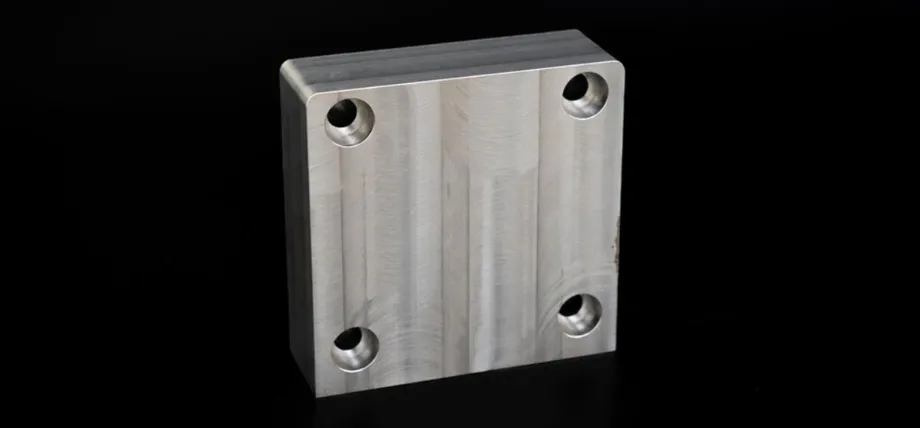
Machined aluminum block
CNC machining aluminum parts is very popular among industries, to the level that you will rarely find one that doesn’t use aluminum CNC machining. The most common applications include:
- Brackets, fittings, and housings used in the aerospace and aviation industries
- Many consumer electronic components, such as frames, camera mounts, and premium enclosures. Aluminum precision machining is widely used here for premium requirements.
- Mounting plates, frames, and housings are needed for the robotics and automation industries.
- Medical equipment, such as fixtures, custom brackets, and surgical tools, with precise dimensions.
- Lightweight parts in the automotive industry, such as adapter plates, brackets, and housings (CNC aluminum prototypes are widely used during initial design stages of this industry)
And in most of these sectors, customers usually request a CNC aluminum prototype when they need a functional interface, a tight-fit assembly, or a part that should match CAD exactly.
Custom Aluminum Machining at Proleantech
Proleantech provides high-quality custom machining for all aluminum alloys, aluminum castings, and metal machining services. We also provide post-machining services like improving surface finishes through mechanical treatments, and available finishes include:
- Brushed Finish
- Polished Finish
- Satin Finish
- Anodized Finish
- Hard Anodized
Standard CNC machining tolerances for all aluminum parts are around 0.025 mm, with precision aluminum milling achieving even lower tolerances. Request a free quote today!
Conclusion
Aluminum CNC machining often gives you fast, accurate, and scalable production of components. If you choose the right alloy, the right method (milling, turning, drilling, etc.), and the right design, you will always get reliable aluminum CNC machining parts with excellent performance and quality. Sometimes, CNC machining might not be the best choice depending on your needs, and then you’ll need to consider alternative methods as well.
In it different material facts. I agree with you, thanks for the help in this question. As always all ingenious is simple.
Hi Prolean
i am interested in information, which of these materials are mostly used for making boxes with heat sink: Aluminum 2024, 6061, 7075, 3003, and 5052.
best regards
Badri khvitia
Hello, Khvitia. Thank you for your comment. Generally, 6000 series aluminum alloys are suitable for heat sink applications, so 6061 could be a best choice for this project. However, we advise to choose the grade according to end-application of product and other specifications. If provide the more details, we can help you with material selection & manufacturing.
+86 15361475335
+44 7729718039
quotes@proleantech.com