
17-4 stainless steel vs 304
The right grade of stainless steel can have a significant impact on your project’s cost, performance, and durability. Engineers and manufacturers face a common dilemma when choosing grades of stainless steel corrosion-resistant metals. 17-4 stainless steel vs 304 stainless steel is one of them.
Both offer outstanding durability and resistance against environmental degradation. However, their mechanical and metallurgical properties make them excel in applications that are vastly different. The wrong choice could lead to premature failures, high manufacturing costs, or over-engineering, which can negatively impact your bottom line.
This comprehensive guide breaks down the eight critical differences in the 17-4 stainless steel vs 304 debate, examining everything from chemical composition and heat treatment capabilities to practical considerations like cost and machinability. This article will provide you with the information needed to confidently choose the best stainless steel grade to meet your manufacturing and custom stainless steel part requirements.
Prolean Tech is a metal parts manufacturer with years of experience in the custom metal machining services for steel and other metals like copper, brass, and iron. Our engineers and mechanics know the ins and outs of different grades that make us the best in providing high-quality, durable custom stainless steel parts.
What is 17-4 Stainless Steel
17-4 stainless is a precipitation-hardening martensitic stainless steel alloy. It has good corrosion resistance with great mechanical strength. 17-4 in the name of this alloy refers to its composition. It has 17% chromium and 4% nickel. However, PH stands for precipitation hardening.
The secret to the strength properties of the alloy lies in the copper content present in it. When 17-4 stainless steel goes through specific heat treatment cycles, it gains different common conditions: H900, H1025, and H1150. These conditions depend upon the aging temperature. H900 is the highest strength condition, making it suitable for applications that require higher strength, such as aerospace, oil and gas, and the manufacturing of medical devices.
What is 304 Stainless Steel
304 is the austenitic chromium-nickel alloy. It is a widely used stainless steel alloy in the world. It is commonly referred to as 18-8 as it contains 18% chromium and 8 % nickel. It is widely used in applications where excellent corrosion resistance is required.
304 stainless steel has higher machinability and is easy to fabricate. Its structure is stabilized due to the presence of a high quantity of nickel. 304 stainless steel has face centered cubic structure with greater ductility and non-magnetic properties in the annealed condition.
As compared to precipitation-hardening grades, 304 stainless steel can’t get strength through heat treatment. It is strengthened by the cold working processes. When comparing the alloy steel vs stainless steel, 304 represents that the stainless steel family has higher corrosion resistance than other steel alloys. The chemical and physical properties of 304 stainless steel make it perfect for the food and beverage processing equipment.
Differences Between 17-4 Stainless Steel and 304 Stainless Steel
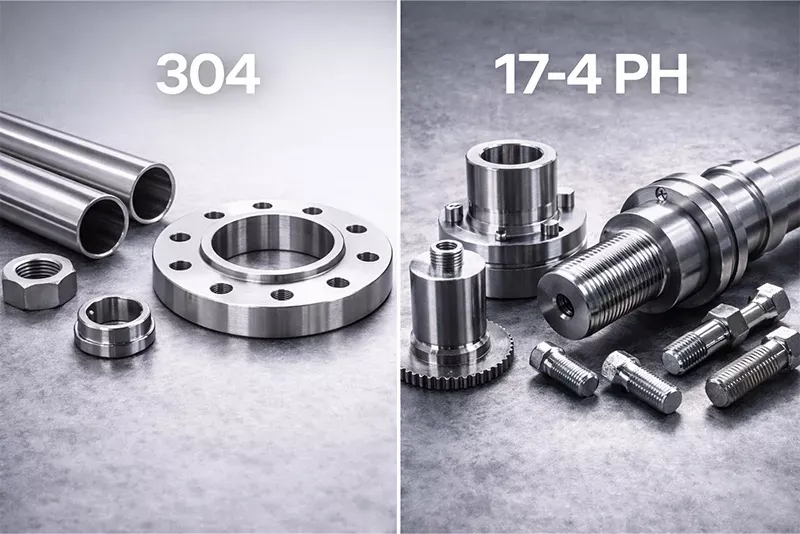
Difference between 17-4 stainless steel and 304 stainless steel
When we want to study 17-4 stainless steel vs 304 stainless steel, we get to know many distinctions in their chemical composition, corrosion resistance, strength, and many other aspects. Let us discuss the differences between the grades of stainless steel below.
Composition & Metallurgy
Chemical Composition
17-4 stainless steel and 304 stainless steel represent an obvious difference in their chemical composition. 304 stainless steel contains 18-20% chromium, 8-10% nickel, and traces of carbon. It also contains iron, and a very small amount of manganese, silicon, phosphorus, and sulfur. The higher chromium content creates an oxide layer on the surface, while nickel provides stability to the austenitic structure of 304 grade. All of these factors make the 304 more corrosion-resistant.
17-4 stainless steel contains 15-17.5% chromium, 3-5% nickel, and almost 3-5% copper. The presence of copper in this alloy provides it with the specific property called precipitation hardening. This makes it distinguishable from other conventional stainless steel grades. Moreover, this alloy also contains niobium. Niobium prevents the chromium carbide formation and maintains the structure during heat treatment processes. 17-4 stainless steel has significantly less nickel than 304 stainless steel, in a martensitic structure rather than an austenitic structure.
The chemical composition of both grades makes them different from each other in magnetic properties, structure, strength, and formability.
Heat Treatment Capability
Heat treatment capability is one of the most significant parameters that makes them unique and specific in terms of their usage. 304 stainless steel is an austenitic alloy with a stable face-centered cubic structure. It stays strong and cannot be hardened using precipitation hardening methods. Other strengthening methods, like quenching and tempering, work on carbon steels but not on 304 stainless steel.
However, in the case of 17-4 stainless steel, precipitation hardening is one of its defining properties. Solution treated at ~1020–1050 °C, and strength is achieved during low-temperature aging (≈480–620 °C). Its hardening comes from copper precipitation during aging, not the high-temperature step itself. It is followed by the aging treatment for a couple of hours. This whole process results in the formation of copper-rich precipitates in its martensitic structure.
Different aging temperature combinations produce different conditions of the alloy. Some of them are below.
- H900 is known for its maximum strength
- H1025 has balanced properties
- H1150 has maximum toughness
Functional Properties:
Corrosion Resistance
When we evaluate corrosion-resistant metals, in comparison of 17-4 stainless steel vs 304 stainless steel, it is very important to understand their environment in which they have to perform. 304 stainless steel is the best go-to choice for applications where high corrosion protection is required. It contains a higher level of chromium that helps to create an oxide layer over the surface. This oxide layer protects the underlying metal from chemical reactions. And nickel presence protects it from the reducing environments.
In case of 17-4 stainless steel, the martensitic structure of the alloy causes a compromise in its corrosion resistance properties. Although it has good resistance, it is generally less than that of the austenitic 304 stainless steel. Heat treatment is another factor that influences the corrosion resistance of 17-4 stainless steel. H900 has maximum strength but has less corrosion resistance than H1150. So, the applications where the higher chemical interactions occur, like marine parts, use the 304 stainless steel for superior protection.
Magnetic Properties
Magnetic properties and machinability of 17-4 stainless steel vs 304 stainless steel are significantly different from each other. 304 is non-magnetic only in the fully annealed condition. Cold work can induce magnetism.
However, 17-4 stainless steel represents high magnetic properties due to its martensitic structure. These magnetic properties remain the same in grade even after the heat treatment conditions.
Mechanical Performance
Strength & Hardness
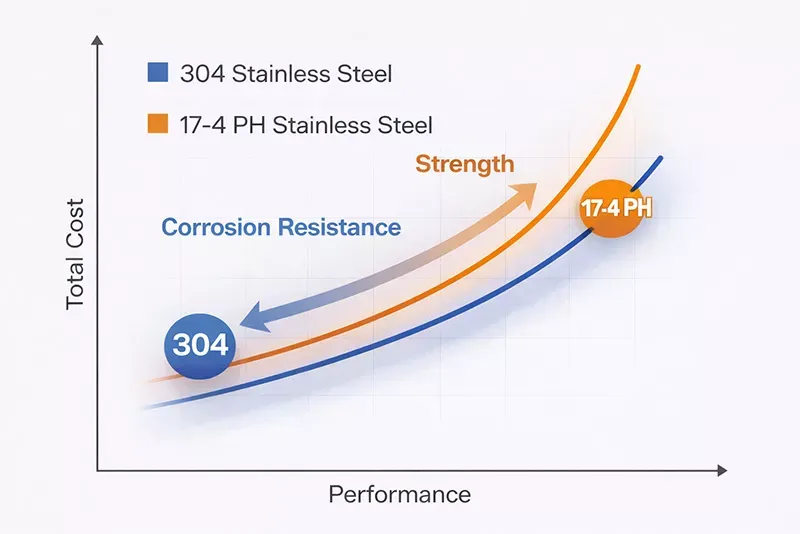
Relation between corrosion resistance and strength of 17 -4 and 304 stainless steel grades
Strength and hardness are two of the significant aspects to consider before selecting the stainless steel grade for your project. 304 stainless steel offers good strength in its standard annealed form. It exhibits tensile strength of 515-620 MPa (75-90 ksi), yield strength of 205-310 MPa (30-45 ksi), and hardness around 150-200 Brinell. These properties can be enhanced by cold working, but still, it is less than the precipitation-hardened conditions.
17-4 stainless steel in its precipitation-hardened forms exhibits great strength and hardness. H900 is the condition that has the highest strength among all of its states. It achieves tensile strength of 1310 MPa (190 ksi), yield strength of 1170 MPa (170 ksi), and hardness of Rockwell C 43-46. Even in its lowest strength form, H1150, it still exceeds the strength of 304 stainless steel.
Understanding this difference makes the 17-4 stainless steel a clear choice in the applications where the high-strength components and parts with more hardness are required.
Durability & Longevity
Durability and service life of 17-4 stainless steel vs 304 stainless steel depend upon their ability to best withstand their use cases and environment. This property is somehow also related to its strength and hardness. 304 stainless steel works well and shows high longevity in moderate stress environments.
It offers high durability in stable environmental conditions. The extra oxide layer over the surface also helps to reduce the maintenance requirements over time. It shows the best usage in food processing equipment, architecture, and indoor applications.
17-4 stainless steel has excellent durability and higher fatigue strength in high-stress environments. This ability makes the 17-4 grade the best choice for custom stainless steel parts that have to be used in high-stress conditions. This grade maintains its dimensions and has a longer service life under the loads.
However, 17-4 stainless steel requires heat treatment to achieve the maximum level of desired properties. It can also be prone to hydrogen embrittlement in certain conditions, so the choice of stainless steel grade is critical to get the best results.
Manufacturing & Processing
Weldability & Formability
17-4 stainless steel vs 304 stainless steel varies in their ability to be welded and ease of fabrication. 304 stainless steel is known for its ease of fabrication in complex forms. It is easy to weld using different processes like TIG, MIG, and stick welding. Generally, there is no need to do any extra treatment like pre-heat or post-weld heat treatments for 304 stainless steel. It is, therefore, ideal for making intricate design shapes and deep drawing operations.
However, 17-4 stainless steel is not as easy to weld as 304 stainless steel. It faces challenges during welding due to its structure. 17-4 stainless steel also requires preheating and post-heating treatment to get the desired properties and strength. Formability of this grade is also limited because it has higher strength and a martensitic structure. If we need to create complex forms, this should be done in a solution-treated environment before aging. Precipitation hardened conditions are too hard and brittle to form complex structures afterwards. This difference should be considered before choosing the right stainless steel grade for custom metal machining services.
Difference in Machinability
In stainless steel machining, 304 stainless steel and 17-4 grades show slightly different patterns in certain conditions. Machining 304 stainless steel faces challenges in machinability, but they are less due to a comparatively less hard structure than 17-4 stainless steel. It requires sharp cutting tools and optimized parameters.17-4 stainless steel machinability depends upon the heat treatment conditions. It is usually easy to cut the metal in solution-treated conditions.
Try Prolean Now!
Technical Considerations in Machining Stainless Steel
In technical aspects of the machining process, milling stainless steel speed and feed rates need significant attention. 304 stainless steel requires a consistent speed and feed rate of the cutting tool during machining to control the work hardening. This grade produces long and stringy chips that can interfere with the cutting tool and affect the overall efficiency of the manufacturing process.
17-4 stainless steel machinability in its precipitation-hardening condition is more challenging, especially in its most hardened condition, H900. It produces shorter chips and require a slow cutting speed. It is preferred to machine the 17-4 stainless steel before the aging treatment. It results in reducing the tool wear and machining time.
Commercial Considerations
Cost & Application
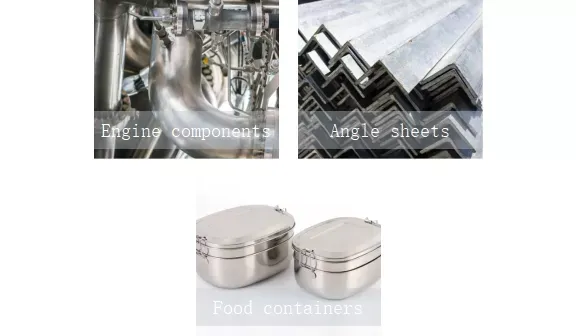
Application of 304 stainless steel and 17 -4 stainless steel
The best grade of stainless steel is determined by the cost and application. Raw material costs for 304 stainless are typically 20-40% lower than those of 17-4 stainless per kilogram. Fabrication costs also tend to be lower due to the excellent weldability. The minimal heat treatment requirements of 304 make it the best choice for stainless steel general applications and custom parts.
Due to its specialized composition, 17-4 stainless steel is more expensive due to the copper content. It also has higher fabrication costs because of the stricter welding and forming regulations. The cost of solution treatment and precipitation-hardening is high, but justified by the fact that high strength can reduce overall system costs through weight savings. Food processing equipment, chemical tanks, and architectural elements are common 304 applications. 17-4 is used for some high-performance springs that require custom metal machining.
Try Prolean Now!
Selection Guide: When to Choose 17-4 or 304 Stainless Steel
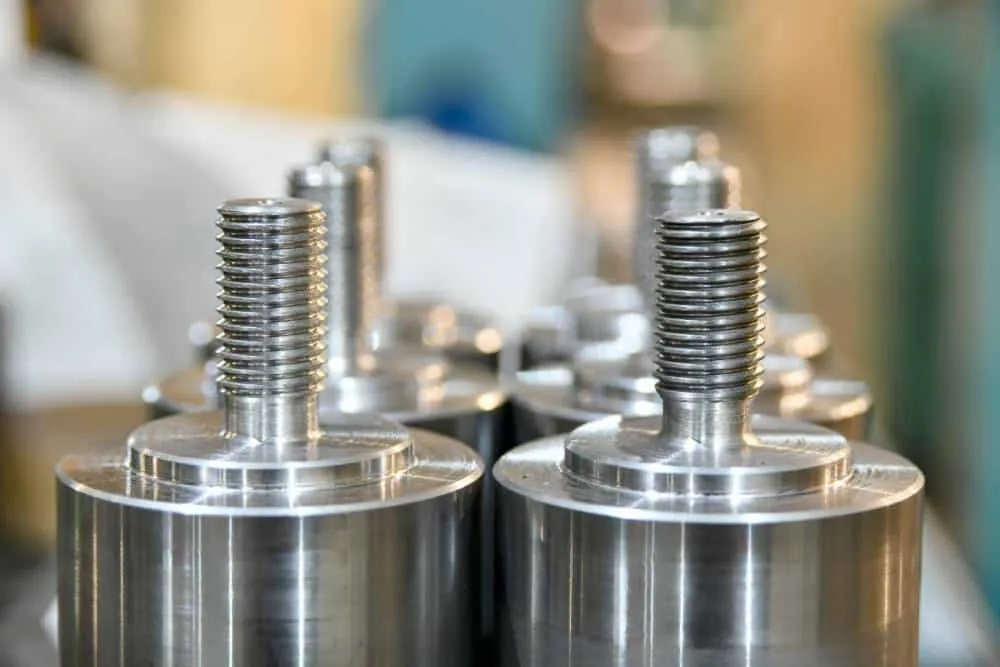
Stainless steel parts
Choose 304 Stainless Steel When:
Choose 304 if corrosion resistance is your primary concern. This includes food-contact, potable, and mild-chemical environments. This is because of its superior corrosion resistance. If you need to form or fabricate complex parts, 304 is the best choice. Its exceptional weldability and formability will reduce the complexity of manufacturing and costs.
Choose 304 when you need non-magnetic properties, such as for magnetic shielding, electronic enclosures, and MRI equipment. 304 is a great choice when strength is not a priority (yield strength less than 300 MPa), but cost reduction and minimization are. Common applications include architectural claddings, kitchen appliances, and pharmaceutical vessels.
Choose 17-4 Stainless steel When:
Choose 17-4 stainless steel for high-strength applications, especially when the yield strength exceeds 700 MPa (100 Ksi). The precipitation-hardening process provides strength levels that are unattainable with 304. It is ideal for structural applications. If weight reduction is important in aerospace, automotive, or portable equipment applications, then 17-4 stainless steel may be the best choice.
Select 17-4 stainless steel when wear resistance is important due to its higher hardness in precipitation-hardened conditions. 17-4 stainless offers the best combination for applications that face moderate corrosion and high mechanical loads. Applications include aerospace structural components and high-pressure valve stems. Other common applications are oil and gas drilling tools, high-performance springs, and turbine components.
Conclusion
The choice between 17-4 stainless steel and 304 is a fundamental tradeoff between strength, corrosion resistance, and cost. This is further complicated by differences in magnetic properties, formability, welding, and cost. 304 stainless is the best choice in applications that prioritize corrosion resistance, fabricability, and cost effectiveness. It’s used for food processing and architecture, chemical processing, and general manufacturing.
The austenitic structure of 304 stainless steel provides unmatched formability and corrosion resistance in diverse environments. 17-4 stainless steel is used in applications that require high mechanical performance. Its strength levels are triple or double those of 304 due to precipitation hardening, which allows for lightweight, high-performance design.
In the comparison of 17-4 stainless steel and 304, neither grade is superior. Each excels at its specific application. Understanding your requirements, the environment, fabrication capabilities, and budget constraints is key to selecting the right material. ProLean Tech provides comprehensive custom metal machining for both 304 stainless steel and 17-4 stainless steel. We have expertise in stainless steel heat treatment optimization and manufacturing process selection. Our engineers can guide you through the decision between 17-4 and 304 stainless steel, helping to ensure optimal material selection for your custom stainless parts. ProLean Tech can help you with your project by utilizing our precision machining expertise. Contact us today to get a quote.
0 Comments