
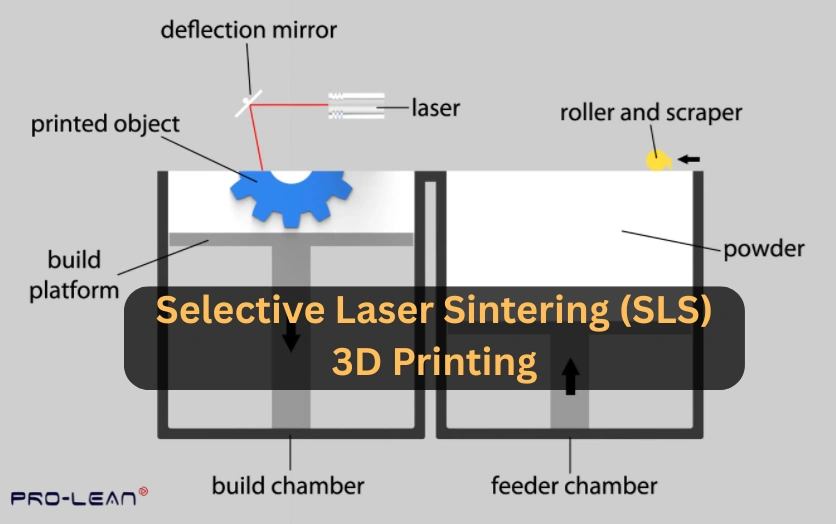
Selective Laser Sintering (SLS) 3D Printing Process
Selective Laser Sintering (SLS) is at the forefront of 3D printing technologies, revolutionizing how industries manufacture complex, high-performance parts. Developed in the 1980s by the University of Texas, this advanced technique uses a high-powered laser to fuse powdered materials into solid, durable, and intricately designed structures. It’s a game-changer for industries like automotive, aerospace, and healthcare, where precision and adaptability are non-negotiable.
SLS offers unmatched versatility and efficiency for engineers, designers, and manufacturers seeking a reliable solution for fast prototyping, low-volume production, or intricate design creation. Its ability to handle complex geometries and deliver superior quality makes it an ideal choice for anyone pushing the boundaries of innovation.
At ProleanTech, we utilize SLS technology to perfect the geometries. Our expertise and state-of-the-art facilities ensure you get parts that meet the highest quality, speed, and precision standards. From prototyping to full-scale production, we are your trusted partner in bringing ideas to life.
This blog will explore how SLS works, its applications, what sets it apart from other 3D printing techniques, and its advantages and limitations. Let’s discover how SLS can elevate your projects to new heights.
What is Selective Laser Sintering (SLS) 3D Printing?
Selective laser sintering 3D printing or SLS 3D printing is an additive manufacturing process that converts a CAD (3D) model into physical items by fusing the polymer powder with a CO₂ laser beam. The laser beam selectively fuses the layer of fine powder on the build chamber, it binds the powder together and solidifies that selective portion. Then, subsequent layers are added on top with the repetitive cycles until the final shape is built.
You can understand this by comparing it with the DMLS Method. In DMLS 3D printing, metal powder is sintered by laser as SLS does with polymers and ceramics. Additionally, you might be confused with the layer deposition. First laser sinters the foundation layer and the solidified section goes down, the laser fuses another layer over the pre-sintered one, and the process goes on.
Here, the movement of the laser head or selective sintering is carried out with the pre-loaded digital instructions on a 3D printer machine.
How Does Selective Laser Sintering Work?
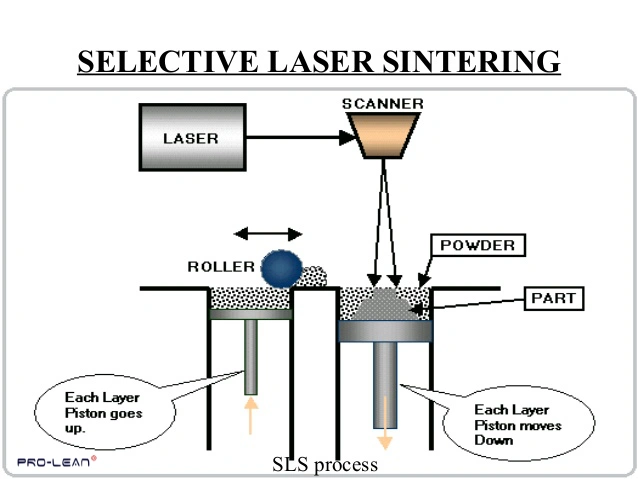
Selective Laser Sintering (SLS) Diagram
Understanding the 3D printing process is essential. By learning how SLS works in 3D printing, you can learn about its capabilities and benefits in the printing industry. The protocol begins with a 3D model of an object, which is then sliced and converted into a 2D digital structure.
A preheated chamber with the temperature set to the material’s melting point is set and filled with the powdered material, commonly nylon or other polymer compounds, also known as sintered nylon. The laser, which consists of CO₂, is applied to the powdered material, fusing the particles and giving them the shape of a 2D digital model.
When the powder is converted into layers of solid form, more fresh powder is spread over the previous layer. This step is repeated until the 2D model object is completed.
As soon as the printing process is completed, the chamber cools the unsintered powder, which then supports the prepared object. This step eliminates the need for additional support for the built structure. And this is the most efficient quality of SLS in 3D Printing.
After manufacturing, sandblasting, polishing, and dyeing are additional steps that can enhance the surface finish of SLS-printed objects. These steps ensure the quality requirements of the product.
Try Prolean Now!
Here’s an overview of the specifications of SLS in 3D printing:
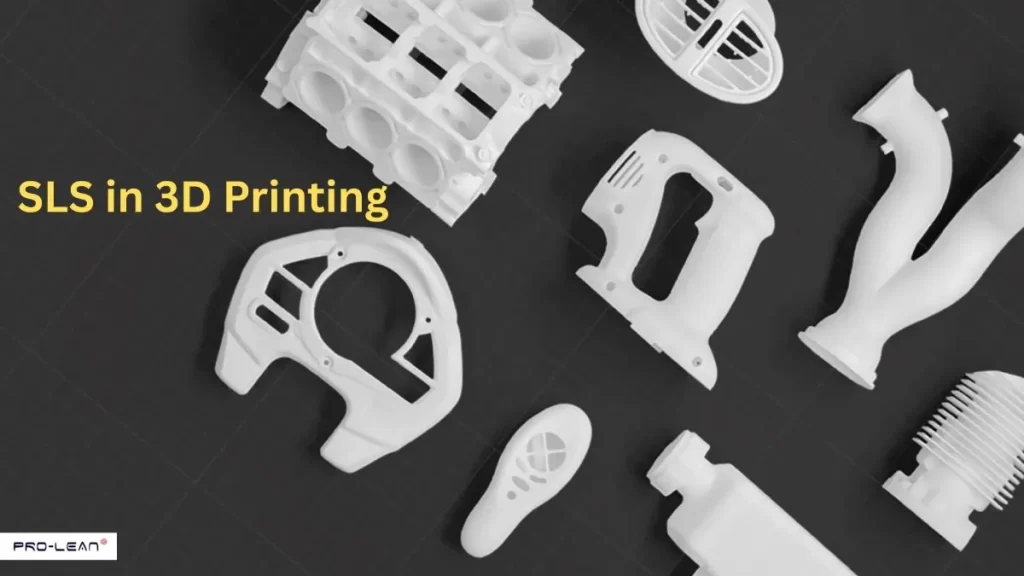
SLS in 3D Printing Applications
| Selective Laser Sintering (SLS) | |
| Materials | Thermoplastics (usually nylon) |
| Dimensional accuracy | ± 0.3% (lower limit of ± 0.3 mm) |
| Typical build size | 300 x 300 x 300mm (up to 750 x 550 x 550mm) |
| Common layer thickness | 100–120 µm |
| Support | Not required |
Learn more about the SLS printing process, materials & benefits.
SLS Printed Parts
SLS-printed parts are the best 3D-printed items you can make today because of their exceptional mechanical properties and design freedom. A high-powered laser melts powder bit by bit, building solid objects that stand on their own without requiring support structures during production.
SLS parts have a slightly non-shiny and rough surface. But they’re equally strong in all directions, a valuable isotropic quality barely found in other 3D-printed items. They keep their dimensional accuracy even when designs get complicated, which is why they work great for testing prototypes and end-use parts across the healthcare and aerospace industries.
While SLS parts need post-processing for smooth finishes, their combination of strength, precision, and design flexibility allows them to handle complex designs. One big advantage is their ability to consolidate many separate pieces into one solid part, further enhancing their appeal for engineering solutions.
Steps of SLS Printing
- Preparation of SLS Printing File
The first step is creating the 3D model of the part that you want to print. CAD software is used to create detailed 3D drawings. Then, the file is converted into STL format, a format that an SLS 3D printer can read. STL or OBJ formats include information like printing layer structure, print time, etc.
- 3D Printer and Powder Setup
A thin layer of polymer powder is placed in the printing (build) chamber and toolings are fixed, such as connecting the continuous powder supply mechanism, prepaid the STL file for execution, etc. Next, the laser and build plate(foundation) are aligned to ensure precision.
- Printing Process
The SLS printer’s built-in system preheats the chamber below the fusing temperature, and the laser sinters the selective portion of the dispersed layer on the chamber foundation. The machine dictates the laser head motion and time-based on uploaded files and instructions. The laser fused the foundation layer and continuously subsequent layer (up to 200 µm). During the process, the powder delivery system continuously supplies the powder layers.
- Cooling
After printing of all layers, the built part is left in the chamber for cooling. It retains the original material properties after cooling down to room temperature.
- Post Processing
Once the part is cooled, it is ejected from the building chamber and excessive powder is removed. Next, bead blasting, sandblasting, grinding, polishing, or other post-processing can achieve the desired surface smoothness. Additionally, painting, coating, or other finishing are also compatible.
SLS Material and Its Versatility
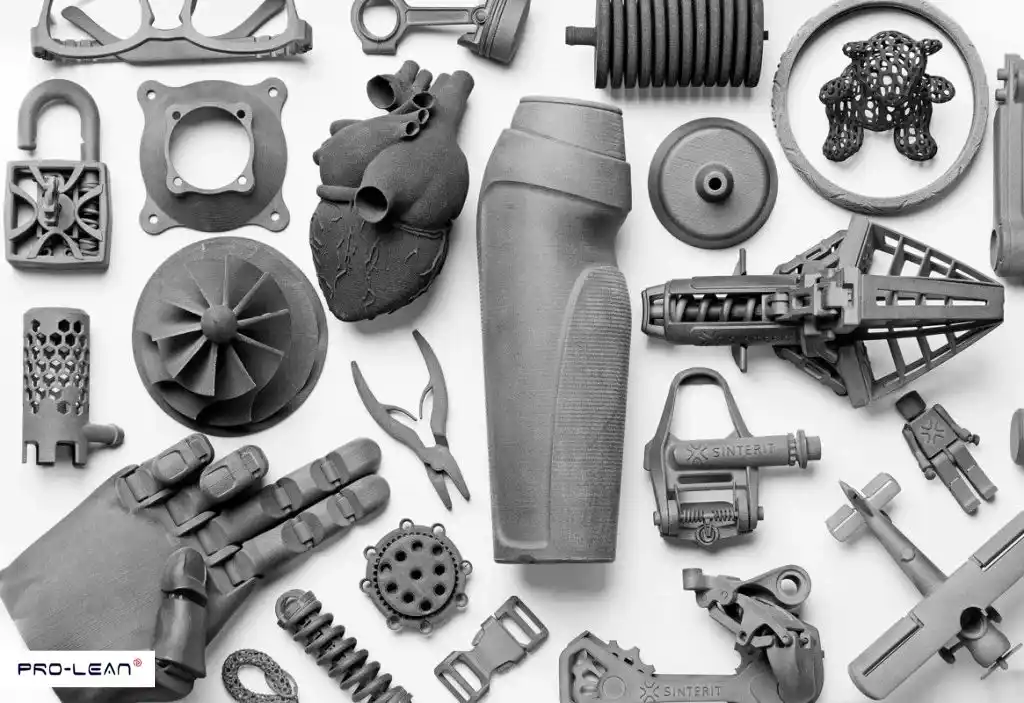
Diverse Parts Created by SLS 3D Printing
The popularity of SLS in 3D printing is attributed to its versatility and compatibility with various materials. Top PLA options for smooth 3D printing include Nylon 11 and 12, as they are considered ideal for creating functional parts. Additionally, they are renowned for their durability and tensile strength. Furthermore, SLS in 3D printing can handle intricate compounds and be used in various selective laser sintering applications.
When comparing 3D printing vs injection molding, SLS can work with materials such as laser-sintered nylon, ceramics, and SLS aluminium. This is what makes it best suited for use in SLS 3D printing, particularly in industries that require durability, such as healthcare and the automotive industries.
Using thermoplastic powders in SLS 3D printing would be more beneficial and increase the process’s sustainability. The remaining powder at the end of the production process, after the final product is made, is reusable, which minimizes resource wastage, is eco-friendly, and makes the process more sustainable.
Another advantage of SLS 3D printing is its rapid prototyping capability, which enables the fast production of prototypes and enhances precision, a crucial factor for product testing. Additionally, sintered metal parts are efficiently created by using SLS manufacturing.
Apart from the advantages and benefits of SLS printed parts, the cost is also high compared to other printing technologies due to the post-processing requirements.
Common Materials Used in SLS 3D Printing
Here is the list of common materials for selective laser sintering 3D printing;
Polyamide
PA6, PA 11, and PA 12 are the typical polyamide types used for SLS, PA6 offers good wear, abrasion, and fatigue resistance. PA 11 is flexible, ductile, and heat resistant. Meanwhile, PA12 is known for its high tensile strength and dimensional stability.
Polypropylene
It is a tough and high-strength thermoplastic polymer. Polypropylene powder can print durable, flexible, and chemically inert components for different applications.
Nylon
Nylon is a popular polymer for SLS printed parts with high stiffness. Besides the standard nylon, Glass, carbon fibre, and aluminum-filled nylon powder are also used as a printing material.
Low melting point, excellent printing finish, and high strength-to-weight ratio are other key benefits of nylon.
Thermoplastic Elastomers
Thermoplastic elastomers refer to rubber-like plastic materials with lightweight, elastic recovery, and good temperature resistance. Thermoplastic Polyurethanes (TPU), Styrenic Block Copolymers (SBCs), Thermoplastic Polyolefins(TPO), and other variations are available for SLS 3D printing.
Other Materials
Besides the polymers mentioned above, other various SLS 3d printing materials are available, including polymer-coated metal powders, castable polystyrene, aluminide, etc.
Try Prolean Now!
SLS Rapid Prototyping and Manufacturing
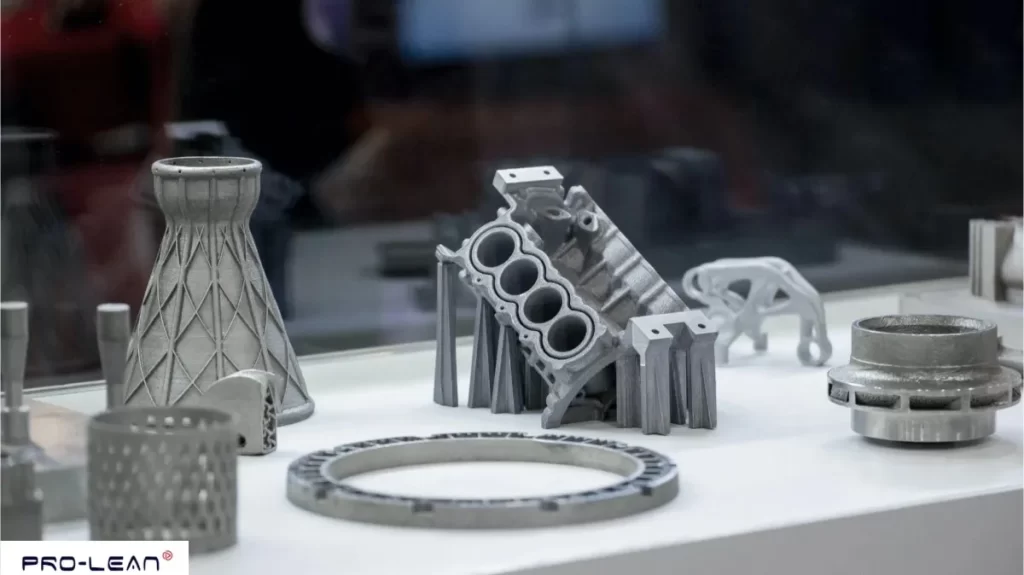
3D-Printed Metal Engine Block and Parts
SLS rapid prototyping is an application of SLS 3D Printing, allowing for the production of exact, fast, and functional prototypes. SLS 3D printing doesn’t require additional support for model objects and can rapidly support the creation of intricate designs. These designed prototypes are more accurate and capable of testing in the automotive and aerospace industries.
Also Read: How 3D Printing is Shaping Cat Toys & Armor
Another area of SLS 3D printing is SLS manufacturing, which involves creating intricate and complex design functional parts that enhance strength and durability. This technique enables the creation of structures without compromising or altering the properties of the materials, producing lightweight yet strong materials.
This feature of SLS 3D printing makes SLS manufacturing a top choice for low-volume production runs. Laser-sintered nylon and SLS material provide the final product with the characteristics required to meet industry quality standards.
Lastly, in SLS applications, recyclable thermoplastics can be converted into SLS-printed parts that play a crucial role in the overall sustainability of the process. The production of strong, durable, highly precise, and accurate SLS materials, including selective laser sintering aluminum and sintering ceramics, makes SLS 3D printing a versatile solution in modern printing and manufacturing industries.
Wondering about: 3D printing materials and how to choose the right one?
What Are the Advantages of Using SLS?
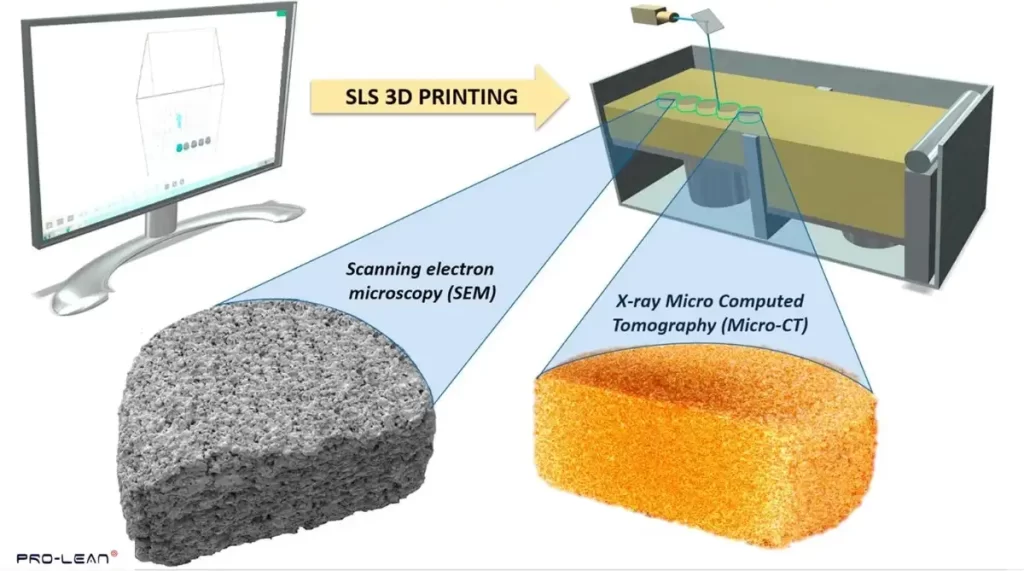
SLS 3D Printing Analysis Techniques
The following are a few benefits of SLS in 3D printing. That includes:
Intricate Modelling: SLS can design intricate structures without additional support and processes.
Sustainability: Unused materials can be recycled to create more structures, reducing waste and making the process more eco-friendly.
Durability: Parts manufactured using SLS 3D printing exhibit strong mechanical characteristics, making them ideal for functional prototypes.
Versatility: Complex materials can be used in SLS 3D printing, making it a versatile and suitable option for a wide range of applications.
Scalability: SLS in 3D printing is particularly efficient for use in low-volume production runs.
3D Printing Advantages and 3D printer Disadvantages
While SLS in 3D printing has a wide range of benefits in various industries, it also has some disadvantages, like any other technology. SLS-printed parts may require post-processing to enhance their surface finish, and their cost can be higher than that of different printing methods due to the advanced techniques and energy consumption involved. The high cost and expense of SLS can be justified by comparing it to other printing methods, such as Fused Deposition Modeling (FDM).
SLS 3D Printing Vs Injection Molding Vs CNC Machining
Unlike 3D printing, CNC machining is a subtractive manufacturing process that creates the designed part by removing the material from the workpiece with computer-controlled machining tools. The main difference in 3D printing vs CNC machining is that CNC can handle materials beyond plastic polymers, including metal, alloys, and composites. On the other hand, 3D printing creates complex, lightweight designs with minimal material waste.
Furthermore, injection molding forms the desired part by injecting the molten material into an injection mold. Like the SLS 3D printing application, it also makes complex polymer items. However, it requires a high upfront investment for injection mold and other related tooling.
Selective Laser Sintering Cost and Value
The cost of SLS 3D printing is higher than that of any other printing technology. The initial investment may be higher due to the operating expenses associated with selective laser sintering processes compared to simple printing. SLS in 3D printing can create highly durable, high-quality products using sustainable techniques, making it cost-effective for specific applications.
Comparison: SLS vs. Other 3D Printing Methods
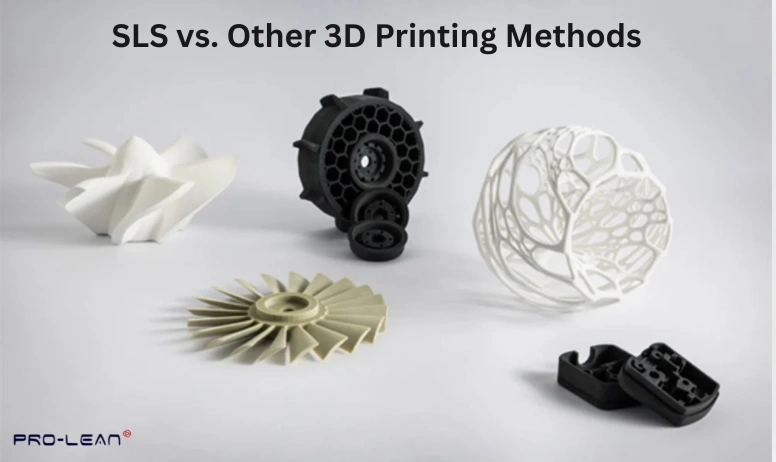
SLS Versus Other 3D Printing Methods
| Aspect | SLS | SLA | SLM |
| Material Type | Thermoplastics, metals | Photopolymer resins | Metals |
| Complexity | High (no supports needed) | Moderate (supports required) | High |
| Surface Finish | Rough, requires finishing | Smooth | Varies |
| Durability | Excellent | Moderate | Excellent |
| Cost | High | Moderate | Very High |
| Applications | Prototyping, low runs, functional parts | Aesthetic models, prototypes | Industrial-grade parts |
Get a quote from industry experts to determine which one works best for your project.
SLS 3D Printing Applications
SLS technology is popular for prototyping, rapid production, and low-volume batches of different industrial and research items. For example, design proofs and models, 3D printing automotive parts, low-weigh aerospace components, casting patterns, and electronics components housing.
Here is a table illustrating SLS 3D printing applications;
| Industry | Why SLS? | Application Examples |
| Automotive | High precision, durable materials, and complex designs | Prototypes, air ducts, brackets, dashboards, and clips. |
| Aerospace | Lightweight, strong parts, and ability of strict quality control | Engine components, UAV parts, and air ducts. |
| Consumer Goods | Customization, fast production, etc. | Shoe soles, wearable devices, and electronics casings. |
| Medical | Biocompatible materials, custom-fit products, and intricate designs. | Prosthetics, orthopedic implants, dental models, and surgical guides. |
| Industrial | Functional prototyping, rapid production, and high-stress parts | Tooling jigs, brackets, housings, and machine components. |
| Electronics | Fine details and high-quality finishes | Enclosures, connectors, and internal electronics housings. |
Conclusion
That’s all you need to know about SLS in 3D printing. It is a revolutionary addition because it can produce high-quality, more accurate, intricate designs using various materials.
From ceramics to SLS nylon, it exhibits its versatility and advanced techniques. It has a wide range of applications in rapid prototyping, manufacturing, and low-volume production runs, leading to eco-friendly printing solutions for various industries.
Head to ProleanTech to access SLS solutions for 3D printing and help create a sustainable future. Contact us now to receive a quote for our 3D printing services.
FAQ’s About SLS
Q1. How does selective laser sintering work?
It uses a CO₂ laser to combine powdered materials layer by layer, forming a solid object based on a digital 3D model. The unused powder supports the structure, eliminating the need for support materials, making SLS in 3D printing highly efficient.
Q2. What is SLS in 3D printing?
SLS in 3D printing is a technique that uses lasers to sinter powdered materials into complex and durable parts. It’s widely used for rapid prototyping and small-scale manufacturing, offering precision and versatility.
SLS in 3D printing offers better durability, precision, and complexity compared to FDM. However, it’s more expensive and energy-intensive.
Q4. Why is SLS printing so expensive?
The high cost of SLS in 3D printing is attributed to advanced technology, high energy consumption, and stringent post-processing requirements.
Q5. What material is not used in 3D printing?
Traditional materials, such as wood or unprocessed glass, are generally unsuitable for SLS in 3D printing.
Q6. What is the most expensive 3D printing material?
Materials such as titanium and high-performance polymers are among the most expensive when used in SLS 3D printing.
Q7. Can you print metal with SLS?
Yes, SLS in 3D printing can print metal using specialized systems, though SLM is more commonly used for this purpose.


0 Comments