
? Where is your part right now?
SURFACE FINISHING
Black Oxide Service
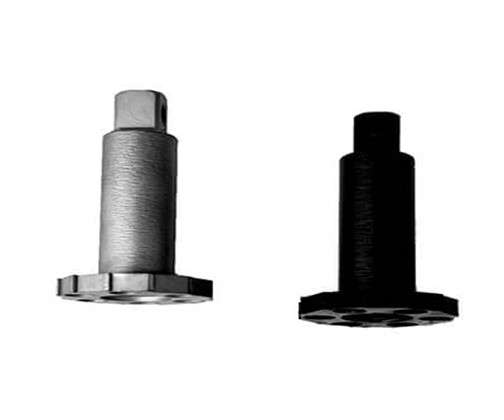
A chemical conversion coating that grows a microscopic layer of magnetite (Fe3O4) on ferrous parts. It darkens the surface, cuts reflection and adds corrosion resistance — and because the layer is only 0 to 30 µm, it is one of the few coatings you can put on a part with critical dimensions.
Sequence
Black oxide is one of the last steps — and it barely moves the drawing
The layer grows from the steel itself, so it follows every machined feature instead of covering them. That is what makes it usable on threads and fits where a plated layer would have to be masked.
Because the layer is so thin, black oxide is often chosen precisely because it does not need masking — threads stay usable. The trade-off is protection: a conversion layer is thinner than a plating, so it is usually finished with an oil or seal. See dimensional change.
Fit check
Can we black-oxide your part? Three things decide it
Material, condition and what happens after. The third one is where most orders go wrong — welding after coating destroys the layer at the joint.
Material
- Yes — steel and stainless steel
- No — aluminium, copper, brass, zinc, plastics
- Not listed: ask first
Black oxide works on ferrous surfaces because the layer is iron oxide. Non-ferrous parts need a different process — see materials.
Condition & size
- Rust, scale and heat-treat oxide interfere with the reaction
- Previously plated or painted parts have to be stripped first
- Maximum part envelope: To confirm
Tell us if the part has been heat treated, welded or plated before, and the largest dimension.
After the coating
- Do not weld after coating — the heat destroys the layer locally
- Oil or seal is the usual finishing step to complete protection
- Handling a dry coated part can leave marks until it is sealed
Tell us the service environment so the right post-treatment can be specified.
Specifications
Black oxide: 0 – 30 µm of magnetite on steel and stainless steel
Every value below is taken from our published specification for this process.
Dimensional change
What 0 – 30 µm does to a thread or a press fit
Black oxide forms from the surface rather than sitting on top of it, so the growth is a fraction of what plating adds. On most parts that is small enough to ignore — on a fine thread it still has to be considered.
| Where it acts | Layer effect | Effect on the fit | What to do |
|---|---|---|---|
| Threads | 0 – 30 µm on the flanks | Much less fill than plating — most threads stay usable without masking. | Flag fine-pitch threads if the assembly is critical. |
| Bores and press fits | 0 – 30 µm on the wall | A light interference fit generally survives the layer. | Check very tight tolerances against the 30 µm upper bound. |
| Ground and lapped faces | Follows the surface | The layer conforms to the surface rather than smoothing it. | Black oxide will not improve a surface finish. |
| Rust or scale before coating | Reaction is blocked | Oxide left on the surface shows as a patch that did not take. | Remove scale and rust before the parts arrive. |
Layer range as published for this process. Because the coating is a conversion layer, the growth per surface is at most the figure shown — not twice it.
Working to a tight tolerance? Send the drawing and we will confirm whether the layer fits inside it.
Get a quoteWhat it is
Black oxide against the other ways to get a dark part
The finish is a magnetite layer grown from the steel. That single fact explains what it is good at — and why it is the wrong choice when you need a thick protective barrier.
Black oxide (magnetite)
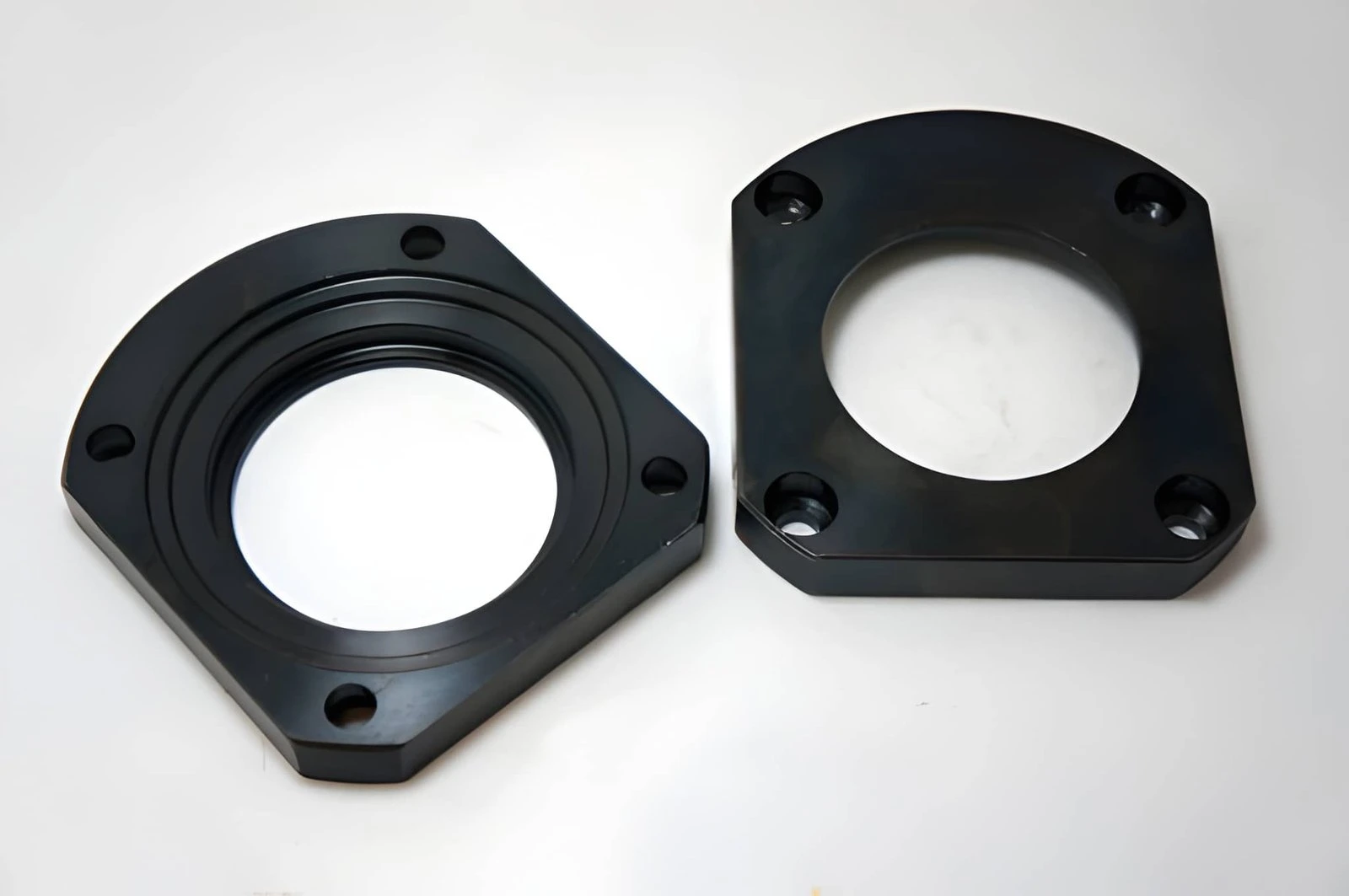
A chemical coating that covers the surface with a smooth, microscopic layer of magnetite (Fe3O4). It is formed from the steel itself, so it follows every machined feature.
Best for: precision parts, threads and fits, minimising reflection
Not for: parts needing a thick sacrificial layer — the coating is only 0–30 µm.
The alternatives
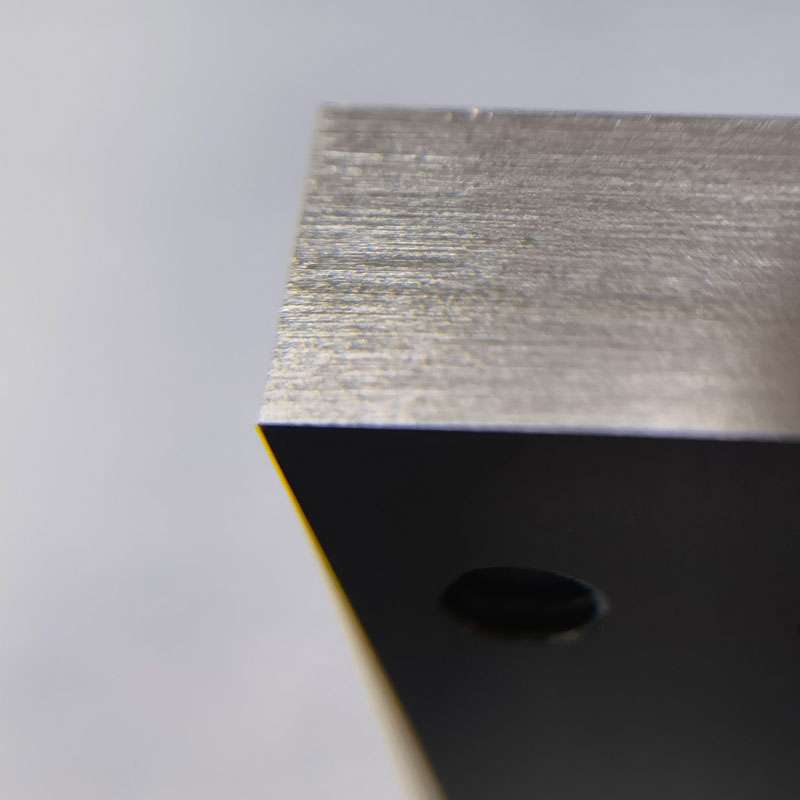
If the requirement is colour rather than protection, painting covers it. If it is sacrificial corrosion protection, galvanizing does that. If it is a hard wear surface, plating is the family to look at.
Painting for colour · galvanizing for sacrificial protection · plating for wear
Trade-off: all of those add a layer measured in tens of microns or more — black oxide does not.
Not sure whether black oxide or plating suits the drawing? Send it and describe the service environment.
Get a quotePick or avoid
When black oxide is the right call — and when it is not
Pick black oxide when
- The part is steel or stainless steel.
- You need a dark, non-reflective surface — the published function of the finish.
- The part has threads, bores or fits that cannot tolerate a thick coating.
- Corrosion resistance is wanted but a plated layer would be too thick.
- The part is a tool, a fastener or a machine component that should look like metal, not painted.
Avoid black oxide when
- The material is not ferrous — aluminium, copper, brass and zinc do not take this coating. See materials.
- You need sacrificial protection that keeps working at a scratch — that is galvanizing, not a conversion layer.
- You need a specific colour other than black — see painting.
- You need a hard, wear-resistant surface — see electroplating.
- The part will be welded after coating.
Need protection that survives a scratch rather than a colour change? Ask for galvanizing and black oxide quoted side by side.
Get a quoteDesign constraints
What decides whether the black oxide comes out even
Three variables: the condition the part arrives in, what happens after coating, and how the part is handled once it is dry.
Starting condition
Black oxide is a reaction with the steel surface. Rust, heat-treat scale, oil or a previous plating blocks it locally — and the blocked area stays bare. Strip and clean first.
Heat treatment
Heat treatment before coating is fine, but it leaves an oxide layer that has to be removed. Tell us if the part has been hardened or stress relieved.
Welding
Weld before coating, never after. The heat burns the layer off at the joint and the affected zone has to be re-coated locally.
Post-treatment
A dry black oxide surface is not the finished state — an oil or seal is normally applied to complete the corrosion protection. Tell us the service environment.
Handling
The layer is thin and can be marked by handling before the post-treatment. Parts should be packed rather than loose-bagged.
Appearance expectation
The finish is matte and slightly uneven by nature on cast or forged surfaces. If the visible face must be uniform, tell us and it can be oriented and checked.
Drawing notes
What to write on the drawing so the layer comes out even
For black oxide the note is mostly about the condition of the part and what happens after coating — masking is rarely needed because the layer is so thin.
1. BLACK OXIDE (MAGNETITE) FINISH ALL SURFACES. LAYER 0-30 um.2. SURFACES TO BE FREE OF RUST, SCALE AND HEAT-TREAT OXIDE BEFORE COATING.3. APPLY OIL / SEAL AFTER COATING: ____________ (SPECIFY PER SERVICE ENVIRONMENT)4. DO NOT WELD, GRIND OR RE-MACHINE AFTER COATING. LOCAL REPAIR TO BE RE-COATED.5. APPEARANCE: MATTE BLACK, NON-REFLECTIVE. SLIGHT TONE VARIATION ACCEPTABLE ON CAST / FORGED SURFACES.
Examples only. The line that most often goes missing is the post-treatment — black oxide is usually applied with an oil or seal, and the choice depends on the environment.
Materials
Which materials take black oxide — and what to use if yours does not
The coating is iron oxide, so it needs iron. Non-ferrous substrates each have their own darkening or protective route, named below.
| Material | Black oxide | Notes | Use instead |
|---|---|---|---|
| Steel | Yes | The main substrate — fasteners, tools, machine parts and hardware. | — |
| Stainless steel | Yes | Darkens as well, though the corrosion benefit is smaller because the base already resists corrosion. | — |
| Cast iron | Yes | Ferrous, so it takes the coating — but the casting skin has to be removed first for an even result. | — |
| Aluminium | No | Aluminium has no iron to convert; its black finish is a dyed anodized layer, not a black oxide. | Anodizing (black) |
| Copper and brass | No | Copper alloys need their own darkening or protective treatments. | Electroplating · Polishing |
| Zinc-plated parts | No | A zinc layer replaces the steel surface the reaction needs. | Zinc plating |
Part in more than one material? Send the assembly and we will route each component to the process that fits it.
Get a quoteApplications
Where black oxide is used
Our published description places it in hardware, automotive and defence work — the common thread is a metal part that must stay metal-looking and non-reflective.
Hardware and fittings
Flanges and nuts that have to look like metal, resist corrosion and stay at their dimensions.
Tools and machine parts
Where a non-reflective dark surface is wanted and a thick coating would throw the tooling dimensions out.
Automotive and defence
Parts that need corrosion resistance and reduced reflection without a change in fit — the published application areas for this finish.
QA and documentation
What you get back with the parts
Purchasing usually needs paper as well as parts. Here is what we can issue today and what is still being confirmed.
Colour and coverage
Visual check for a uniform matte black across the specified faces.
Pre-treatment condition
Confirmation that scale, rust and previous coatings were removed.
Layer thickness
Measured magnetite layer within the 0–30 µm range.
Salt-spray hours
Corrosion hours with the specified post-treatment. Being confirmed with the shop.
Further reading
Black oxide guides and comparisons
Longer answers on the questions this page only has room to state.
The magnetite layer explained, with the limits of a conversion coating.
The sacrificial alternative — a zinc layer protects steel by being consumed itself.
When the requirement is a hard wear surface rather than a colour change.
When the part needs protection that keeps working at a scratch.
The corrosion step usually chosen for stainless steel instead.
Compare all 20 finishes by roughness, thickness, corrosion and cost.
FAQ
Black oxide FAQ: the questions engineers ask us
What is a black oxide finish?
Which materials can be black oxided?
Will black oxide change my part dimensions?
Does black oxide need masking?
Is black oxide the same as painting it black?
How is it applied?
Can you black oxide a part that has been heat treated?
Do I need anything after black oxide?
Get your black oxide quote
Upload a STEP, IGES or PDF drawing. Tell us the material, the surface condition it is in now, and the environment it has to survive.
What to send us
- Drawing — 2D and 3D files (STEP, IGES or PDF).
- Material — steel, stainless steel or cast iron.
- Previous treatment — heat treatment, welding, plating or rust that has to be removed.
- Service environment — so the oil or seal post-treatment can be specified.
- Critical tolerances — anything where the 0–30 µm layer has to be accounted for.
- Quantity — number of units, including any spares.
All uploads are secure and confidential. Engineers review and reply with a quotation and lead time.