
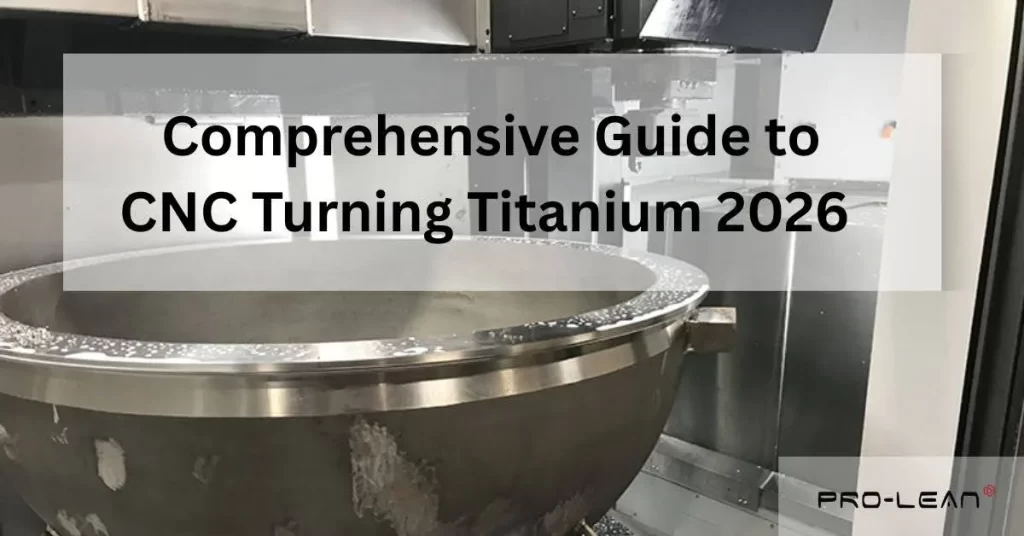
Titanium CNC Turning
Turning titanium is a demanding but rewarding process in precision manufacturing. This aerospace-grade titanium requires specialized knowledge and the use of proper tooling to achieve tight tolerances, superior surfaces, and high-quality surfaces required by critical applications. Knowing how to machine titanium can make the difference between professional and amateur manufacturers.
ProLean Tech specializes in custom CNC Turning of materials that are hard to machine, such as titanium alloys. Our CNC turning services deliver precision components that meet industry standards, whether you’re looking for prototypes or large-scale manufacturing runs. We can provide you with a free consultation to discuss your titanium machining requirements.
Titanium Alloys in CNC Turning
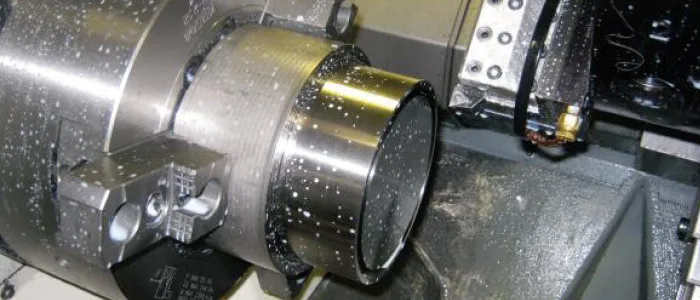
CNC Machine and titanium turning parts
Understanding the material properties of titanium 260 (commercially pure titanium) and other grades is essential to turning this metal. It’s both valuable and hard to machine. Titanium is a metal that combines outstanding strength-to-weight with excellent corrosion resistance. It’s used in industries ranging from marine to medical.
Why is Titanium Hard to Machine?
The question, “Why is titanium hard to machine?” comes up often among new machinists. Titanium’s reputation as a notorious material in machine shops is due to several factors.
Titanium has a low thermal conductivity (about one-seventh of that of aluminium), which causes heat to be concentrated at the cutting edge instead of being dispersed through the workpiece. This localized heat accumulation accelerates tool wear and can lead to premature edge failure. Titanium’s chemical reactivity means that it can be welded to cutting tools at high temperatures, causing a built-up edge that destroys the surface finish.
It also retains its strength at high temperatures, so it does not soften as the cutting temperature increases. Titanium’s elastic modulus is roughly half that of steel. This, along with its spring-backing characteristic, can cause chatter, poor finish, and dimensional errors.
Common Titanium Grades Used for Turning Applications
The key titanium grades for CNC turning
- Grade 2 (Commercially pure): The most common titanium alloy, with excellent corrosion resistance and moderate strength.
- Grade 5 (Ti-6Al-4V): Most commonly used titanium alloy, with 6% aluminum and 4.4% vanadium to enhance strength
- Grade 23 (Ti-6Al-4V): Low interstitial variant. Grade 5 preferred for medical implants
- Grade 9 (Ti-3Al-2,5V): Less strength than Grade 5, but easier to weld and form
The grade of titanium you are machining will affect everything from the titanium turning speeds and feeds to the coolant and tool geometry.
Titanium Turning Feed Rates and Cutting Depth
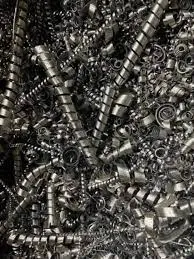
Titanium turning scrap
The relationship between feed rate, cutting speed, and depth of cut is crucial when determining titanium turning speeds and feedings. Titanium is more responsive to reduced cutting speeds and higher feed rates than the opposite approach.
To prevent tool wear, maintain chip thickness at or above 0.003 inchs. Insufficient feed rates can cause the cutting edge of the tool to rub instead of cut, which generates excessive heat and does not remove material efficiently. The titanium surface is also hardened by this rubbing action, making it more difficult to make subsequent passes.
The depth of the cut should be sufficient to penetrate any previously hardened layers. If you use finishing tools that are designed for light finishing passes, it can be difficult to achieve a depth of less than 0.020 inch.
Titanium Vs Steel & Aluminium for CNC Turning
By comparing titanium to other materials for CNC turning, manufacturers can make an informed decision about the material they choose and adapt their machining strategy accordingly.
Titanium vs steel
Titanium vs steel have significant differences when compared in terms of machinability. Steel is 3-5 times more machinable than titanium. Mild steel can reach cutting speeds of 400-600 SFM, whereas titanium only reaches 150-300 SFM.
Steel’s greater thermal conductivity dissipates heat away from the cutting area, reducing thermal stresses on tooling. Titanium’s superior strength-to-weight ratio – nearly twice as much as steel – makes it unreplaceable for aerospace applications, where weight reduction is directly related to fuel efficiency and performance.
Cost-wise, titanium is 5-10 times as expensive as comparable steel grades. The machining time also increases due to the slower cutting speeds. This makes the decision to select titanium based on performance rather than just economics.
Titanium vs Aluminum
Aluminum and titanium have even greater differences. Aluminum is a machine that performs exceptionally well. Cutting speeds can reach 1000+ SFM, and tool wear is minimal. Titanium’s cutting speeds are about one-sixth of those in aluminum. This means that cycle times will be longer.
Titanium is superior to aluminum for applications that require high stress, despite its machining advantages. It offers a 50% greater strength while maintaining a similar density.
Selecting the Right Tool for Titanium Turning Operations
The success rate of turning titanium is greatly affected by the tooling used. While the wrong tooling can lead to catastrophic failure in minutes, optimized tooling produces hundreds of high-quality parts.
Carbide tool grades and geometries
Titanium CNC machining is mostly done using carbide. Certain grades exist to fulfill the requirements of this material. Titanium can be made of carbide grades C2-C4, whereas titanium alloys such as Grade 5 can be made of grades C5 – C8.
Tool geometry is important. Positive angle (6-10 degrees) of rake sharp cutting edges minimise work hardening and low cutting force. Radius on the edges must be tightly regulated. The radius of the edges should be well-regulated. End mill designs tend to be aggressive with variable pitch spacing and aggressive helix angle in reducing harmonics.
Coating Technologies To Enhance the Tool Life
Titanium alloys have a longer life expectancy through the addition of PVD coatings. Coatings composed of TiAlN (Titanium Aluminum Nitride) that are applied to the cutting edges of titanium are extremely hard and resist much corrosion at high temperatures.
With its higher performance, the titanium is enhanced with the superior performance of AlCrN (Aluminum Chromium Nitride), which are the better performing coating. In addition, they possess low coefficients of friction. These coatings minimise the propensity of titanium to weld on the cutting edge. Such is the mode of failure that is most frequent when machining this metal. Carbide (uncoated) tends to be better than coated tools with regard to turning commercially available grades of titanium. This is because of the thinner coatings. The tool life of coated tools is 2-3 times higher than Ti-6Al or4V.
Coolant and Cutting Fluids Strategies
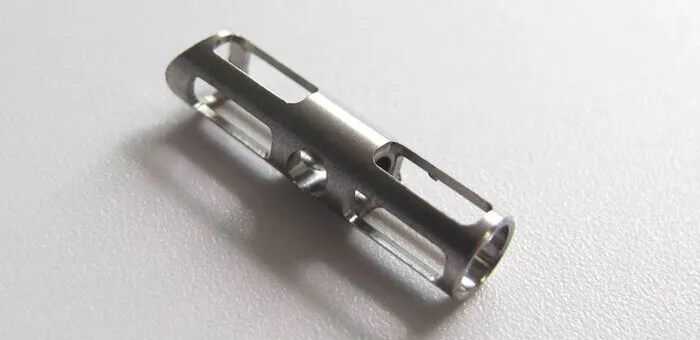
Titanium turned small part
The success of CNC titanium machining depends on the application of coolant. Due to titanium’s low thermal conduction, external cooling is necessary to maintain tool life and to achieve acceptable surface finishes.
High-Pressure Coolant Systems
Cooling fluid at high pressure (1000+ PSI), delivered through the tool centre, is more efficient and improves chip removal. Coolant is directed to the cutting zone where heat is produced. The coolant also removes chips that could otherwise be welded to the workpiece.
The through-spindle system directs fluid to the cutting surface during titanium CNC machining. This prevents re-cutting of chips and reduces the tendency for an edge to accumulate. Chip control is as important as cooling when turning titanium 260 and other grades. The surface finish will be damaged by a stringy Titanium Chip.
Titanium cannot be cooled by standard flood coolants at lower pressures because the fluid is unable to penetrate the cutting zone. Investment in high-pressure systems will pay off through improved tool life and part quality.
Coolant Chemistry for Titanium
It is better to avoid cooling liquids that contain chlorine, even though they are excellent lubricants. Titan components can be affected by stress corrosion cracking. Coolants specifically formulated for titanium and hard materials offer the best combination of corrosion protection, cooling protection, and lubrication.
Try Prolean Now!
Machine Requirements for Rigidity and Setup
Due to titanium’s difficult machining characteristics, rigidity is essential. Vibrations and deflections can make the material more work-hardening which could cause tool failure.
Reduce Vibration and Runout
The tool holder must not exceed 0.001 inch (TIR) when turning titanium. Even minor runouts can lead to uneven chip loading on cutting edges, premature tool failure, and even premature tool failure. Collet-style holders offer a higher level of rigidity and less runout than hydraulic or shrink-fit tool holders.
If the bearings of the machine spindle are in poor condition, chatter marks may appear on the surface of the titanium. It is highly sensitive to vibrations due to the low elastic modulus. Even small vibrations can lead to visible surface defects and tool wear. Attention must also be paid to the workholding. Workpieces must be held rigidly and evenly with the jaws applied to prevent distortion.
Powerful HPCSs
High-pressure (1000+ PSI) cooling fluid sprayed out through the tool centre is more efficient and enhances the removal of the chips. A cut zone is fed with coolant in which heat is generated. The coolant also removes the chips, which would otherwise be welded to the workpiece.
The through-spindle system pushes fluid to the cutting area when machining titanium by a CNC machine. This avoids re-cutting of chips and minimizes the propensity to have an edge build up. Cooling is not as important as chip control in turning titanium 260 and other grades. A stringy Titanium Chip will damage the finish on the surface.
Titanium is not cooled by simple flood coolants at lower pressures, as the liquid cannot get into the cutting zone. Investment on high-pressure systems will be justified by the extension of tools life and the quality of parts.
Titanium Coolant Chemistry
Liquids containing chlorine are better avoided when it comes to cooling them down, though they are very good lubricants. Stress corrosion cracking can occur in titanium constituents. Coolants expressly designed for titanium and hard materials give optimality in terms of corrosion protection, cooling protection and lubrication.
Rigidity and Setup Requirements of Machines
The rigidity is needed due to the machining nature of titanium, which is difficult. The material may become work-hardening due to vibrations and deflections, and this may result in the failure of tools.
Reduce Vibration and Runout
When machining titanium, the tool holder should not be more than 0.001 inch (TIR). Even small runouts may result in uneven chip loading to cutting edges, early tool failure, and even damage to the tool. Collet style holders are more rigid and run less than hydraulic or shrink-fit tool holders.
In the event that the bearings of the machine spindle are of poor quality, the surface of the milling titanium might have chatter marks. The elastic modulus is low, and hence it is very sensitive to vibrations. Even small vibrations may cause surface defects and wear of tools.
The workholding also needs to be taken into consideration. The workpieces should be firmly held and evenly clamped with the jaws so that they are not distorted.
Machine parameters
The settings of current CNC controls may play a major role in affecting the outcome of titanium turning. CSS mode (constant surface speed) is one that keeps optimum parameters to cut as the diameter of the cutting increases. This is particularly valuable in operations where the diameter differs significantly, like in profiling and faceting.
One should select the appropriate feed rate. The cutting edge may be overloaded in the incidence of overfeeding. In titanium calibration, adaptive feeding control systems can make tool life up to 20-30 percent higher. This is done through automated adjustment of the feed rate depending on cutting force feedback.
Quality Control and Surface Finishing Considerations
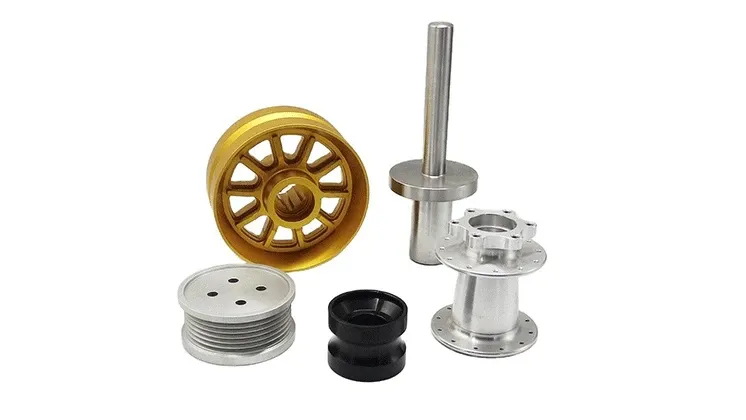
Finished CNC-turned titanium parts
Understanding how titanium’s properties impact measurement and inspection is essential to achieving specified surface finishes and dimensional accuracy on titanium components.
Surface Finishing Requirements for Industry
To achieve these specifications, titanium must be turned with care throughout the entire machining process. With wiper inserts, final finishing passes can be made at reduced speeds to achieve 32 Ra finishes. This eliminates secondary grinding.
Surface integrity is more than just roughness. Even when the surface is smooth, subsurface damage due to excessive cutting forces or hardening may compromise fatigue strength. X-ray Diffraction and other non-destructive methods can detect subsurface defects that would be missed by visual inspection.
Dimensional Stability & Thermal Effects
Titanium has a low thermal expansion coefficient (roughly half that of steel), which means it is less likely to experience thermal growth when machining. The heat generated during cutting may cause a localized expansion, which can affect in-process measurements.
Allow sufficient cooling time before final measurements. Temperature differences of only 10degF on precision components can lead to measurement errors of up to 0.0001 inch per inch. The most accurate measurement conditions are found in climate-controlled inspection chambers maintained at 68F.
Try Prolean Now!
Titanium Turning: Advanced Techniques
Standard turning techniques may not be sufficient as part complexity increases. Custom CNC turning capabilities for titanium components can be enhanced by using advanced techniques.
Thread Turning Titanium Components
Due to its springback properties and tendency to gall when exposed to high surface pressures, threading titanium is a unique challenge. If you use the right techniques, single-point threading offers greater control for small to medium diameter threads than thread milling.
The best results are achieved with threading inserts that have a positive rake geometry, sharp edges, and a positive rake. Multiple light passes (0.003-0.005 inch radial depth each pass) produce lower cutting forces and reduce hardening of the work compared to aggressive single-pass methods.
Swiss-type turning for small Titanium parts
Swiss-type machines are excellent for producing small titanium components because they have a guide bushing system that minimizes deflection. Swiss-type turning machines are used extensively by medical implant manufacturers for titanium CNC turning of surgical instruments, dental implants, and bone screws.
This design eliminates the length of unsupported material that can cause deflection on conventional lathes. This rigidity allows for tighter tolerances on thin titanium parts and improved surface finishes.
Cost Optimization Strategies for the Titanium Turning Industry
Although titanium is more expensive than most other materials and can be fabricated in a variety of ways, a strategic approach to cost-effectiveness will not compromise quality.
Material Use and Near-Net Shapes
When producing titanium components, starting with forgings and castings that are close to net shape rather than barstock reduces waste material and machining time. Although initial material costs increase per piece, the total cost of a part often decreases because machining operations are reduced.
Custom forgings pay off quickly in high-volume production. Even for small quantities, using semi-finished shapes such as hexagonal or square barstock instead of round bar stock can reduce the need to face and profile certain geometries.
Tool Life Extension Methods
A systematic tool management system is possible by reducing costs and increasing insert life. It involves tracking the wear on tools and reindexing them as soon as the signs appear. Maintaining detailed records of successful cutting parameters and utilizing tool wear compensation in order to optimize tool use can maintain dimensional accuracy while optimizing tool usage.
You can discover many proprietary geometries and coatings when working with tooling suppliers for application-specific engineering. These are not found in catalogs. This can result in significant improvements to performance when working with difficult materials.
Conclusion
Titanium is a unique metal with many properties that require special knowledge. These include its low thermal conductivity and its tendency to harden. Maintaining the correct cutting parameters and using sharp tools, with appropriate coatings, as well as high-pressure cooling, are key factors. Understanding titanium grades, preventing built-up edges, and optimizing tool life through systematic management are essential for achieving tight tolerances, superior surfaces, and high-pressure cooling systems in aerospace and medical applications.
The quality control process includes in-process monitoring as well as an extensive final inspection using calibrated equipment, and under climate-controlled conditions. Our team at Prolean Tech is experienced and can assist you with any project, whether it is aerospace structural components with precise geometric tolerances or a medical-grade titanium implant. Contact us to get a quote now!
0 Comments