
Alumina ceramic machining
Machining is not limited only to shaping metals and plastics; it can also work with various ceramic materials using specialized tooling and the right machining variables. Alumina ceramic is a common ceramic machining material widely used to manufacture semiconductor handling items, insulators, and medical components, among others.
This high-performance ceramic is made from compositions of additives and aluminum oxide (Al₂O₃). In engineering & manufacturing, it is known for high hardness, wear & chemical resistance, compressive strength, and insulation properties.
Since it is not a regular material, several specific considerations are required during alumina ceramic machining, from raw material properties and tooling to post-processing operations.
This article will discuss how is alumina made, its properties, considerations for Ceramic CNC machining, and applications across multiple sectors.
Let’s get started.
Alumina Ceramic Properties
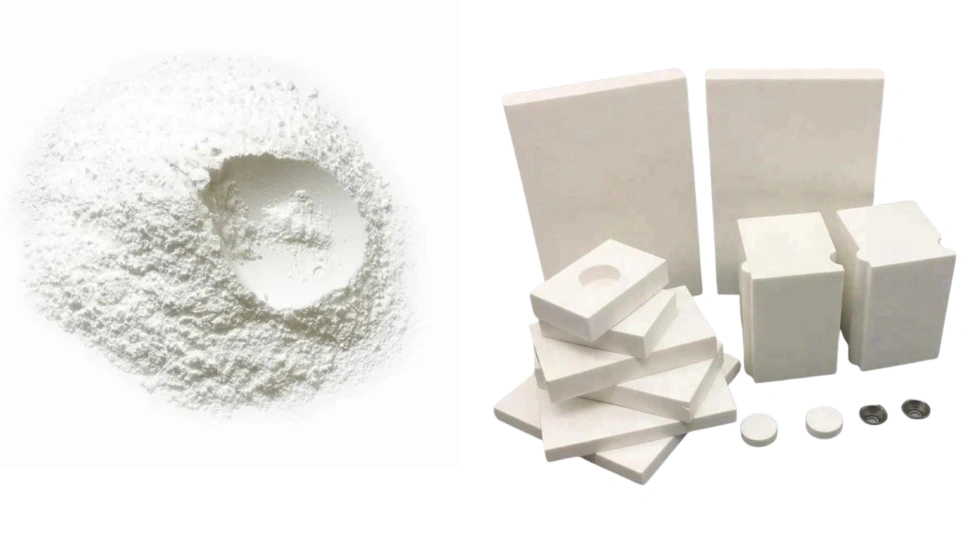
Aluminum oxide
Alumina or alumina ceramic is a high-performance material that provides excellent strength, hardness, thermal stability, chemical neutrality, electrical insulation, and durability. It can perform consistently up to 1600°C, resisting thermal shocks.
Let’s look at the list below to understand the properties of alumina:
- Mechanical Strength: Alumina is known for high flexural & compressive strength, and it withstands high stress without fractures.
- Hardness and Wear Resistance: The hardness of alumina is > 1500 HV (Vickers scale), and it resists wear and abrasion.
- Tensile Strength: Alumina has a moderate tensile strength(up to 300 MPa) and is brittle in nature, which is a significant downside for many applications.
- Thermal Insulation: Alumina resists heat transfer and maintains its mechanical properties even at elevated temperatures.
- Electrical Insulation: It does not conduct electricity and absorbs high-voltage electrical shocks. The dielectric strength of alumina is 10 to 35 kV/mm.
- Chemical Neutrality: Alumina is neutral to harsh acids, alkalis, and solvents, even at high temperatures, which is beneficial in chemical processing applications.
- Biocompatible & non-magnetic: Alumina is safe to use for dental and medical applications. Additionally, its non-magnetic nature is suitable for sensitive electronics.
How is Alumina Produced? Concept and Ceramic Fabrication Method
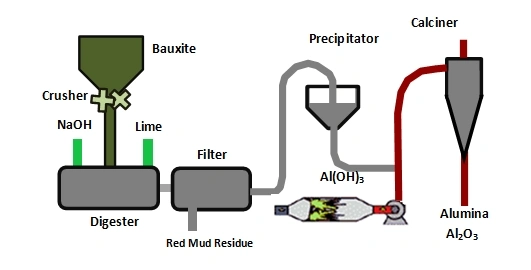
Alumina production
First, let’s look at the composition of how alumina ceramic is made. Aluminum oxide (Al₂O₃) powder is the primary constituent, typically comprising 90 to 99% of the composition. Subsequently, binders and additives are also mixed with the powder. The type of mixing elements (binders, additives, lubricants, etc.) depends on the technique used for alumina manufacturing and the desired quality. Next, there are three major alumina ceramic fabrication methods: Isostatic Pressing, Extrusion, and Molding.
Isostatic Pressing
This method involves pressing a mixture-filled (feed) rubber mold from all directions, pressing the inside feed, and shaping it into the desired form. Meanwhile, hydrostatic pressure is used in this process. Once pressing is complete, the ceramic goes for debinding & sintering.
Extrusion
In extrusion, aluminum oxide feed mixed with binders and thermoplastic plasticizers is forced into the extrusion die cavity using screw-pushing or other mechanisms. This method produces long profiles of alumina ceramic. It is not only economical but also maintains uniformity.
Injection Molding
Ceramic Injection Molding (CIM) is preferred for complex and precise shapes. In this process, the feedstock of aluminum oxide and the mixing element are heated and injected into the mold once the mixture becomes flowable. The high injecting pressure (up to 400 MPa in some cases) fills the mold and forms a compact shape. Then, it is ejected and undergoes debinding & sintering.
Alumina Ceramic Machining Processes
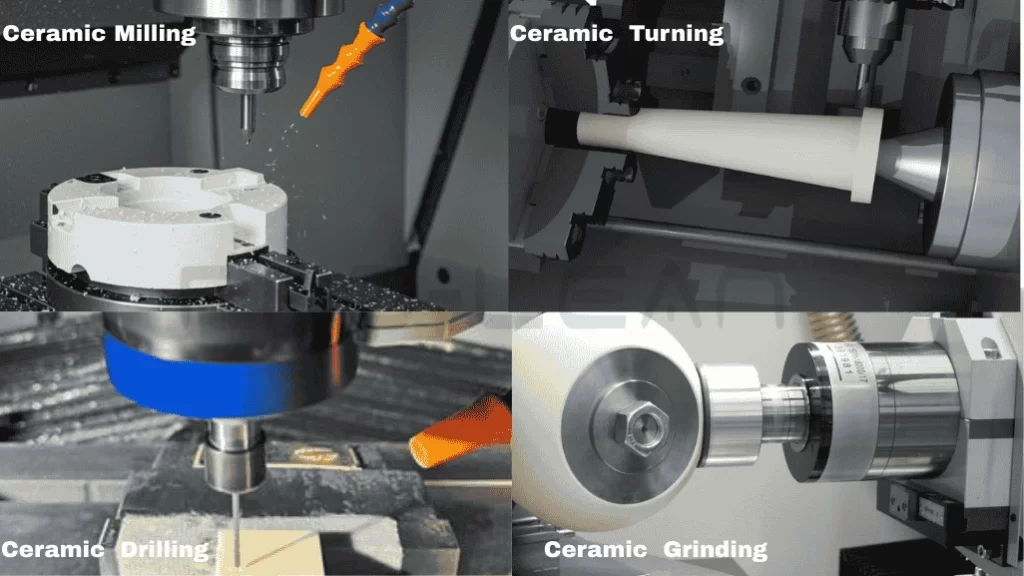
Ceramic machining processes
Once ceramic components are produced, they can be machined with CNC mills, lathes, drills, grinders, and other equipment to exact the shape & dimensions, add features, and refine the surface.
Let’s further discuss five alumina ceramic machining processes: cutting, milling, turning, drilling, and grinding.
CNC Cutting
It is not like workpiece splitting, but rather an initial material removal process to shape the geometry.
- Tooling: Diamond-coated cutters can be the best alumina cutting tools.
- Cutting Speed: 100–200 m/min
- Feed: Very low, 5–30 mm/min
CNC Milling
Ceramic milling involves rotating multi-flute cutters to remove material and create pockets, profiles, contours, etc.
- Tooling: Diamond-coated or full-diamond end mills in a rigid machining center
- Spindle Speed: 2500–5000 rpm
- Feed: 0.02–0.10 mm/rev
- Depth of Cut: 0.1–3.0 mm
CNC Turning
The symmetric ceramic work rotates, and a stationary tool shapes it into the desired geometry.
- Tooling: CBN or diamond-coated turning inserts. Spindle: ~1500–3000 rpm
- Feed: 0.02–0.20 mm/rev
- Depth of Cut: 0.05–1.5 mm
CNC Drilling
It involves creating holes of the desired shape and size using the pecking motion of drill bits.
- Tooling: Diamond-coated or PCD drills
- Spindle: 2500–3500 rpm
- Feed: 0.05–0.10 mm/rev
CNC Grinding
Grinding refers to the process of removing minor material using abrasive wheels to correct dimensions and smooth surfaces.
- Wheel speed: 20–35 m/s
- Feed/pass: 0.01–0.05 mm
- Depth: 0.02–0.5 mm per pass
These are general recommendations based on industry practices; the actual feed & speed might depend on multiple factors. Manufacturers also perform trials to optimize the machining parameters.
Try Prolean Now!
Alumina Ceramic Machining Challenges and Prevention Strategies
The following are the primary challenges that can be encountered during the precision CNC machining of alumina ceramic materials.
Ceramic Abrasiveness & Hardness
As alumina ceramic is a hard and abrasive material, it is challenging to machine. Even the diamond-coated alumina cutting tools can wear if the variables for machining aluminum oxide ceramic are not chosen correctly.
Risk of Material Cracks
The brittle nature of ceramic and its low fracture toughness cause cracks in the material when the cutting load exceeds the safe limit.
Heat Buildup on Tool
The low thermal conductivity of alumina ceramic does not allow for effective heat dissipation, which is generated by the friction of the tool and workpiece interface. This heat buildup can cause dimensional distortion and rapid tool wear.
Complex Shape Machining
The tool accessibility limits, vibration, and brittleness of ceramic make it challenging to machine complex shapes and features. For example, deep narrow cavities, thin walls (< 1.0 mm), micro-channels, and intricate freeforms.
Prevention Strategies
To overcome the challenges of machining alumina ceramic and avoid cracks & defects, you can follow the strategies outlined below.
- Consider manufacturability and optimize the tool path for minimal vibration.
- Choose machining tools carefully; both the tool material and coating need to be considered.
- Use suitable coolants and lubricants.
- Utilize ultrasonic-assisted machining to minimize the cutting force.
- Ensure a rigid fixture and minimize the machining vibration.
Try Prolean Now!
Applications of Alumina Ceramic Machining
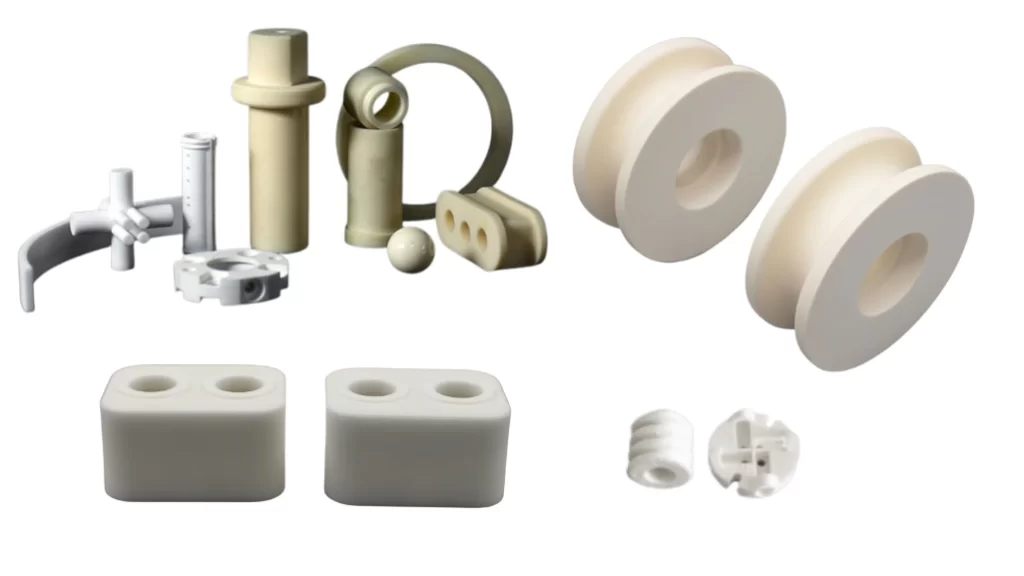
Machined alumina ceramic parts
CNC machining is used to produce diverse alumina ceramic parts across industries, from electrical and electronics to medical and aerospace. The table below outlines the application examples of alumina ceramic machining across different industries.
|
Industry |
Key Benefits |
Application Examples |
|
Automotive |
Wear resistance, thermal stability, and lightweight |
Spark plug insulators, sensor substrates, valve seats, DPF catalyst supports |
|
Electronics |
Excellent Insulation, dimensional stability, and chemical inertness |
High-voltage insulators, LED heat sinks, connector sleeves, and circuit substrates |
|
Semi- Conductor |
Thermal stability and precision machining |
Wafer chucks, vacuum seals, insulator supports, etc. |
|
Aerospace |
High strength, lightweight, chemical & corrosion resistance |
Thermal shields, turbine insulators, radar windows, igniter components |
|
Medical |
Biocompatibility, sterilization, and dimensional accuracy |
Dental implant abutments, surgical tool guides, implant fixtures, and lab ceramics |
|
Industrial Machinery |
Hardness, abrasion resistance, thermal shock resistance |
Mechanical seals, guide rails, valve cores, wear rings, etc. |
“If you are interested in machining other non-metallic materials, read about composites CNC machining here.”
Summing Up
Alumina can be machined into parts, regardless of whether it is green or hard-body ceramic. The primary shaping is achieved through methods such as injection molding, extrusion, and others. Then, machining is used to correct the shape, add features, and refine the finish quality.
Meanwhile, it is essential to use the right tooling and machining variables, along with other strategies, to overcome the possible challenges of ceramic machining. To conclude, the machining capabilities of the available equipment and technical expertise significantly impact the alumina machining results, and you must consider these factors when choosing a manufacturer to outsource CNC machining services.
FAQs
Is alumina a ceramic?
Yes, Alumina is a high-performance ceramic, made of inorganic material, aluminum oxide (Al₂O₃)
How is alumina used in ceramics?
Raw alumina powder from bauxite is used as a primary raw material, which is mixed with binders and additives to make a feedstock for ceramic production.
What is alumina made of?
Alumina is produced from bauxite ore utilizing the Bayer process.
How to cut alumina?
Alumina ceramic can be cut using diamond-coated saws or wheels at a slow speed, whereas waterjet cutting is also an effective alternative.
0 Comments